The Future We Choose: Surviving the Climate Crisis by Christiana Figueres and Tom Rivett-Carnac

Tags

, , , ,


Front Cover – The Future We Choose: Surviving the Climate Crisis by Christiana Figueres and Tom Rivett-Carnac
Alfred A. Knopf – New York – USA – 2020


Based on NOAA’s 140-year climate record, 2019 is the second-hottest year on Earth, after 2016. In their book, The Future We Choose: Surviving the Climate Crisis (Knopf 2020), Christiana Figueres and Tom Rivett-Carnac, architects of the 2015 Paris Climate Agreement, remind us that we live in a critical decade. If we the people of Earth fail to attain our goal of halving our carbon emissions by 2030, it would be highly unlikely that we will attain net zero emissions by 2050. They invite us “to take part in creating the future of humanity, confident that despite the seemingly daunting nature of the challenge, collectively we have what it takes to address climate change now” (xxi).

To make clear the choices we face, Figueres and Rivett-Carnac devote two chapters to describe two possible worlds in 2050: the one we’re now creating and the one we must create. If we don’t limit our carbon emissions, extreme summer temperatures in the world we’re creating in 2050 force us to stay indoors. Working outdoors is a death sentence. Wearing a proper face mask is not an option, but a necessity for surviving in the hot, toxic air. Food and water shortages cause riots and wars. No wall is high or strong enough to deter the mass migrations worldwide. Economies are in free fall.

On the other hand, if we act now to reduce our carbon emissions to net zero and have avoided heating up our planet to no more than 1.5 degrees Celsius (34.7 degrees Fahrenheit), the authors note that, in 2050, we’re still dealing with the aftereffects of the record levels of carbon dioxide already in our atmosphere. Glaciers and Arctic ice are still melting. Sea levels are rising. Severe droughts and desertification are still occurring. But we enjoy a stable lifestyle. Our cities are greener and better places to live. Forest cover has expanded 50 percent worldwide. We no longer burn fossil fuels. Our energy now comes from renewable sources like wind, solar, geothermal, and hydro. All homes and buildings produce their own electricity. Food production and procurement become a communal effort.

As is already evident, Earth’s regenerative systems can no longer keep up with humanity’s exploitative mindset and consumption levels. To co-create a better world, the authors argue, we need both a systemic transformation and individual behavioral changes. They believe that this can be achieved with three mindsets: stubborn optimism, endless abundance, and radical regeneration. Considering the immensity of the task ahead of us, they admit that success is not guaranteed. But, for the future of humanity’s survival, failure is unthinkable. Stubborn optimism empowers us to create a new reality and energize all those with the same conviction. Creating endless abundance requires focusing on the benefits of limiting our carbon emissions. Radical regeneration bridges the gap between how nature works and how we humans have used extraction to organize our lives.

To achieve a regenerative future, Figueres and Rivett-Carnac set out ten necessary actions:

Action 1: Let Go of the Old World. We cannot go back to the way of life that created the climate emergency in the first place.

Action 2: Face Your Grief but Hold a Vision of the Future. The pain of loss should spur us to greater action rather than sink us into a pit of blame, despair, or hopelessness. Having a vision is essential to inspire the kind of commitment and energy we will need to get through the difficult years ahead.

Action 3: Defend the Truth. We must free our mind to new ways of thinking and learn to distinguish real science from pseudo-science.

Action 4: See Yourself as a Citizen – Not as a Consumer. Letting go means reclaiming our idea of a good life, becoming a better consumer, and dematerializing.

Action 5: Move Beyond Fossil Fuels. We must let go of the conviction that fossil fuels are necessary for humanity to thrive in the future and stand up for 100 percent renewable energy.

Action 6: Reforest the Earth. The future we must choose will require us to pay more attention to our bond with nature. We must plant trees, boycott products contributing to deforestation, and move to a plant-based diet.

Action 7: Invest in a Clean Economy. We will require a clean economy that operates in harmony with nature, repurposes used resources as much as possible, minimizes waste, and actively replenishes depleted resources.

Action 8: Use Technology Responsibly. We will need to be mindful of investments in AI: what it’s being used for and the regulatory systems in place.

Action 9: Build Gender Equality. Women are better at working collaboratively, with a longer-term perspective—traits essential to responding to the climate crisis.

Action 10: Engage in Politics. We must engage at all levels of government and elect only leaders who see far-reaching action on climate change as their absolute priority. At the same time, we can stop buying stocks, products, and services from corporations that fund and engage in political lobbying against citizen action on climate change.

Figueres and Rivett-Carnac conclude that meeting the challenge of climate change must become part of a new story of human striving and renewal. “This is not the quest of one nation. This time it’s up to all of us, to all the nations and peoples of the world. No matter how complex or deep our differences, we fundamentally share everything that is important: the desire to forge a better world for everyone alive today and all the generations to come” (161).

The time for doing what we can has passed. To survive, each one of us must now do everything that is necessary. Inciting hate, violence, and chaos is not the way forward to creating a better America today, in 2050, and beyond.


Christiana Figueres is a Costa Rican citizen and was the Executive Secretary of the United Nations Framework Convention on Climate Change from 2010 until 2016. During her tenure at the UNFCCC Ms. Figueres brought together national and sub- national governments, corporations and activists, financial institutions and NGOs to jointly deliver the historic Paris Agreement on climate change, in which 195 sovereign nations agreed on a collaborative path forward to limit future global warming to well below 2C.

Tom Rivett-Carnac is a Founding Partner of Global Optimism and works across the portfolio of engagements and initiatives. He has spent 20 years working at the intersections of international diplomacy, energy policy and climate change in business, non-profit, financial services and international institutions. Learn more at https://globaloptimism.com/about-us/

“for the mothers who did the best they could” – Poem by Caribbean-American Poet Aja Monet

Tags

, , , , ,

Caribbean-American Poet Aja Monet
Photo Credit: gal-dem magazine


My Poetry Corner May 2020 features the poem “for the mothers who did the best they could” from the poetry collection, My Mother Was a Freedom Fighter (USA, 2017), by Caribbean-American poet Aja Monet. Born in 1987 in Brooklyn, New York, to Cuban and Jamaican immigrants, Monet is a cofounder of Smoke Signals Studio, a political safe-haven for artists and organizers in Little Haiti, Miami. She facilitates a workshop “Voices: Poetry for the People” in collaboration with Community Justice Project and Dream Defenders. She currently lives in Miami, Florida.

Monet’s mother raised her and two siblings with little help from their absentee father. In the “Author’s Note” of her poetry collection, Monet notes: My mother was a freedom fighter and so were her mother and her mother’s mother. I witness their movements in this world and it informs my own, their labor to love and live freely, their joy and their pain, the magic and madness… I dream of a world where no mother regrets, no mother resents, no mother buries her child.  Continue reading

The Writer’s Life Under the COVID-19 Pandemic Lockdown

Tags

, , , , , , ,

Today marks the fifty-third day of my home isolation under our statewide lockdown to slow the spread of COVID-19. Though I’m used to working at home, the fallout of this global pandemic has unsettled my creative writing process. I can no longer focus. Our federal government’s chaotic mishandling of this health disaster has scrambled my brain cells. Each day brings new shocks that demand processing.

Attempts to write the fourteenth chapter of my third book have proved futile. Instead, I focus on completing the essential research required to add legitimacy and depth to the profiles of women I plan to feature in this book. More than ever, men and women must work together as equal partners to find solutions for the existential crises the human species now face. No more name calling. No more putting down. No more cries to lock her up.

After my initial consideration to postpone the 2020 release of my second novel, The Twisted Circle, I’ve decided to go ahead with its publication. I’m now ticking off each step completed of the process for submission of my complete manuscript from cover to cover. More about the cover art at a future date. Continue reading

Thought for Today: We Must Imagine a Different World

Tags

, , ,

The [COVID-19] pandemic should awaken us to the realization that in a just world, social fetters should be replaced by social bonds, ideals that trace back to the Enlightenment and classical liberalism. Ideals that we see realized in many ways. The remarkable courage and selflessness of health workers is an inspiring tribute to the resources of the human spirit. In many places, communities of mutual aid are being formed to provide food for the needy and help and support for the elderly and disabled.

There is indeed “an uplift in solidarity among common people in many parts of the world, and perhaps even the realization that we are all global citizens.” The challenges are clear. They can be met. At this grim moment of human history, they must be met, or history will come to an inglorious end.

~ Noam Chomsky in excerpt from a discussion with Robert Pollin from the article “Chomsky and Pollin: To Heal From COVID-19, We Must Imagine a Different World” by C.J. Polychroniou, Truthout, published April 10, 2020.

NOAM CHOMSKY (born 1928) is an American linguist, cognitive scientist, philosopher, historian, social critic, and political commentator. Considered the father of modern linguistics, he holds a joint appointment as Professor Emeritus at the Massachusetts Institute of Technology (MIT) and Laureate Professor at the University of Arizona. He is the author of more than a hundred books, covering such topics as linguistics, war, politics, and mass media.

Earth Day 2020: Climate Action

Tags

, , , , ,

Earth Day 2020 – 50 Years
Photo Credit: Earth Day Official Website


April 22, 2020 is Earth Day’s 50th anniversary. The theme this year is Climate Action with the aim of mobilizing all citizens of Earth “to call for greater global ambition to tackle our climate crisis. Unless every country in the world steps up with urgency and ambition, we are consigning current and future generations to a dangerous future.”

Fifty years ago, on April 22, 1970, twenty million Americans took to the streets, college campuses, and hundreds of cities to protest environmental degradation and demand a new way forward for our planet. With the launch of the environmental movement that year came two important developments: passing of the Clean Air, Clean Water and Endangered Species Act; and creation of the Environmental Protection Agency (EPA). Continue reading

“Advice for Countries, Advanced, Developing and Falling: A Call and Response” – Poem by U.S. Poet Laureate Joy Harjo

Tags

, , ,

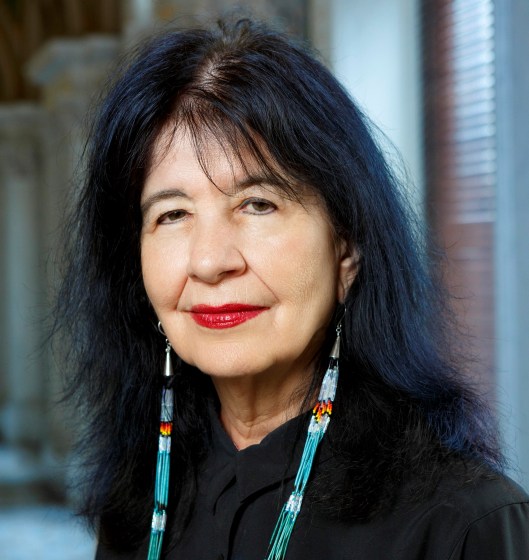
2019 United States Poet Laureate Joy Harjo
Photo Credit: Joy Harjo Official Website (Photo by Shawn Miller)


My Poetry Corner April 2020 features the poem “Advice for Countries, Advanced, Developing and Falling: A Call and Response” from the poetry collection An American Sunrise: Poems by Joy Harjo, Poet Laureate of the United States. (Note: The following excerpts of poems are all sourced from this collection.)

Born in 1951 in Tulsa, Oklahoma, the first of four siblings, Joy Harjo is a poet, musician, playwright, and author of the Muscogee (Creek) Nation. Her father was Muscogee (Creek) Nation and her mother of mixed ancestry of Cherokee, French, and Irish. Her mother exposed her to poetry at an early age, but painting was her first love.

My mother was a songwriter and singer, Harjo relates in her poem “Washing My Mother’s Body.” My mother’s gifts were trampled by economic necessity and emotional imprisonment. // My father was a dancer, a rhythm keeper. His ancestors were orators, painters, tribal chiefs, stomp dancers, preachers, and speakers… All his relatively short life he looked for a vision or song to counter the heartache of history. Her father’s drinking and abuse ended their marriage.

At sixteen years of age, Harjo’s abusive and violent stepfather kicked her out of their home. She moved to Santa Fe, New Mexico, where she received her high school education at the Institute of American Indian Arts. After graduation, she returned to Oklahoma, gave birth to a son, and returned to New Mexico to pursue a life as an artist. In 1973, as a second-year undergraduate at the University of New Mexico, she discovered poetry. After earning her BA in 1976, she moved to Iowa to obtain an MFA at the University of Iowa Writers’ Workshop.

“After all the abuse I had been through, I saw [poetry] as a way to transform what is harsh into something nourishing,” Harjo said, during an interview with Santa Barbara Poet Laureate Laure-Anne Bosselaar in January 2020. “I had found something in poetry not found in painting that was so compelling. I could write about Native women, fighting for our rights in over 500 tribal nations.” Continue reading

Now is the time…

Tags

, , , , ,

We are living in a time of great societal disruption. Despite all our advanced technology, we have been kicked off our pedestal by a mere virus. The COVID-19 doesn’t adhere to humanity’s border controls nor our military might. Its rampant spread across human populations is yet another reminder of the consequences of the imbalance our species have exerted on our planetary interconnected Web of Life.

As we grapple with social isolation, anxiety about paying our bills, and uncertainty about our future, now is the time to take stock of how we got here and where we are headed. If we wish to survive as a species, we humans must drastically change the way we live.

It’s no coincidence that our planetary societal disruption is occurring at a time of climatic and ecological crises. They are all connected. What’s more, these crises all have a common denominator—homo sapiens, Earth’s apex predator. The COVID-19 pandemic is just a taste of what lies ahead for humanity with the ongoing unraveling of the Web of Life.

Now is the time to appreciate our collective contribution and responsibility in providing and caring for each other.

Now is the time to determine what is truly essential for our well-being.

Now is the time to question our values and priorities.

Now is the time to examine our economic theories and beliefs built on individual acquisition and ownership of Earth’s gifts to all in the Web of Life.

Now is the time to determine what kind of future we want for ourselves, our children, our grandchildren, and future generations.

I recommend for your consideration the predictions of 34 big thinkers presented in the article, “Coronavirus Will Change the World Permanently. Here’s How,” published by Politico Magazine on March 19, 2020. The areas covered include community, tech, health/science, government, elections, the global economy, and lifestyle.

Fear not the duality of life. New beginnings come with letting go of what we hold today as precious for our well-being.

Thought for Today: A Warrior of the Light faces the COVID-19

Tags

,

A Warrior of the Light knows that certain moments repeat themselves.

He often finds himself faced by the same problems and situations, and seeing these difficult situations return, he grows depressed, thinking that he is incapable of making any progress in life.

“I’ve been through all this before,” he says to his heart.

“Yes, you have been through all this before,” replies his heart. “But you have never been beyond it.”

Then the Warrior realizes that these repeated experiences have but one aim: to teach him what he does not want to learn.

~ Excerpt from Warrior of the Light: A Manual by Paulo Coelho, Translated from the Portuguese by Margaret Jull Costa, HarperOne, New York, USA, 2003.

PAULO COELHO, born in Rio de Janeiro in 1947, is a Brazilian lyricist and novelist, best known for his novel, The Alchemist (1988). His work has been published in more than 170 countries and translated into eighty languages. His books have had a life-enchanting impact on millions of people worldwide.

Climate Crisis Update

Tags

, , , ,

Last week, a high pressure system over the overheated Pacific Ocean brought summer temperatures to Los Angeles of over 80℉ (26.6℃), reaching its peak of 88℉ (64℃) on Friday, February 28. Experts have observed that violent crime increases with hotter temperatures. Had the heat inflamed the man who entered our parking structure at 12:17 a.m. that Friday morning? Our surveillance cameras show him heading straight for a vehicle, dosing it with gasoline from front to back, and then setting it ablaze.

We were lucky. The winds blew the flames away from our apartment complex and onto the neighboring building, causing smoke and fire-hose water damage to two apartments. With concrete walls separating each four-vehicular unit, the fire did not spread throughout our parking structure. While only four of our neighbors lost their vehicles, the event left us all unsettled and vulnerable.

Meanwhile, further north, an extreme low pressure system over the Arctic has brought a warmer winter across much of Russia and parts of Scandinavia and eastern Canada. In Moscow, heavy snowfall arrived mid-January, two to three months later than usual. Beginning in December 2019, rising temperatures have broken the record, reaching 44℉ (6.6℃) last week. The spring-like weather in February, the snowiest time of the year with nose-biting cold below 5℉, have left many people in Moscow amazed. Ice skating enthusiasts are disappointed with Gorky Park’s melting ice rink. Continue reading

The Writer’s Life: Getting Feedback for Work in Progress

Tags

, , , , ,


I’ve been blessed in being part of a supportive writers’ critique group comprised of accomplished writers. Over the past five years, we’ve met once a month at a local restaurant. Our numbers have fluctuated between four to six writers with work in progress. But things don’t always work out the way we would like them to. Life happens. We have other pressing needs besides our writing.

With our active members now down to two of us, we’ve begun frequenting the Monday Night Fiction Workshop held at Beyond Baroque, a Literary | Arts Center in Venice, Los Angeles County. As I struggle with the first draft of my current writing project, I’ve found the fresh voices stimulating and motivating to keep pressing forward.

Instead of a third novel, to be set in Brazil, as planned, I’ve decided to explore the theme of the woman as a social construct. The minority male elite–not forgetting the women who support them–who control our global capitalist economic system are leading the human species, along with non-human species, towards extinction. Women play a vital role in maintaining the profitability of this system. If we are to reverse course, the role of women in society urgently needs to be re-examined. Continue reading