Climate Crisis Update: Reasons for Hope in 2020

Tags

, , , , , , ,

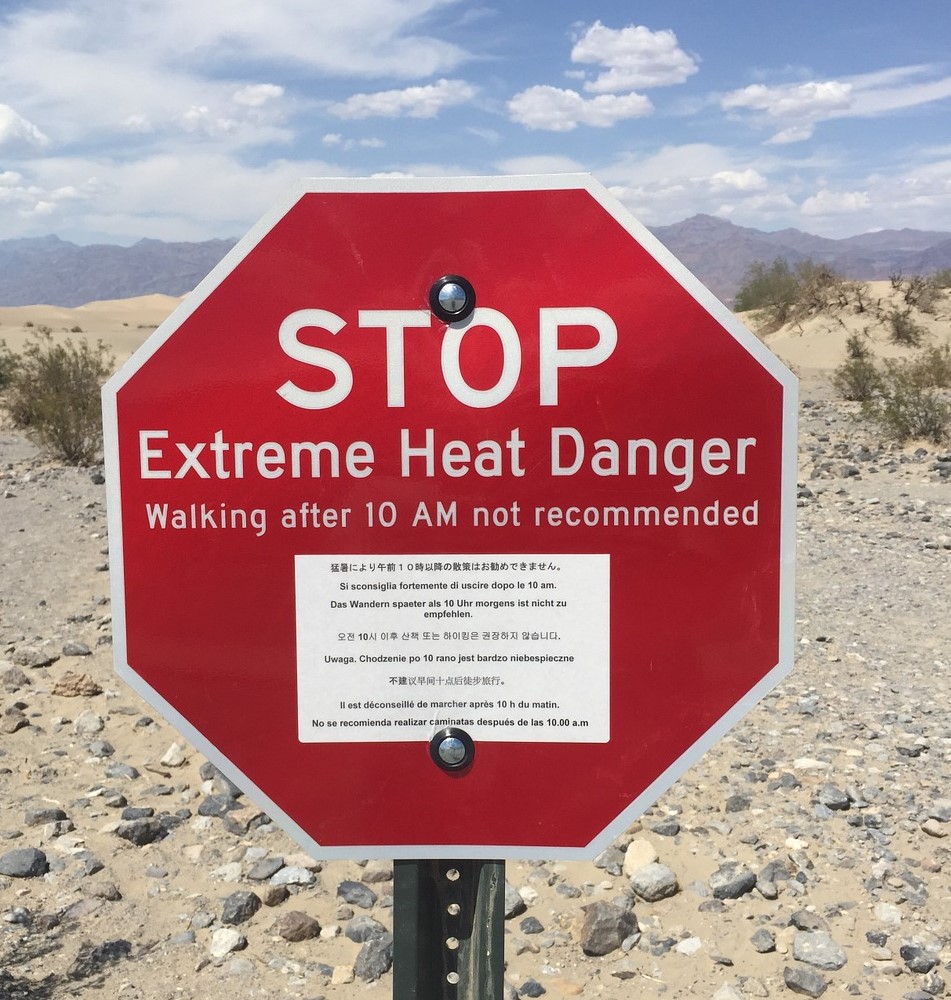
Stop Sign Extreme Heat Warning – Death Valley – California – USA

It is hot here in California. On August 16th, a heat wave sent temperatures soaring in Death Valley to 130℉ (54.4℃), believed to be the highest temperature recorded on Earth in over a century. With a historic wildfire season threatening life and property, Governor Gavin Newson has declared a state of emergency. On August 24th, as reported by Cal Fire, the state has had 7,002 fires this year, burning over 1.4 million acres…and growing. At the same time last year, 4,292 fires had burned 56,000 acres.

Depending upon where you live, you are probably facing your own extreme weather-related danger. Given our climate crisis, this is our new reality as inhabitants on Earth. Though the COVID-19 global pandemic may have forced our climate activists off the streets worldwide, they continue to press for urgent action.

On July 28, 2020, The Climate Reality Project released a message of hope amidst all the chaos going on around us. Their article, “9 Reasons to Have Climate Hope in 2020,” outlines why we should be optimistic about attaining a just, sustainable clean energy future.

Continue reading

“The Punt Trench” – Poem by Guyanese-Canadian Author Ken Puddicombe

Tags

, , ,

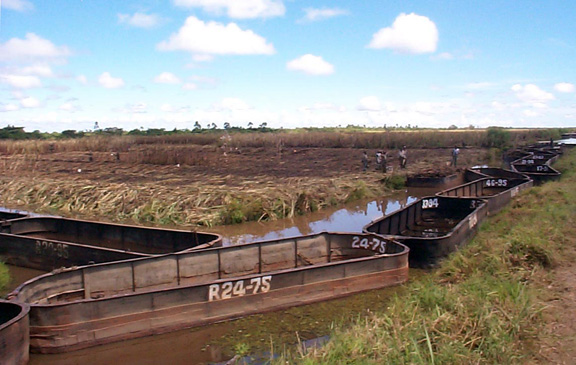
Punts to be loaded with cut sugar cane – Sugar Estate in Guyana

My Poetry Corner August 2020 features the poem “The Punt Trench” from the first poetry collection, Unfathomable And Other Poems (2020), by Guyanese-Canadian author Ken Puddicombe. Since retiring from his accounting work, Puddicombe has been pursuing his love of writing. To date, he has published two novels and a short story collection.

His poetry collection is filled with nostalgia of his boyhood days in Guyana. As an immigrant living in Canada since 1971, he writes in “Nostalgic”:

Immigrants.
As they grow older, the yearning
For a return to the old country increases.
Memories plague them, of a childhood in a familiar spot.
Any little incident will send their senses reeling and take
them back in time and place.

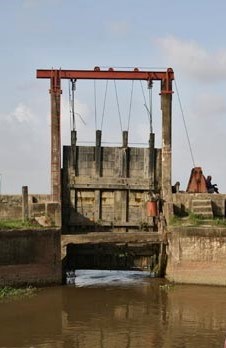
The punt trench is a recurring memory in Puddicombe’s poems. For readers unfamiliar with Guyana’s coastal lowlands of sugar cane fields crisscrossed by canals or trenches, a legacy of Dutch colonizers (1648-1814), a punt or cane-punt is a flat-bottomed iron barge for transporting harvested canes along the system of canals or punt trenches from field to factory. About 20 feet long, 8 feet wide, and 3 or 4 feet deep, the punt is drawn by a mule (in the early days) or tractor, attached by a long chain, moving along the punt-trench earth dam or unsurfaced road. The punt trench also serves as a drainage canal during low tides and periods of flooding, controlled by kokers or sluices.

Seawall with Koker or Sluice – Guyana
 

Puddicombe’s memories of the punt trench are somber and haunting. The title poem, “Unfathomable,” the longest narrative poem with seventeen stanzas, recounts the tale of the unfathomable death of his playful and daring friend—crushed between two punts moving along in a convoy on their way to the sugar factory.

The punts in the mule-train linked
With short lengths of chain hooked
Into metal clasps welded at the front
And rear of each craft. Six mules up front
Kept the convoy moving, each animal
Bound to a punt by a length of chain.

Lincoln was clinging to the connecting
Chain between two punts in the middle
Of the convoy, hanging on for a ride,
When the distance narrowed swiftly
Between the punts.

“Drowning” describes the time the author/poet almost lost his life in the cocoa-brown waters of the punt trench. Though he could not swim like the older boys, he plunged into the deep / Murky, swirling pit of the Punt Trench, made murkier still when his feet stirred up the mud and silt at the bottom of the trench.

On his first return visit to Guyana in 1987 after a sixteen-year absence, Puddicombe questions whether one could ever really go back to a time and place long gone. In his poem, “Middle Road,” the street where he had once lived, he finds The bridge over the Punt Trench where / I fell into the water now collapsed, the Trench / Filled in with debris.

In the featured poem, “The Punt Trench,” he reflects on the changes over time in four stanzas, each beginning with a different theme: Memory, Despair, Change, and Hope. His Memory of the punt trench as Fast moving torrential / Waves flashing through / The Koker to the raging Atlantic is no more. Instead, he feels only despair.  

Despair.
The Punt Trench is a dumping
Ground filled with debris and
Castoffs. Empty shell of a car.
Rusting frame of a bicycle. Bags of
Garbage piled in mounds. A dog’s bloated
Carcass. Tall paragrass and wild eddo bush
Reaching to the sky.

The punt trench, once a haunting memory of youthful joy and dread, is now a symbol of the decay of a neighborhood and of a nation; of promises not yet realized. It is not the change promised by the founding leaders of the independent nation.

Change.
From the Koker in Public Road
All the way to the Backdam
The Punt Trench is now Independence
Boulevard. Every time the breeze zips
Across from the north-east,
It reeks and fills my
Nostrils. Repulsive
Odours.

Only birdsong brings the poet Hope that Life goes on!

As the author and poet acknowledges in “You Can Never Go Back,” the final poem in the collection, the places of his idyllic youth have changed or no longer exist. People are no longer the same. Yet…some among us grasp a dream of returning to a time we consider our days of glory. Life goes on, for better or for worse, with or without us.

To read the complete featured poem, “The Punt Trench,” and learn more about the work of Ken Puddicombe, go to my Poetry Corner August 2020.

From Loneliness to Love: Five Steps for Finding a Healthy Relationship by JoAnne Macco

Tags

, ,

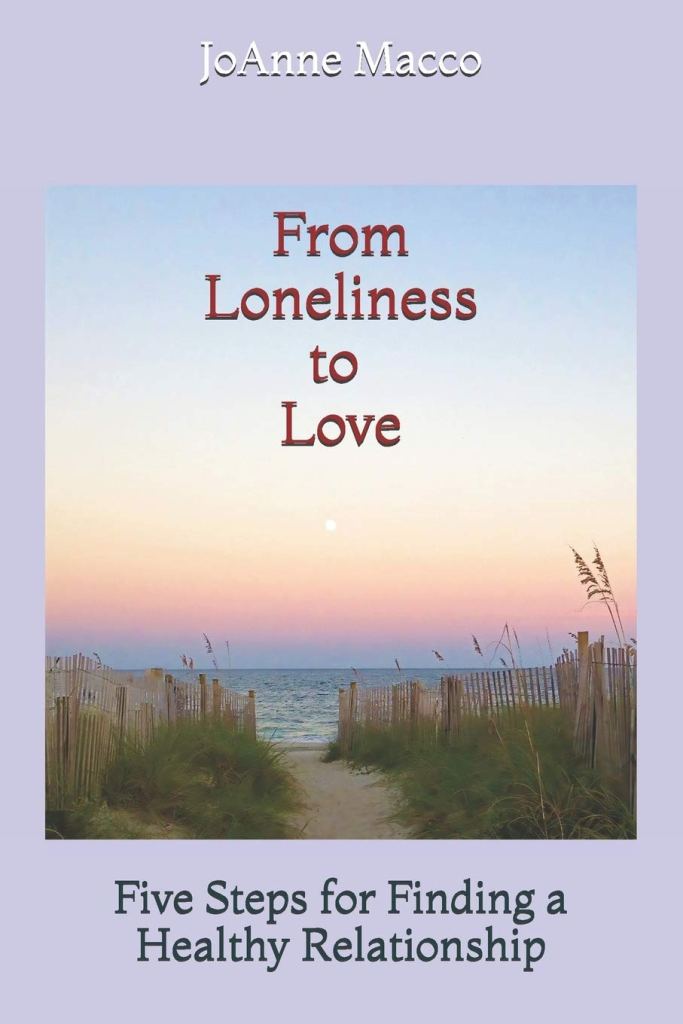
Front Cover – From Loneliness to Love: Five Steps for Finding a Healthy Relationship by JoAnne Macco (USA, 2020)

With all the social distancing and lockdown during these uncertain times of a global pandemic, there is no reason for us to give up on finding the love of our life. In her self-help guide, From Loneliness to Love: Five Steps for Finding a Healthy Relationship, memoirist and former mental health therapist JoAnne Macco does not dillydally with meanderings. She presents each recommended step with clear and concise descriptions and exercises for realizing the change we seek in our lives.

Based on her own journey of finding a compatible partner, following her divorce and two rebound damaging relationships, Macco knows well the pitfalls that await us along the way. She believes that the steps she had taken for a successful outcome could also work for others.

Her first step is intuitive: “Clarify Your Heart’s Desire.” Yet, so many of us can stumble in defining exactly what we seek in a relationship. Tips and exercises help the lonely heart to zero in on the list of qualities that really matter, based on each person’s wants and needs.

Continue reading

Thought for Today: Grounds for Hope

Tags

, ,

Hope locates itself in the premises that we don’t know what will happen and that in the spaciousness of uncertainty is room to act. When you recognize uncertainty, you recognize that you may be able to influence the outcomes—you alone or you in concert with a few dozen or several million others. Hope is an embrace of the unknown and the unknowable, an alternative to the certainty of both optimists and pessimists…. It’s the belief that what we do matters even though how and when it may matter, who and what it may impact, are not things we can know beforehand. We may not, in fact, know them afterward either, but they matter all the same, and history is full of people whose influence was most powerful after they were gone.

Rebecca Solnit in the Foreword to the Third Edition (2015) from Hope in the Dark: Untold Histories, Wild Possibilities, published by Haymarket Books, Illinois, USA, 2016. First published by Nation Books, USA, 2004.

Rebecca Solnit, born in 1961 in Connecticut/USA, is a writer, historian, and activist. She is the author of more than twenty books on feminism, western and indigenous history, popular power, social change and insurrection, hope and disaster. An independent writer since 1988, she is a columnist at the Guardian and a regular contributor to Literary Hub. Her most recent book, Recollections of My Non-Existence, was released in March 2020.

Darkness Descends

Tags

,

Photo by Su0130NAN u00d6NDER on Pexels.com

Darkness descends upon the land

The evil deployed far & wide

return home to devour our flesh

Our enemies revel in our undoing

vengeful gods spewing discord in the wind

The brave are silenced & threatened with evil

teargassed & spirited away in the night

Who will save us from the hateful heart?

Who will save us from the faithful

holding onto false promises?

Who will save us from collaborators

bought with wealth & power?

Candles flickering in the darkness

guide our faltering steps

“American Sonnet for My Past and Future Assassin” by African American Poet Terrance Hayes

Tags

, ,

My Poetry Corner July 2020 features sonnet 13 from the poetry collection American Sonnets for My Past and Future Assassin (2018) by African American poet Terrance Hayes. (Note: The following excerpts of poems are all sourced from this collection.) Born in 1971 in Columbia, South Carolina, Hayes is a national award-winning poet and university professor. After receiving his MFA from the University of Pittsburgh in 1997, he taught in Japan, Ohio, and Louisiana before returning to the University of Pittsburgh where he worked for several years. In Pittsburgh, he gained local fame as co-director of the Center for African American Poetry and Poetics.

Hayes moved on to New York University to take up his current post of Professor of English. In 2017, he was elected a Chancellor of the Academy of American Poets and now serves as an ex-officio member of the Academy’s Board of Directors. The divorced father of two children resides in New York City.

Hayes’ featured sonnet 13 is one of seventy freestyle sonnets, all bearing the same title and length of fourteen lines required for the poetic form. Written during the first two hundred days of the Trump presidency, the sonnets in this poetry collection are mostly political poems about life, love, and death of black men—haunted and hunted by violent racism.

In his 2018 interview for the Poets & Writers Magazine, Hayes tells interviewer Hanif Abdurraqib why he chose the sonnet: “How can I write a traditional love poem to someone or something I don’t deem worthy of my love? I just don’t know what other form would be able to hold this particular moment.”

He further expands on his poetic choice during his interview for The White Review Magazine in January 2019. In trying to express all the complications of love and politics, “I have to change my mind, because it’s a sonnet, because of the volta,” he tells interviewer Rachel Long. “Otherwise, it’s just a box. Something has to give. So whatever I go in with, I have to come out with something new.”

In sonnet 7, the poet alerts (lines 1/2//13/14):

I lock you in an American sonnet that is part prison,
Part panic closet, a little room in a house set aflame.
[…]
Voltas of acoustics, instincts & metaphor. It is not enough
To love you. It is not enough to want you destroyed.

In the following eight sonnet, the poet pour[s] a pinch of serious poison and merciful panic into [the] river for assassins like James Earl Ray, Dylann Roof, and others named in the poem. On the volta (lines 11-14), he then affirms:

Love trumps power or blood to trump power
Beauty trumps power or blood to trump power
The names alive are like the names in the graves

In the featured thirteenth sonnet on my Poetry Corner July 2020, Hayes describes all the ways in which the black male is silenced and erased by violent racism.

The earth of my nigga eyes are assassinated.
The deep well of my nigga throat is assassinated.
The tender bells of my nigga testicles are gone.
You assassinate the sound of our bullshit & blissfulness.

Hayes commentary on Trump’s rise to the presidency in sonnet 26 (lines 1-4) resounds loudly today:

America, you just wanted change is all, a return
To the kind of awe experienced after beholding a reign
Of gold. A leader whose metallic narcissism is a reflection
Of your own…

He asks in sonnet 30 (lines 4-6):

Is this a mandate for whiteness, virility, sovereignty,
Stupidity, an idiot’s threats & gangsta narcissisms threading
Every shabby sentence his trumpet constructs?

“…I ain’t mad at you, / Assassin,” Hayes writes in sonnet 53 (lines 12-14). “It’s not the bad people who are brave / I fear, it’s the good people who are afraid. (Emphasis mine)

To read the complete featured thirteenth sonnet, “American Sonnet for My Past and Future Assassin,” and learn more about the work of the poet Terrance Hayes, go to my Poetry Corner July 2020.

Thought on America’s Independence Day: “A country coming apart at the seams”

Tags

, ,

On America’s 244th year of independence, I offer these “rants” from Tom Engelhardt, an American editor, publisher, and author who belongs to the same generation as our 45th president.

That my generation, whether in the form of Donald Trump or Mitch McConnell, would be responsible for turning imperial America into an autocratic-leaning, collapsing semi-democracy, and a first-class world annihilator, I would have found hard to imagine. [In the early 1970s], if you had told me that, half a century into the future, the world’s fate would rest on a presidential election between a genuine madman and something close to a dead man (that, for all we know, may not prove to be an election at all), I would have dismissed you out of hand. And yet that, it seems, is the pandemic legacy of my generation for which we should all be ashamed, even as we watch the young, driven by the insanity and inanity of it all, turning out in our diseased streets to protest a country coming apart at the seams.

Excerpt from “The Age of Disappointment? Or How the American Century Ends” by Tom Engelhardt, published in TomDispatch.com on June 18, 2020.

Tom Engelhardt is a co-founder of the American Empire Project and the author of a history of the Cold War, The End of Victory Culture. He runs TomDispatch.com and is a fellow of the Type Media Center. His sixth and latest book is A Nation Unmade by War.

A Happy Fourth of July to all my American blogging friends! For the sake of our country and planet, may saner minds prevail.

“Negridians” by Afro-Brazilian Poet Lívia Natália de Souza

Tags

, , , , ,

Afro-Brazilian Poet Lívia Natália de Souza
Photo Credit: Gazeta Online – Brazil

My Poetry Corner June 2020 features the poem “Negridians” (Negridianos) from the poetry collection Currents and other marine studies (Correntezas e outros estudos marinhos) by Lívia Natália de Souza, an Afro-Brazilian poet and university professor. Born in 1979 in Salvador, Bahia, Northeast Brazil, Lívia Natália earned her Bachelor’s degree in Literature at the Federal University of Bahia in 2002. She further earned a Master’s degree (2005) and Doctorate (2008) in Theories and Criticism of Literature and Culture at the same institution where she lectures in Literary Theory. She also coordinates and teaches Literary Creation Workshops and works in projects for children at risk.

Lívia Natália’s debut poetry collection, Black water (Água negra), published in Salvador in 2011, received the Capital Bank Culture and Art-Poetry Award. In her poem “Asé” from that collection, the poet describes herself in terms of her African roots and connection with the natural world.

I am a black tree of gnarled root.
I am a river of muddy and calm profundity.
I am the arrow and its range before the scream.
And also the fire, the salt of the waters, the storm
and the iron of the weapons.

During the poet’s 2016 interview with SciELO, a São Paulo-based online forum, Lívia Natália admitted that racism influenced her work. “Racism in [Brazil], which calls itself a racial democracy, structures all relationships,” she said. “When I enter a room, not just a woman enters, a black woman enters and people read me with the racism machine assembled, even if that person is not a racist.” She added: “Racism is present from the moment I open my eyes to the moment that I close them. And…it’s present in my dreams, my nightmares.”

When speaking about violence in Brazil, the poet noted: “A black man or a black woman has to be in a combat position 24 hours a day, because when we sleep, the racist who lives inside people appears to accuse us of something.”

The poet shared her own experience with Bahia’s military police (MP) in February 2016 when they censored her short poem, “Quadrilha,” selected for the project “Poetry in the Streets” and featured on a billboard in Ilhéus—a city in Bahia’s southern coastal region popular with tourists for its cultural heritage and beaches. Bahia’s Police Association called for its removal for “inciting prejudices and intolerance against the military police.” When news spread among the police force nationwide, the poet received rape and death threats.

Inspired by Carlos Drummond’s poem of the same name, Lívia Natália’s version of life’s “Square Dance” of human relationships is one of two lives interrupted by police brutality.

Maria did not love João.
Only worshipped his dark feet.
When João died,
murdered by the MP,
Maria kept all his shoes.

In killing João, the police did not only take João’s life. They also destroyed Maria’s hoped-for relationship with her beloved, leaving her only with memories of times spent together square dancing.

In the featured poem, “Negridians,” the poet explores the black and white divide that, far too often, ends in lives interrupted by police brutality. The poet describes this global divide—a meridian she calls negridian—in the first stanza.

There is an invisible line,
raging twilight dividing the current.
Something that distinguishes my blackness from your white flesh
on a map where I do not have dominion.

As a black woman, the poet has no power over the space the dominant white population has assigned her and other blacks. She expands on the effects of the imposed confinement and oppression in the second stanza.

My negritude navigates in the riffraff,
in the shadows where light does not wander,
and the line imposes itself powerful,
oppressing my black soul,
curly with folds.

The spaces in which blacks are forced to live are not conducive for developing their full potential as human beings. Though she does not mention the police, their powerful role of control can be inferred in the third verse.

In the third and final stanza, Lívia Natália notes that, while the negridianal meridian is invisible, blacks feel in the flesh the consequences of overstepping the boundaries imposed by the dominant white elite. Pain is interwoven between the verses. And anger, too.

There is a negridianal meridian in our lives,
destroying them in a treacherous manner,
the line is indeed invisible:
but burns on the backs
in blood-red tracks,
the track-blade of these absurd lines that you draw
while I don’t see them.

To read the featured poem in its original Portuguese and to learn more about the work of Lívia Natália de Souza, go to my Poetry Corner June 2020.

Book Review: Under the Tamarind Tree–A Novel — my quest blog

Tags

In her novel Under the Tamarind Tree, Guyanese-born author Rosaliene Bacchus has spun a fascinating tale of family feuding, personal loss and a longing for love and self-acceptance, all set against the backdrop of crumbling Colonial power in British Guiana during the two-decade period […]

Book Review: Under the Tamarind Tree–A Novel — my quest blog

Henry Lewis is an American blogger who writes from his home in Colombia, South America, where he has settled after years of working in countries like China, Thailand, Iraq, and Oman.

My thanks go out to Henry for this unexpected and wonderful review of my debut novel.

Thought for Today: A Recipe for Murder

Tags

, , ,

The glorification of one race and the consequent debasement of another—or others—always has been and always will be a recipe for murder. There is no way around this. If one is permitted to treat any group of people with special disfavor because of their race or the color of their skin, there is no limit to what one will force them to endure, and, since the entire race has been mysteriously indicted, no reason not to attempt to destroy it root and branch.


James Baldwin in The Fire Next Time, published by Vintage Books Edition, New York, USA, 1993 (pp 82-83). Originally published by The Dial Press, New York, USA, 1963.

James Baldwin (1924-1987) is an American novelist, playwright, essayist, poet, and activist. He is the author of more than twenty works of fiction and nonfiction. Among the awards he received are a Eugene F. Saxon Memorial Trust Award, a Rosenwald Fellowship, a Guggenheim Fellowship, a Partisan Review Fellowship, and a Ford Foundation grant. He was made a Commander of the Legion of Honor in 1986.