“It is the policy of my Administration that climate considerations shall be an essential element of United States foreign policy and national security,” said President Biden.
In his Administration’s commitment to addressing the global climate crisis, he also confirmed the appointment of former Secretary of State John Kerry as America’s first Special Presidential Envoy for Climate.
Another first will be the establishment of the White House Office of Domestic Climate Policy within the Executive Office of the President. Headed by the Assistant to the President and National Climate Advisor, the Climate Policy Office will coordinate the domestic policy-making process and monitor its implementation nationwide. The National Climate Adviser will also chair the National Climate Task Force that will be comprised of twenty-one members from across federal agencies and departments. With the creation of a Civilian Climate Corps Initiative, our youth—who were clamoring for urgent action before the pandemic drove them off the streets—will have the opportunity for training in conservation and climate resilience.
At last, a government-wide approach to addressing the climate crisis!
To achieve a sustainable clean energy economy and meet our commitment of net-zero carbon emissions by no later than 2050, our nation will need millions of construction, manufacturing, engineering, and skilled-trades workers to build new infrastructure.
President Biden noted: “Such jobs will bring opportunity to communities too often left behind—places that have suffered as a result of economic shifts and places that have suffered the most from persistent pollution, including low-income rural and urban communities, communities of color, and Native communities.”
It is my hope that the escalating evidence of Mother Nature’s fury will silence the voice of climate change deniers within the Biden Administration.
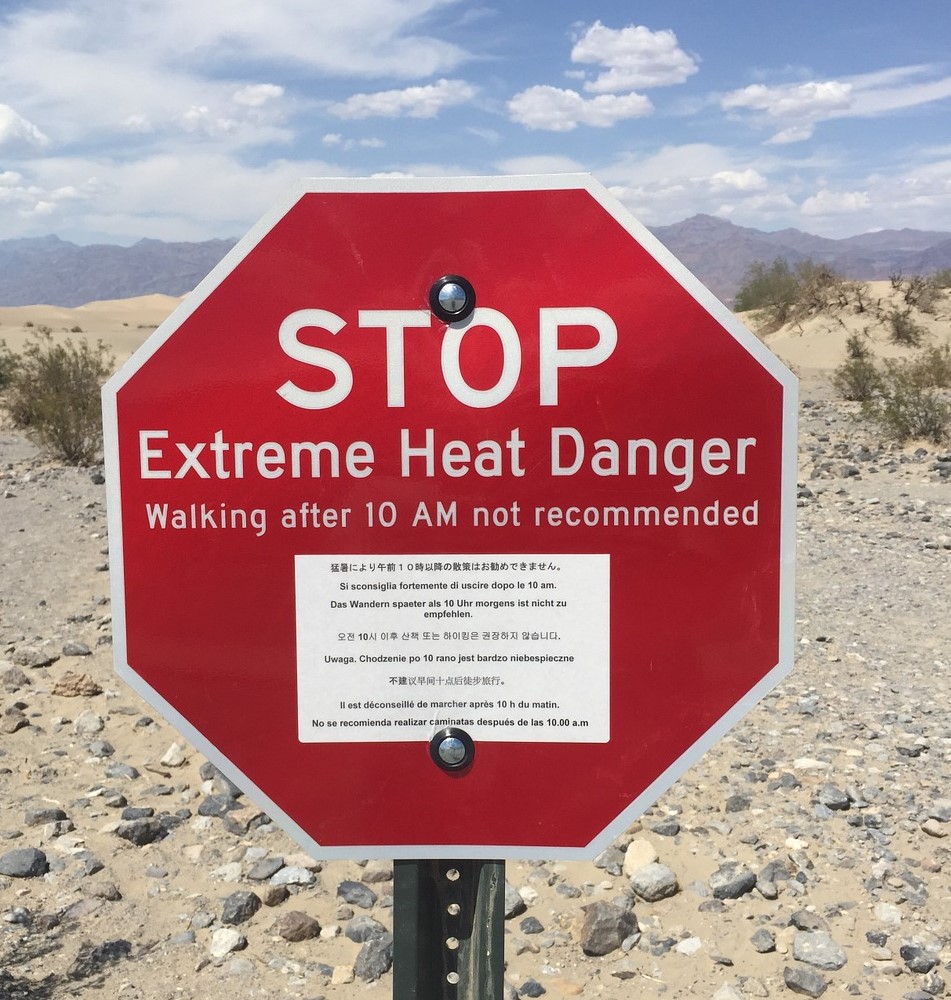
Stop Sign Extreme Heat Warning – Death Valley – California – USA
It is hot here in California. On August 16th, a heat wave sent temperatures soaring in Death Valley to 130℉ (54.4℃), believed to be the highest temperature recorded on Earth in over a century. With a historic wildfire season threatening life and property, Governor Gavin Newson has declared a state of emergency. On August 24th, as reported by Cal Fire, the state has had 7,002 fires this year, burning over 1.4 million acres…and growing. At the same time last year, 4,292 fires had burned 56,000 acres.
Depending upon where you live, you are probably facing your own extreme weather-related danger. Given our climate crisis, this is our new reality as inhabitants on Earth. Though the COVID-19 global pandemic may have forced our climate activists off the streets worldwide, they continue to press for urgent action.
On July 28, 2020, The Climate Reality Project released a message of hope amidst all the chaos going on around us. Their article, “9 Reasons to Have Climate Hope in 2020,” outlines why we should be optimistic about attaining a just, sustainable clean energy future.
Front Cover – The Future We Choose: Surviving the Climate Crisis by Christiana Figueres and Tom Rivett-Carnac Alfred A. Knopf – New York – USA – 2020
Based on NOAA’s 140-year climate record, 2019 is the second-hottest year on Earth, after 2016. In their book, The Future We Choose: Surviving the Climate Crisis (Knopf 2020), Christiana Figueres and Tom Rivett-Carnac, architects of the 2015 Paris Climate Agreement, remind us that we live in a critical decade. If we the people of Earth fail to attain our goal of halving our carbon emissions by 2030, it would be highly unlikely that we will attain net zero emissions by 2050. They invite us “to take part in creating the future of humanity, confident that despite the seemingly daunting nature of the challenge, collectively we have what it takes to address climate change now” (xxi).
To make clear the choices we face, Figueres and Rivett-Carnac devote two chapters to describe two possible worlds in 2050: the one we’re now creating and the one we must create. If we don’t limit our carbon emissions, extreme summer temperatures in the world we’re creating in 2050 force us to stay indoors. Working outdoors is a death sentence. Wearing a proper face mask is not an option, but a necessity for surviving in the hot, toxic air. Food and water shortages cause riots and wars. No wall is high or strong enough to deter the mass migrations worldwide. Economies are in free fall.
On the other hand, if we act now to reduce our carbon emissions to net zero and have avoided heating up our planet to no more than 1.5 degrees Celsius (34.7 degrees Fahrenheit), the authors note that, in 2050, we’re still dealing with the aftereffects of the record levels of carbon dioxide already in our atmosphere. Glaciers and Arctic ice are still melting. Sea levels are rising. Severe droughts and desertification are still occurring. But we enjoy a stable lifestyle. Our cities are greener and better places to live. Forest cover has expanded 50 percent worldwide. We no longer burn fossil fuels. Our energy now comes from renewable sources like wind, solar, geothermal, and hydro. All homes and buildings produce their own electricity. Food production and procurement become a communal effort.
As is already evident, Earth’s regenerative systems can no longer keep up with humanity’s exploitative mindset and consumption levels. To co-create a better world, the authors argue, we need both a systemic transformation and individual behavioral changes. They believe that this can be achieved with three mindsets: stubborn optimism, endless abundance, and radical regeneration. Considering the immensity of the task ahead of us, they admit that success is not guaranteed. But, for the future of humanity’s survival, failure is unthinkable. Stubborn optimism empowers us to create a new reality and energize all those with the same conviction. Creating endless abundance requires focusing on the benefits of limiting our carbon emissions. Radical regeneration bridges the gap between how nature works and how we humans have used extraction to organize our lives.
To achieve a regenerative future, Figueres and Rivett-Carnac set out ten necessary actions:
Action 1: Let Go of the Old World. We cannot go back to the way of life that created the climate emergency in the first place.
Action 2: Face Your Grief but Hold a Vision of the Future. The pain of loss should spur us to greater action rather than sink us into a pit of blame, despair, or hopelessness. Having a vision is essential to inspire the kind of commitment and energy we will need to get through the difficult years ahead.
Action 3: Defend the Truth. We must free our mind to new ways of thinking and learn to distinguish real science from pseudo-science.
Action 4: See Yourself as a Citizen – Not as a Consumer. Letting go means reclaiming our idea of a good life, becoming a better consumer, and dematerializing.
Action 5: Move Beyond Fossil Fuels. We must let go of the conviction that fossil fuels are necessary for humanity to thrive in the future and stand up for 100 percent renewable energy.
Action 6: Reforest the Earth. The future we must choose will require us to pay more attention to our bond with nature. We must plant trees, boycott products contributing to deforestation, and move to a plant-based diet.
Action 7: Invest in a Clean Economy. We will require a clean economy that operates in harmony with nature, repurposes used resources as much as possible, minimizes waste, and actively replenishes depleted resources.
Action 8: Use Technology Responsibly. We will need to be mindful of investments in AI: what it’s being used for and the regulatory systems in place.
Action 9: Build Gender Equality. Women are better at working collaboratively, with a longer-term perspective—traits essential to responding to the climate crisis.
Action 10: Engage in Politics. We must engage at all levels of government and elect only leaders who see far-reaching action on climate change as their absolute priority. At the same time, we can stop buying stocks, products, and services from corporations that fund and engage in political lobbying against citizen action on climate change.
Figueres and Rivett-Carnac conclude that meeting the challenge of climate change must become part of a new story of human striving and renewal. “This is not the quest of one nation. This time it’s up to all of us, to all the nations and peoples of the world. No matter how complex or deep our differences, we fundamentally share everything that is important: the desire to forge a better world for everyone alive today and all the generations to come” (161).
The time for doing what we can has passed. To survive, each one of us must now do everything that is necessary. Inciting hate, violence, and chaos is not the way forward to creating a better America today, in 2050, and beyond.
Christiana Figueres is a Costa Rican citizen and was the Executive Secretary of the United Nations Framework Convention on Climate Change from 2010 until 2016. During her tenure at the UNFCCC Ms. Figueres brought together national and sub- national governments, corporations and activists, financial institutions and NGOs to jointly deliver the historic Paris Agreement on climate change, in which 195 sovereign nations agreed on a collaborative path forward to limit future global warming to well below 2C.
Tom Rivett-Carnac is a Founding Partner of Global Optimism and works across the portfolio of engagements and initiatives. He has spent 20 years working at the intersections of international diplomacy, energy policy and climate change in business, non-profit, financial services and international institutions. Learn more at https://globaloptimism.com/about-us/
Last week, a high pressure system over the overheated Pacific Ocean brought summer temperatures to Los Angeles of over 80℉ (26.6℃), reaching its peak of 88℉ (64℃) on Friday, February 28. Experts have observed that violent crime increases with hotter temperatures. Had the heat inflamed the man who entered our parking structure at 12:17 a.m. that Friday morning? Our surveillance cameras show him heading straight for a vehicle, dosing it with gasoline from front to back, and then setting it ablaze.
We were lucky. The winds blew the flames away from our apartment complex and onto the neighboring building, causing smoke and fire-hose water damage to two apartments. With concrete walls separating each four-vehicular unit, the fire did not spread throughout our parking structure. While only four of our neighbors lost their vehicles, the event left us all unsettled and vulnerable.
Meanwhile, further north, an extreme low pressure system over the Arctic has brought a warmer winter across much of Russia and parts of Scandinavia and eastern Canada. In Moscow, heavy snowfall arrived mid-January, two to three months later than usual. Beginning in December 2019, rising temperatures have broken the record, reaching 44℉ (6.6℃) last week. The spring-like weather in February, the snowiest time of the year with nose-biting cold below 5℉, have left many people in Moscow amazed. Ice skating enthusiasts are disappointed with Gorky Park’s melting ice rink. Continue reading →
On Thursday, January 23, 2020, our atomic scientists advanced the Doomsday Clock another twenty seconds, bringing the fate of humanity to a hundred seconds to midnight. For those who don’t know, midnight signifies humanity’s self-annihilation with its nuclear arsenal. The guns that Americans cling to, like a toddler clings to his teddy bear, would be rendered useless in the face of a nuclear threat. To learn more, read the full statement issued by the Bulletin of the Atomic Scientists.
In his article “Twin Threats,” published in The Nation magazine (issue dated 01/27/2020), Michael T. Klare argues:
“All things being equal, rising temperatures will increase the likelihood of nuclear war, largely because climate change will heighten the risk of social stress, the decay of nation-states, and armed violence in general…”
Of special concern are India, Pakistan, and China—all well-armed with nuclear weapons of mass destruction—that will face conflicts over dwindling water supplies. Pakistan and western India share the same Indus River system. Likewise, eastern India and western China both depend upon the Brahmaputra River for their water needs. Unlike oil, water is essential for human survival.
While the American government continues to publicly disavow our global climate emergency, Klare notes that our “nation’s senior military leaders recognize that climate disruption is already underway, and they are planning extraordinary measures to prevent it from spiraling into nuclear war.”
On Friday, January 24, at the 2020 World Economic Forum in Davos, during a panel discussion about the impact of climate change on the global economy, U.S. Treasury Secretary Steven Mnuchin was quick to say: “Let’s call it an environmental issue and not climate change.” What’s more, he argued, experts are overestimating its monetary impact.
During a press briefing the day before, Mnuchin dismissed climate activist Greta Thunberg’s call for divestment from fossil fuel companies. He told Yahoo Finance: “After she goes and studies economics in college, she can come back and explain that to us.” What can Greta and the rest of us economic neophytes learn from the experts?
On January 15, prior to its event in Davos, the World Economic Forum released The Global Risks Report 2020 in London, UK. Bear in mind that this report, produced in partnership with Marsh & McLennan and the Zurich Insurance Group, deals with financial risks for transnational corporations and national and the global economies.
Over 750 global experts and decision-makers were asked to rank their biggest concerns in terms of likelihood and impact. For the first time in the survey’s ten-year outlook, the top five global risks in terms of likelihood are all environmental. In concise terms, these risks are:
The political landscape is polarized, sea levels are rising and climate fires are burning. This is the year when world leaders must work with all sectors of society to repair and reinvigorate our systems of cooperation, not just for short-term benefit but for tackling our deep-rooted risks. ~ Borge Brende, President of the World Economic Forum
Biologically diverse ecosystems capture vast amounts of carbon and provide massive economic benefits that are estimated at $33 trillion per year – the equivalent to the GDP of the US and China combined. It’s critical that companies and policy-makers move faster to transition to a low carbon economy and more sustainable business models. We are already seeing companies destroyed by failing to align their strategies to shifts in policy and customer preferences. Transitionary risks are real, and everyone must play their part to mitigate them. It’s not just an economic imperative, it is simply the right thing to do. ~ Peter Giger, Group Chief Risk Officer of the Zurich Insurance Group
I’m no economic expert. I know only that the soulless corporate personhood has devised ways to thrive on the chaos and detritus of human calamity. To the billionaire-class and those who aspire to join them, gathered recently at the World Economic Forum, I say: Your self-enrichment economic system is the Number One risk to humanity’s continued existence on Planet Earth. While you continue to amass unimaginable wealth, the explosive inequality among the masses of real people worldwide just requires a climate-induced drought and famine in a nuclear-armed nation for ignition.
When the Doomsday Clock strikes midnight, money markets and a nation’s gross domestic product (GDP) will lose their value and meaning for any surviving remnant of our species.
On November 5, 2019 more than 11,000 scientists from 153 countries signed a declaration, published in the journal of the American Institute of Biological Sciences, that states “clearly and unequivocally that planet Earth is facing a climate emergency.” Though scientists began alerting world leaders forty years ago about global warming, greenhouse gas emissions continue to soar.
In an effort to expand our understanding of the climate emergency, the scientists have prepared several graphics of the vital signs of climate change over the last forty years.
The climate crisis is closely linked to excessive consumption of the wealthy lifestyle.
The 15 charts in Figure 1 depict the changes in global human activities from 1979 to the present:
01. Human population
02. Total fertility rate
03. Ruminant livestock (cattle)
04. Per capita meat production
05. World GDP (Gross Domestic Product)
06. Global tree cover loss
07. Brazilian Amazon Forest loss
08. Energy consumption (oil, coal, gas, solar/wind)
09. Air transport (by number of passengers)
10. Total institutional fossil fuel assets divested
11. CO2 (carbon dioxide) emissions
12. Per capita CO2 (carbon dioxide) emissions
13. Greenhouse gas emissions covered by carbon pricing
14. Carbon price
15. Fossil fuel subsidies
The 14 charts in Figure 2 depict the climatic response time series for the same period, 1979 to the present:
01. Carbon dioxide in atmosphere
02. Methane in atmosphere
03. Nitrous oxide in atmosphere
04. Surface temperature change
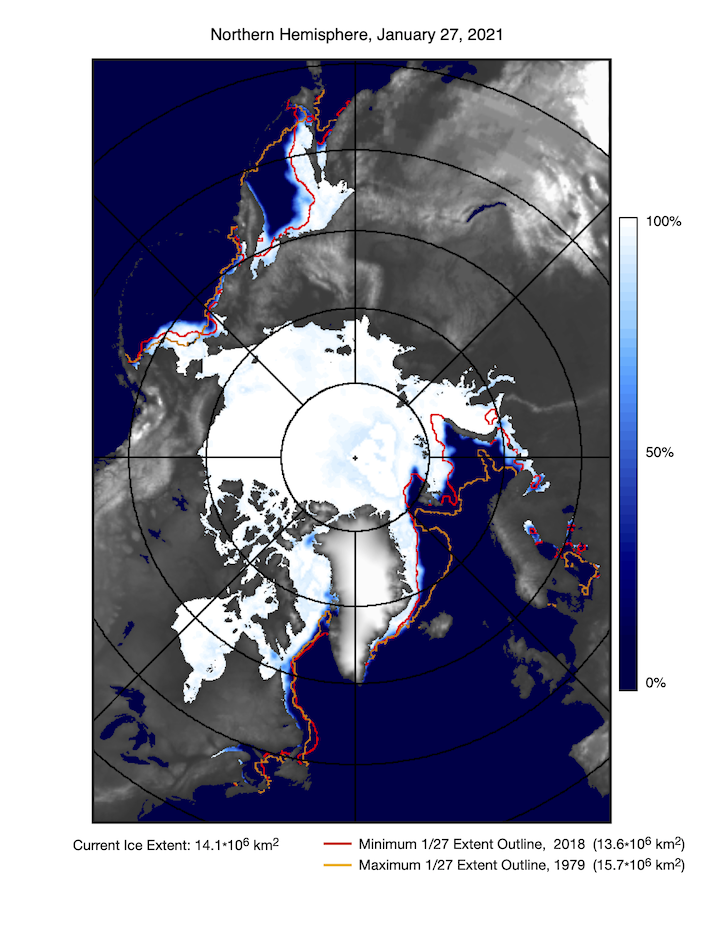
05. Minimum Arctic sea ice
06. Greenland ice mass change
07. Antarctica ice mass change
08. Glacial thickness change
09. Ocean heat content change
10. Ocean acidity
11. Sea level change
12. Area burned in the United States
13. Extreme weather/climate/hydro events
14. Annual losses due to weather/climate/hydro events Continue reading →
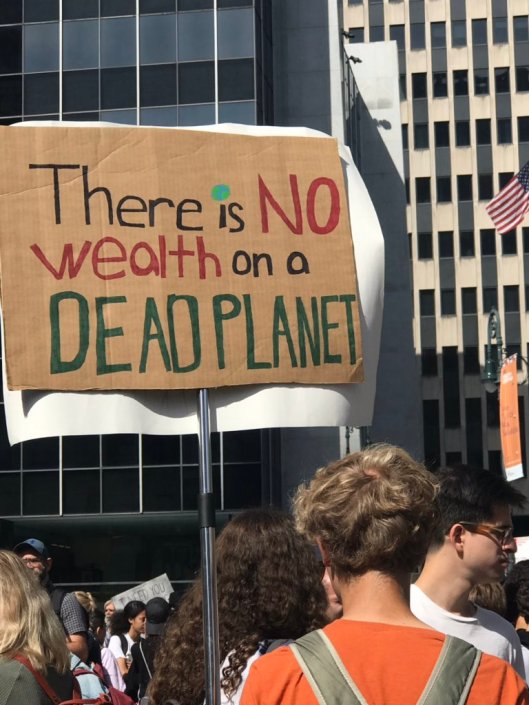
There is no wealth on a dead planet
Global Climate Strike 2019 – New York City – USA
Photo Credit: Common Dreams
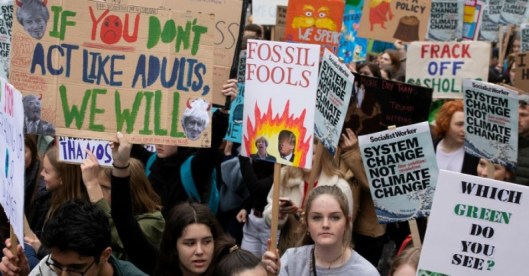
On Friday, September 20, 2019, millions of young people and supporting adults in more than 150 countries took part in the Global Climate Strike, calling on decision-makers to take immediate action to address our global climate crisis. I’m heartened that sixteen-year-old, Swedish environmentalist activist, Greta Thunberg, has awakened our youth to the future that awaits them.
“It’s just not the young people’s house,” Thunberg told the thousands of participants gathered in New York City. “We all live here. It affects all of us. Why should we study for a future that is being taken away from us? That is being stolen for profit? Some people say we should study to become climate scientists or politicians, so that we can, in the future, solve the climate crisis. But by then, it will be too late. We need to do this now.” (Emphasis mine.)
“The climate emergency is a race we are losing, but it is a race we can win. This is not a climate talk summit. We have had enough talk. This is not a climate negotiation summit. You don’t negotiate with nature. This is a climate action summit.” (Emphasis mine.) Continue reading →
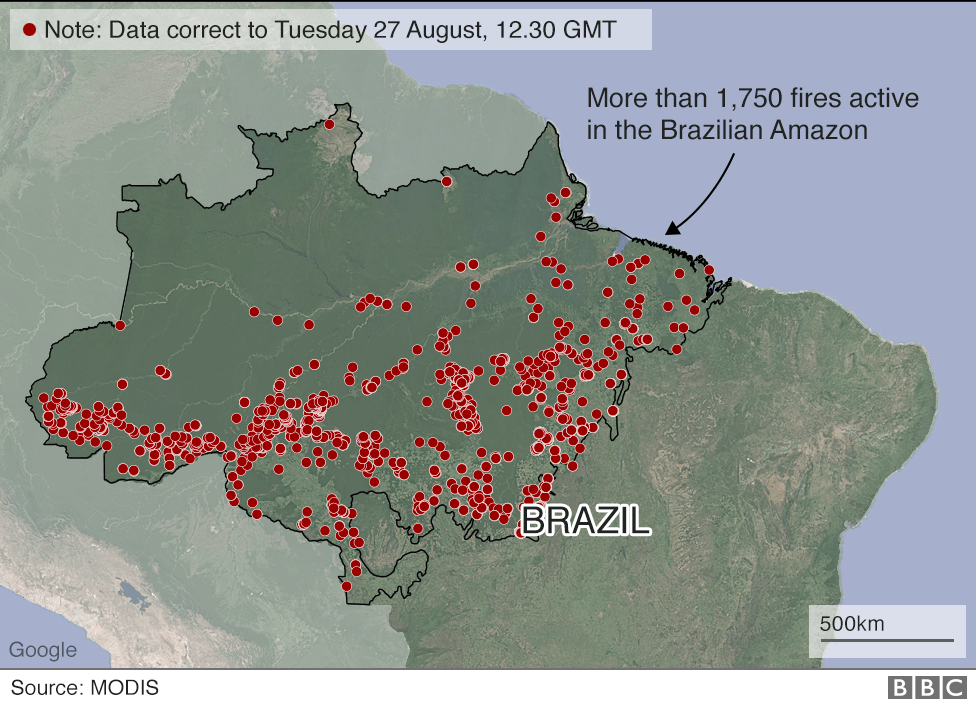
Map of Active Fires in the Amazon Basin – Brazil – August 27, 2019
Photo Credit: BBC News
Brazil’s Amazon rainforest is under attack. So far this year, she has received nearly 75,000 stab wounds, setting the targeted areas ablaze. Seventy-five thousand! Her belching smoke trails turned daylight into darkness over Brazil’s largest city, some 1,677 miles away. How many trees and the non-human lives they sustain have we humans condemned to ashes? For what?
Some arsonists are loggers, raping the forest for more wood to feed global demand. Others want easy access to the mineral wealth—gold, diamonds, iron-ore, and bauxite. Most of them are land-grabbers. They covet the land for raising more cattle and expanding soybean cultivation for animal feed production. We are trading the Amazon rainforest to satiate our taste for beef.
The Amazon Basin, regarded as the ‘Lungs of Earth,’ absorbs about 25 percent of Earth’s total carbon dioxide emissions and releases oxygen into the atmosphere. What could go wrong? Continue reading →
YouthStrike4Climate Student March – London, UK – April 12, 2019
Photo Credit: Common Dreams (Photo Dan Kitwood/Getty Images)
To those people who are still in denial that humanity faces a climate crisis that would most likely lead to the extinction of our species, not to mention most other species, I say, wake up to reality. We cannot afford to wait until reality strikes you in the groin or chest for us to take evasive action as a united nation.
Greta Thunberg at the World Economic Forum 2019 – Davos, Switzerland
Watch Video: World Economic Forum, Published on January 25, 2019
Because we adults are asleep at the wheel, leadership in humanity’s existential crisis now falls upon our youth. After all, it’s their future that is at stake. Greta Thunberg, a fifteen-year-old Swedish student has had enough of the failure of world leaders to act. In her address to the ultra-rich gathered at the World Economic Forum in January 2019, she tells them:
“I want you to panic. I want you to feel the fear I feel every day. And then I want you to act. I want you to act as you would in a crisis. I want you to act as if our house is on fire. Because it is.”
Senator Dianne Feinstein speaks with young activists of the Sunrise Movement
California Office, USA – February 22, 2019
Watch Video: Washington Post
Here in the world’s leading economy, our leadership is more concerned about preserving their self-interests, their political party, and the status quo. On February 22, 2019, when young activists of the Sunrise Movement visited the California office of Sen. Dianne Feinstein (D-CA) to ask her to vote for the Green New Deal, she was firm in rejecting their petition.
“We have our own Green New Deal,” Feinstein tells them. “I’ve been doing this for thirty years. I know what I’m doing. You come in here and you say it has to be my way or the highway. I don’t respond to that… I just won a big election.”
Youth climate activists during sit-in at Washington DC office of Senate Majority Leader Mitch McConnell – February 25, 2019
Photo Credit: Common Dreams (Photo Sunrise Movement)
The following Monday, February 25th, over 200 young members of the Sunrise Movement joined about twenty Kentucky high school students outside the Capitol Hill office of Senate Majority Leader Mitch McConnell (R-KY) to demonstrate their support for the Green New Deal. They failed to meet him. Instead, the Capitol Police arrested more than forty of them.
While there is yet no consensus on the Green New Deal—which right-wing commentators view as a socialist takeover of our economy—lawmakers in Washington DC are busy undoing decades of environmental protection regulations. Then, on June 20th, the New York State Assembly passed its own Green New Deal at the state level. Their aggressive Climate Leadership & Community Protection Act calls for net zero carbon emissions statewide by 2050.
On July 9th, our young climate activists gained another victory in their call for action. Sen. Bernie Sanders (I-VT), Rep. Earl Blumenauer (D-OR), and Rep. Alexandria Ocasio-Cortez (D-NY) announced the introduction of a resolution in Congress to declare that the climate emergency facing our planet demands a “national, social, industrial, and economic mobilization of the resources and labor of the United States” in order to “restore the climate for future generations.”
Over two dozen lawmakers, including most of the senators currently running for president, signed on as co-sponsors.
Blumenauer calls for a reality check. “To address the climate crisis, we must tell the truth about the nature of this threat,” he said in his statement.
“What we need now is Congressional leadership to stand up to the fossil fuel industry and tell them that their short-term profits are not more important than the future of the planet,” Sanders said. “Climate change is a national emergency, and I am proud to be introducing this resolution with my House and Senate colleagues.”
Working to solve the climate crisis will create tens of millions of union jobs, empower communities, and improve the quality of life for people across the globe,” Ocasio-Cortez added.
Bill Snape, senior counsel at the Center for Biological Diversity, supports the resolution. “With an unhinged climate denier in the White House, it’s on Congress to steer us away from climate suicide,” he said in a statement. “This resolution is a sane recognition that science says we need a massive transition away from the production and consumption of dirty fossil fuels.”
The time is now to break down the walls of partisanship, the walls of fear, the walls of ignorance, the walls of hatred and divisiveness, the walls of exclusion, the walls of separateness, the walls of inequality.
“Our house is on fire!” alerts the high school student Greta Thunberg.
“Let it burn!” says The Bully, sitting at the top of the world. “The oil is mine! All mine!”
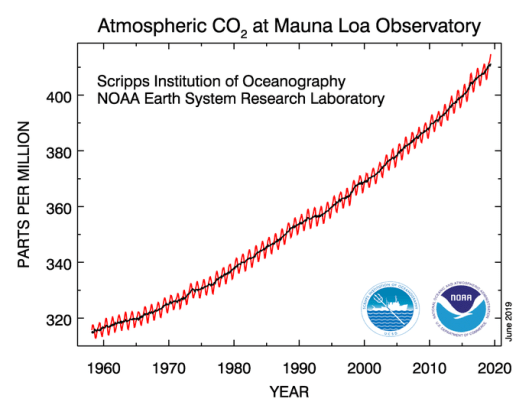
Atmospheric carbon dioxide continued its rapid rise in 2019, with the average for May peaking at 414.7 parts per million (ppm) at NOAA’s Mauna Loa Atmospheric Baseline Observatory.
The measurement is the highest seasonal peak recorded in 61 years of observations on top of Hawaii’s largest volcano and the seventh consecutive year of steep global increases in concentrations of carbon dioxide (CO2), according to data published June 4, 2019, by NOAA and Scripps Institution of Oceanography.