• About

Three Worlds One Vision

~ Guyana – Brazil – USA

Three Worlds One Vision

Author Archives: Rosaliene Bacchus

How the web of life became Cheap Nature

25 Sunday Feb 2018

Posted by Rosaliene Bacchus in Human Behavior, Nature and the Environment

≈ 45 Comments

Tags

Anthropocene, Anthropocene or Capitalocene? Nature History and the Crisis of Capitalism Edited by Jason W Moore (2016), Artist and painter Mike Caimbeul, “Cheap Nature”, Capitalocene, Humans and the web of Life, Jason W Moore, Man and Nature, Rise of Capitalism

The Web of Life Reshaped - Painting by Mike Caimbeul

The Web of Life Reshaped – Painting by Mike Caimbeul
Photo Credit: Bongdoogle.com


Part Two of my series on the book, Anthropocene or Capitalocene? Nature, History, and the Crisis of Capitalism (Kairos Books, 2016), edited by Jason W. Moore, is a synopsis of Moore’s article on “The Rise of Cheap Nature.” In his article, he refers to two kinds of nature: nature with a common ‘n’ is the web of life; Nature with a capital ‘N’ is environments without humans.

Like Eileen Crist (Part One), Moore argues that we live in the “Age of Capital,” the Capitalocene. Until we understand that “capital and power do not act upon nature, but develop through the web of life,” we cannot formulate solutions for the environmental crises we now face.

Most people (myself included), Moore notes, still think about capitalism in economic terms – markets, prices, money, and the like. He proposes that we think about the rise of capitalism as a new way of organizing nature. We would start to consider capitalism not as world-economy but as world-ecology – the organization of work, re/production of nature, and the conditions of life as an organic whole for the accumulation of capital and pursuit of power. In other words, human activity is environmental-making.

Moore challenges the Anthropocene narrative that capitalism emerged in eighteenth-century England with the Industrial Revolution, powered by coal and steam. The focus on fossil fuels as the ignition for the growth of capital ignores the greatest landscape revolution in human history – in terms of speed, scale, and scope – that occurred in the three centuries after 1450.

The conquest of the Atlantic and appropriation of the New World brought vast expanses of “Cheap Nature” and the labor-power to create wealth. “Cheap” refers to the unpaid work/energy of organic life. Numbered among Cheap Nature – along with trees, soils, and rivers – were indigenous peoples, enslaved Africans, nearly all women, and even white-skinned men (Slavs, Jews, Irish) living in semi-colonial regions. These humans, deemed not Human, provided Cheap Labor.

By 1500, Spain alone had colonized an area greater than the whole of Europe and more than 25 million indigenous peoples. Sugar, the modern world’s original cash crop, fed on the work/energy of African slaves. Sugar production devoured forests and exhausted soils. Between 1570 and 1640, Brazilian sugar grew three percent every year. In northeastern Brazil at the height of the sugar boom in the 1650s, twelve thousand hectares of forest were cleared in a single year, as compared with 200 years in twelfth-century Europe.

Scientific advances made it possible to put the whole of nature to work for capital. “Science” revealed nature’s secrets for capital accumulation. “Economy” channeled the labor-power of the landless proletariat into the cash nexus of the labor market. The “state” enforced the cash nexus.

To maintain expanding commodity production required cheap, productive labor; cheap food to control the price of labor-power; cheap raw materials; and cheap energy for diverse industries. Fossil fuels, seemingly unlimited supplies of Cheap Nature, were put to work for the rapid expansion of capitalism.

Though rising costs of fossil fuel production and labor costs have shrunk sources of Cheap Nature and Cheap Labor, capitalism has managed to keep ahead with Cheap Nature strategies within reach of its power. (I think of low cost labor of America’s private prison population and the expanding gig economy.)

Moore concludes that financialization and extreme inequality are predictable results of the end of Cheap Nature. The web of life can no longer sustain capitalism’s world-ecology. Our strategies for liberation must not only determine how to redistribute wealth, but also “how to remake our place in nature in a way that promises emancipation for all life.”
How do humans fit into the web of Life?

18 Sunday Feb 2018

Posted by Rosaliene Bacchus in Human Behavior, Nature and the Environment

≈ 45 Comments

Tags

Anthropocene, Anthropocene or Capitalocene? Nature History and the Crisis of Capitalism Edited by Jason W Moore, Capitalocene, Eileen Crist, Humans and the web of Life, Jason W Moore, Man and Nature, Sixth Mass Extinction

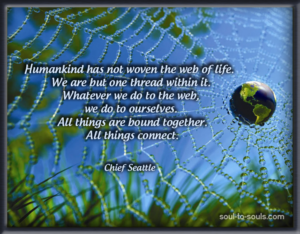
Web of Life Quote from Chief Seattle


According to the tenets of Abrahamic religions – Judaism, Christianity, and Islam – Man is the crown of God’s creation, with dominion over all living species on the Earth (Genesis 1: 26-31). Thus empowered, Man has transformed Earth’s ecosystems with devastating effects on forests, rivers, lakes, seas, oceans, and all the non-humans that live therein. With our factories belching carbon into the atmosphere, global warming has become our new reality. The course is set for an unknown state in human experience.

In 2000, the atmospheric chemist and Nobel Laureate Paul Crutzen conceived the concept “Anthropocene” to denote a new geological time in which Man is a major geological force. But several geologists and environmentalists disagree with his word choice. Others believe we live in the age of capital, the “Capitalocene.”

Jason W. Moore, an environmental historian and historical geographer at Binghamton University, is one such social scientist. In his book, Anthropocene or Capitalocene? Nature, History, and the Crisis of Capitalism (Kairos Books, 2016), he and six other contributors argue that Capitalocene is a much more appropriate alternative. Concepts matter, he reiterates in his “Introduction,” since we use them to make sense of our world.

“The kind of thinking that created today’s global turbulence is unlikely to help us solve it,” Moore notes.

In this article, the first of a series, I share the contribution “On the Poverty of Our Nomenclature” by Eileen Crist, a sociologist and professor at Virginia Tech.

Crist argues that the concept of the Anthropocene reinforces human dominion over Nature, “corralling the human mind into viewing our master identity as manifestly destined, quasi-natural, and sort of awesome.” We arrogantly perceive ourselves on par with the tremendous forces of Nature. Such mentality empowers “the human enterprise” to manage the planet for production of resources and, through technological engineering, to contain the risks and ecological disasters.

She observes that Man’s historical records do not record the non-human others who don’t speak and have no control over their destinies. The sixth mass extinction, resulting from destruction of their habitats for human expansion, becomes just a casualty of history. We accept as normal the humanization of Earth, at the expense of its non-human inhabitants.

“Where is the freedom of humanity to choose a different way of inhabiting Earth, to change our historical discourse,” Crist asks.

Crist calls for humankind to end our species-supremacist civilization and become integrated with the biosphere. This would require an end to viewing our planet as an assortment of “resources” or “natural capital,” “ecosystem services,” “working landscapes,” and the like. While she does not envisage an end to human technological innovation, the sociologist has no idea what such a world would look like. In deindustrializing our relationship with land, seas, and domestic animals, we-humans would have a better chance of reversing the takeover of Nature for our own needs and appetites.

“In making ourselves integral, and opening into our deepest gift of safeguarding the breadth of Life, the divine spirit of the human surfaces into the Light,” Crist concludes.

“Theology of Junk” by Brazilian Poet Manoel de Barros

04 Sunday Feb 2018

Posted by Rosaliene Bacchus in Poetry

≈ 40 Comments

Tags

About Scrap Metal, Brazilian poet Manoel de Barros, Pantanal/Mato Grosso do Sul/Brazil, Teologia do Traste por Manoel de Barros, Theology of Junk by Manoel de Barros

Giant Water Lily - Victoria Amazonia - Pantanal - Mato Grosso do Sul - Brazil

Giant water lily, Victoria Amazonica – Pantanal – Mato Grosso do Sul – Center-West Brazil
Photo Credit: Andre Dib/WWF


My Poetry Corner February 2018 features the poem “Theology of Junk” (Teologia do Traste) by Brazilian poet, lawyer, and farmer Manoel de Barros (1916-2014). Born in Cuiába, Mato Grosso, he was a year old when his father decided to start a cattle ranch in Pantanal, the world’s largest wetland area, in Mato Grosso do Sul. The young Manoel grew up playing in the yard, between the pens and the “unimportant things” that would influence his poetry.

In “Manoel by Manoel,” he describes his childhood experience:

… I used to play pretending that stone
was lizard. That a can was a ship. That the sloth was a
little problematic creature and equal to a young grasshopper.
I grew up playing on the ground, among ants. Of a
childhood free and without comparisons. I had more
communion with things than with comparison.

When he moved to the city to go to school, Manoel found it a strange and complicated world. In the countryside, they had to make their own toys: small bone animals, sock balls, tin can cars. In “About Scrap Metal,” from his book Memories Invented for Children (2006), he observes:

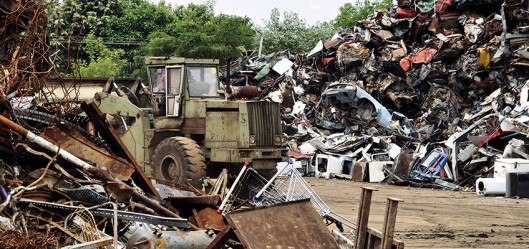
I saw that everything that man makes becomes scrap metal: bicycle, plane, automobile. What doesn’t become scrap is only bird, tree, frog, stone. Even a spaceship becomes scrap metal. Now I think a white swamp heron is more beautiful than a spaceship. I beg your pardon for committing this truth.

Great uses for scrap metal
Photo Credit: Premier Metal Buyers

  Continue reading →

Planet Earth: Our Home & Resting Place

28 Sunday Jan 2018

Posted by Rosaliene Bacchus in Nature and the Environment, Poetry by Rosaliene Bacchus

≈ 47 Comments

Tags

Doomsday Clock, Mother Earth Gaia, Planet Earth, Saving our Home Planet, The Overview Effect

View of Earth from Space - NASA

View of Earth by the Apollo 17 Crew while traveling to the Moon on December 7, 1972
Photo Credit: NASA


Planet Earth
Mother Gaia to the Ancient Greeks
goddess and primordial power
to emerge after Chaos

Spinning and hurtling through space
at about 66,600 miles per hour
always in motion
trapped in orbit around the Sun

Earth your home and mine
no escape
gravity holds us all hostage
except for

Astronauts and cosmonauts
in their rocket ships
a privileged few
to view Earth from space
a tiny, fragile, blue ball of life
with a paper-thin shield
hanging in the void
exposed & vulnerable to

Solar flares and radiation
reflected and absorbed by a 300-mile-thick atmosphere
holding the life-giving air we breathe
a ticking time-bomb with rising carbon dioxide levels
as of January 25, 2018
the Doomsday Clock moved to two minutes to midnight
a notch closer to the end of humanity
from looming threats of climate change and nuclear war

Doomsday Clock updated to two minutes to midnight - 25 January 2018

Doomsday Clock updated to two minutes to midnight – January 25, 2018
Updated yearly by the Bulletin of the Atomic Scientists since its creation in 1947
Photo Credit: Science Magazine


Spaceship Earth
one living, breathing organism
with one destiny
the “overview effect” causes
a cognitive shift of self-awareness
as part of the larger whole 

Mother Earth Gaia
our home and final resting place
if we the people of Earth don’t take care of her
if we don’t set aside our differences
and work together
who else will

Watch the Video: The Overview Effect

Climate Science Special Report

21 Sunday Jan 2018

Posted by Rosaliene Bacchus in Anthropogenic Climate Disruption, United States

≈ 68 Comments

Tags

Climate Change, Climate Science Special Report November 2017 (CSSR), Global warming, U.S. Global Change Research Program

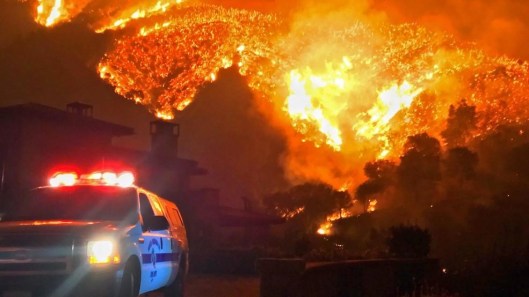
Thomas Fire - Santa Barbara County - Southern California - 12 December 2017

Thomas Fire – Santa Barbara County – Southern California – December 12, 2017
Photo Credit: Mike Eliason/Santa Barbara County Fire Department


Here in California, after years of drought, ferocious wildfires have consumed the tinder and everything in their path. Ignited on December 4, 2017, the Thomas Fire was not fully contained until January 12, 2018. Now ranked as the largest fire in California’s modern history, it burned about 281,900 acres, equivalent to the size of Dallas and Miami combined. It destroyed 1,063 structures and damaged another 280.

Torrential rainfall on January 9, a welcome respite for firefighters, brought more distress to residents in the area. Mudslides roared down fire scarred slopes, destroying and damaging hundreds of homes, as well as commercial property. Twenty people lost their lives; three are still missing.

A home on Glen Oaks Road damaged by mudslides in Montecito

Home damaged by mudslides – Montecido – Santa Barbara County – Southern California
January 10, 2018
Photo Credit: Kenneth Song/Santa Barbara News


Meanwhile, extreme winter weather on America’s East Coast provides vindication for climate change deniers. But, as world-renowned climate scientist Dr. Michael Mann explains, this is “an example of precisely the sort of extreme winter weather we expect because of climate change.” What’s happening is the collision of increasingly warm Atlantic Ocean waters with cold Arctic air masses. To make matters worse, the warmer oceans also mean more moisture in the atmosphere to fuel the storm and produce larger snowfalls.

Woman walks down street in East Boston - Massachusetts - 4 January 2018

Woman walks down street in East Boston – Massachusetts – January 4, 2018
Photo Credit: Michael Dwyer/AP


In November 2017, the U.S. Global Change Research Program released its 477-page Climate Science Special Report (CSSR), in compliance with regulations issued by the Department of Commerce/National Oceanic and Atmospheric Administration (NOAA). The CSSR is “designed to be an authoritative assessment of the science of climate change, with a focus on the United States, to serve as the foundation for efforts to assess climate-related risks and inform decision making about responses.”

Continue reading →

I come from a “shit-hole”

14 Sunday Jan 2018

Posted by Rosaliene Bacchus in People, Social Injustice, United States

≈ 87 Comments

Tags

El Salvador, Haiti, Immigrants in America, Javier Zamora, Koyote the Blind, Temporary Protected Status (TPS)

Wahoo Bay Beach - Haiti
Wahoo Bay Beach – Haiti


It is so easy to disparage others when we are in a privileged position of wealth and power. In such positions, we can lose touch with our shared fragility as human beings. We can forget that the labor of millions of invisible human beings sustains our lives. Immersed in our comforts and luxuries, we can believe we belong to an invincible special breed.

In October 2017, I featured the work of the young immigrant Salvadoran poet, Javier Zamora, who holds a Temporary Protected Status (TPS) now up for review by our Congress. Following that post, another Salvadoran immigrant, who blogs under the name Koyote the Blind, started following my blog. Our president’s disparaging remarks about his country has struck a deep wound.

Ruins of Tazumal - El Salvador
Ruins of Tazumal – pre-Columbian Mayan archeological site in Chalchuapa – El Salvador


In his blog post, “I come from a shit-hole,” on Thursday, January 11, he wrote:

I am Salvadoran, even if the term was imposed by Spain. I am American, even if the US thinks they own the name. I am güanaco, even if you think it’s an insult.

I am not Mexican. Mexicans call me “cerote”–a piece of turd.

Today, Trump agreed with them. Today, he said he didn’t understand why liberals want to bring people from those shit-hole countries.

I am a piece of turd from a shit-hole country in the backyard of Ronald Reagan.

Yet, I am here. And I come from the Land of the Jewel, Cuzcatlan, the last bastion of resistance.

I am here to stay, and to change this land, this entire continent, into what it truly is: the mother land in the process of awakening.

You may see in me a turd from a shit-hole country, but I see in you and me and all the true silver light of the empty mind, the freedom from the past, the glory of the New Sun that heralds the coming of the True Human Being. I am here to share that future with you, my reader, without hatred in my heart, without resentment, and without any names to hurl back at you.

You can read his complete post here.

Whether we live on the African continent, El Salvador, Haiti, Norway, or the United States of America, we are all human beings with short life spans in the grand scheme of death and rebirth of interconnected cycles of life on Planet Earth. What makes our insignificant lives meaningful is not our material trappings, but rather the way in which we touch the lives of others we meet along our journey. The greater our influence and power, the greater our responsibility to do good in the world.

Our Gods of War

07 Sunday Jan 2018

Posted by Rosaliene Bacchus in United States

≈ 41 Comments

Tags

Costs of America’s endless wars, Costs of War Project, Costs of War Project Map of USA Counterterror War Locations 2015-2017, Tom Engelhardt of TomDispatchdotcom, USA War of Terror, Watson Institute for International and Public Affairs

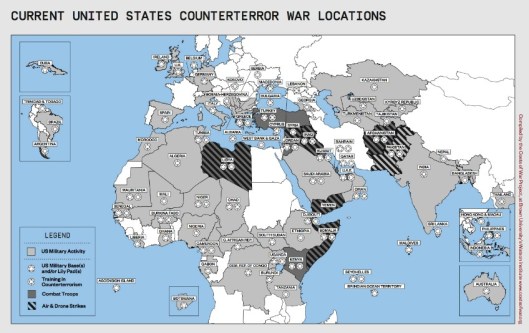
Costs of War Project Map of USA Counterterror War Locations 2015-2017

Costs of War Project Map of USA Counterterror War Locations 2015-2017
Prepared by: Watson Institute for International and Public Affairs – Brown University


In his article “Mapping a World From Hell,” published on January 4, Tom Engelhardt presents a unique map produced by Costs of War Project at Brown University’s Watson Institute for International and Public Affairs. After more than 16 years since the United States embarked on its war on terror that has transformed entire countries into hell on Earth, we finally have a visual representation of the true extent of our never-ending wars.

After first targeting Afghanistan in pursuit of Osama bin Laden’s al-Qaeda terrorist group back in October 2001, as retribution for the group’s 9/11 attack on the World Trade Center, our nation is now militarily engaged in some form in 76 countries. That’s 39 percent of the world’s nations, as indicated in the captioned map.

In places like Afghanistan, Iraq, Libya, Pakistan, Somalia, Syria, and Yemen, U.S. drone or other air strikes are the norm and U.S. ground troops (often Special Operations forces) have been either directly or indirectly engaged in combat. In these and several other countries, American advisers are also training local militaries or militias in counterterror tactics.

The number of U.S. military bases and “lily pads” (small, cooperative security locations) is also impressive. In 2017 alone, the USA deployed American Special Operations forces to 149 countries. We have so many troops on so many bases in so many places worldwide that the Pentagon has trouble keeping track of all of them.

While our gods of war reap the profits and spoils of warmongering, we the American people must pay the bill. In a separate study, released in November 2017, the Costs of War Project estimated a price tag that had already reached $5.6 trillion. That’s more than enough money to put millions of Americans to work again in rebuilding our crumbling infrastructure.

In the gods of war, we trust. In defense of our nation, we must rain down terror on our enemies. It matters not that our endless wars have created more terrorists and enemies. Next in line to suffer our fire and fury—North Korea. To follow: Iran, Russia, and China. World without end. Amen. 

Read more details at Mapping a World From Hell: 76 Countries Are Now Involved in Washington’s War on Terror


What is God?

30 Saturday Dec 2017

Posted by Rosaliene Bacchus in Religion

≈ 37 Comments

Tags

A human history of God, Canaanite god El, God is All of Sufism, God the Trinity of Christianity, Islamic Sufism, Pantheism, Prophet Muhammad, Reza Aslan, The humanized god, Yahweh the One God of Judaism

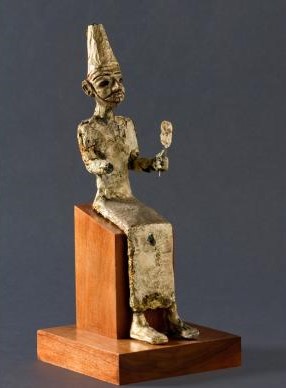
Seated statue of El
Seated statue of El from Megiddo (1400-1200 BCE)
Photo Credit: Oriental Institute of the University of Chicago


The final post of my three-part series covers “Part Three: What is God?” of Reza Aslan’s book, God: A Human History. The author traces the evolution of the nature of God from God is one, to God is three, and later to God is all.

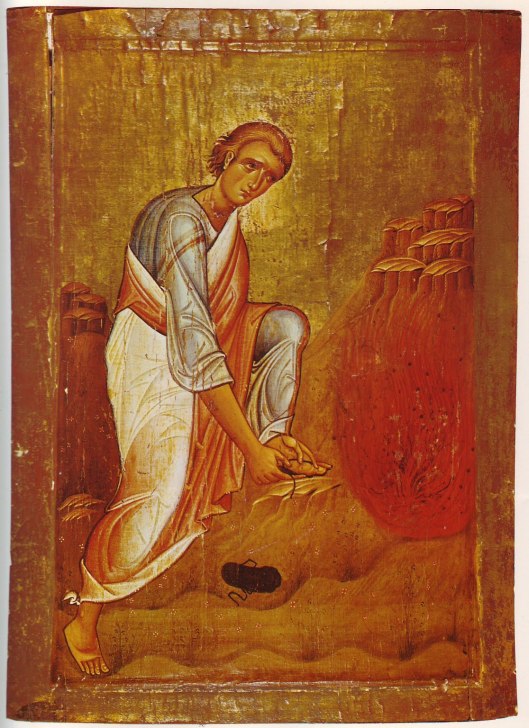
The ancient Israelites worshiped the Canaanite god El as their chief god presiding over a pantheon of lesser gods. The very word Israel means “El perseveres.” The god who became known as Yahweh first appeared to Moses in the form of a burning bush. Around 1050 BCE when they established the Kingdom of Israel, Yahweh became their patron God. In the capital, Jerusalem, they built a temple to house the Ark of the Covenant, Moses’s covenant with Yahweh: the highest and strongest god over all other gods.

Moses and the Burning Bush
Moses and the Burning Bush – Saint Catherine’s Monastery, Sinai, Egypt
Photo Credit: Wikimedia Commons


In 586 BCE, the Babylonian King Nebuchadnezzar II breached the walls of Jerusalem, plundered the capital, and burned the temple to the ground. Survivors suffered a humiliating exile in Babylonia. That the Babylonian god, Marduk, was more powerful than Yahweh caused an identity crisis. Rather than accept the possibility of a defeated god, Israelite religious leaders rationalized that Yahweh was the one and only god who created light and darkness, brought peace, and created evil.

Yahweh of Judaism became the singular, eternal, and indivisible God who exhibits both the good and bad of human emotions and qualities. Continue reading →

The Humanized God

17 Sunday Dec 2017

Posted by Rosaliene Bacchus in Religion

≈ 28 Comments

Tags

A human history of God, Gobekli Tepe (Potbellied Hill), Greek pantheon of gods, Mesopotamia, Reza Aslan, Sumerians, The humanized god, Zarathustra or Zoroaster

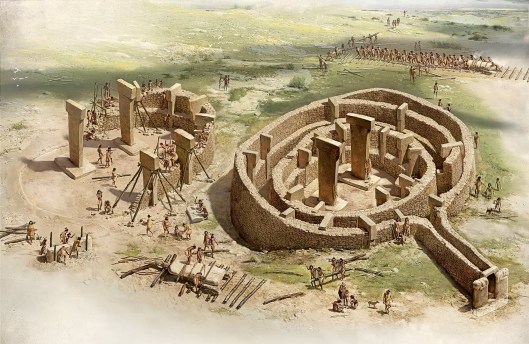
Gobekli Tepe - Artist's rendition of construction

Artist’s rendition of the construction of Gobekli Tepe (c. 12,500 to 10,000 B.C.E)
By Fernando G. Baptista/National Geographic Creative
Photo Credit: National Geographic Magazine


The second of my three-part series covers “Part Two: The Humanized God” of Reza Aslan’s book, God: A Human History. The author traces the development of organized religion with its pantheon of humanized gods from its birthplace in the Ancient Near East to Egypt, Greece, and Iran.

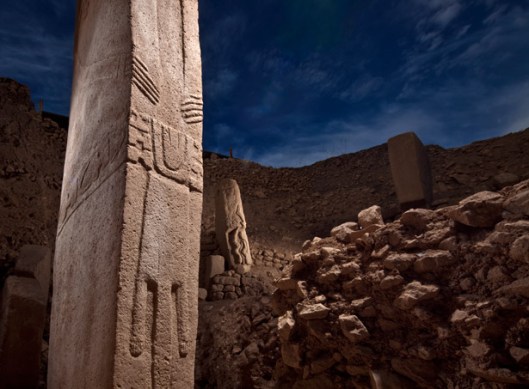
For almost two and a half million years, we were hunters-gatherers. Then, some 12,000 to 10,000 years ago, we settled down, built villages, and began growing our own food and rearing animals. The discovery of the temple at Gobekli Tepe (Potbellied Hill) in eastern Turkey, widely recognized as the earliest religious temple, suggests that the birth of organized religion may have precipitated this dramatic shift. Based on archeological records, we know that the first domesticated animals appeared in this region around the same time the temple was under construction. What better way to feed a large workforce over several years?

Gobekli Tepe - T-shaped pillar with human hands and belt

T-shaped pillar at Gobekli Tepe with human hands and belt (c. 12,500 to 10,000 B.C.E.)
By Vincent J. Musi/National Geographic Creative
Photo Credit: National Geographic Magazine

Continue reading →

The Embodied Soul

10 Sunday Dec 2017

Posted by Rosaliene Bacchus in Religion

≈ 54 Comments

Tags

A human history of God, “The Sorcerer” cave drawing, Cave of the Trois-Frères/France, Origin of belief in the soul, Origin of the religious impulse, Reza Aslan, The embodied soul

ImageJ=1.31o min=0.0 max=65535.0

On September 11, 2001, a group of Islamic extremists struck America’s major financial center in New York. Since then, we have embarked on a “War on Terror” that has morphed into an assault on all Muslims, except for allied Muslim nations. This past week, our endless war of terror has pivoted to Jerusalem, the holy city of three of the world’s major religions by number of followers (World Atlas) – Christianity (2.22 billion), Islam (1.6 billion), and Judaism (13.9 million).

Within this context, I share with you in the first of a three-part series my synopsis of Reza Aslan’s book, God: A Human History. Like the author, I have “no interest in trying to prove the existence or nonexistence of God for the simple reason that no proof exists either way.” Whether you believe in one God or many gods or no god at all, I would like you to consider Aslan’s bold assertion that “it is we who have fashioned God in our image, not the other way around.”

In “Part One: The Embodied Soul,” Aslan investigates the origin of our belief in a soul, a byword for “spiritual essence” or “mind.” It’s a journey back in time to the emergence of our primitive ancestors, Homo sapiens (the wise human) – the “historical” Adam and Eve. According to archaeological records, Homo sapiens first appeared during the Lower Paleolithic Period, between 2.5 million and 200,000 years ago. Remains unearthed in burial mounds indicate that they buried their dead together with artifacts that must have been precious to them. Continue reading →

← Older posts
Newer posts →

Subscribe

  • RSS - Posts
  • RSS - Comments

Archives

  • March 2026
  • February 2026
  • January 2026
  • November 2025
  • October 2025
  • September 2025
  • August 2025
  • July 2025
  • June 2025
  • May 2025
  • April 2025
  • March 2025
  • February 2025
  • January 2025
  • December 2024
  • November 2024
  • October 2024
  • September 2024
  • August 2024
  • July 2024
  • June 2024
  • May 2024
  • April 2024
  • March 2024
  • February 2024
  • January 2024
  • December 2023
  • November 2023
  • October 2023
  • September 2023
  • August 2023
  • July 2023
  • June 2023
  • May 2023
  • April 2023
  • March 2023
  • February 2023
  • January 2023
  • December 2022
  • November 2022
  • October 2022
  • September 2022
  • August 2022
  • July 2022
  • June 2022
  • May 2022
  • April 2022
  • March 2022
  • February 2022
  • January 2022
  • December 2021
  • November 2021
  • October 2021
  • September 2021
  • August 2021
  • July 2021
  • June 2021
  • May 2021
  • April 2021
  • March 2021
  • February 2021
  • January 2021
  • December 2020
  • November 2020
  • October 2020
  • September 2020
  • August 2020
  • July 2020
  • June 2020
  • May 2020
  • April 2020
  • March 2020
  • February 2020
  • January 2020
  • December 2019
  • November 2019
  • October 2019
  • September 2019
  • August 2019
  • July 2019
  • June 2019
  • May 2019
  • March 2019
  • February 2019
  • January 2019
  • December 2018
  • November 2018
  • October 2018
  • September 2018
  • August 2018
  • July 2018
  • June 2018
  • May 2018
  • April 2018
  • March 2018
  • February 2018
  • January 2018
  • December 2017
  • November 2017
  • October 2017
  • September 2017
  • August 2017
  • July 2017
  • June 2017
  • May 2017
  • April 2017
  • March 2017
  • February 2017
  • January 2017
  • December 2016
  • November 2016
  • October 2016
  • September 2016
  • August 2016
  • July 2016
  • June 2016
  • May 2016
  • April 2016
  • March 2016
  • January 2016

Categories

  • About Me
  • Anthropogenic Climate Disruption
  • Brazil
  • Economy and Finance
  • Family Life
  • Festivals
  • Guyana
  • Health Issues
  • Human Behavior
  • Immigrants
  • Nature and the Environment
  • People
  • Philosophy
  • Poetry
  • Poetry by Rosaliene Bacchus
  • Recommended Reading
  • Relationships
  • Religion
  • Religion & Spirituality
  • Reviews – The Twisted Circle: A Novel by Rosaliene Bacchus
  • Reviews – Under the Tamarind Tree: A Novel by Rosaliene Bacchus
  • Save Our Children
  • Social Injustice
  • Technology
  • The Twisted Circle: A Novel by Rosaliene Bacchus
  • The Writer's Life
  • Uncategorized
  • Under the Tamarind Tree: A Novel by Rosaliene Bacchus
  • United States
  • Urban Violence
  • Women Issues
  • Working Life

Blogroll

  • Angela Consolo Mankiewicz
  • Caribbean Book Blog
  • Dan McNay
  • Dr. Gerald Stein
  • Foreign Policy Association
  • Guyanese Online
  • Writer's Digest
  • WritersMarket: Where & How to Sell What You Write

Meta

  • Create account
  • Log in
  • Entries feed
  • Comments feed
  • WordPress.com

Enter your email address to subscribe to this blog and receive notifications of new posts by email.

Join 3,089 other subscribers

Create a free website or blog at WordPress.com.

Privacy & Cookies: This site uses cookies. By continuing to use this website, you agree to their use.
To find out more, including how to control cookies, see here: Cookie Policy
  • Subscribe Subscribed
    • Three Worlds One Vision
    • Join 3,089 other subscribers
    • Already have a WordPress.com account? Log in now.
    • Three Worlds One Vision
    • Subscribe Subscribed
    • Sign up
    • Log in
    • Report this content
    • View site in Reader
    • Manage subscriptions
    • Collapse this bar
 

Loading Comments...