
Tags
Behavioral Change, Extreme weather events, Indigenous knowledge and wisdom, Indigenous Voices, Listening to Mother Earth, Living from the Heart, The Changing Earth
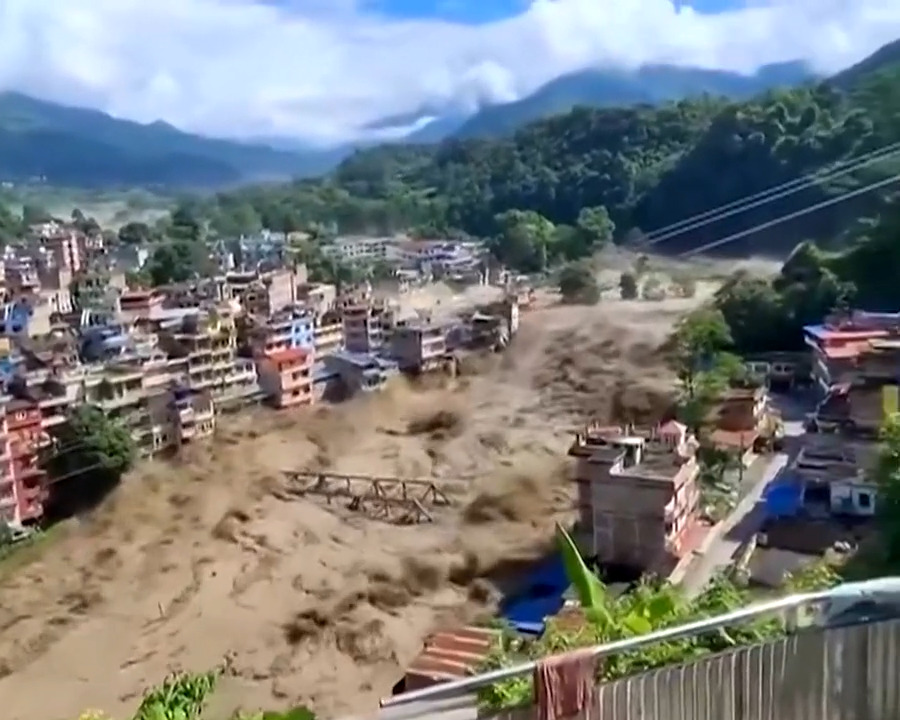
Nepal near Border with Tibet – August 26, 2026
See Videos and Learn More at The Guardian Online
This is the eight article in my series about our changing Earth from interviews with Native Americans shared in We Are the Middle of Forever: Indigenous Voices from Turtle Island on the Changing Earth, edited by Dahr Jamail and Stan Rushworth (USA 2022). My presentation does not follow the order of the interviews.
#8: Ilarion Merculieff (Unangan)
(Chapter 3, pp. 30-47)
Ilarion ‘Kuuyux’ Merculieff was born and raised on St. Paul Island in the Bering Sea, where his people the Unangan (Aleut)—the name means “the people of the sea”—have lived for more than ten thousand years. When he was four years old, he received his traditional name ‘Kuuyux’ from the previous Kuuyux, to become the carrier of ancient messages for his people into modern times. After living half of his life on the island, he now resides in Homer, Alaska, where he welcomed Dahr and Stan for their interview.
Ilarion is the founder and president of the Global Center for Leadership and Lifeways. He was the first Alaska Native commissioner of the Alaska Department of Commerce and Economic Development, a state cabinet position. He has given keynote addresses at the National Academy of Sciences Annual Meeting and the White House Conference on the Oceans. In 2009, he chaired the Indigenous Knowledge sessions of the Global Summit of Indigenous Peoples on Climate Change. Among his numerous awards is his lifetime achievement award for Environmental Excellence from the Alaska Forum on the Environment.
For more than five decades, Ilarion has worked with the traditional knowledge, wisdom, and spirituality he has received from the elders, and in sharing with culture bearers worldwide. He says of his traditional upbringing (p. 33): “[They were] very present in the moment and in the heart. Through that place of the heart, it tells the mind what to do, not the mind telling the heart what to do.” He adds that the great imbalance playing out across our planet stems from the fact that “We left our hearts. And when we left our hearts, we left ourselves.”
In 2017, the Sacred Fire Foundation gave him the Wisdom Fellowship Award for wisdom carriers and tradition bearers. That same year, he gathered thirteen Indigenous elders from around the world in Kauai (Hawaii) to discuss the state of Mother Earth and what humans should do now. After four days of ceremony, the elders said that we must let go of all our human attachments and go into the heart center, the center of the river of life (p. 36): “It knows where it is going and we don’t, and we need to find others who have done the same.”
Ilarion shares the message from the elders with Dahr and Stan regarding the gravity of the converging crises humanity now faces on our planet (pp. 36-37):
There’s very little time left. And that time is even shorter for human beings. Mother Earth, she has survived for billions of years. She’s going to survive for billions more. It’s a question about whether or not we, human beings, are going to survive during this time. And it’s going to be decided by those in this lifetime, who are alive today in the world.
The elders agreed for everything to be filmed, even the ceremonies. This is unprecedented. The 14-minute video, translated by volunteers into 15 different languages, was shared globally by Reuters News agency for the 50th anniversary of Earth Day on April 22, 2020. A link to the video is available on the website of the Wisdom Weavers of the World.
Ilarion adds that other Indigenous elders in Canada and from around the world share similar messages (pp 38-39):
People are reacting to situations around the world, be it corruption, violation of women, wars, murders, suicides, refugees…any of these issues. And the elders said that what you choose to focus on becomes your reality. So if you’re choosing to focus on stopping something, in reaction to what somebody else did, then what you’re doing is pouring your mental, physical, and spiritual energy into that. That makes that thing grow because your energy is going into it. And they said that instead, you must look at what world you want to see, not in reaction to anything. Just the world you want to see and to do that, you have to go to your heart.
Ilarion next shares his thoughts on the lessons of the global pandemic (p. 39):
With COVID-19, Mother Earth is speaking. She has been speaking a long time to Indigenous people and she’s crying for her Earth children. She’s trying to help us wake up, and since we haven’t listened, has introduced this virus. It comes from Mother Earth to teach us to slow down. We call it the Earth-based pace…. Going faster disconnects us from our relationship to Mother Earth. Another thing that it teaches is that we must take stock of what we have done.
Unfortunately, we’re not listening to Mother Earth. As a result, according to the elders, what’s to come will be much worse. The people best suited to deal with these challenging times, says one elder, are the people of the heart.
With the aim of bringing traditional knowledge and wisdom to modern society, Ilarion had immersed himself in Western science for thirty years. He was forced to admit that science lacks humility. He explains (p. 40):
Because of that, they [policy makers using only Western science] talk about incorporating traditional knowledge into Western science, and they don’t acknowledge the part wisdom plays. But when I met with the elders in Alaska about this, the Western system calls it subsistence, and they have all their laws about subsistence to govern us, and they said that is the wrong way to go.
Indigenous perspectives remain largely invisible to those in society who adhere to those of Western science. Such invisibility makes it difficult for them to have an input in decision making that affects their lives.
Ilarion believes that, after thousands of years of the Kuuyux tradition, he will be the last Kuuyux among the Unangan people. Many other Indigenous traditions that have messengers like him also share the same belief. He adds (p. 41):
Business as usual is not going to work. It’s not going to work. And we’re all scurrying around trying to maintain businesses as usual around the world, and these solutions are not going to work. We have got to change our consciousness, and we have got to change it now (emphasis mine).
When Dahr asks what he thinks prevents so much of Western society from listening with the heart, Ilarion says the answer is very simple. We’ve grown accustomed to living in noisy cities. We’re always on the go. We need to slow down to talk with Mother Earth.
Dahr wonders if some of this behavior is a symptom of people’s fears of really listening to the heart, and of living from their hearts. Ilarion agrees (p. 45):
Exactly. Everything is based on the fear of the unknown, and fear disappears when you are in the heart. The heart does not worry about what’s happening tomorrow or yesterday. It just is here, now. And that’s also why we invented time, when we separated from our hearts. Then we are consumed with time because we have guilt, fear, remorse, anger, rage, jealousy, all these things from the past that live with us today. Or fear, which is projection into the future of something that hasn’t happened. Every place except now.
As human beings, we do not have the luxury of time.
* * * * * *
I have slowed down since the global pandemic upended our lives in 2020-2022. The lessons learned of who and what are truly essential in my life have shaped a new awareness and consciousness. I listen to my heart more. I listen to Mother Earth. I listen to the pleas for justice from people worldwide. But this aching heart of mine is afraid. Fearful of the way we humans stumble forward like zombies into the gloom. As the thirteen Indigenous elders have warned us: We who are alive today decide the fate of the generations to come.
While the ‘One Without a Heart’ lives in an alternate reality, the real world slowly collapses around us. Catastrophes intensify and multiply. The melting glacier that collapsed on the Nepal-Tibet border (see captioned photo with link to article) is yet another warning from Mother Earth. Listen. Take heed.
Click on links below for previously featured interviews:
#1: Raquel Ramirez (Ho-Chunk, Ojibwe, Lenca) – Awareness
#2: Alexii Sigona (Amah Mutsun) – Stewardship
#3: Terri Delahanty (Cree) – Sacred Feminine and Sacred Masculine
#4: Shannon Rivers (Akimel O’otham) – Balance
#5: Lyla June Johnston (Diné [Navajo], Tsétsêhéstâhese [Cheyenne]) – Trust
#6: Dr. Kyle Powys Whyte (Potawatomi) – Kinship
#7: Marita Hacker (Hunkpapa, Norwegian) – Change
 Three Worlds One Vision
More profound natural wisdom. “We left our hearts. And when we left our hearts, we left ourselves.” and “We who are alive today decide the fate of the generations to come.” are such key points
LikeLike
Rosaliene, I am afraid that nowadays we have lost the capability to listen to our hearts! Many thanks for your words, which should wake us up.
LikeLike