
Tags
Behavioral Change, Extreme weather events, Indigenous knowledge and wisdom, Indigenous Voices, Listening to Mother Earth, Living from the Heart, The Changing Earth
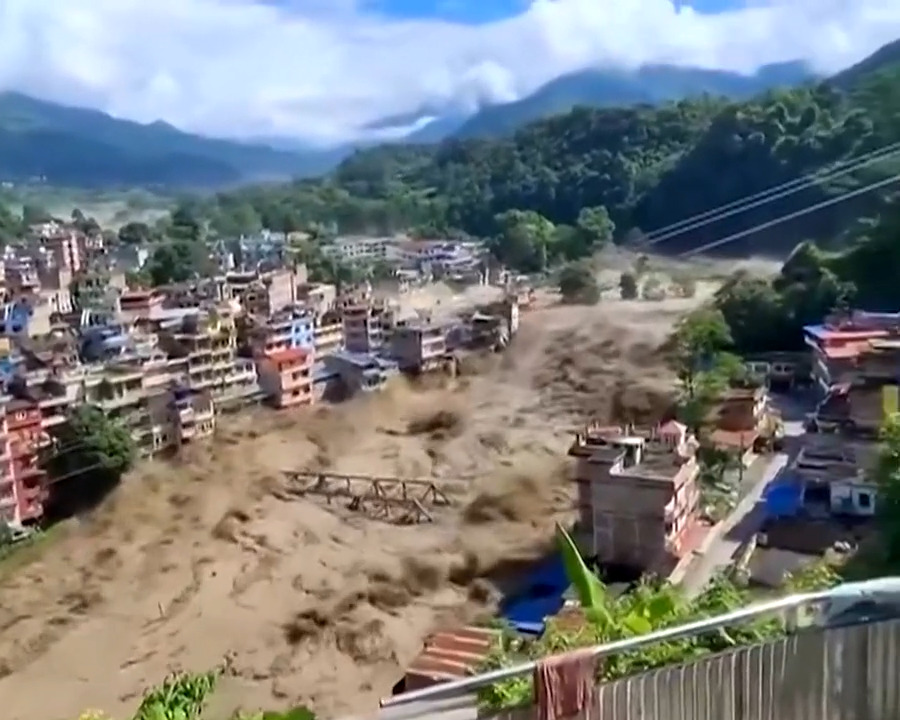
Nepal near Border with Tibet – August 26, 2026
See Videos and Learn More at The Guardian Online
This is the eight article in my series about our changing Earth from interviews with Native Americans shared in We Are the Middle of Forever: Indigenous Voices from Turtle Island on the Changing Earth, edited by Dahr Jamail and Stan Rushworth (USA 2022). My presentation does not follow the order of the interviews.
#8: Ilarion Merculieff (Unangan)
(Chapter 3, pp. 30-47)
Ilarion ‘Kuuyux’ Merculieff was born and raised on St. Paul Island in the Bering Sea, where his people the Unangan (Aleut)—the name means “the people of the sea”—have lived for more than ten thousand years. When he was four years old, he received his traditional name ‘Kuuyux’ from the previous Kuuyux, to become the carrier of ancient messages for his people into modern times. After living half of his life on the island, he now resides in Homer, Alaska, where he welcomed Dahr and Stan for their interview.
Ilarion is the founder and president of the Global Center for Leadership and Lifeways. He was the first Alaska Native commissioner of the Alaska Department of Commerce and Economic Development, a state cabinet position. He has given keynote addresses at the National Academy of Sciences Annual Meeting and the White House Conference on the Oceans. In 2009, he chaired the Indigenous Knowledge sessions of the Global Summit of Indigenous Peoples on Climate Change. Among his numerous awards is his lifetime achievement award for Environmental Excellence from the Alaska Forum on the Environment.
For more than five decades, Ilarion has worked with the traditional knowledge, wisdom, and spirituality he has received from the elders, and in sharing with culture bearers worldwide. He says of his traditional upbringing (p. 33): “[They were] very present in the moment and in the heart. Through that place of the heart, it tells the mind what to do, not the mind telling the heart what to do.” He adds that the great imbalance playing out across our planet stems from the fact that “We left our hearts. And when we left our hearts, we left ourselves.”
In 2017, the Sacred Fire Foundation gave him the Wisdom Fellowship Award for wisdom carriers and tradition bearers. That same year, he gathered thirteen Indigenous elders from around the world in Kauai (Hawaii) to discuss the state of Mother Earth and what humans should do now. After four days of ceremony, the elders said that we must let go of all our human attachments and go into the heart center, the center of the river of life (p. 36): “It knows where it is going and we don’t, and we need to find others who have done the same.”
Ilarion shares the message from the elders with Dahr and Stan regarding the gravity of the converging crises humanity now faces on our planet (pp. 36-37):
There’s very little time left. And that time is even shorter for human beings. Mother Earth, she has survived for billions of years. She’s going to survive for billions more. It’s a question about whether or not we, human beings, are going to survive during this time. And it’s going to be decided by those in this lifetime, who are alive today in the world.
The elders agreed for everything to be filmed, even the ceremonies. This is unprecedented. The 14-minute video, translated by volunteers into 15 different languages, was shared globally by Reuters News agency for the 50th anniversary of Earth Day on April 22, 2020. A link to the video is available on the website of the Wisdom Weavers of the World.
Ilarion adds that other Indigenous elders in Canada and from around the world share similar messages (pp 38-39):
People are reacting to situations around the world, be it corruption, violation of women, wars, murders, suicides, refugees…any of these issues. And the elders said that what you choose to focus on becomes your reality. So if you’re choosing to focus on stopping something, in reaction to what somebody else did, then what you’re doing is pouring your mental, physical, and spiritual energy into that. That makes that thing grow because your energy is going into it. And they said that instead, you must look at what world you want to see, not in reaction to anything. Just the world you want to see and to do that, you have to go to your heart.
Ilarion next shares his thoughts on the lessons of the global pandemic (p. 39):
With COVID-19, Mother Earth is speaking. She has been speaking a long time to Indigenous people and she’s crying for her Earth children. She’s trying to help us wake up, and since we haven’t listened, has introduced this virus. It comes from Mother Earth to teach us to slow down. We call it the Earth-based pace…. Going faster disconnects us from our relationship to Mother Earth. Another thing that it teaches is that we must take stock of what we have done.
Unfortunately, we’re not listening to Mother Earth. As a result, according to the elders, what’s to come will be much worse. The people best suited to deal with these challenging times, says one elder, are the people of the heart.
With the aim of bringing traditional knowledge and wisdom to modern society, Ilarion had immersed himself in Western science for thirty years. He was forced to admit that science lacks humility. He explains (p. 40):
Because of that, they [policy makers using only Western science] talk about incorporating traditional knowledge into Western science, and they don’t acknowledge the part wisdom plays. But when I met with the elders in Alaska about this, the Western system calls it subsistence, and they have all their laws about subsistence to govern us, and they said that is the wrong way to go.
Indigenous perspectives remain largely invisible to those in society who adhere to those of Western science. Such invisibility makes it difficult for them to have an input in decision making that affects their lives.
Ilarion believes that, after thousands of years of the Kuuyux tradition, he will be the last Kuuyux among the Unangan people. Many other Indigenous traditions that have messengers like him also share the same belief. He adds (p. 41):
Business as usual is not going to work. It’s not going to work. And we’re all scurrying around trying to maintain businesses as usual around the world, and these solutions are not going to work. We have got to change our consciousness, and we have got to change it now (emphasis mine).
When Dahr asks what he thinks prevents so much of Western society from listening with the heart, Ilarion says the answer is very simple. We’ve grown accustomed to living in noisy cities. We’re always on the go. We need to slow down to talk with Mother Earth.
Dahr wonders if some of this behavior is a symptom of people’s fears of really listening to the heart, and of living from their hearts. Ilarion agrees (p. 45):
Exactly. Everything is based on the fear of the unknown, and fear disappears when you are in the heart. The heart does not worry about what’s happening tomorrow or yesterday. It just is here, now. And that’s also why we invented time, when we separated from our hearts. Then we are consumed with time because we have guilt, fear, remorse, anger, rage, jealousy, all these things from the past that live with us today. Or fear, which is projection into the future of something that hasn’t happened. Every place except now.
As human beings, we do not have the luxury of time.
* * * * * *
I have slowed down since the global pandemic upended our lives in 2020-2022. The lessons learned of who and what are truly essential in my life have shaped a new awareness and consciousness. I listen to my heart more. I listen to Mother Earth. I listen to the pleas for justice from people worldwide. But this aching heart of mine is afraid. Fearful of the way we humans stumble forward like zombies into the gloom. As the thirteen Indigenous elders have warned us: We who are alive today decide the fate of the generations to come.
While the ‘One Without a Heart’ lives in an alternate reality, the real world slowly collapses around us. Catastrophes intensify and multiply. The melting glacier that collapsed on the Nepal-Tibet border (see captioned photo with link to article) is yet another warning from Mother Earth. Listen. Take heed.
Click on links below for previously featured interviews:
#1: Raquel Ramirez (Ho-Chunk, Ojibwe, Lenca) – Awareness
#2: Alexii Sigona (Amah Mutsun) – Stewardship
#3: Terri Delahanty (Cree) – Sacred Feminine and Sacred Masculine
#4: Shannon Rivers (Akimel O’otham) – Balance
#5: Lyla June Johnston (Diné [Navajo], Tsétsêhéstâhese [Cheyenne]) – Trust
#6: Dr. Kyle Powys Whyte (Potawatomi) – Kinship
#7: Marita Hacker (Hunkpapa, Norwegian) – Change


More profound natural wisdom. “We left our hearts. And when we left our hearts, we left ourselves.” and “We who are alive today decide the fate of the generations to come.” are such key points
LikeLiked by 3 people
Derrick, I believe that future generations will curse/condemn those of us living today for our lack of courage to do what was needed.
LikeLiked by 1 person
Rosaliene, I am afraid that nowadays we have lost the capability to listen to our hearts! Many thanks for your words, which should wake us up.
LikeLiked by 2 people
Tragically true, Martina.
LikeLiked by 1 person
Dear Rosaliene,
Thank you for bringing Ilarion Merculieff’s timeless words into focus. This reading is not merely an article; it is a profound resonance for our hurried age.
What deeply strikes me in Kuuyux’s message is the diagnosis of our modern condition: we lost our way when we separated the mind from the heart, substituting the quiet depth of presence with the artificial linear rhythm of time. When we live solely in memory or anticipation, fear fills the void. Yet, as he reminds us, the heart knows only the infinite now.
True wisdom requires the humility to slow down – to move at an Earth-based pace where genuine attention becomes possible again. In a world consumed by noise and superficial reactions, returning to the heart is not a retreat, but an act of quiet, uncompromising courage and fidelity.
Thank you for sharing these vital voices and for keeping this sacred sanctuary of thought open.
Light and warm blessings,
György Németh (szigetingy)
LikeLiked by 3 people
Well stated and summarized.
LikeLiked by 2 people
Thank you for taking the time to read and leave your kind note. I am glad these reflections echoed with you amidst the noise of our age. 🏛️📜
LikeLiked by 2 people
Gyorgy, thank you for so eloquently summarizing Kuuyux’s message. Light and warm blessings to you, too.
LikeLiked by 1 person
Dear Rosaliene,
Thank you for your warm words and for creating a sanctuary for such vital reflections. When timeless wisdom meets attentive reading, a quiet, shared understanding is born. Wishing you light and continued inspiration. 🏛️✨
LikeLiked by 1 person
Wishing you the same, Gyorgy.
LikeLiked by 1 person
Wise words from Ilarion “Kuuyux” Merculieff. Indigenous perspectives would certainly help as the self-destruction of humanity on Earth accelerates. Thanks for the post, Rosaliene.
LikeLiked by 2 people
My pleasure in sharing, Dave. For how long will we continue to rely solely on Western scientific knowledge that has led us to these converging crises?
LikeLiked by 1 person
Yes, Rosaliene, western scientific knowledge can lack some wisdom, be overrated, be too “status quo,” be too “corporatized,” etc.
LikeLiked by 1 person
I wish we could all agree on that.
LikeLiked by 1 person
Dear Rosaliene, thank you for this wonderful post! 🤗❤️🙇♂️
LikeLiked by 2 people
My pleasure in sharing, Ashley 🙂 ❤
LikeLiked by 1 person
Why is it that the richest people always ignore the smartest people and deny science, ethics and civility. The pursuit of money and stuff seems to mesmerize them all. I had hoped that humans would all pull together after Covid 19, but that did not happen. There were still the believers and the non believers. I have always said that God sits above with fingers poised over Control-Alt-Delete, ready to reboot the program as this version of the app has failed. Perhaps that is why God allowed us to invent A-I, the very thing that might ultimately destroy us all and rid the world of the human virus. Have a great Sunday Rosaliene. Allan
LikeLiked by 1 person
We have truly messed up, Allan. And now we’ve found yet another way to destroy our species.
LikeLiked by 1 person
A sobering read regarding this crucial time that will decide the future existence of humans. We have clearly lost our way. However, I don’t think we can afford to drop our opposition to the individuals and entities that do harm. Instead, we must continue to envision the world we want as we work to stop those harms. Either way, thank you for this series, Rosaliene.
LikeLiked by 1 person
Tracy, I’m glad you raised the point about dropping our opposition. That also struck me and brought to mind Lao-tzu’s advice in Chapter 60 of the Tao Te Ching: Give evil nothing to oppose / and it will disappear by itself.
I’ve been pondering these words of late. From my observations in life and from the historical record, evil doesn’t simply disappear, it also destroys itself. I believe the key is the kind of opposition; the kind that defangs the monster through a change in one’s behavior.
LikeLiked by 1 person
I was not familiar with this thought and am going to think on that some more. I appreciate you offering new ideas and perspectives, Rosaliene.
LikeLiked by 1 person
Tracy, our foes are formidable. But they know that they are not invincible. (More about this in a future post.) Take heart ❤
LikeLiked by 1 person
Thank you for sharing and opening your heart Rosaliene. May more of us open our hearts and listen to the wisdom of earth and indigenous people like Ilarion. Things are dire, but as he said, we must not live from past or future, but rooted in heart centered presence.
LikeLiked by 2 people
My pleasure in sharing, Brad. I recall the time in Brazil when my heart centered presence in dealing with two powerful opponents, in the firm where I worked at the time, led to their dismissal. It turned out that they were embezzling the firm.
LikeLiked by 2 people
Kudos on being able to trust yourself and hold that space in a challenging environment.
LikeLiked by 1 person
Thanks, Brad. Those were very challenging times for me as a professional.
LikeLiked by 1 person
Thanks for sharing these wise words Rosaliene. After this summer of catastrophes, and the message still hasn’t gotten out, what will it take? The Nepal floods really hit me personally. We used that border crossing roughly 8 years ago. To see the wall of water crashing down was horrifying. Maggie
LikeLiked by 2 people
You’re welcome, Maggie. The video of people fleeing the giant wall of water looked so unreal, like a movie clip. It was indeed horrifying to realize that real people, seen running in the video clip, lost their lives in that moment. Many of them were tourists, just as you were years ago. Glacial collapse in the Himalayas is now a real danger to consider when planning one’s adventure trip to the region.
LikeLiked by 1 person
SOS!!!!
LikeLiked by 1 person
I know the feeling, Neil. I look at the little ones today and wonder if they will be prepared for what awaits them.
LikeLiked by 1 person
Thanks for sharing more indigenous wisdom, Rosaliene. It’s so hard not to be cynical these days. To even think we have hearts gives me some hope. Maybe if the ecosystem can survive the crashing western empire, it will be much better off. I also say replacing oligarchs with elders might not be a bad idea. In any case, the planet will go on, with or without us.
LikeLiked by 1 person
My pleasure in sharing, Mara. It’s my hope that we would learn to be less cynical about the heartless oligarchs governing our country. We do have lots of elders in our government, but few of them have any heart or wisdom to guide us through these dark days.
LikeLiked by 1 person
Your message and that of the Native Americans is essential to helping us take the time to address and listen to the planet. It is a shame and a tragedy that the Native Americans have been so easily and repeatedly dismissed.
The white men fail to remove their blinders. The reminder to look forward and take on what can be done is essential. Thank you, Rosalie.
LikeLiked by 1 person
A shame and tragedy indeed, Dr. Stein. We have so much to learn from peoples who have populated this planet for far longer than Western civilizations.
LikeLiked by 1 person
Such a sad and difficult time we are in the midst of. There is such need to focus on the heart, and I believe to make a start by deciding what each of us could actually do to make the world better, even if in a small way ( a la the prayer or Bishop Romero).
It gets more and more difficult to organize a helpful and positive activity for the day, as each morning brings yet more unbelievable crazy news.
Thanks for sharing these important posts!
LikeLiked by 1 person
Julie, it is indeed a sad and difficult time. Don’t let the craziness prevent you from organizing daily positive activities. They matter even more now.
LikeLiked by 1 person
The world feels so off kilter at the moment… here in Australia we have politicians referring to the indigenous First Nations People as ‘primitives’ then back peddling with lame apologies… I’m so sad that a group of people 60,000 years old is seen as anything other than mighty. sigh. Beautiful post as always, and lots to think about. Linda xx
LikeLiked by 1 person
Linda, thanks for reading and sharing news about the treatment of Australia’s First Nations People. What shortsightedness in deeming as primitive sixty thousand years of wisdom and intimate knowledge of living in harmony with Mother Earth!
LikeLiked by 1 person
It’s the mindset of the colonizer. As a descendant, I have to tread carefully, because I can’t fully understand the perspective of our First people, but I can certainly understand just how back to front the label / thinking is. Meanwhile, I’m trying my best to learn how to be a better custodian of Nature…
LikeLiked by 1 person
Linda, since Earth is our home, it’s up to each one of us to do the best we can to conserve, preserve, and protect her natural ecosystems upon which our lives depend.
LikeLiked by 1 person
Agreed – thank you for being you xx
LikeLiked by 1 person
🙂 ❤
LikeLiked by 1 person
I just watched the videos from the Guardian article of the flash flood in Nepal and thought how they reminded me of the many disaster movies that have been so captivating. I’ve been guilty of getting caught up in watching some of those dramas but have been steering myself away from them lately because I completely agree that “you must look at what world you want to see, not in reaction to anything (like fear). Just the world you want to see and to do that, you have to go to your heart.” In my mind, I will look to a world where more and more of us go to our hearts for guidance and how to live our lives, a world where we respect and cherish Mother Earth. I know there is much work to do for humans to move closer to that world of heart. Thank you for sharing this wisdom, Rosaliene.
LikeLiked by 1 person
JoAnna, our disaster movies are fast becoming reality somewhere in our world. Building resilient communities is becoming more and more urgent. Now is the time to envisage what kind of community we want. One in which we “go to our hearts for guidance…[and] respect and cherish Mother Earth” works for me.
LikeLiked by 1 person
Thank you for the reminder about building resilient communities. That is definitely something we can all work on.
LikeLiked by 1 person
I share your concern, Rosaliene. People are losing sight of what’s happening to the environment, and, like you said, they seem like zombies going through the motions. I was reading an article the other day about homeowners getting angry because they are losing their beach properties to erosion. They are mad at the government because they feel it isn’t doing enough to save their houses. They are also angry because they want the government to pay them to move their houses to another location. Currently, they have to pay out of pocket, and insurance only pays after the house is destroyed by the waves. There aren’t a lot of concerns about the environment or climate change, only the loss of property.
Coming from Puerto Rico and knowing how devastating hurricanes can be, I don’t understand how people keep building houses near the beaches, especially those who really want to be right next to the water. Like zombies, yes, you are absolutely right.
LikeLiked by 1 person
Edward, thanks for sharing the news report. There are lots of American homeowners who still believe that climate change is a hoax. Other homeowners believe that the risks caused by severe weather events are worth the prime beach locations. We want what we want. No matter the danger. Right now, here in California, there are upscale beachfront homes being destroyed by exceptionally high and powerful waves.
Who will pay for relocation to higher and safer ground? I imagine that will be determined by each county and state.
LikeLiked by 1 person
You’re welcome, Rosaliene. I agree that payment should come from within the state government, but then they would need to change the ordinance and prohibit any additional beachfront properties. I know that’s probably on the impossible side of things because, as you said, “We want what we want.” But, the government can’t afford to waste money, especially since I’m sure those properties are no longer benefiting the county or state now that the land is gone.
LikeLiked by 1 person
A time is soon coming when relocations will become a critical issue for all states with coastal properties.
LikeLiked by 1 person
That is true, even along rivers. There are areas around my city that get flooded pretty badly.
LikeLiked by 1 person
A time is coming when no place on Earth will be safe from some form of extreme weather.
LikeLiked by 1 person
Indeed, and this summer was brutal for Europe.
LikeLiked by 1 person
A moving post, Rosaliene, and very necessary given all the weather-related issues sweeping the globe. I appreciate the message you give in this post—humanity’s ecological and social crises arise from having “left our hearts.” Living from the heart—and slowing down enough to hear what the Earth is telling us—makes sense at every level of our lives: ecological & political, and also in society and among people in general. Beautifully expressed.
LikeLiked by 1 person
Thanks very much, Randall. I believe that a time is coming when we humans will embrace this wisdom shared by the elders of our Indigenous peoples worldwide.
LikeLike
What a huge responsibility for those alive today to decide the fate of future generations. The phrase “change our consciousness” seems key. It is not just what kind of energy we will use, it is the focus of our lives that must change.
LikeLiked by 1 person
It is indeed a huge responsibility, Rebecca. We are failing them. You’re right when you say that it’s not just the kind of energy we use. Changing the focus of our lives will not come easy within the current systems, established over centuries, for organizing our society, economy, and governance.
LikeLiked by 1 person
Yes, I think living according to the heart rather than the pocketbook will be part of that big change.
LikeLiked by 1 person
How shameful of the human race to cause so much destruction. This book sounds rich with profound guidance, Rosaliene. I was especially hit by this, “So if you’re choosing to focus on stopping something, in reaction to what somebody else did, then what you’re doing is pouring your mental, physical, and spiritual energy into that. That makes that thing grow because your energy is going into it. And they said that instead, you must look at what world you want to see, not in reaction to anything. Just the world you want to see and to do that, you have to go to your heart.“
You have a keen sense of what we would find helpful, my friend.
LikeLiked by 1 person
Thanks very much for your kind closing remark, Mary. I was also struck by the message you’ve cited from Indigenous elders worldwide. I believe that they have much wisdom to share with us as we humans struggle to find our footing on a changing planet. We Are the Middle of Forever is the kind of book one has to digest and reflect on, one chapter at a time.
LikeLiked by 1 person
Thank you, Rosaliene! Wisdom like this is a much-needed break from the cynicism.
LikeLiked by 1 person
Ravindra, it’s a joy to be able to share this wisdom.
LikeLike