
Tags
America’s Identity Crisis, Religion and Politics, The Christian Doctrine of Discovery 1493, The Hidden Roots of White Supremacy and the Path to a Shared American Future by Robert P Jones (USA 2023), White Christian Nationalism, White supremacy
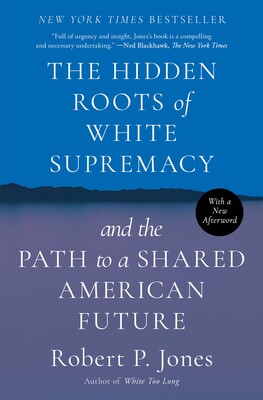
Photo Credit: Simon & Schuster
Every US state contains similar legacies of white racial violence because every US state was built on the same foundation, anchored by the Doctrine of Discovery: the conviction that America was divinely ordained to be a new promised land for European Christians. In each of the thirteen original colonies and in eight additional slave states, this deep founding myth justified the enslavement and exploitation of Africans in pursuit of white flourishing. In all, it justified the killing and dispossession of Native Americans and the claiming of their lands by good white Christian people, who alone possessed the virtues necessary for sustaining “civilization.”
[…]
The Christian Doctrine of Discovery continues to cast a long shadow across America. After more than five centuries, we collectively continue to refuse to answer, once and for all, the fundamental question: Is America a divinely ordained promised land for European Christians, or is America a pluralistic democracy? The coexistence of these contradictory traditions has created fractures in our nation’s foundation that weaken the integrity of our laws, our culture, and our politics…
Excerpts from The Hidden Roots of White Supremacy and the Path to a Shared American Future by Robert P. Jones, published by Simon & Schuster, New York, USA, 2023, pp. 258 & 311.
The Doctrine of Discovery, 1493
The Papal Bull “Inter Caetera,” issued by Pope Alexander VI on May 4, 1493, played a central role in the Spanish conquest of the New World. The document supported Spain’s strategy to ensure its exclusive right to the lands discovered by Columbus the previous year. It established a demarcation line one hundred leagues west of the Azores and Cape Verde Islands and assigned Spain the exclusive right to acquire territorial possessions and to trade in all lands west of that line. All others were forbidden to approach the lands west of the line without special license from the rulers of Spain. This effectively gave Spain a monopoly on the lands in the New World.
The Bull stated that any land not inhabited by Christians was available to be “discovered,” claimed, and exploited by Christian rulers and declared that “the Catholic faith and the Christian religion be exalted and be everywhere increased and spread, that the health of souls be cared for and that barbarous nations be overthrown and brought to the faith itself.” This “Doctrine of Discovery” became the basis of all European claims in the Americas as well as the foundation for the United States’ western expansion. In the US Supreme Court in the 1823 case Johnson v. McIntosh, Chief Justice John Marshall’s opinion in the unanimous decision held “that the principle of discovery gave European nations an absolute right to New World lands.” In essence, American Indians had only a right of occupancy, which could be abolished.
Read an excerpt of the English translation of the 1493 Papal Bull at The Gilder Lehrman Institute of American History.
Robert P. Jones, PhD is the president and founder of the Public Religion Research Institute (PRRI) and a leading scholar and commentator on religion and politics. He is the author of the New York Times bestseller The Hidden Roots of White Supremacy and the Path to a Shared American Future (USA, 2023), as well as White Too Long: The Legacy of White Supremacy in American Christianity, which won a 2021 American Book Award. He is also the author of The End of White Christian America, which won the 2019 Grawemeyer Award in Religion.
Jones writes a column on politics, culture, and religion for The Atlantic, Time, Religion News Service, and other media outlets. He is frequently featured in major national media, such as CNN, MSNBC, NPR, The New York Times, The Washington Post, and others. He holds a PhD in religion from Emory University and an MDiv from Southwestern Baptist Theological Seminary.


 Three Worlds One Vision