My Poetry Corner October 2019 features the poem “A Simple Man” by Ian McDonald from the joint poetry collection, People of Guyana, by Ian McDonald and Peter Jailall. Born in the Caribbean island of Trinidad in 1933, Ian McDonald is a poet, novelist, dramatist, and non-fiction writer. After moving to then British Guiana in 1955, he made his home there. Today, he lives partly in his adopted homeland and partly in Canada.
Born into a white family of power and privilege, the young Ian fell in love with literature and writing as a schoolboy. In 1955, after graduating from Cambridge University in England with a Bachelor’s Honors Degree in History, he began working with Bookers Ltd., then owners of the British Guiana sugar estates. When the company was nationalized in 1976, McDonald remained as the Administrative Director of the newly formed Guyana Sugar Corporation until his retirement in 1999.
On one of those days while working with Guyana’s sugar estates, McDonald visited Betty, a former sugarcane laborer, “an old woman in a run-down logie room,” to get details for her resettlement. In his heart-wrenching poem, “Betty,” the poet captures her long life of deprivation, forgotten by society.
she said her life was nothing to her she said all women’s lives were as nothing no one had been pleased when she was born she was sure of that boys were princes
Once married, she had been abandoned by her husband for another woman, eventually ending up “with old women in this place.” Betty didn’t want to move. They were the only people she knew. Continue reading →
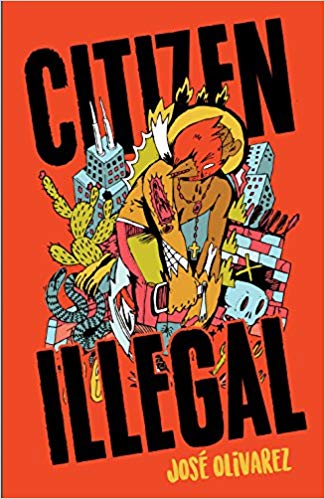
Front Cover: Poetry Collection, Citizen Illegal by José Olivarez
My Poetry Corner September 2019 features the poem “Mexican Heaven” from the poetry collection Citizen Illegal (Haymarket Books, 2018) by José Olivarez, a poet, teacher, and poetry slam performer. Born in Calumet City on the south side of Chicago, Illinois, he is the son of Mexican immigrants. Despite all the odds, he earned his Bachelor of Arts degree from Harvard University.
Olivarez’s first contact with poetry occurred through his high school’s poetry slam team. Their poetry had a profound impact on him. In a conversation with Jessica Hopper in July 2018, Olivarez said, “It made me feel like I could question more.” For the first time, he saw a way of becoming his true self, other than the reserved person everyone wanted him to be.
In his poem, “I Tried to Be a Good Mexican Son,” he shares his parents’ disappointment that he didn’t become a doctor, lawyer, or businessman.
I even went to college. But i studied African American studies which is not The Law or The Medicine or The Business. my mom still loved me. […] i tried to be a good Mexican son. Went to a good college & learned depression isn’t just for white people…Continue reading →
Caribbean immigrants remember loved ones at the 9/11 memorial on September 11, 2018
Photo Credit: News Americas
On September 11, we will remember all those we have lost on that ill-fated day when a terrorist attack on the World Trade Center in New York City turned the world-famous landmark into rubble.
I was living in Brazil when the tragedy occurred, sending a tsunami across the world. More than ninety other nations also lost loved ones that day, including three Brazilian-Americans and twenty-six Guyanese-Americans.
In his poem, “Guyanese Roll Call,” Guyanese-Canadian poet Peter Jailall remembers his twenty-six countrymen and women who died on that day. Their American Dream had been suddenly cut short.
Listen to our roll call
Of those who died
On that dreadful September day, Following their American Dream:
Patrick Adams Leslie Arnold Austin Rudy Bacchus Kris Romeo Bishundauth Pamela Boyce Annette Datarom Babita Guman Nizam Hafiz Ricknauth Jhagganauth Charles Gregory Jolin Bowanie Devi Kemraj Sarab Khan Amerdauth Luchman Shevonne Meutis Narendra Nath Marcus Neblett Hardai Parbhu Ameena Rasool Shiv Sankar Sita Sewnarine Karini Singh Rosham Singh Astrid Sohan Joyce Stanton Patricia Staton Vanava Thompson
These are our dedicated, Hard-working country people, Who travelled from South to North To savour just a small bite Of the Big Apple.
We will always remember them.
Source: Poetry Collection, People of Guyana by Ian McDonald and Peter Jailall, MiddleRoad Publishers, Canada, 2018.
While violent anti-immigrant activism spread across America, let us remember that Guyanese and other Caribbean immigrant families also share our nation’s grief for loved ones lost on September 11, 2001.
Peter Jailall is a teacher, poet, and storyteller. He has published five books of poetry. In 2011, he received the Marty’s Award for Established Literary Arts in Mississauga, Ontario, where he lives. Since his retirement, Jailall has conducted workshops on Poetry Writing in schools across Guyana and Canada.
My Poetry Corner August 2019 features the poem “Counter-narcissus” (Contranarciso) by Paulo Leminski (1944-1989), a Brazilian poet, translator, and biographer. He was born of humble origins in Curitiba, capital of the southern state of Paraná. His father was of Polish descent; his mother was a mixture of Portuguese, Black, and Native Indian. He publicly owned with pride, the derogatory labels of “polaco” and “negro mestiço.”
At the age of fourteen, with his parents’ approval, Paulo entered the Monastery of Saint Benedict in São Paulo. Within a year and a half, unable to cope with the disciplined lifestyle, he returned home. But his time spent among the monks wasn’t wasted. His studies exposed him to theology, philosophy, and Classical literature which demanded a knowledge of Latin and Greek. Later in life, Leminski applied the monks’ rigid and strenuous study routine to his work. Passionate about language, he became an autodidact polyglot fluent in six foreign languages.
Before the realization that poetry was his life, Paulo abandoned his undergraduate studies in literature and law after just a year, taught history and creative writing for a while, and later applied his writing skills as a journalist and advertising editor. Continue reading →
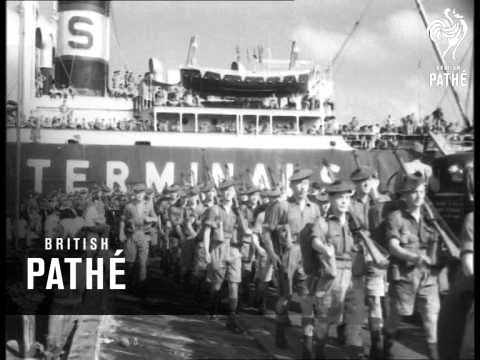
British soldiers arrive in Georgetown – British Guiana – October 9, 1953
Photo Credit: Stabroek News (Photo British Pathé)
My Poetry Corner July 2019 features the poem “This is the Dark Time My Love” by Guyanese poet Martin Carter (1927-1997) from his poetry collection, Poems of Resistance from British Guiana (London 1954). Following the suspension of the British Guiana Constitution in 1953, the poet-politician composed the poems in this collection during his three-month detention, together with other political leaders, by the British Army.
For readers unfamiliar with Guyana’s history, a former British colony until May 26, 1966, slavery ended in 1834. Indentured laborers began arriving from India in 1838 and continued until 1917. Other immigrant workers came from Portuguese Madeira (1835-1882) and China (1853-1879). The population of the colony in the mid-1950s was about 450,000 people (UN estimate).
Born in 1927 in Georgetown, the capital of then British Guiana, to middle class parents of African, Indian, and European ancestry, the young Martin grows up with an appreciation for literature, poetry, and philosophy. After attending the colony’s prestigious Queen’s College, for boys only, he gains entry to the civil service, working first at the post office, then later as the secretary of the superintendent of prisons.
Aware of the oppression and despair of the sugarcane workers who toil under harsh conditions on the British-owned sugar plantations, Carter joins the political struggle for self-governance. In “Looking at Your Hands” (1), he affirms his solidarity with the plantation workers in their shared struggle under British rule.
No!
I will not still my voice!
I have
too much to claim –
[…]
you must know I do not sleep to dream
but dream to change the world.Continue reading →
My Poetry Corner May 2019 features the poem “the woman is a construction” (a mulher é uma construção) from the poetry collection, a uterus is the size of a fist (um útero é do tamanho de um punho), by Angélica Freitas, a contemporary Brazilian poet and translator.
Born in Pelotas, Rio Grande do Sul, in 1973, the eldest of four siblings, Angélica Freitas began writing poetry at the age of nine, but her journey to finding herself as a poet took a long and circuitous route. Her discovery, at the age of fifteen, that she was gay made it difficult for her to fit in with her peers. Bullies found her an easy target. At nineteen, following her father’s death, she escaped to Glasgow with a Scottish girlfriend. After six months of washing dishes and cleaning restrooms, she returned to her family home.
Opting to study journalism at the Federal University of Rio Grande do Sul, Freitas moved to the capital, Porto Alegre, where she remained after graduation. There, she could be invisible. In her poem, “the pink book of the foolish heart,” she recalls:
I had a girlfriend
with super powers
of invisibility
and when I walked beside her
I was also invisible
In 2000, an unexpected acceptance as a trainee with OEstado de São Paulo newspapers led Freitas to the metropolis of São Paulo. She confesses that she wasn’t a good reporter, but that the experience exposed her to other realities of life. After four years of suffering to write with the rhythm of a daily newspapers, she left them for a slower paced work schedule at a telecommunications magazine. A career in journalism, she came to realize, wasn’t for her. What she desired above all was to write poetry.
Her life changed on a Saturday in 2005 when, during a period of depression, she decided to attend a poetry workshop conducted by Carlito Azevedo, a poet from Rio de Janeiro. Two years later, under his mentorship, she published her first collection of poetry. That same year, she moved to Argentina where she lived for two years with her girlfriend. For the first time, she became part of a feminist group. Living among them made her question her own condition as a woman. On her return to Brazil, she moved back to her hometown to work full-time as a poet and writer. Continue reading →
Front Cover: Fault Lines by Kendel Hippolyte Cover Art by Cecil Fevrier
My Poetry Corner April
2019 features the poem “Fault Lines” from the poetry collection, Fault Lines, by Kendel Hippolyte, a
poet, playwright, and director. Born in the Eastern Caribbean Island of St.
Lucia in 1952, he lived in Jamaica in the 1970s, where he explored his talents
in writing plays and poetry. After earning his bachelor’s degree in 1976 at the
University of the West Indies Mona campus, he returned to St. Lucia.
Four poetry collections have followed his first publication in 1980. Fault Lines – published by the UK publisher, Peepal Tree Press, in 2012 – won the 2013 OCM Bocas (Caribbean Literature) Prize for Poetry. In 2000, he was awarded the St. Lucia Medal of Merit for Contribution to the Arts.
Since retiring from teaching theater arts and literature at the Sir Arthur Lewis College (1992-2007), Hippolyte focuses on raising public awareness and contributing to solutions of critical social issues. A major Caribbean tourist destination, the island nation of an estimated 165,510 inhabitants (July 2018) is vulnerable to global capitalism and its ills of consumerism, drugs, crime, and violence.
Cruise ships at the Port of Castries – St. Lucia – Eastern Caribbean Photo Credit: St. Lucia Taxi & Tours
In his poem, “Paradise” (from the same collection), the poet laments in Caribbean English: “Every time this tourist ship name Paradise come dock in the harbor / you does realize we never going to make it.”
In “Fault Lines,” the collection’s titular poem, Hippolyte invites the reader to look beyond the natural beauty of the idyllic, island nation to the underlying fault lines that rupture its communities.
The lines appear on sidewalks and on streets just recently resurfaced,
on bridges and on buildings, the creases, cracks, accumulation;
the fractures of a thin, brittle civilization aging prematurely.
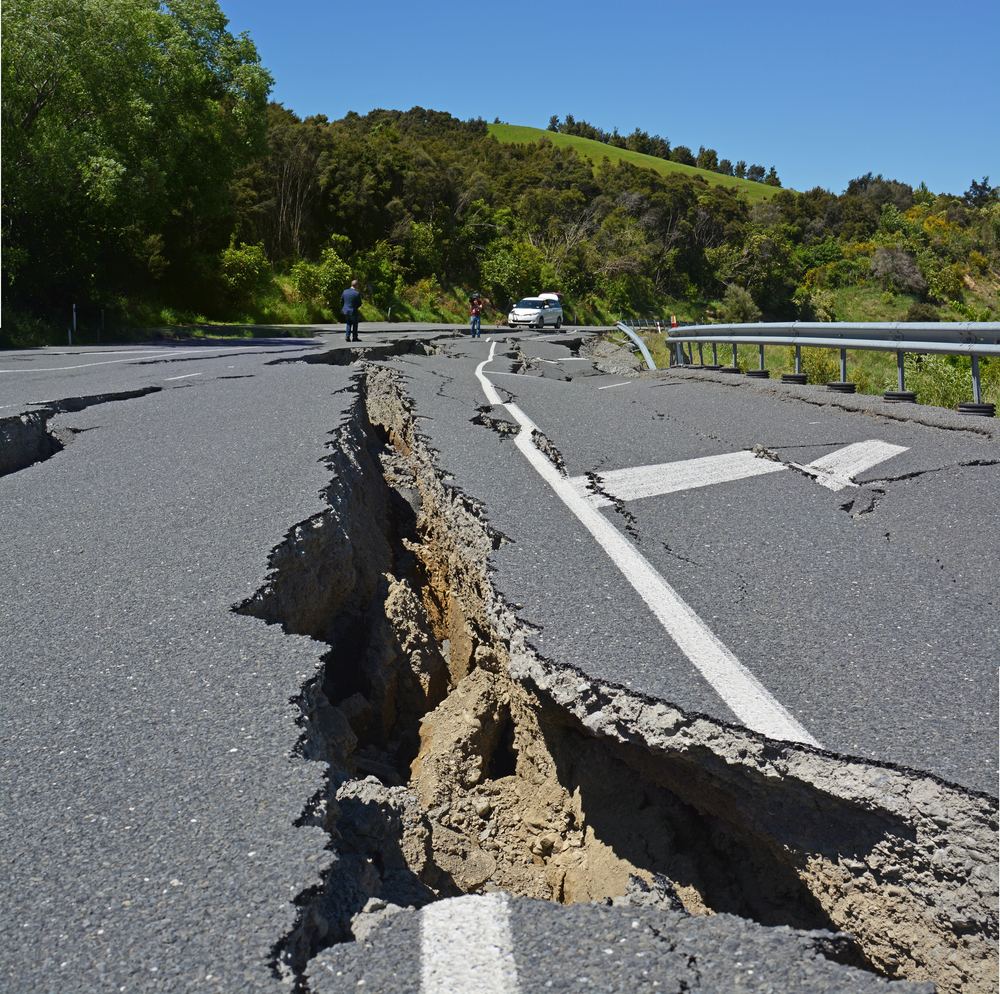
Earthquake rupture along freeway in Southern California – USA Photo Credit: HPCwire
For those of us who live along the geological fault lines on Earth’s surface, as in the Caribbean and in my home state of California, the fissures or cracks are warnings of mounting pressure beneath our feet. So, too, the fault lines that divide us. And there are many such lines, such as inequality and rising white nationalism.
The hand of something dying scrabbles these last messages everywhere,
a harsh cuneiform trying to break through surfaces into our understanding.
But we can barely read that ancient language now, of earth writing itself.
Yet, the poet says, we are blind to the signs everywhere of our undoing. We have failed to learn from the errors of past civilizations.
We walk between the lines, fill in the blank telling cracks, deconstruct, if need be,
our crumbling edifices breaking out in fault lines from trying to contain what we’ve become.
We humans have a way of creating alternate realities that fit our narratives about who we are as a species.
The hand is writing too on faces – lines of bewilderment, fear, guilt;
other unfinished lines trail off, coagulating red on bodies left as messages,
torsos punctuated with the exclamation marks of knife wounds, full stops of bullet holes;
final sentences marked on faces of those who used to be too young to kill or to be killed.
The imagery here is powerful. These are no longer cracks on our sidewalks, streets, bridges, and buildings. These are self-inflicted wounds, especially to our young people who die in mass shootings and in our war zones.
Something is desperately writing a threnodic poem to us, hoping we will read
the lines appearing on the sidewalks, streets, bridges, buildings, bodies, faces. But
we do not read – and what hope for a poem, like this one, struggling to translate,
with nothing but words, these dark fault lines of our disintegration into poetry?
Hippolyte makes clear that this is a poem of lamentation for a species that refuses to see the myriad “dark fault lines” that herald our disintegration as communities and nations. He holds out little hope that his poetic words would awaken us to action.
When the fault lines finally rupture and dislocate the earth beneath our feet, would it be too late for humankind to change its ways?
To read the featured poem and learn more about the work of Kendel Hippolyte, go
to my Poetry
Corner April 2019.
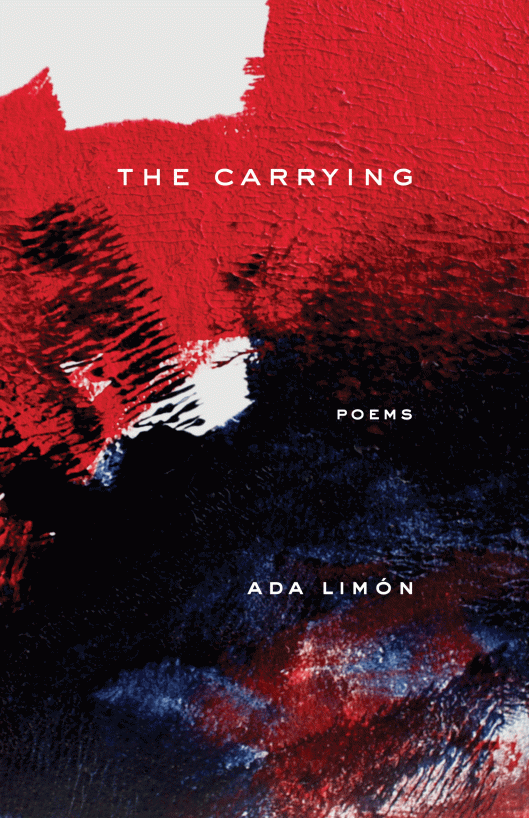
Front Cover The Carrying: Poems by Ada Limón Milkweed Editions – Minnesota/USA – August 2018 Photo Credit: Ada Limón
My Poetry Corner March 2019 features the poem “The Leash” from the poetry collection, The Carrying: Poems, by Ada Limón. Native of Sonoma, California, Limón is a poet, writer, and teacher. After earning an MFA in creative writing from the University of New York, she spent the next ten years working for various magazines, such as Martha Stewart Living, GQ, and Travel + Living. In 2011, she moved to Lexington, Kentucky, to be close to her now-husband, Lucas, a business owner in the horse racing industry. In addition to working as a freelance writer, she serves on the faculty of the low-residency MFA program at Queens University of Charlotte (NC) and the online and summer programs for the Provincetown Fine Arts Work Center (MA).
In an interview with the Lexington Herald-Leader magazine (August 2018), Limón says that The Carrying, her fifth book of poetry, “is incredibly personal. It’s more political than my other books… It deals with the body, with fertility. It also deals with what it is to do the day-to-day work of surviving.”
In her poem, “The Vulture & The Body,” she shares her struggle with infertility. In coming to terms with the failure of fertility treatment, she asks:
What if, instead of carrying a child, I am supposed to carry grief?Continue reading →
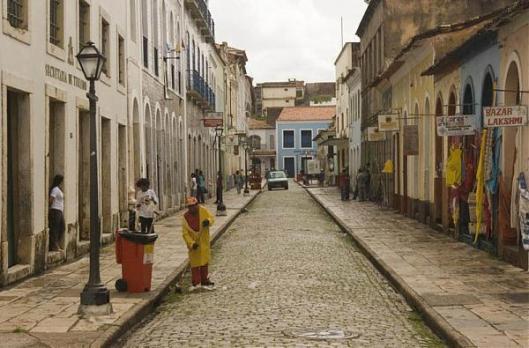
Historical Center of São Luís – Maranhão – Brazil
UNESCO World Heritage Site: Portuguese colonial architecture
Photo Credit: Kamaleao
My Poetry Corner February 2019 features the poem “There are Many Traps in the World” (No Mundo Há Muitas Armadilhas) by Ferreira Gullar (1930-2016), a Brazilian poet, playwright, art critic, and essayist. Born in São Luís, capital of the northeastern state of Maranhão, he was the fourth child of eleven siblings of a poor, working-class family.
As a young man, while earning a living as a radio announcer and editor of literary magazines, Gullar frequented poetry readings and devoured books of poetry by the best of Brazilian and foreign poets. At nineteen, he published his first poetry collection. But he saw no future in his suffocating, small-town life in the impoverished northeast region. He fled to Rio de Janeiro in the early 1950s, where he worked as a journalist for magazines and newspapers.
Beginning in 1962, his work reflected his concern about combating oppression and social injustice. After becoming a member of the communist party, he joined the struggle against the military dictatorship (1964-1985). Following his arrest and imprisonment in 1968, he went into exile in 1971. For the next six years, he lived in Moscow, Santiago, and Buenos Aires. In Buenos Aires in 1975, fearful for his safety in the wake of Argentina’s military takeover (1976-1983), he wrote his best-known work, “Dirty Poem” (Poema Sujo).
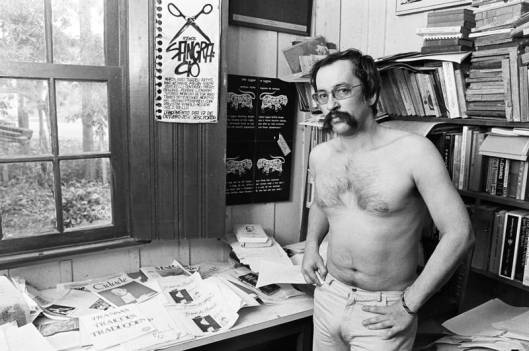
Ferreira Gullar among millions of students and other demonstrators gathered to protest against military dictatorship – Rio de Janeiro – Brazil – June 26, 1968
Photo Credit: Folha de São Paulo
In the opening stanza of the featured poem, “There are Many Traps in the World,” Gullar makes a simple declaration:
There are many traps in the world and what is a trap could be a refuge and what is a refuge could be a trap
Some traps that we humans perceive as refuge come to mind: religion, cults, Facebook, and narcotic drugs. Continue reading →
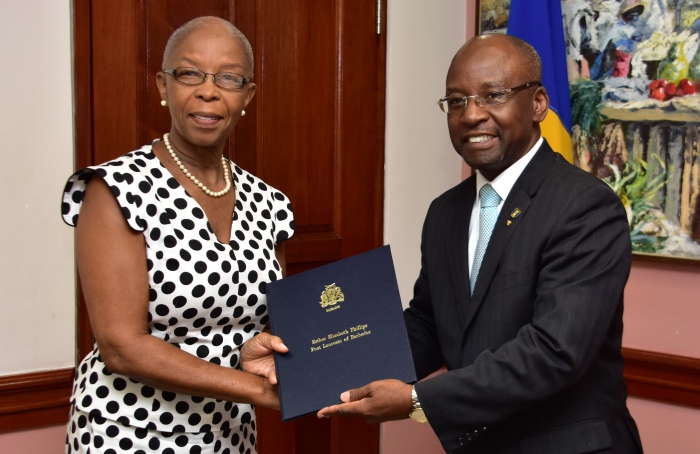
My Poetry Corner January 2019 features the poem “Unwritten Poem” from the poetry collection, The Stone Gatherer, by Esther Phillips, a poet and educator born in Barbados, where she still resides. In February 2018, she was appointed the first Poet Laureate of the Caribbean island-nation.
After attending the Barbados Community College at the University of the West Indies Cave Hill Campus, she won a James Michener fellowship to the University of Miami where, in 1999, she gained an MFA degree in Creative Writing. Her poetry collection/thesis won the Alfred Boas Poetry Prize of the Academy of American Poets.
In 2001, she won the leading Barbadian Frank Collymore Literary Endowment Award. Years later, the third of her three well-received poetry collections, Leaving Atlantis (2015), won the Governor General’s Award for Literary Excellence.
Phillips is a Sunday columnist of the Nation newspaper and editor of Bim: Arts for the 21st Century, a 2007 revival of the seminal Caribbean literary and arts magazine, first published in 1942. In 2012, she formed Writers Ink Inc. and, together with its members, the Bim Literary Festival & Book Fair.Continue reading →






 Three Worlds One Vision
