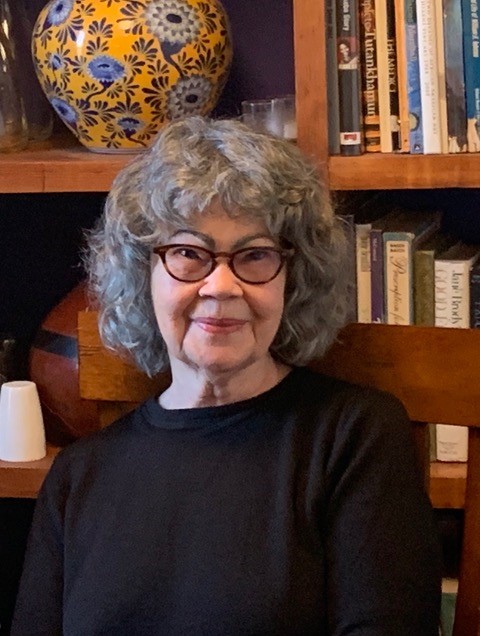
My Poetry Corner August 2021 features the poem “W for Workers” from the 2021 poetry collection, Pandemic Poems: First Wave, by Jamaica’s third Poet Laureate Olive Senior (2021-2024). Since 1993, the award-winning poet, novelist, short story and non-fiction writer has made Toronto, Canada, her home. She returns frequently to the Caribbean which remains central to her work.
The seventh of ten children, the Poet Laureate was born in 1941 in the wild mountainous landscape in the interior of Jamaica. The child of peasant farmers, the young Olive enjoyed a better, though solitary, life as the only child in the home of a wealthy and cosmopolitan great uncle and great aunt who encouraged her love for reading and writing.
After winning a scholarship to attend the prestigious Montego Bay High School for Girls, Olive embarked on a career in journalism. At nineteen, she joined the staff of The Daily Gleaner, Jamaica’s major newspaper located in Kingston. She soon won a scholarship to study journalism at the Thomson Foundation in Cardiff, Wales. Later, while attending the Carleton University School of Journalism in Ottawa, Ontario, Canada, she began writing fiction and poetry. She returned to Jamaica where, in 1982, she joined the Institute of Jamaica as editor of the Jamaica Journal, a magazine that promotes the history and culture of the Caribbean Island nation.
In the summer of 2020, between May and September, when the Covid-19 pandemic transformed our lives, Senior began writing pandemic poems and posting them on her Twitter and Facebook pages “as a way of keeping [her]self engaged and not falling into depression.” Each of the 71 poems in her collection Pandemic Poems: First Wave is “a riff on a word or phrase trending at the period.” This pandemic lexicon has since become a part of our new normal.
My Poetry Corner July 2021 features the poem “On a Saturday in the Anthropocene” from the anthology HERE: Poems for the Planet (Copper Canyon Press, 2019) edited by Elizabeth J Coleman an American poet, public-interest attorney, environmental activist, and teacher of mindfulness. A graduate of the University of Pennsylvania Law School and Swarthmore College, she practiced law for over thirty years and has served as an executive at several organizations.
In 2012, she received an MFA in Writing from the Vermont College of Fine Arts. She credits Mindfulness-Based Stress Reduction (MBSR) and mindfulness for her decision to become a late-career poet. She lives in New York City where she runs Mindful Solutions LLC and is president of the Beatrice R and Joseph A Coleman Foundation.
In the anthology HERE: Poems for the Planet, Coleman brings together her love for poetry, for justice, and for our planet. With a foreword from His Holiness the Dalai Lama, HERE explores our planet’s beauty and plight through the vision of 128 living poets from all over the world.
“When we see photographs of the earth from space, we see no boundaries between us, just this one blue planet, a natural world that supports us all. Therefore, we have to see humanity as one family and the natural world as our home. It’s not necessarily somewhere sacred or holy, but simply where we live—so it’s in our interest to look after it,” writes the Dalai Lama.
The anthology is divided into five sections. In the first section that puts us in touch with the beauty of our planet, Kentuckian farmer and poet Wendell Berry gives us “The Peace of Wild Things” (p.40):
When despair for the world grows in me
and I wake in the night at the least sound
in fear of what my life and my children’s lives may be,
I go and lie down where the wood drake
rests in his beauty on the water, and the great heron feeds.
I come into the peace of wild things
who do not tax their lives with forethought
of grief. I come into the presence of still water.
And I feel above me the day-blind stars
waiting with their light. For a time
I rest in the grace of the world, and am free.
Brazilian Music Composer & Poet Leonardo André Photo Credit: Official Website at WiX.com
My Poetry Corner June 2021 features the poem “Father’s Presence” (Presença de Pai) by Leonardo André, a Brazilian music composer, music teacher, writer, and poet. He composed his first song at the age of thirteen. In the 1980s, during his years as an undergraduate pursuing an Artistic Education at The Marcelo Tupinambá College in the City of São Paulo, he frequented several poetry groups and joined the Santo Amaro Poets Association.
A year after his graduation, André released five self-published books at the 1990 Biennial Book Fair in São Paulo. These include three children’s books and two poetry collections, Verses that Sing (Versos que Canto) and Verses of Love, Desires, Longing and Solitude (Versos de Amor, Desejos, Saudade e Solidão).
In “Father’s Presence,” André pays homage to a father who is a positive role model in his life. What is made clear at the outset is his father’s constant presence.
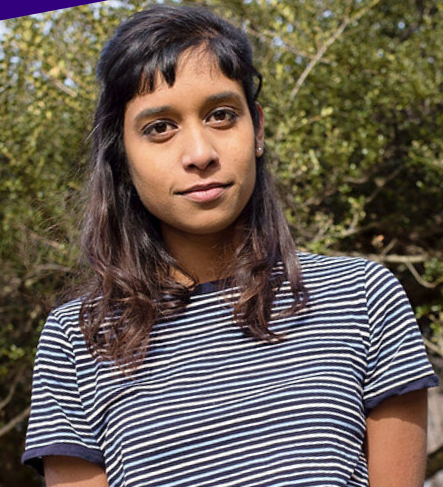
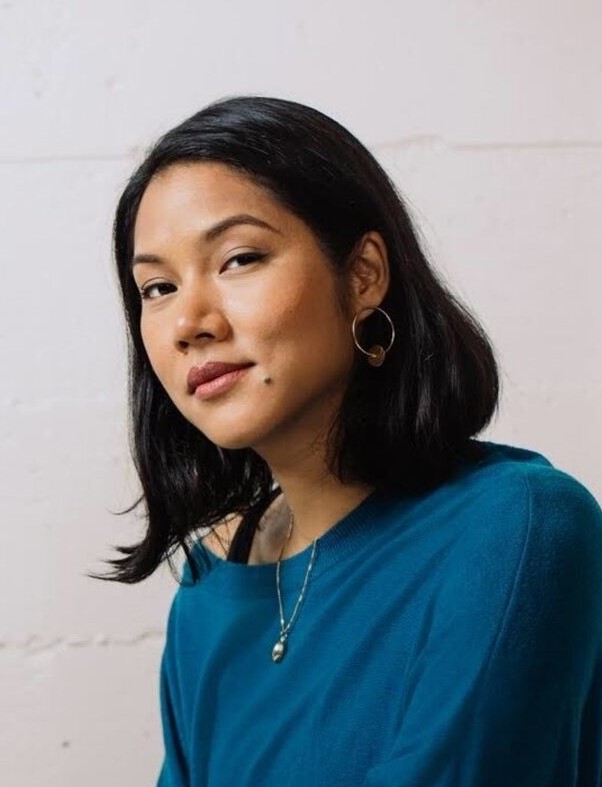
Caribbean American Poet Jihan Ramroop Photo by Em Hampton published on Poet’s Website
My Poetry Corner May 2021 features the poem “Waitress / Suppose” from the debut poetry collection, We Used to Waitress, by the Caribbean American poet, actress, and playwright Jihan Ramroop. Born in Queens, New York, of immigrant Indo-Guyanese parents, Ramroop was raised in Fort Pierce, Florida, and Georgetown, Guyana. She graduated in Theatre and Performance from Purchase College of the State University of New York (SUNY). She lives in upstate New York.
All excerpts of poems featured in this article are taken from Ramroop’s poetry collection, We Used to Waitress, published in 2020. The collection is divided into four parts: Stay, Still, Stubborn, and Suppose.
In Part 1/Stay, the poet notes in “Sunday Inventory” that she has lived in 27 places, went to 14 schools, and held 10 jobs. Throughout this section, she laments love lost for men who did not stay in her life. In “Waitress / Stay,” the final poem in the section, she recalls those days we used to waitress / outside the city / pretending i was / saving up / for dreams and freedom / and something big. Since then, she concludes, everything and nothing changed.
My Poetry Corner April 2021 features the poem “Cruel Radiance” from the debut poetry collection A Nail the Evening Hangs On (Copper Canyon Press, 2020) by Cambodian American poet Monica Sok. Born in 1990 in Lancaster, Pennsylvania, Sok is the daughter of refugees. She is a Jones Lecturer at Stanford University and teaches poetry to Southeast Asian youth at the Center for Empowering Refugees and Immigrants in Oakland, California.
Sok dedicates her poetry collection to her grandmother Bun Em who arrived in the USA in 1981, two years after escaping genocide under the Khmer Rouge regime with her four daughters and two sons. A master silk weaver, Bun Em’s loom, grief, joy, and perseverance infuse Sok’s real and imagined collective memory.
In “The Weaver,” Sok transforms her grandmother’s grief into nourishment for others around her. It made her happy / as she worked on silk dresses / and her hair never ran out. / Sometimes, when she was tired, / she’d tie it up / and let all the tired animals around her house / drink from her head. Her loom becomes an old friend and an ancestor she prays to in the poem “Ode to the Loom.” Her grief is re-imagined as nails falling like rain in the darkness, so that when her hair falls / not as rain does / but as nails the evening hangs on, / and her hands slip no longer / from silk but on walls in the dark / hall to her room…
As the daughter of genocide survivors, Sok grew up with familial silence. Her poems came out of silence, she told Danny Thanh Nguyen during an interview in May 2020. “I’m writing about the genocide, but I’m writing more about the inheritance of that trauma…. I had to give myself the permission to write the stories and I went into myth-making, tried to mythologize my family’s narratives.” But the narratives are not just about her family’s experience, she noted. Rather, she was working towards a collective history of all Cambodian families.
My Poetry Corner March 2021 features the poem “The woman without a name” (A mulher sem nome) from the poetry collection Lot’s Wife (A mulher de Ló) by Carlos Machado, a Brazilian poet and journalist. Born in 1951 in Muritiba, Bahia, Northeast Brazil, Machado earned his bachelor’s degree in mechanical engineering at the Federal University of Bahia. He studied journalism at the Faculty of Cásper Libero in São Paulo, where he lived for forty years before returning to his home state of Bahia in 2020. He is the creator and editor of the fortnightly bulletin, poesia.net, in which he promotes contemporary Brazilian poets.
Machado’s poetry collection Lot’s Wife, published in 2018, reflects his deep concern for the condition of women. In support of the feminist movement, he is involved in studying the causes and means of combating the increasing incidents of violence against women in Brazil. The biblical story of Lot’s wife is a story of violence against a woman whose only crime was that of looking back.
For readers unfamiliar with the biblical story told in the Old Testament Book of Genesis, chapter 19, the God of Abraham destroys the towns of Sodom and Gomorrah for their sinful ways. Two angels warn Abraham’s nephew Lot, living in Sodom, of the coming cataclysm. They instruct him to flee with his family and not to look back until they had reached the next town. Only Lot’s wife and two daughters heed the warning. Other members of Lot’s extended family refuse to join them, declaring it fake news. We don’t know why Lot’s wife looks back as they leave Sodom. We know only that her punishment is immediate and severe: She is transformed into a pillar of salt. Silenced.
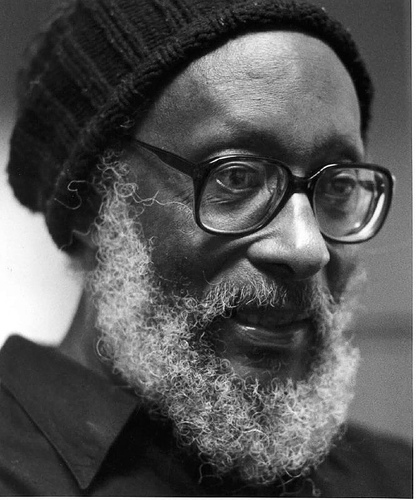
Barbadian Poet Edward Kamau Brathwaite Photo by Beverly Brathwaite
My Poetry Corner February 2021 features the poem “Islands” from the poetry collection, The Arrivants: A New World Trilogy, by the Caribbean poet and historian Edward Kamau Brathwaite (1930-2020). Born in Bridgetown, Barbados, into a middle-class family, he won a British scholarship to Pembroke College, Cambridge. There he earned a bachelor’s degree in history in 1953 and gained a diploma in education the following year.
Brathwaite’s illusions of regarding himself as a British citizen were shattered on arrival in the Mother Country. He felt “rootless” and, like other British colonial West Indians of the time, he was ready to become an “Afro-Saxon.” This changed when he took a job as an Education Officer in Ghana, then the West African colony of the Gold Coast. For him, it was a spiritual homecoming. The eight years (1955 to 1962) that he spent travelling to villages across the country also expanded his thinking about history, culture, and ways of perceiving the world.
On returning to the Caribbean, he held teaching posts at the University of the West Indies, first in St. Lucia, and then in Kingston, Jamaica. While working in Jamaica, he began writing Rights of Passage, his first poetry collection, later published in 1967. Set in the Caribbean, the collection traces the movement of the black people’s dispossession of their African homeland, the sufferings of the Middle Passage and slavery, and struggle to find their footing in the new world and beyond. The people lament in “New World A-Comin’”:
It will be a long time before we see
this land again, these trees
again, drifting inland with the sound
of surf, smoke risingIt will be a long time before we see
these farms again, soft wet slow green
again: Aburi, Akwamu,
mist rising
American Poet John Sibley Williams Photo Credit: Poet’s Website
My Poetry Corner January 2021 features the poem “No Island Is an Island, & So Forth” from the poetry collection As One Fire Consumes Another (2019) by John Sibley Williams, an award-winning poet, educator, and literary agent. Born in 1978 in Massachusetts, Williams earned his bachelor’s degree at the University at Albany in New York in 2003. Then in 2005, he received a Master of Fine Arts in Creative Writing from Rivier University in New Hampshire. He moved to Portland, Oregon, in 2009 where he earned a Master of Arts in Book Publishing from Portland State University. He lives in Portland with his partner and twin toddlers.
Williams’ poetry collection As One Fire Consumes Another comes at a critical time in American history with the empowerment of white supremacist and white nationalist groups. Framing his poems in column-like boxes, resembling coffins, the poet confronts the violent side of American history and bears witness as one fire consumes an unending series of fires in our homeland, on our southern border, and in distant lands. In an interview with Jeanne Huff of Idaho Press, Williams confessed that he struggled in exploring the extent of his “personal privilege as a white, CIS, able-bodied male whose labors and strains are so trifling compared to others.”
In the poem, “Everything Must Go,” a house is portrayed with ghost-white covering sheets and that new coffin smell. Its mossed gables are weighed down by a full century. Out-of-synch always with the dark drift of history, and hopeful that these are not self-repeating tragedies, the poet proposes that we must sell off what we fear owning. To remain silent is not atonement for our dark history.
We have become so numb to the cruelty we inflict on others with our unending wars that nothing stirs the / birds from our oak when we learn that six children were killed in Kabul, the poet observes in “When instinct matures into will.” The horizon sits / precisely where we left it. Fat with / faith. Fat, faithful, choosing what to / feel, feeling nothing.
Fire also rages in the homeland. The poem “A Gift of Violence,” in memory of the Charlottesville riots in August 2017, speaks of the racist hatred still alive across generations.
 Memories of burning buildings raw
 & righteous. A grandfather’s flames
 passed down, undimmed. A full set
 of knives in the drawer without time
 to blunt from underuse. A city never
 quite white enough. A city furiously
 lit by misremembered histories…
Even Noah’s ark would not be big enough to un- / ruin, no flood more violent than our / own, the poet laments in “Dear Noah.” Like a ghost haunted by itself, / we move along old scars terrified of / what would happen if left to heal.
As a nation, we remain disunited and self-destructive. Call it by its true name: schism, the poet declares in “The Bones of Us.” Before we were a country of / burning buildings & protest & want, / we were the same. A shining city on / a shining hill raised on the silenced / bones of others.
In the featured poem, “No Island Is an Island, & So Forth,” the poet calls on white Americans to consider the role they all play in the hate and violence permeating our society. Holding on to illusions of bygone glories serve only to sever our body politic.
 Sign your name to ruined Civil War
 forts. Next time, use a Sharpie when
 listing your demands to god. Instead
 of touching forehead to ground as if
 in supplication/ecstasy/grief, set fire
 to the old battlefield & let the winds
 unsever your strings to the past. In
 dust & degrees, redraw boundaries.
 This is what happened & this might
 be what we let happen again…
When Williams penned these words, did he envisage white insurrectionists carrying the Confederate Flag while they stormed Capitol Hill on January 6, 2021? They fashioned their strings to the past into a Jim Crow-styled noose to hang our Vice President who, they believed, had sold out their cause to hold onto political power.
 No island is an island; no body just a
 body, & so forth. When the South
 rises again, carry your father with the
 rebel flag tattoo to the window to
 watch the burning. Let the world
 laugh at itself. Break from tradition.
 To men who want & want & want,
 admit you’ve tried so hard not to be
 one of them.
Emboldened and incited by their leader in the White House, white supremacists and white nationalists among us have risen to prominence. To men who want & want & want there is no end to the burning. Fire consumes lives and livelihoods—black, brown, and white alike. No island is an island; no body just a / body, & so forth.
Only we can set ourselves free from the coffins, filled with hate and fear, that imprison our bodies and souls. Are we up to the task?
To read the complete featured poem, “No Island Is an Island, & So Forth,” and learn more about the work of the poet John Sibley Williams, go to my Poetry Corner January 2021.
My Poetry Corner December 2020, featuring the poem “Poema de Natal” (Christmas Poem) by Brazilian poet and lyricist Vinicius de Moraes (1913-1980), is dedicated to those among us who have lost a loved one this year to COVID-19.
Born in the city of Rio de Janeiro, in Southeast Brazil, Vinicius de Moraes is the poet of love and passion. At twenty years old, he published his first book of poetry. Two years later, his second collection won Brazil’s National Poetry Award. He served as a diplomat during the period 1946 to 1969. His first diplomatic post was as Vice-Consul in Los Angeles (1946-1950) where he immersed himself in North American cinema and jazz.
His featured poem, “Christmas Poem,” written in 1946, appears unconnected with the Christmas story of the birth of Jesus in Bethlehem in Judea. Instead, as the title suggests, the poem is more like reflections on the passing year. The poet ponders over death and what is truly essential to our lives. Why such somber thoughts during the Christmas festivities? Had the sudden death of a great friend, the year before, unsettled his life? The loss of a loved one has a way of giving us a new perspective of human existence.
Jamaica’s Poet Laureate Lorna Goodison (2017-2020) Photo Credit: Pan American World Magazine (Photo by Hugh Wright)
My Poetry Corner November 2020 features the poem “Mother, the Great Stones Got to Move” from the 1995 poetry collection, To Us, All Flowers Are Roses, by Jamaica’s second Poet Laureate Lorna Goodison (2017-2020) and the first female to receive this honor. The eight of nine children, six boys and three girls, she was born in 1947 in Kingston, capital of the Caribbean island nation of Jamaica. She grew up in a lower-middle-class family on a noisy street with concrete yards. No roses grew in the neighborhood gardens of potted plants, so the people gave the name roses to all their flowers.
The hymns the young Lorna sang during Sunday Mass at the Anglican Church laid the foundation for her poetry. In her interview with Pádraig Ó Tuama for the Image Journal, Goodison recalled that her mother sung hymns as she did her household chores. “In the Jamaica I grew up in,” she told him, “it seemed to me that women sang hymns all the time—washing, doing chores, working—so it was all around me, that language.”
That language of the great composers of Anglican hymns shines through in the opening poem of her third book of poetry, Heartease (1988), in which the persona declares:
I shall light a candle of understanding in thine heartwhich shall not be put out.[…]By the illumination of that candleexit death and fear and doubthere love and possibilitywithin a lit heart, shining out.
Goodison’s trips in her youth to the lush rural landscapes, to visit her extended family, shaped her imagination for the rest of her life. Though she began writing poems from seven or eight years old, she kept them a secret. Growing up in the shadow of her oldest sister who excelled in writing, she questioned her poetic gift and opted instead to focus on painting, her other passion. Then, at fifteen years old, tragedy struck. Her father, who had brought humor and laughter into their lives, passed away.
“It was terrible watching him die of stomach cancer, and maybe brought on a loss of faith, but that was when I really turned to painting and reading and writing poetry,” Goodison told Tuama. “So I guess the arts became my religion, and I’d consider that good religion because I felt connected, I felt cleansed and healed by poetry and painting and music.”
On completing high school, she worked for a year as a bookmobile trainee librarian with the Jamaica Library Service. She traveled deep into rural areas, where small humble places like Heartease, became mythic and real, strengthening her connection with place that runs through her poetry. Deciding to pursue a career in art, she studied painting at the Jamaica School of Art (1967-1968), and then moved to New York City to attend the Art Students’ League (1968-1969).
Her poem “Who Was the Mother of Jamaican Art?” from her 2005 poetry collection, Controlling the Silver, was inspired by an article about enslaved women making carvings of human figures representing their children sold to other plantation slave owners.
She was the first nameless woman who createdimages of her children sold away from her.She suspended those wood babies from a roperound her neck, before she ate she fed them,touched bits of pounded yam and plantainsto sealed lips; always urged them to sip water.She carved them of heartwood, teeth and nailswere her first tools, later she wielded a blunt blade.Her spit cleaned face and limbs, the pitch oilof her skin burnished. When the woodwormsbored into their bellies, she warmed castor oil;they purged. She learned her art by breakinghard rockstones. She did not sign her work.
While Goodison considered herself as an artist, she never stopped writing poetry. But poetry chose her. “It’s a dominating, intrusive tyrant,” she said in an interview for the Guardian newspaper, as quoted in The Walrus Magazine. “It’s something I have to do—a wicked force.”
Many of Goodison’s poems speak of ordinary women, their struggles and the many roles they play. Her country’s traumatic past of colonialism and slavery permeates the people and the landscape. The featured poem “Mother, the Great Stones Got to Move” addresses Jamaica’s violence and poverty, legacy of empire. In the first of her six-stanza poem, the poet invokes the untold stories of slavery, kept hidden by empire, that need to be told.
Mother, one stone is wedged across the hole in our historyand sealed with blood wax.In this hole is our side of the story, exact figures,headcounts, burial artifacts, documents, lists, mapsshowing our way up through the stars; lockets of brasscontaining all textures of hair clippings.It is the half that has never been told,and some of us must tell it.
These untold stories, she writes in the second stanza, live on through generations, like the stone on the hearts of some women and men, preventing the small / dreamers of this earth from healing. But there is yet another obstacle destroying their future, raised in the third stanza, that mothers want removed as we think of our children and the stones upon their future. In the following fourth stanza, the poet describes the poisonous stone, born of hunger, that drives the violence in their communities and kill their children.
For the year going out came in fat at firstbut toward the harvest it grew lean,and many mouth corners gathered whiteand another kind of poison, powdered whitewas brought in to replace what was green,And death sells it with one handand with the other death palms a gunthen death gets death’s picturein the paper’s asking“where does all this death come from?”
Driven by the drug trade, death comes to a people already broken by the legacy of slavery and colonialism. As the poet notes in the fifth stanza, narcotics become the soup and meat for its users, leaving the homeless to sleep on concrete sheets. In her call to action in the final stanza, the poet links the great stones of the past with the present and the future.
Mother, the great stones over mankind got to move,It’s been ten thousand years we’ve been watching them nowfrom various points in the universe.From the time of our birth as points of lightin the eternal coiled workings of the cosmos.Roll away stone of poisoned powders cometo blot out the hope of our young.Move stones of the sacrificial lives we breedto feed to suicide god of tribalism.From across the pathway to mount morningsite of the rose quartz fountainbrimming anise and star waterbright fragrant for our children’s futureMother these great stones got to move.
Poverty, drug addiction, gang violence, and homelessness are not just the scourges of the Jamaican people. They afflict all humans worldwide. For the sake of our children’s future, mothers must remain vigilant and work tirelessly to remove these scourges from our communities.
To read the complete featured poem and learn more about the work of Lorna Goodison, go to my Poetry Corner November 2020.



 Three Worlds One Vision