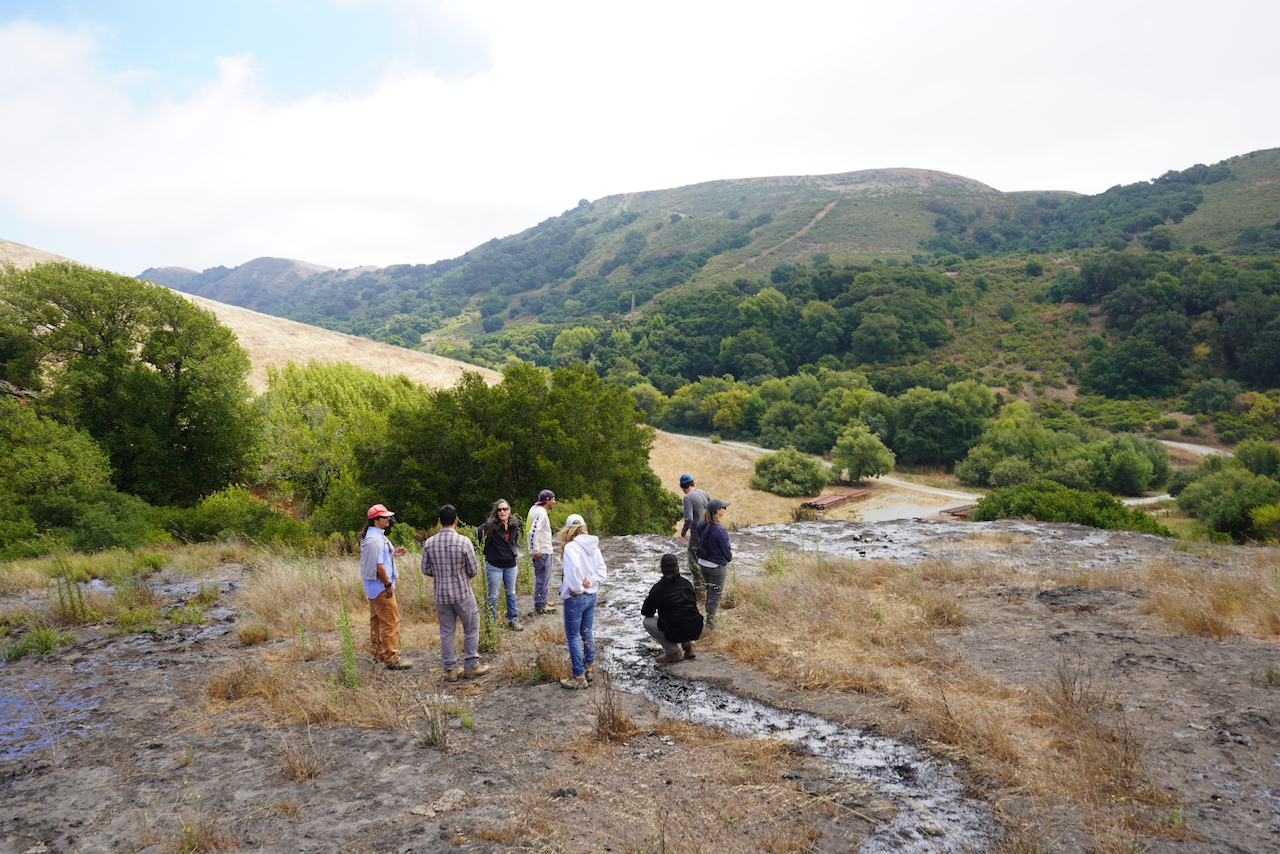
Natural Tar Springs at La Brea – Juristac Tribal Cultural Landscape – California/USA – January 2026 Photo Credit: Protect Juristac Website
This is the second article in my series about our changing Earth from interviews with Native Americans shared in We Are the Middle of Forever: Indigenous Voices from Turtle Island on the Changing Earth, edited by Dahr Jamail and Stan Rushworth (USA 2022). My presentation does not follow the order of the interviews.
This is the first article in my series about our changing Earth from interviews with Native Americans shared in We Are the Middle of Forever: Indigenous Voices from Turtle Island on the Changing Earth, edited by Dahr Jamail and Stan Rushworth (USA 2022). My presentation does not follow the order of the interviews.
Born on that memorable day of September 11, 2001, Raquel Ramirez is the youngest participant interviewed via Skype during the pandemic lockdown in midsummer 2020. She defines herself as an urban Native American, Ho-Chunk and Ojibwe, and other strong Native family roots. Growing up in California, she’s greatly influenced by the state’s indigenous cultures.
In addressing the crises we face on our changing Earth, Raquel considers awareness as a challenge to confront and overcome. Breaking free of ignorance in society and our own ignorance is, she acknowledges, an emotional and difficult process.
Awareness doesn’t just mean listening or hearing or recognizing. It is very much being present and being conscious of people beyond you!
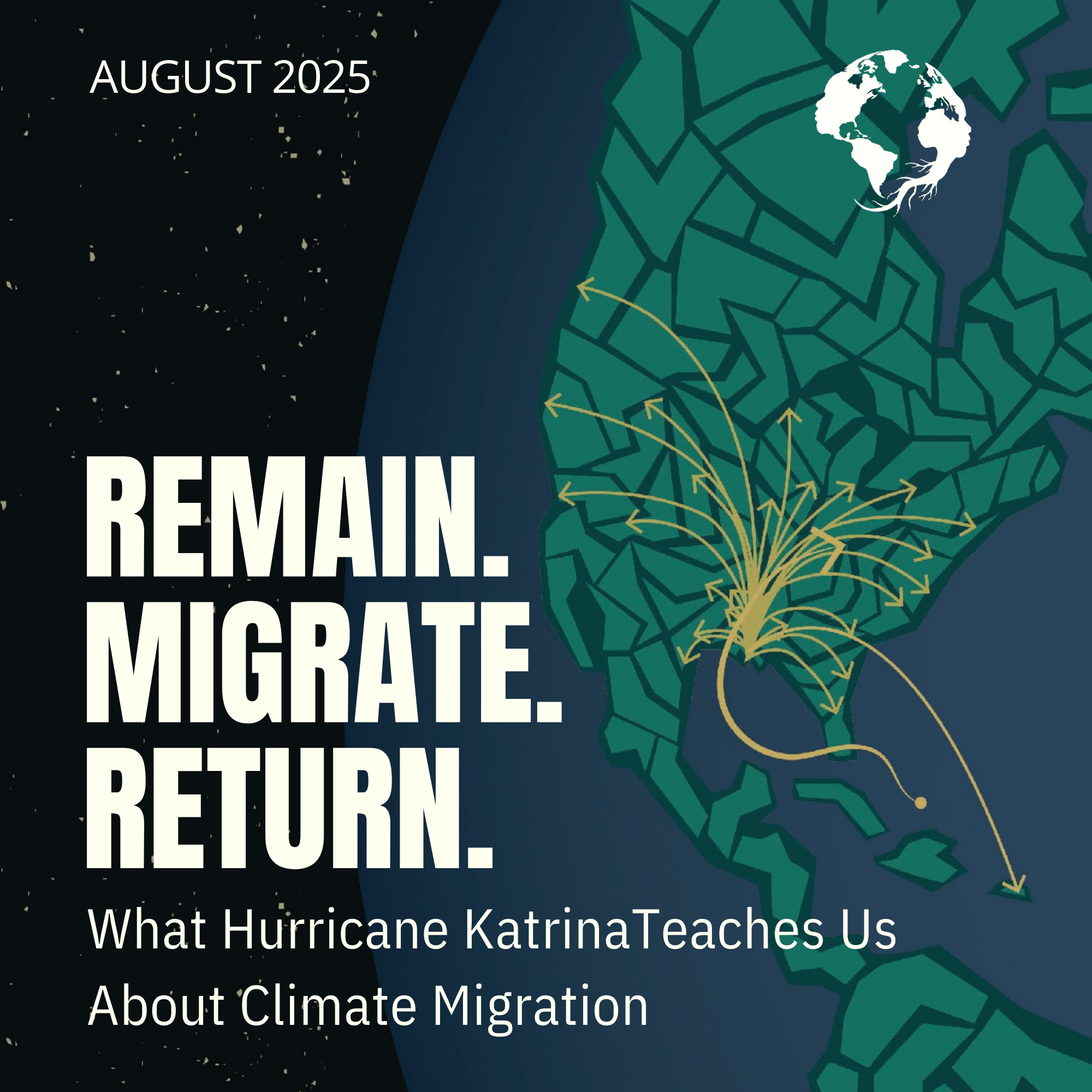
Cover of Remain. Migrate. Return.: What Hurricane Katrina Teaches Us About Climate Migration – PDF Publication August 22, 2025 Photo Credit: Taproot Earth
On August 29, 2005, Hurricane Katrina caused record-breaking devastation across a 144 mile swath of Louisiana, Mississippi, and Alabama. A less often told story is that Hurricane Katrina sparked a mass migration of people. More than 1.5 million Hurricane Katrina survivors evacuated to all 50 states representing one of the largest and most abrupt relocations of people in U.S. history. As of 2015, Center for American Progress reported that 40% of the 1.5 million evacuees, or 600,000 people, were not able to return home. While the idea of “climate migration” is often talked about as an issue that exists only outside of the United States, Hurricane Katrina teaches us that climate migration is also a domestic issue that is already underway.
Excerpt from Remain. Migrate. Return.: What Hurricane Katrina Teaches Us About Climate Migration, PDF publication by Taproot Earth, USA, August 22, 2025, p. 6.
Community responses to Hurricane Katrina (2005) taught them that the standards for climate migration are rooted in the Right to Remain, the Right to Migrate, and the Right to Return.
The Right to Remain is grounded in the principle that people have self-determination, power, and resources to remain on their lands and in their communities (pp. 9-11).
The Right to Migrate includes the principles of cooperation and solidarity, as well as legal protections (pp. 12-13).
The Right to Return includes principles of reclaiming power and culture, repairing and restoring the land, plus re-awakening and repairing the spirit (pp. 14-15).
Taproot Earthis a nonprofit organization, registered in Slidell, Louisiana, USA. Their work is rooted in the community responses to Hurricane Katrina (2005), BP Deepwater Horizon Oil Drilling Disaster in the Gulf (2010), and Hurricane Ida (2021). They honor and build on the efforts of Black and Indigenous communities by invoking accountability, abundance, and justice. Together, they are forging connections that strengthen and sustain frontline climate leaders across the Gulf and Global South.
On that day in July at an auto dealership in Indiana, the Environmental Protection Agency (EPA) Administrator Lee Zeldin made the grand announcement. Also present were US Secretary of Energy Chris Wright, as well as several Indiana officials: the Governor, Attorney General, and Secretary of Energy and Natural Resources. If finalized, the proposal would repeal all greenhouse gas emissions regulations for motor vehicles and engines, and other sources.
“With this proposal, the Trump EPA is proposing to end sixteen years of uncertainty for automakers and American consumers,” said EPA Administrator Zeldin.“In our work so far, many stakeholders have told me that the Obama and Biden EPAs twisted the law, ignored precedent, and warped science to achieve their preferred ends and stick American families with hundreds of billions of dollars in hidden taxes every single year. We heard loud and clear the concern that EPA’s GHG [Greenhouse Gases] emissions standards themselves, not carbon dioxide which the Finding never assessed independently, was the real threat to Americans’ livelihoods. If finalized, rescinding the Endangerment Finding and resulting regulations would end $1 trillion or more in hidden taxes on American businesses and families.” [Emphasis is mine.]
[Note to readers: Carbon dioxide comprises over 79% of all greenhouse gas emissions.]
For their part, the auto industry promises to give us “more safe and affordable cars.” The American Trucking Association promises a decrease in “the cost of living on all products that trucks deliver.”
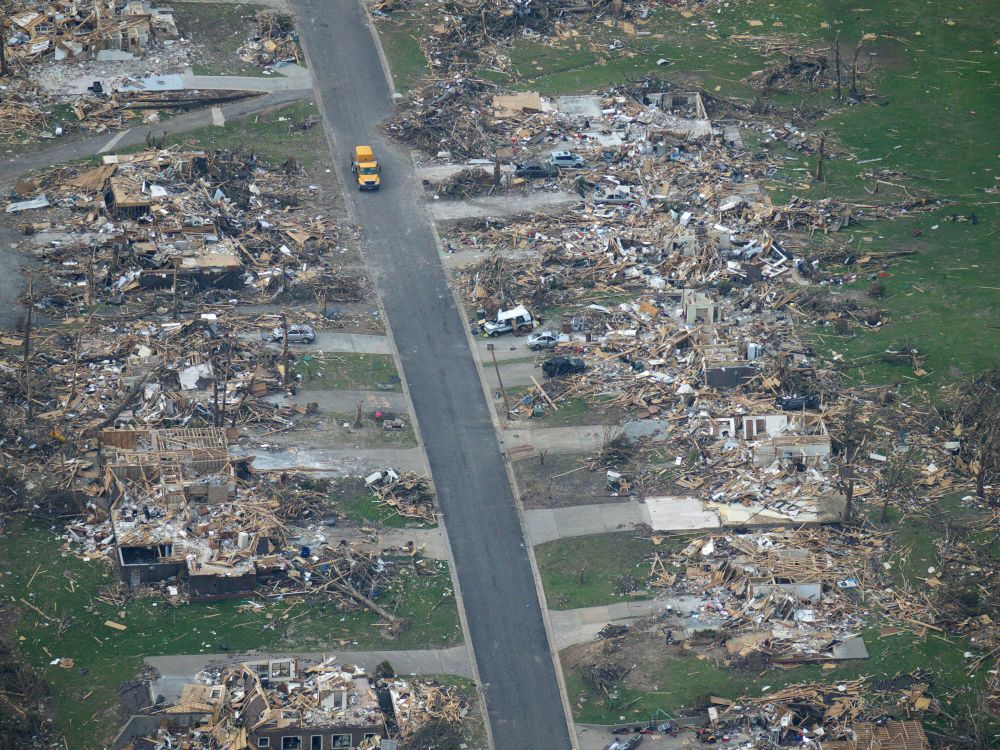
As a resident of Southern California, I’ve yet to come face-to-face with one of those terrifying tornadoes I’ve seen in movies. Tornadoes don’t occur often in our state. Whenever they do occur, they are weak, ranked EF-0 in the Enhanced Fujita Scale, causing little damage. The reality of being pummeled by a violent tornado is a devastating, life-changing, traumatic experience. Such was the case for people living in Joplin, Missouri, on May 22, 2011, featured in the Netflix Documentary The Twister: Caught in the Storm, released on March 19, 2025.
The tornado that struck Joplin in 2011 was rated EF-5 on the Enhanced Fujita Scale, with maximum winds over 200 mph (320 kph). Ranked seventh among the top ten deadliest tornadoes in United States history, it is the deadliest so far in the 21st century.
With a population of more than 50,000 and a population density near 1,500 people per square mile, Joplin suffered extensive damage amounting to US$2.8 billion. According to the account recorded in President Obama White House Archives, the tornado first touched down in the southern part of the city at 5:41 p.m. local time. During the following 32 minutes, it headed eastward across the city, demolishing everything in its path for 13 miles (21 kilometers) and extending as much as a mile (1.6 kilometers) wide at its widest extent.
I know… I share your pain. I’m also scared. These are dangerous times for immigrants in America—scapegoats for the social and economic ills of our nation. Our trade partners, too, have come under attack. It’s now tit-for-tat for unfair trade practices. “Liberation Day” on April 2nd has unleashed import tariffs/taxes, ranging from 10 percent to 54 percent, for all countries that sell goods to the United States. What a high-risk economic strategy! But this is just the latest drastic change assaulting us daily since January 20, 2025.
Regardless of our political views or ideology, we the people will have to deal with the negative or unexpected consequences of dismantling our government agencies and picking a fight with our closest allies since the end of World War II. Judging from these developments, it seems that the globalized capitalist economic system is under stress. And so it should be. For how much longer can we sustain an economic model of continual growth and profits that is pushing our planetary life systems to their limits?
Non-human life faces extinction and more frequent, extreme weather events are disrupting and threatening human life. The minority billionaire ruling class (MBRC) believes that environmental and other deregulations are the answer to renewed economic growth. Their insatiable greed blinds them to all the warning signs of economic and societal collapse. Instead, they now grasp at AI, an energy guzzler, to preserve their way of life.
During 2024, thousands of our American brothers and sisters lost loved ones, property, and jobs to various weather/climate-related disasters that struck their state. Many of them are still recovering from their losses. Without resources, others will never recover. Tragedy does not impact us all in the same way.
On January 10, 2025, the National Oceanic and Atmospheric Administration (NOAA) released the data and analysis quantifying the economic costs of the disasters that reached or exceeded US$1 billion. They confirmed 27 weather/climate disaster events, amounting to a total ofUS$182.7 billion. This places 2024 as the fourth costliest on record, trailing behind 2017 (US$395.9 billion), 2025 (US$268.5 billion), and 2022 (US$183.6 billion).
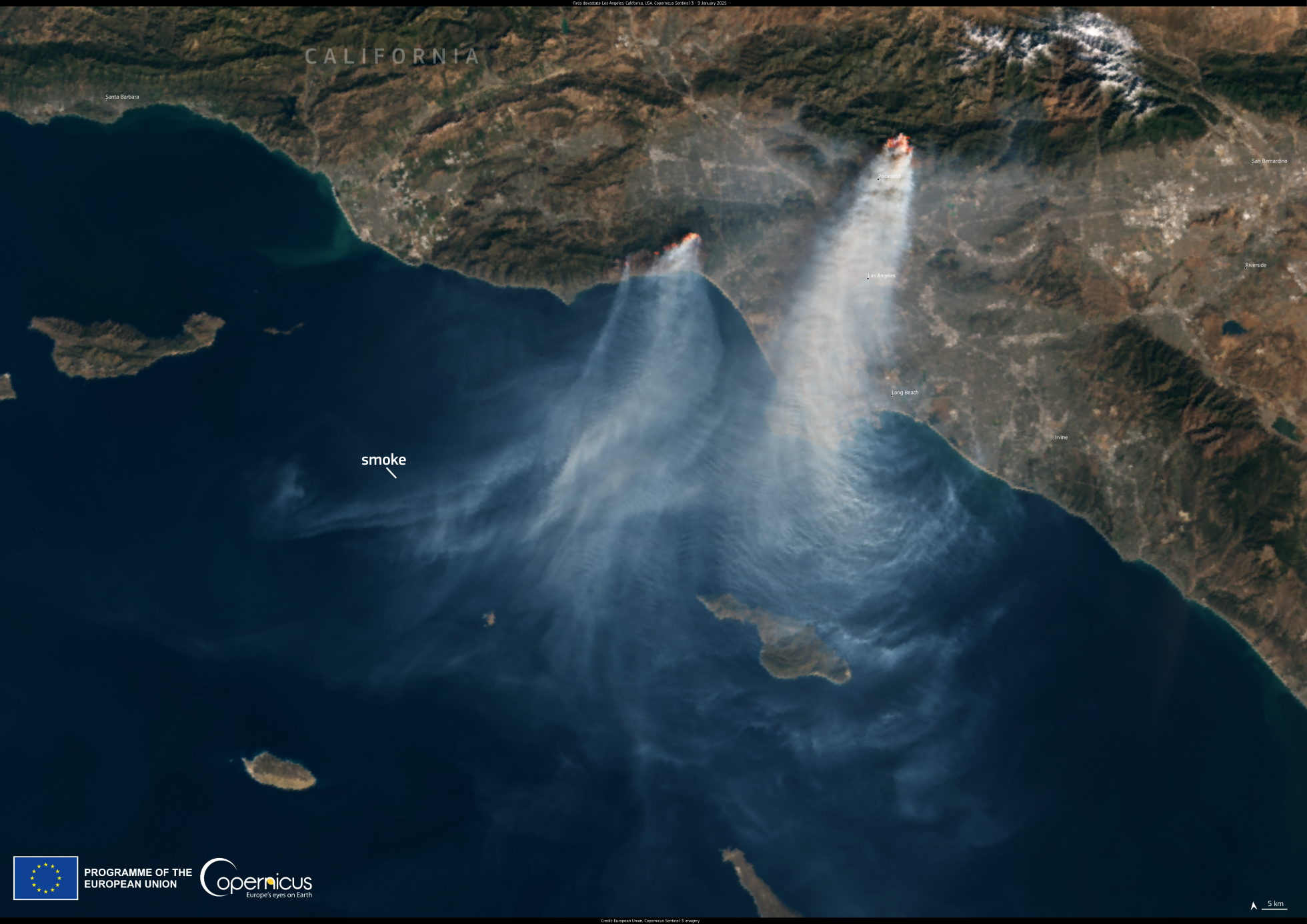
Satellite Image of Smoke Plumes from Palisades and Eaton Wildfires – Los Angeles County – Southern California – January 7, 2025 Source : Copernicus European Union
On Tuesday, January 7th, in Los Angeles, our year began with wildfire like no other. I first learned about the Palisades Fire, which ignited at 10:30 a.m. in the affluent Pacific Palisades neighborhood, when I tuned into our local TV news broadcast at noon that day. At that moment, I was not alarmed. Like earthquakes, wildfires all year round have become a part of living in California. Besides, this was not the first wildfire in this area. On December 9th, 2024, the Franklin Fire had set more than 4,000 acres (16 square kilometers) ablaze in neighboring Malibu over nine days.
When I tuned in again that evening around eight o’clock, I was shocked to learn that a second wildfire, named the Eaton Fire, had ignited further inland in Altadena, a working-class community just north of Pasadena, where the New Year’s Day Tournament of Roses Parade had celebrated “Best Day Ever!” as its theme for 2025. Who knew then, that the best day ever would end in tragedy seven days later for thousands of Altadena residents?
Even more alarming, the Palisades Fire, driven by exceptionally fierce Santa Ana winds blowing offshore from over the San Gabriel Mountains, was spreading like the fiery breath of an angry dragon. On following the local live newsfeed, I learned that an Evacuation Order went out for an area in the neighboring city of Santa Monica on the southeastern edge of the fire. My heart fluttered. The Palisades Fire was advancing closer to our home. How could this be happening?
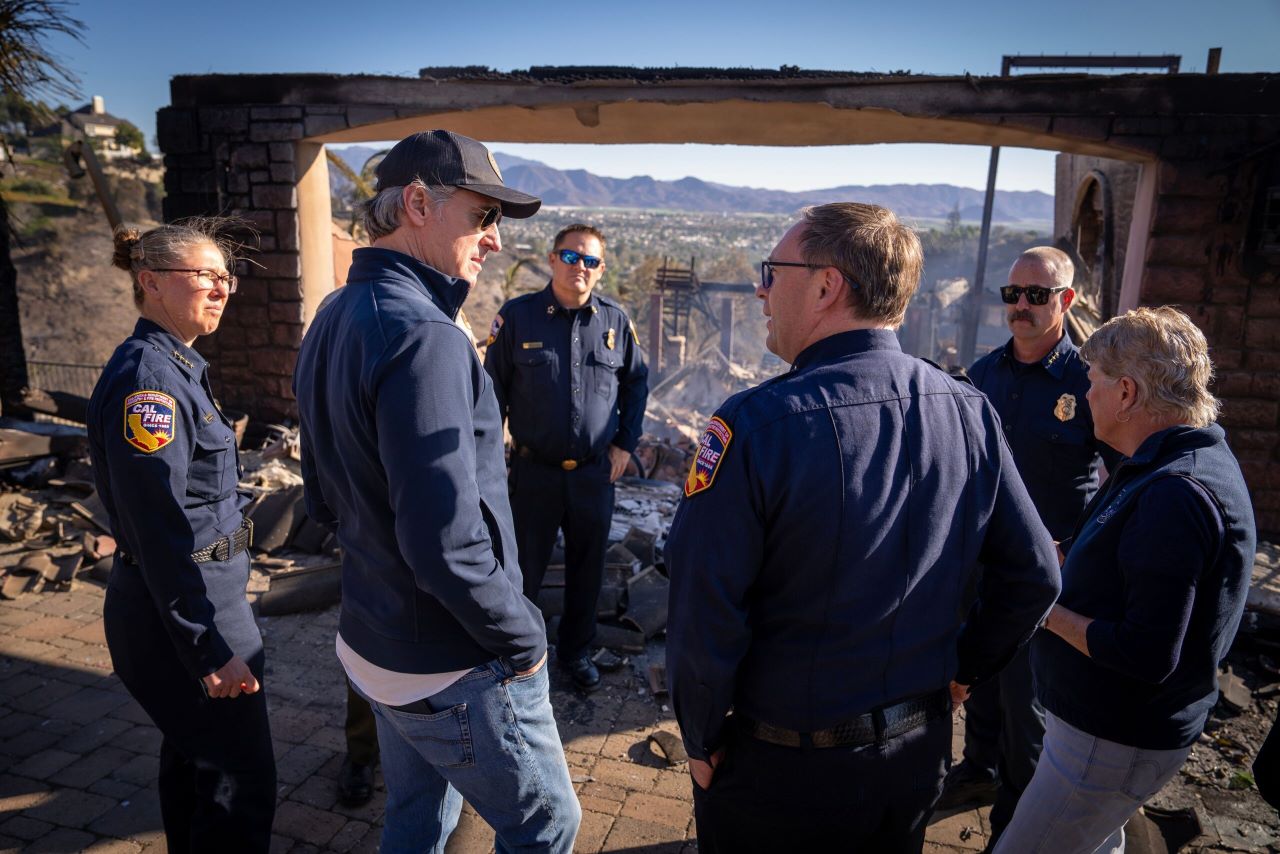
California Governor Gavin Newson (second from left) visits the Mountain Fire disaster area – Ventura County – Southern California – November 7, 2024 Photo Credit: Official Website of Governor Gavin Newsom
“We are on the brink of an irreversible climate disaster,” they warn. “This is a global emergency beyond any doubt. Much of the very fabric of life on Earth is imperiled. We are stepping into a critical and unpredictable new phase of the climate crisis.”
Why the bleak prognosis? Of the 35 “planetary vital signs” they use to track the climate emergency, 25 are at record extremes. These include U.S. heat-related mortality, fossil fuel subsidies, coal and oil consumption, carbon dioxide emissions, per-capita meat production, global tree cover loss due to fires, ocean acidity and heat content change, glacier thickness change, and ice mass change in Antarctica and Greenland.
As demonstrated in “Table 1: Recent Climate Disasters from November 2023 to August 2024,” they emphasize the rapidly escalating climate-related impacts of our global failure to support a rapid and socially just fossil fuel phasedown. Not included in this list are the supercharged Hurricanes Helene and Milton that developed in the Gulf of Mexico in late September during publication of their report. Unforeseen, too, are the flash floods in Spain on October 29th triggered by an “extraordinary deluge” that dumped twenty months of rain in just eight hours. Sounds familiar?
My heart goes out to all the folks whose lives have been upended by Hurricanes Helene and Milton. As the warming of Earth’s oceans and atmosphere continues unabated—due to humanity’s inability to reduce our dependency on fossil fuels—tropical storms have become supercharged and more destructive over a much wider area.
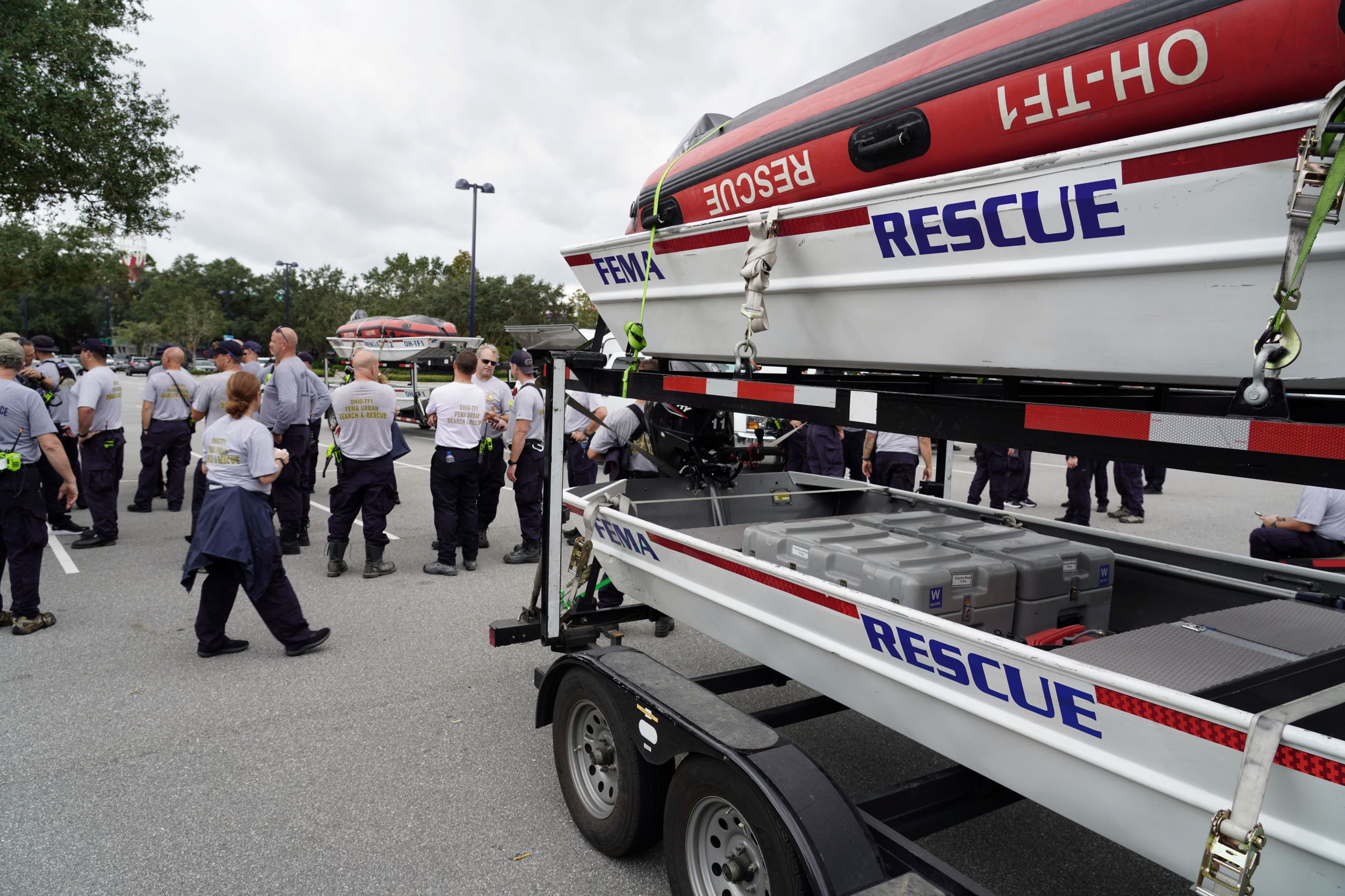
Such was the case recently when America’s southeastern states were hit by Hurricanes Helene (September 26-28) and Milton (October 9-10). It’s not just their wind speeds that make these storms deadly. Their size, speed, and capacity to hold more moisture can wreak havoc over more extensive areas. What’s more, their rapid intensification has alarmed our meteorologists. Within just two days, the unusually warm water of the Gulf of Mexico transformed Hurricane Helene from a relatively weak tropical storm into a historic Category 4 hurricane for this time of the year. Not to be outdone, Hurricane Milton took just over 48 hours to intensify from a tropical depression to a Category 5 Hurricane, according to NOAA Climate.gov. This is bad news. Millions of people in their projected path may not have sufficient time in which to evacuate to safety.



 Three Worlds One Vision
