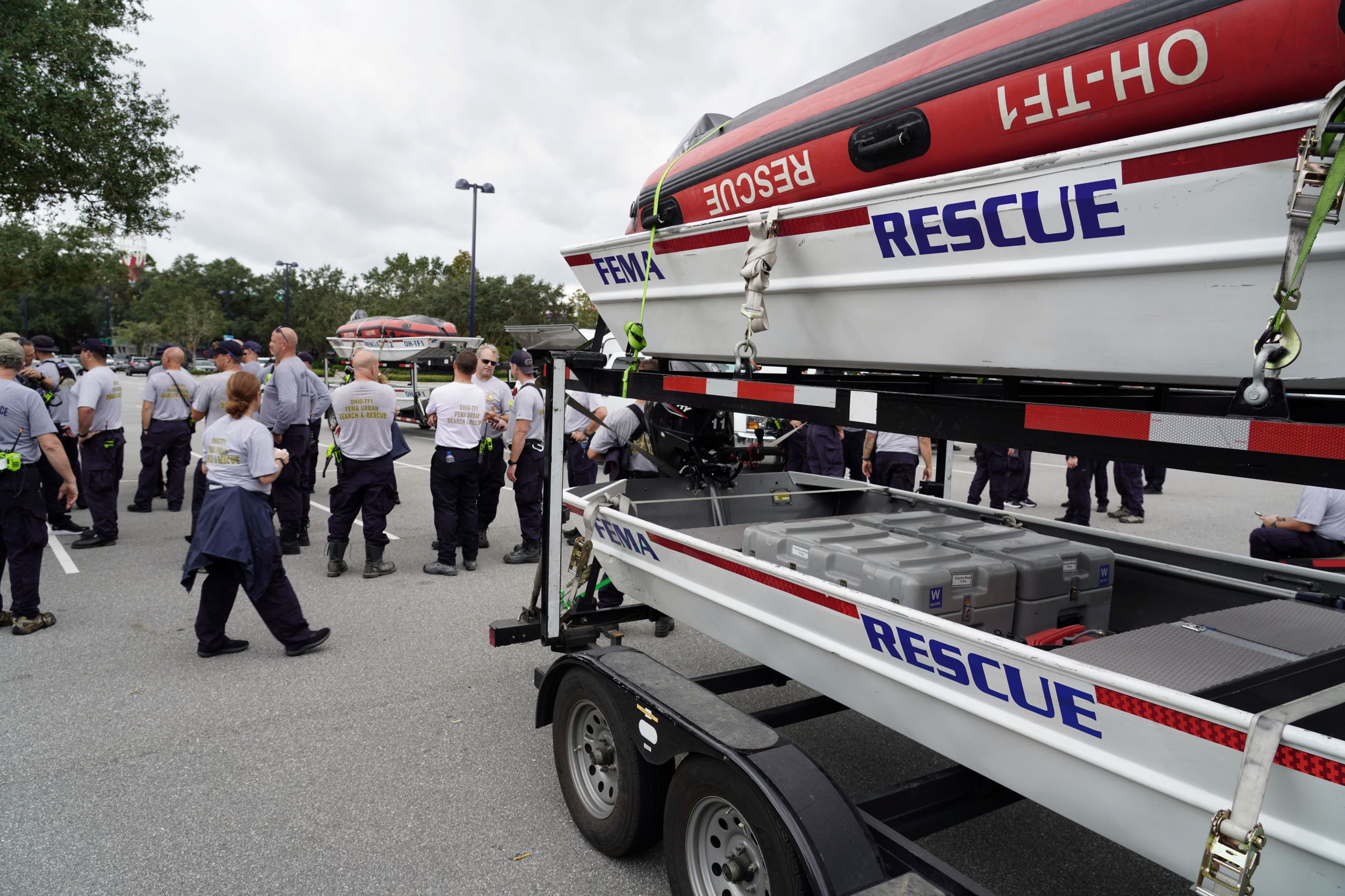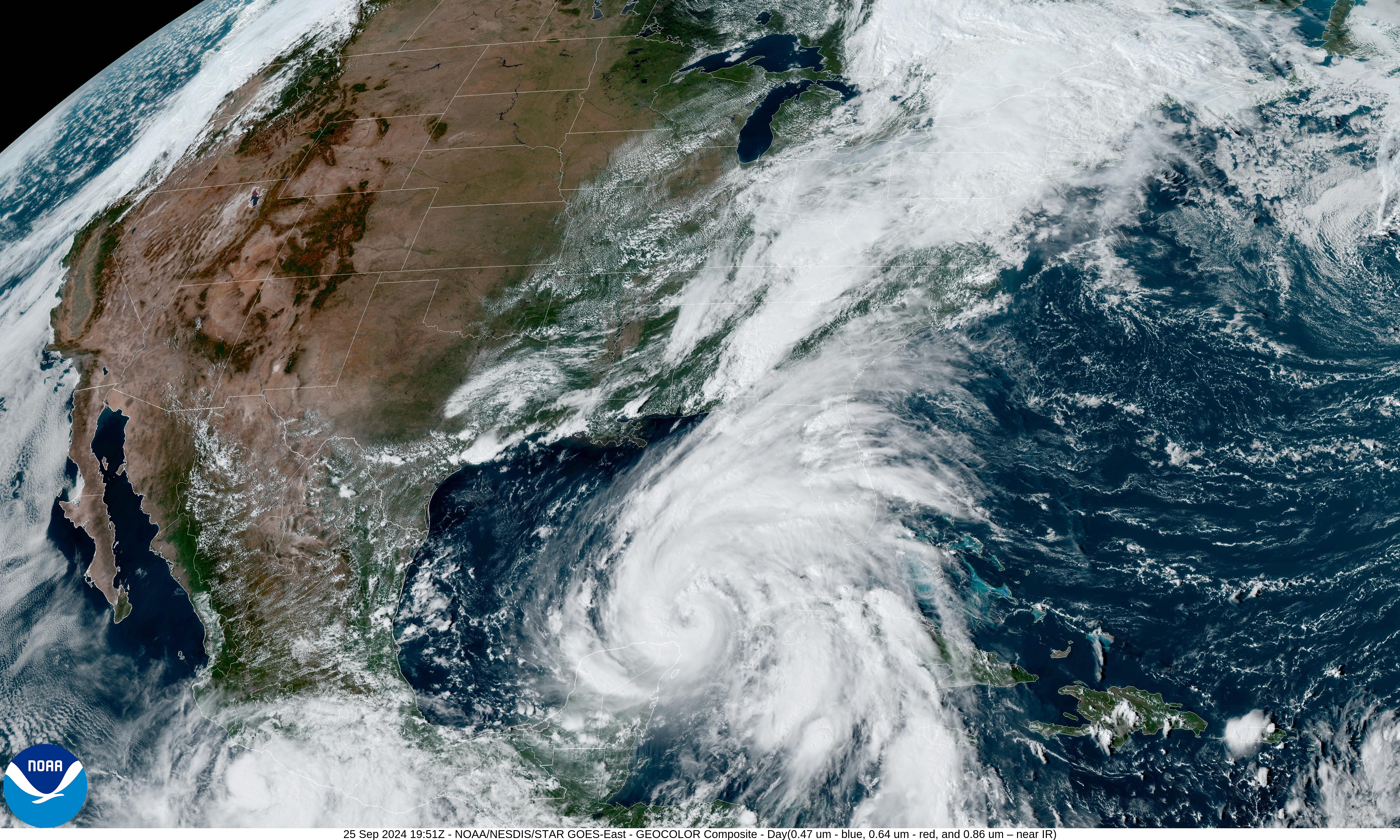
My heart goes out to all the folks whose lives have been upended by Hurricanes Helene and Milton. As the warming of Earth’s oceans and atmosphere continues unabated—due to humanity’s inability to reduce our dependency on fossil fuels—tropical storms have become supercharged and more destructive over a much wider area.
Such was the case recently when America’s southeastern states were hit by Hurricanes Helene (September 26-28) and Milton (October 9-10). It’s not just their wind speeds that make these storms deadly. Their size, speed, and capacity to hold more moisture can wreak havoc over more extensive areas. What’s more, their rapid intensification has alarmed our meteorologists. Within just two days, the unusually warm water of the Gulf of Mexico transformed Hurricane Helene from a relatively weak tropical storm into a historic Category 4 hurricane for this time of the year. Not to be outdone, Hurricane Milton took just over 48 hours to intensify from a tropical depression to a Category 5 Hurricane, according to NOAA Climate.gov. This is bad news. Millions of people in their projected path may not have sufficient time in which to evacuate to safety.
NATIONAL OCEANIC AND ATMOSPHERIC ADMINISTRATION (NOAA)
Break Up NOAA. The single biggest Department of Commerce agency outside of decennial census years is the National Oceanic and Atmospheric Administration, which houses the National Weather Service, National Marine Fisheries Service, and other components. NOAA garners $6.5 billion of the department’s $12 billion annual operational budget and accounts for more than half of the department’s personnel in non-decadal Census years (2021 figures).
NOAA consists of six main offices: The National Weather Service (NWS); The National Ocean Service (NOS); The Oceanic and Atmospheric Research (OAR); The National Environmental Satellite, Data and Information Service (NESDIS); The National Marine Fisheries Service (NMFS); and The Office of Marine and Aviation Operations and NOAA Corps.
Together, these form a colossal operation that has become one of the main drivers of the climate change alarm industry and, as such, is harmful to future U.S. prosperity.This industry’s mission emphasis on prediction and management seems designed around the fatal conceit of planning for the unplannable. That is not to say NOAA is useless, but its current organization corrupts its useful functions. It should be broken up and downsized.[Emphasis mine.]
[…]
Focus the NWS on Commercial Operations. Each day, Americans rely on weather forecasts and warnings provided by local radio stations and colleges that are produced not by the NWS, but by private companies such as AccuWeather. Studies have found that the forecasts and warnings provided by the private companies are more reliable than those provided by the NWS.
The NWS provides data the private companies use and should focus on its data-gathering services. Because private companies rely on these data, the NWS should fully commercialize its forecasting operations.
Thomas F. Gilmanserved as Assistant Secretary of Commerce for Administration and Chief Financial Officer of the U.S. Department of Commerce in the Trump Administration. Currently, he is a Director of ACLJ Action and Chairman of Torngat Metals. Gilman is the former CEO of Chrysler Financial and has had a 40-plus year career as a senior executive and entrepreneur in the global automotive industry, including roles at Chrysler Corporation, Cerberus Capital Management, Asbury Automotive Group, TD Auto Finance, and Automotive Capital Services. He holds a BS in finance from Villanova University.
The National Oceanic and Atmospheric Administration (NOAA) is one of six agencies falling under the umbrella of the U.S. Department of Commerce. The agency’s mission is “to provide daily weather forecasts, severe storm warnings, climate monitoring to fisheries management, coastal restoration, and the supporting of marine commerce. NOAA’s products and services support economic vitality and affect more than one-third of America’s gross domestic product. NOAA’s dedicated scientists use cutting-edge research and high-tech instrumentation to provide citizens, planners, emergency managers and other decision makers with reliable information they need when they need it.”
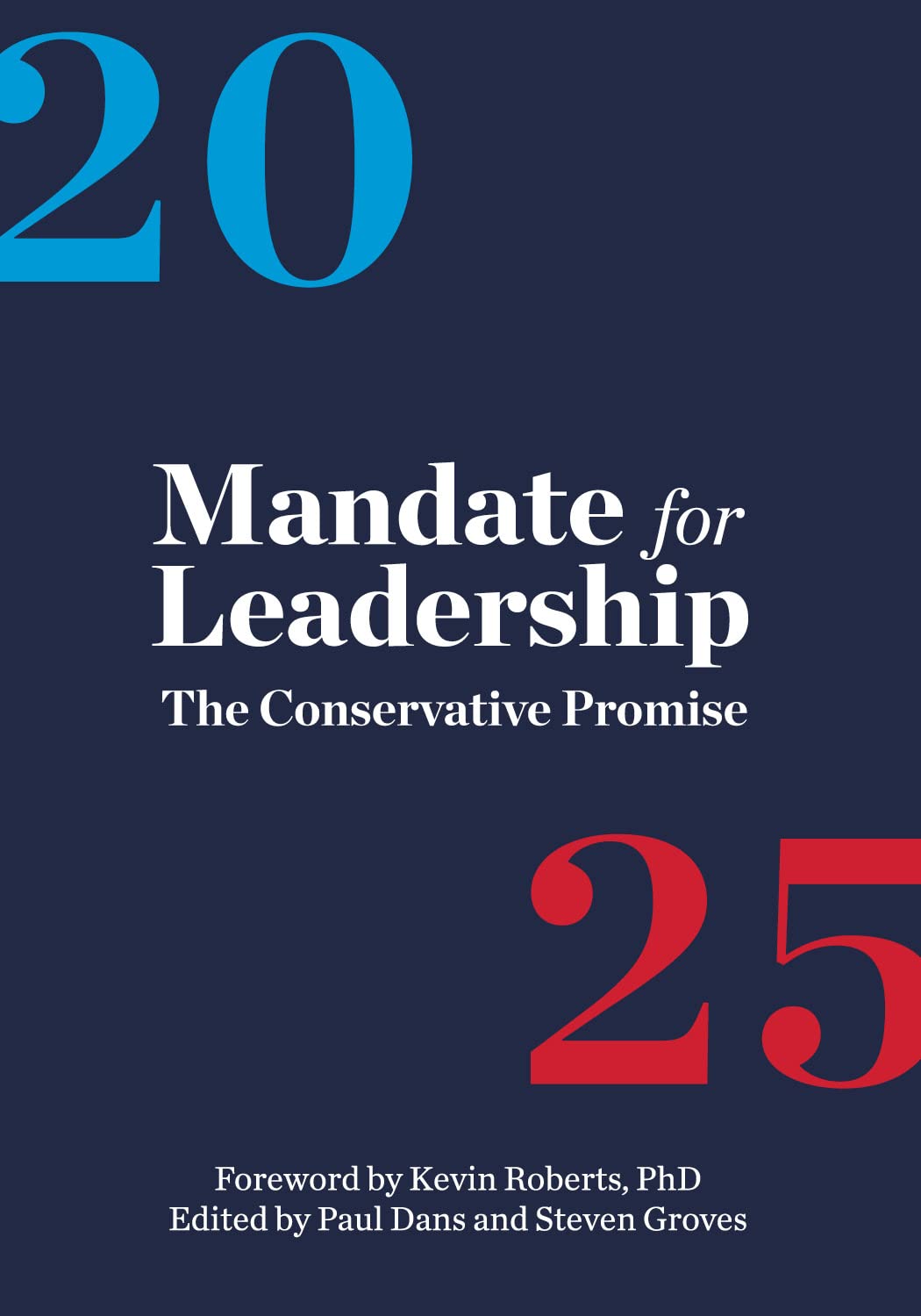
Front Cover: Mandate for Leadership 2025: The Conservative Promise by the Heritage Foundation Photo Credit: The Heritage Foundation
The new energy crisis is caused not by a lack of resources, but by extreme “green” policies. Under the rubrics of “combating climate change” and “ESG” (environmental, social, and governance), the Biden Administration, Congress, and various states, as well as Wall Street investors, international corporations, and progressive special-interest groups, are changing America’s energy landscape. These ideologically driven policies are also directing huge amounts of money to favored interests and making America dependent on adversaries like China for energy. In the name of combating climate change, policies have been used to create an artificial energy scarcity that will require trillions of dollars in new investment, supported with taxpayer subsidies, to address a “problem” that government and special interests themselves created.
Highlighted below are the major proposals presented in Chapter 12 that place our current climate change policies at risk:
Eliminate the Office of Energy Efficiency and Renewable Energy (EERE) which focuses on climate change and green subsidies and sets energy efficiency standards for appliances. If EERE cannot be eliminated, its budget should be reduced (pp 378-379). [Learn more about EERE at http://www.energy.gov/eere/office-energy-efficiency-renewable-energy%5D
End the role of the Grid Development Office (GDO) in grid planning for the benefit of renewable energy developers and defund most of its programs (pp 380-381). [Learn more about GDO at http://www.energy.gov/gdo/grid-deployment-office%5D
Eliminate the Office of Clean Energy Demonstrations (OCED) established in December 2021 “[to] deliver clean energy demonstration projects at scale in partnership with the private sector to accelerate deployment, market adoption, and the equitable transition to a decarbonized energy system” (pp 381-382). [Learn more about OCED at http://www.energy.gov/oced/office-clean-energy-demonstrations%5D
Eliminate the Clean Energy Corps, charged with delivering a more equitable clean energy future for the American people, by revoking funding and eliminating all positions and personnel hired under the program (p 386). [Learn more about the Clean Energy Corps at http://www.energy.gov/CleanEnergyCorps%5D
Bernard L. McNamee is an energy and regulatory attorney with a major law firm and was formerly a member of the Federal Energy Regulatory Commission. He is also the Street Distinguished Visiting Professor of Law at the Appalachian School of Law. In addition to serving as a Federal Energy Regulatory Commissioner, McNamee has served in various senior policy and legal positions throughout his career, including at the U.S. Department of Energy, for U.S. Senator Ted Cruz, and for Virginia Governor George Allen. McNamee also served four attorneys general in two states (Virginia and Texas).
Front Cover: Eye of the Storm: Facing Climate and Social Chaos with Calm and Courage by Terry Lepage Photo Credit: Open Door Communication (USA, 2023)
[D]ue to the baked-in heating of the planet, we are experiencing ever-increasing regional catastrophes across the globe from storms, fires, floods, droughts, crop failures, and heat waves. A barrage of local, regional, and specific collapses on an uncertain time frame against a background of more general decline seems to be in store, rather than one grand collapse…. This is the storm we face.
Fear is contagious, calm is contagious, and courage is contagious. Those of us who have some idea of what is unfolding can prepare ourselves mentally, emotionally, and spiritually to be (as we are able) centers of calm, compassion, and courage. We can be ready to coach others to hold onto their values in hard times. Because we will have pre-processed some of the loss that others will deny for a while longer, we will be able to support them when they finally face what comes.
Excerpt from Eye of the Storm: Facing Climate and Social Chaos with Calm and Courage by Terry Lepage, Open Door Communication, California, USA, 2023 (pp. 11 & 12).
Terry LePage creates spaces for connection, healing, insight, and inspiration. With a PhD in chemistry and a Master of Divinity, she combines heart and head with her clear and insightful writing, speaking, and facilitation. She has worked as a research chemist, transitional minister, and hospice chaplain. She currently lives in Southern California and facilitates Nonviolent Communication practice groups, grief circles, and social justice groups both locally and for the international Deep Adaptation Forum.
Jamaican American Poet Geoffrey Philp Photo Credit: Vanessa Diaz / National Library of Jamaica
MyPoetry Corner February 2024 features the title poem “Archipelagos” from the poetry collection Archipelagos by poet and novelist Geoffrey Philp, published by Peepal Tree Press (UK, 2023). Born in 1958 in Kingston, Jamaica, Philp left the Caribbean Island nation in 1979 to attend the Miami Dade College in the United States. After graduation, he studied Caribbean, African, and African American literature. As a James Michener Fellow at the University of Miami, he studied poetry with Kamau Brathwaite and fiction with George Lamming.
Philp is the author of seven books of poetry, two books of short stories, a novel, and two children’s books. In 2022, he was awarded the Silver Musgrave Medal by the Institute of Jamaica for outstanding merit in literature. That same year, he also received the Marcus Garvey Award for Excellence in Education. A retired Miami Dade College professor, he lives in Miami, Florida.
The publisher Peepal Tree Press describes Philp’s poetry collection Archipelagos as “a call to arms that opens out the struggle for human survival in the epoch of the Anthropocene to remind us that this began not just in the factories of Europe but in the holds of the slave ships and plantations of the Caribbean…. Philp’s powerful and elegant poems span past and present and make it very clear that there cannot be a moral response to the climate crisis that is not also embedded in the struggle for social justice, for overcoming the malignancies of empire and colonialism and the power of global capitalism—the missions of the West that always had and still have at their heart the ideology of white supremacy and a capitalism endlessly voracious for the world’s human and natural resources.”
Storm Damage from mudslide – Studio City – City of Los Angeles – Southern California – February 5, 2024 Photo Credit: David Crane / Associated Press
The sun is out again. Alleluia! Beginning last Sunday and throughout Monday, Tuesday, and Wednesday, the Pineapple Express atmospheric river unloaded its burden across California. Don’t get me wrong: We need the rain to replenish our state’s depleted reservoirs after years of drought. Is it asking too much not to have the rain all at once? Consider downtown Los Angeles. Within just four days, the area was drenched with more than 8 inches (20 cm) of rain. That’s more than half of the area’s normal annual rainfall of 14.25 inches (36 cm).
We were well warned ahead of the onslaught. To ensure our city had the required resources to respond to the storm’s impacts, on Monday, February 5th, our Mayor Karen Bass signed a Declaration of Local Emergency throughout the City of Los Angeles. Flooding, fallen trees, and hundreds of mudslides were merciless to everything and everyone in their path. I give thanks that our neighborhood was spared from such devastating blows. At our apartment complex, the lawn and garden plots are fully saturated. Some plants thrive in such weather. Others, like some of my succulents, not so much.
Extreme climate change events have become more frequent and severe. How the gods must laugh at human ineptitude in connecting the dots between our behavior and our environment! We can no longer have it all. Yet, we persist in our self-destructive ways of being and doing. Drill, Baby, Drill!
Hurricane Idalia hits Florida with 125 mph winds – USA – August 30, 2023 Photo Credit: AP News (Photo/Daniel Kozin)
This is the sixth and final part of my series of reflections on the “c-o-s-m-o-s remedy” proposed in opposition to the “ideology of e-s-c-a-p-e” by Jem Bendell in Deep Adaptation: Navigating the Realities of Climate Chaos (UK/USA 2021).
In contrast to the habit of Exceptionalism in e-s-c-a-p-e ideology, which means assuming ‘I am annoyed in this world because much about it upsets me and so I believe I’m better and/or needed…,’ Bendell proposes that Solidarity involves acting from the part of you that knows ‘our common sadness and frustration arise from our mutual love for all life and motivate us towards fairness, justice and healing’ (p. 147).
Solidarity is defined as unity (as a group or class) that produces or is based on community of interests, objectives, and standards (Merriam-Webster Dictionary). As he so often does, Bendell calls us to look at the essence of what drives our shared sense of solidarity as a group or class.
For some unknown reason, I do not use the word ‘solidarity.’ Yet, I’m very familiar with the word since my childhood growing up in then British Guiana during the 1950s and 1960s. Whenever I hear the word, I immediately recall the song “Solidarity Forever” that played every day on our local radio stations. Though I don’t remember the verses, I can still sing the chorus:
Solidarity forever! Solidarity forever! Solidarity forever! For the Union makes us strong!
I later learned that it was the anthem of the workers’ unions, mainly the agricultural workers, who were fighting for better wages, workplace safety, and living conditions. Could it be that I associate the word with its negative images of danger to one’s safety?
In those early days of my youth, the managers and owners of the sugar plantations and factories across the colony were hostile towards striking workers. They were known to hire thugs to terrorize the workers on the picket line. To join picket lines in a show of solidarity came with the risk of losing one’s job, being beaten, teargassed, or even killed. Such risks did not change when we became an independent nation in May 1966.
Father Bernard Darke SJ (left) flees from armed thug (bottom right) – Guyana – July 14, 1979 Photo Credit: Wikipedia from Jesuits.org.uk
On Saturday morning, July 14, 1979, after celebrating Mass and having his breakfast, Father Bernard Darke SJ spent the morning marking examination papers at the Catholic high school where he taught the Scriptures and Mathematics. As Scouts Master, the British Jesuit priest also made plans with some of the scouts for their annual camp. At the request of the Editor of the Catholic Standard newspapers, he had his cameras with him to take photos of a political demonstration to be held outside the Magistrates’ Court.
During a period of civil rebellion against the dictatorship government, leading members of the opposition party Working People’s Alliance (WPA) had been arrested and charged with burning down the building housing the Ministry of National Development. As peaceful demonstrators marched along the street heading towards the court, Father Darke stood on the sidelines, in front of the school building, taking photographs.
The demonstrators were about 65 feet (20 meters) away from him when thugs, armed with wooden staves, cutlasses, and knives, charged into the picket line. The crowd scattered in all directions. Father Darke captured the confusion with his camera. Across the two-lane roadway, three men attacked the Assistant Editor of the Catholic Standard newspapers, who was covering the story. After receiving a blow to the head, the Assistant Editor fell to the ground, bleeding. In taking photos of the attack, Father Darke became the next target. He tried fleeing to safety, but the two cameras slung around his neck slowed him down. After beating him to the ground with wooden staves, one of the three assailants stabbed him in the back with an old bayonet. That evening, shortly after 6:00 p.m., he died in hospital from a ruptured lung.
Serving in the Guyana Mission since 1960, Father Bernard Darke SJ (1925-1979) was a quiet man who did not seek attention. He served in the Royal Navy during World War II and joined the Jesuit Order in 1946. His killing in broad daylight shook us all in the Catholic community.
Working for change in unjust social, economic, and political systems involves taking life-changing risks. Solidarity can come with a steep price. I don’t join picket lines or take part in mass public demonstrations. I lack such courage. I prefer to contribute in quiet ways: speaking out, making posters and banners, spreading awareness, listening to and engaging with others, and changing my behavior.
Solidarity in our fight to save Earth’s pollinators and other endangered species! Solidarity in our fight for clean air and clean water! Solidarity in our fight to end humanity’s dependence on fossil fuels! Solidarity makes us strong!
NASA Earth Observatory image by Lauren Dauphin, based on data from NASA’s Goddard Institute for Space Studies.
Summer of 2023 was Earth’s hottest since global records began in 1880, according to scientists at NASA’s Goddard Institute of Space Studies (GISS) in New York.
The months of June, July, and August combined were 0.41 degrees Fahrenheit (0.23 degrees Celsius) warmer than any other summer in NASA’s record, and 2.1 degrees F (1.2 C) warmer than the average summer between 1951 and 1980. August alone was 2.2 F (1.2 C) warmer than the average. June through August is considered meteorological summer in the Northern Hemisphere.
This new record comes as exceptional heat swept across much of the world, exacerbating deadly wildfires in Canada and Hawaii, and searing heat waves in South America, Japan, Europe, and the U.S., while likely contributing to severe rainfall in Italy, Greece, and Central Europe.
Flooding following Tropical Storm Hilary – Death Valley National Park – California/USA – August 2023 Photo Credit: USA National Park Service (NPS/ N. Bernard)
This is the fifth in my six-part series of reflections on the “c-o-s-m-o-s remedy” proposed in opposition to the “ideology of e-s-c-a-p-e” by Jem Bendell in Deep Adaptation: Navigating the Realities of Climate Chaos (UK/USA 2021).
In contrast to the habit of Progress in e-s-c-a-p-e ideology, which involves thinking and feeling that ‘the future must contain a legacy from me, or make sense to me now, because if not, then when I die, I would die even more…,’ Bendell proposes that Oneness awareness involves sensing ‘what is important is how I live more lovingly right here and now, without needing to believe that I matter or am improving’ (pp.146-147).
Oneness is defined as the quality or state or fact of being one: such as singleness, integrity/wholeness, harmony, identity, and unity/union (Merriam-Webster Dictionary). The oneness that Bendell refers to is much deeper in meaning: that feeling of interconnectedness that expands our awareness of the inherent goodness of all beings. We feel part of something greater. We see beauty everywhere, in everyone, and everything.
Front Cover: All Hell Breaking Loose: The Pentagon’s Perspective on Climate Change by Michael T Klare Photo Credit: Macmillan Publishing Group (2019)
[T]he American military leadership has devised its own distinctive analysis of the climate change threat to U.S. and world security. In contrast to scientific and environment assessments, which tend to begin with warming’s threat to vulnerable wildlife and natural habitats, the military’s analysis begins with the threat to human systems—both physical (energy infrastructure, medical facilities, communication and transportation networks) and organizational (governments, public services, community organizations). From this perspective, climate change presents its greatest harm not by hastening the extinction of endangered species but by decimating the vital systems upon which our communal life depends. When those systems fail, chaos and conflict ensue, triggering waves of human migrations and the violent resistance they often provoke. “Destruction and devastation from hurricanes can sow the seeds for instability,” former secretary of defense Chuck Hagel once explained. “Droughts and crop failures can leave millions of people without any lifeline, and trigger waves of mass migrations.”
Excerpt from All Hell Breaking Loose: The Pentagon’s Perspective on Climate Change by Michael T. Klare, Henry Holt and Company, New York, USA, 2019 (pp. 234-235).
Michael T Klare, the author of fifteen books, is the Five College Professor Emeritus of Peace and World Security Studies at Hampshire College and a senior visiting fellow at the Arms Control Association. He holds a B.A. and M.A. from Columbia University and a PhD from the Graduate School of the Union Institute. He has written widely on U.S. military policy, international peace and security affairs, the global arms trade, and global resource politics. He lives in Northampton, Massachusetts.
Department of Defense, Office of the Undersecretary for Policy (Strategy, Plans, and Capabilities). Department of Defense Climate Risk Analysis. Report Submitted to National Security Council. 2021.