• About

Three Worlds One Vision

~ Guyana – Brazil – USA

Three Worlds One Vision

Author Archives: Rosaliene Bacchus

Space-time: A Cosmic Perspective of Man’s Entanglement

27 Sunday May 2018

Posted by Rosaliene Bacchus in Human Behavior, Poetry by Rosaliene Bacchus

≈ 22 Comments

Tags

Cosmic perspective of life, Einstein's theory of relativity, Jerusalem, Misogyny, Quantum entanglement, Racism, Space-time continuum, The Doomsday Machine by Daniel Ellsberg, World Peace, Xenophobia

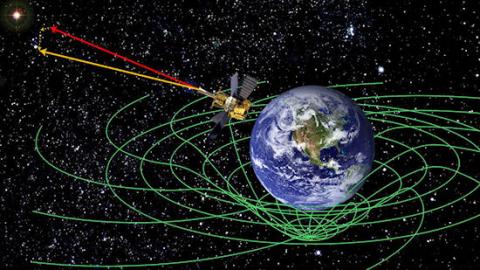
Artist conception of curved space-time around Earth - NASA

Artist’s conception of GP-B measuring the curved space-time around Earth
Photo Credit: NASA


Einstein’s theories of relativity
upending the way we view time.
Past – present – future but an illusion.
Time & space woven together
forming a four-dimensional fabric.
Space-time, Einstein called it.

Quantum entanglement defies physics.
Separate entangled photons
& they remain connected
mimicking the behavior of the other
at the same time.
Spooky action at a distance, Einstein called it.

What of Man made from stardust
of atoms & entangled photons
existing in space-time
mindless of his cosmic entanglement
and shared fate?

Misogyny – racism – xenophobia
expand space-time between photons
disrupting their entanglement.
Same but separate
yearning and friction without end.

America
rising from the detritus of war
splits the atom
unleashing humanity’s Doomsday Machine
in space-time.

Jerusalem
citadel of the gods
of Christians – Jews – Muslims
trapped in space-time
where past – present – future are one.

In space-time warped by Man
world peace is impossible.

Man of Earth
how do you undo
what can’t be disentangled?


LEARN MORE:
Space-time Continuum
http://einstein.stanford.edu/content/relativity/q411.html
Quantum Entanglement
http://www.livescience.com/28550-how-quantum-entanglement-works-infographic.html
The Doomsday Machine: Confessions of a Nuclear War Planner by Daniel Ellsberg (USA 2017)
http://www.ellsberg.net/doomsday-documents/


Extreme Weather and the Climate Crisis: What You Need to Know

20 Sunday May 2018

Posted by Rosaliene Bacchus in Anthropogenic Climate Disruption, United States

≈ 58 Comments

Tags

Climate Change, Climate Reality Project, Climate-related natural disasters, Extreme Weather & the Climate Crisis: What You Need to Know, Global warming, Jet Stream, NASA’s Carbon Monitoring System (CMS)

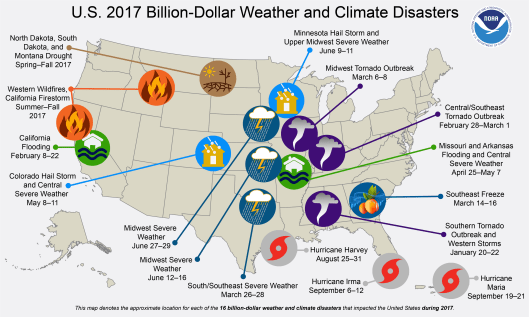
US 2017 Billion-Dollar Disaster Map - NOAA

U.S. 2017 Billion-Dollar Weather and Climate Disasters
Photo Credit: NOAA


Earlier this month, while the Trump administration quietly cancelled NASA’s Carbon Monitoring System (CMS), concentrations of carbon dioxide at the Mauna Loa Observatory averaged above 410 parts per million (ppm) throughout April. With such irresponsible action, we-the-people must prepare ourselves for more extreme weather.

Extreme Weather & the Climate Crisis: What You Need to Know, published by the Climate Reality Project (March 2018), helps us to understand the challenges we now face. As the captioned NOAA chart shows, climate-related and other natural disasters are costly. Total damages in 2017 left the U.S. with a bill of $306 billion. Families who were hit are still recovering from their loss. Families in poor communities may never recover.

Here’s what we need to know about our extreme weather and the climate crisis. Bear in mind that weather refers to short-term atmospheric changes in temperature, humidity, precipitation, wind, cloud cover, and visibility. Climate is the average of weather patterns over a longer period of 30 or more years.

Hurricanes – With average global sea surface temperatures becoming warmer, hurricanes can become more powerful. A warmer ocean also means an increase in evaporation, thereby feeding hurricanes with much more water to dump on those of us who live in their path. It gets worse. As melting ice caps and glaciers raise sea levels, storm surges caused by hurricanes will be stronger and carry water farther and farther inland.

Flooding – As air temperatures increase, more water evaporates into the atmosphere. Because warmer air holds more water vapor, some places get more rain and snow than their average annual amounts; other places may experience intense rainstorms. At the same time, rising sea levels are worsening coastal flooding worldwide.

Drought – Soils dry out when evaporation increases over land. When the rain comes, the hard, cracked ground absorbs little water. The run-off carries pollutants in the dry soil into our streams, rivers, and lakes. Drought also worsens forest fires.

Wildfires – Droughts kill plant life. Dried out, dead vegetation can ignite with a spark. Once started, these fires are harder to contain. With warm weather arriving earlier and extending further into the fall, we now face longer fire seasons. To make matters worse, pests like the mountain pine beetle thrive in the warm, dry weather. The dead trees dry out, adding to the fury of our forest fires.

Extreme Heat – Of the 18 hottest years on record, 17 have occurred this century. If we don’t reduce the greenhouse gases heating up our atmosphere, more and more of us will face the deadly threshold of extreme heat on our fragile human bodies.

Extreme Cold – As global temperatures rise and the Arctic continues to warm, the jet stream is slowing and becoming more wavy. This causes bone-chilling Arctic air to linger longer in northern regions and spread much farther south than usual.

While we cannot prevent climate-related natural disasters from occurring, it’s our responsibility to do everything we can to prevent the worst of it. And it certainly could get much worse.

Motherhood: Where is the joy?

13 Sunday May 2018

Posted by Rosaliene Bacchus in Family Life, Human Behavior, United States

≈ 38 Comments

Tags

Family relationships, Katy Talento/White House, Mother’s Day, motherhood

Today on Mother’s Day in America, families are celebrating the day with their mothers and grandmothers. While my sons will mark the day by joining me in activities I enjoy, I see no cause to celebrate motherhood.

Where is the joy of motherhood, I ask myself, when you live in fear of ICE agents separating you from your American-born children? Where is the joy in motherhood when your hours of labor value little to provide food and shelter for your children? Where is the joy in motherhood when intolerance, bullying, and hate put your children’s lives at risk? Where is the joy in motherhood when you watch your child suffer for lack of medical treatment?

Why, I ask myself, do we bring children into a hostile world that no longer fights for their right to life once they leave our womb? Why do we bring children into a world facing ecological collapse, climate disruption, and threat of nuclear war?

Speak to me not of love. Love protects and defends our young. Love nurtures.

I speak not to parents and grandparents who are doing their best, going beyond the possible. Rather, I speak to those among us who support laws and policies that favor corporations and billionaires and punish the families of our nation.

In an overpopulated world, motherhood has lost its meaning. Our uterus is for “baby-hosting.” Just ask Katy Talento on the White House team.


“Poems for the Men of Our Time” by Brazilian Poet Hilda Hilst

06 Sunday May 2018

Posted by Rosaliene Bacchus in Poetry

≈ 30 Comments

Tags

“Poemas aos Homens do Nosso Tempo” por Hilda Hilst, “Poems for the Men of Our Time” by Hilda Hilst, Brazilian poet, Father-daughter relationship, Hilda Hilst Institute, São Paulo/Brazil

Entrance to Hilda Hilst Institute - Casa do Sol - Campinas - Sao Paulo - Brazil

Entrance to Hilda Hilst Institute – Casa do Sol – Campinas – São Paulo – Brazil


My Poetry Corner May 2018 features an excerpt from “Poems for the Men of Our Time” (Poemas aos Homens do Nosso Tempo) by Brazilian poet, playwright, and novelist Hilda Hilst (1930-2004), born in Jaú in the interior of São Paulo, Southeast Brazil. Soon after her birth, her mother moved with her to Santos, a coastal city and port. Her father wanted a lover, not a wife. Having a girl child was “bad luck,” he told her mother. Hilda grew up determined to prove him wrong.

Hilda was seven years old when her mother revealed the truth: Her father suffered from paranoid schizophrenia. Her father’s mental illness and his frequent internment over the years, until his death in 1966, had a profound effect on her poetry and fiction which often drew upon themes of intimacy and insanity with elements of magical realism.

I initiated dialogue a thousand times. It is hopeless.
I prepare and accept myself
Flesh and spirit undone. We could try,
My father, the unequal and tortured poem,
And embrace each other in silence. In secret.
~ Final stanza, “Of the joyful and very unhappy love – 1,” Exercises by Hilda Hilst, 2001.

Though her first love was poetry, like her father, Hilst followed her mother’s advice and studied law at the University of São Paulo (1948-1952). During this period, she published her first two poetry collections (1950 & 1951). After working for a year at an attorney’s office in São Paulo, she abandoned law for the writer’s life. Continue reading →

The Souls of Poor Folk: A National Call for Moral Revival

15 Sunday Apr 2018

Posted by Rosaliene Bacchus in Social Injustice, United States

≈ 39 Comments

Tags

A National Call for Moral Revival 2018, American Systemic Racism, Ecological Devastation in America, Institute for Policy Studies (USA), Poor People’s Campaign 2018, Poverty in America, The Souls of Poor Folk, The War Economy and Militarism in America

Poor Peoples Campaign - A National Call for Moral Revival 2018
Poor People’s Campaign: A National Call for Moral Revival
Photo Credit: Poor People’s Campaign


I’m finding it hard to stay abreast of all the upheaval triggered by our Twitter-in-Chief. His tweets and threats boggle my mind, create instability across our nation, and embolden our rivals and enemies overseas.

While our bombs turn the Middle East into rubble, people at the bottom rungs in America face their own hell. This month, the Institute for Policy Studies has published its empirical study, The Souls of Poor Folk, highlighting the complex issues that entangle our lives: systemic racism, persistent poverty, the war economy and militarism, and ecological devastation. Here are some of their key findings. Continue reading →

“This is My Meditation” – Poem by Guyanese-born Author & Poet Sir Wilson Harris

01 Sunday Apr 2018

Posted by Rosaliene Bacchus in Poetry

≈ 22 Comments

Tags

Abandonment by God, “Bookers Guiana”, Church & State, Georgetown/Guyana, Guyanese-born Author & Poet Sir Wilson Harris, Poem “This is My Meditation” by Sir Wilson Harris, Pre-Columbian Art by Aubrey Williams, Unanswered prayer, Waiting on God

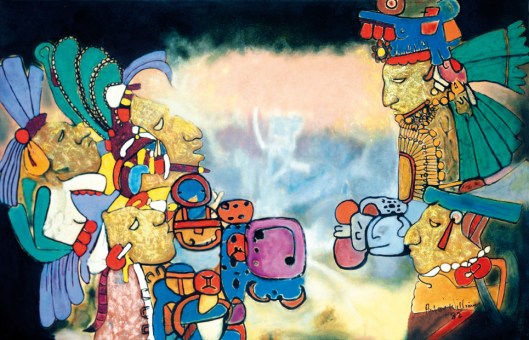
Dawn and Evening Star, Olmec Maya Series by Guyanese-born Artist Aubrey Williams, 1982

Dawn & Evening Star, Olmec Maya Series (1982) by Guyanese-born Artist Aubrey Williams
Source: October Gallery


On March 8th, Guyana’s illustrious literary writer, Sir Wilson Harris, died at the age of ninety-six in England where he had lived since 1959. Born in 1921 in New Amsterdam, British Guiana (now Guyana), Harris began his writing career as a poet, obtaining exposure through the colony’s literary magazine, Kyk-over-Al. My Poetry Corner April 2018 features one of these poems, “This is My Meditation,” published in 1947. Since I couldn’t find the original title of this poem, I’ve used the opening words as a substitute.

When he was two years old, Harris lost his father, “a well-off insurance businessman with a chauffeur-driven car.” His mother moved to the capital, Georgetown, and remarried. Six years later, tragedy struck again. His stepfather disappeared; believed drowned in the Interior.

“At almost the same time, I saw a beggar on a street corner, with holes in his face,” Harris tells Maya Jaggi (The Guardian, December 2006). “I came home and couldn’t eat – I never forgot that man.”

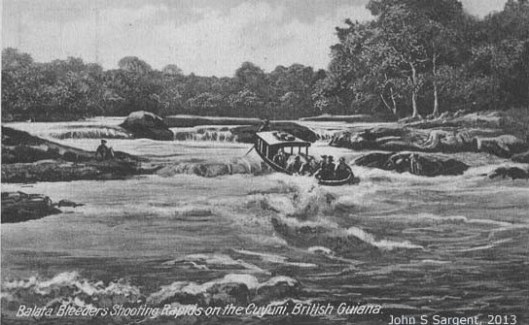
After completing his studies at Queen’s College, the prestigious secondary school for boys in Georgetown, Harris trained in land surveying and geomorphology. Beginning in 1942, his work as a government surveyor, charting the great rivers of the colony’s interior rainforest and savanna regions, changed his vision of man’s relation to the planet.

balata_bleeders_shooting_rapids_on_the_cuyuni,_british_guiana_c1908

Balata Bleeders Shooting Rapids on the Cuyuni River, Interior of British Guiana (c.1908)
Source: Overtown Miscellany UK/John S Sargent


“The shock of contrasts in river, forest, waterfall had registered very deeply in my psyche,” Harris tells Fred D’Aguiar (Bomb Magazine, January 2003). “So deeply that to find oneself without a tongue was to learn of a music that was wordless, to descent into varying structures upon parallel branches of reality, branches that were rooted in a stem of meaning for which no absolute existed.”

Of equal importance was his discovery of pre-Columbian myth and history gained through his contacts with the indigenous peoples in the region.

In his poem, “This is My Meditation,” the young poet calls out what he sees as the cruelty of the Christian God in the treatment of His beloved son, Jesus, left alone to suffer the painful and humiliating death by crucifixion. Continue reading →

The state as ultimate “landlord” of nonhuman nature

11 Sunday Mar 2018

Posted by Rosaliene Bacchus in Human Behavior, Nature and the Environment

≈ 26 Comments

Tags

Anthropocene or Capitalocene? Nature History and the Crisis of Capitalism Edited by Jason W Moore (2016), Capitalocene, Christian Parenti, Construction of Erie Canal, Environment-making, Political Ecology of the State

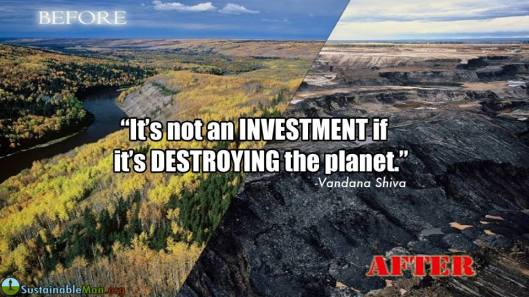
Athabasca Tar Sands - Alberta - Canada - Before and after arrival of oil companies

Athabasca Tar Sands – Alberta – Canada
Before and after arrival of oil companies


The third and final part of my series on the book, Anthropocene or Capitalocene? Nature, History, and the Crisis of Capitalism (Kairos Books, 2016), edited by Jason W. Moore, is a synopsis of Christian Parenti’s article on “Environment-Making in the Capitalocene Political Ecology of the State.” A sociologist and geographer, Christian Parenti is a professor of Global Liberal Studies at the New York University.

Parenti’s core argument is that “the state is an inherently environmental entity, and as such, it is at the heart of the value form.” Within its territorial borders, the modern state controls the surface of the earth – the biosphere. Continue reading →

How the web of life became Cheap Nature

25 Sunday Feb 2018

Posted by Rosaliene Bacchus in Human Behavior, Nature and the Environment

≈ 45 Comments

Tags

Anthropocene, Anthropocene or Capitalocene? Nature History and the Crisis of Capitalism Edited by Jason W Moore (2016), Artist and painter Mike Caimbeul, “Cheap Nature”, Capitalocene, Humans and the web of Life, Jason W Moore, Man and Nature, Rise of Capitalism

The Web of Life Reshaped - Painting by Mike Caimbeul

The Web of Life Reshaped – Painting by Mike Caimbeul
Photo Credit: Bongdoogle.com


Part Two of my series on the book, Anthropocene or Capitalocene? Nature, History, and the Crisis of Capitalism (Kairos Books, 2016), edited by Jason W. Moore, is a synopsis of Moore’s article on “The Rise of Cheap Nature.” In his article, he refers to two kinds of nature: nature with a common ‘n’ is the web of life; Nature with a capital ‘N’ is environments without humans.

Like Eileen Crist (Part One), Moore argues that we live in the “Age of Capital,” the Capitalocene. Until we understand that “capital and power do not act upon nature, but develop through the web of life,” we cannot formulate solutions for the environmental crises we now face.

Most people (myself included), Moore notes, still think about capitalism in economic terms – markets, prices, money, and the like. He proposes that we think about the rise of capitalism as a new way of organizing nature. We would start to consider capitalism not as world-economy but as world-ecology – the organization of work, re/production of nature, and the conditions of life as an organic whole for the accumulation of capital and pursuit of power. In other words, human activity is environmental-making.

Moore challenges the Anthropocene narrative that capitalism emerged in eighteenth-century England with the Industrial Revolution, powered by coal and steam. The focus on fossil fuels as the ignition for the growth of capital ignores the greatest landscape revolution in human history – in terms of speed, scale, and scope – that occurred in the three centuries after 1450.

The conquest of the Atlantic and appropriation of the New World brought vast expanses of “Cheap Nature” and the labor-power to create wealth. “Cheap” refers to the unpaid work/energy of organic life. Numbered among Cheap Nature – along with trees, soils, and rivers – were indigenous peoples, enslaved Africans, nearly all women, and even white-skinned men (Slavs, Jews, Irish) living in semi-colonial regions. These humans, deemed not Human, provided Cheap Labor.

By 1500, Spain alone had colonized an area greater than the whole of Europe and more than 25 million indigenous peoples. Sugar, the modern world’s original cash crop, fed on the work/energy of African slaves. Sugar production devoured forests and exhausted soils. Between 1570 and 1640, Brazilian sugar grew three percent every year. In northeastern Brazil at the height of the sugar boom in the 1650s, twelve thousand hectares of forest were cleared in a single year, as compared with 200 years in twelfth-century Europe.

Scientific advances made it possible to put the whole of nature to work for capital. “Science” revealed nature’s secrets for capital accumulation. “Economy” channeled the labor-power of the landless proletariat into the cash nexus of the labor market. The “state” enforced the cash nexus.

To maintain expanding commodity production required cheap, productive labor; cheap food to control the price of labor-power; cheap raw materials; and cheap energy for diverse industries. Fossil fuels, seemingly unlimited supplies of Cheap Nature, were put to work for the rapid expansion of capitalism.

Though rising costs of fossil fuel production and labor costs have shrunk sources of Cheap Nature and Cheap Labor, capitalism has managed to keep ahead with Cheap Nature strategies within reach of its power. (I think of low cost labor of America’s private prison population and the expanding gig economy.)

Moore concludes that financialization and extreme inequality are predictable results of the end of Cheap Nature. The web of life can no longer sustain capitalism’s world-ecology. Our strategies for liberation must not only determine how to redistribute wealth, but also “how to remake our place in nature in a way that promises emancipation for all life.”

How do humans fit into the web of Life?

18 Sunday Feb 2018

Posted by Rosaliene Bacchus in Human Behavior, Nature and the Environment

≈ 45 Comments

Tags

Anthropocene, Anthropocene or Capitalocene? Nature History and the Crisis of Capitalism Edited by Jason W Moore, Capitalocene, Eileen Crist, Humans and the web of Life, Jason W Moore, Man and Nature, Sixth Mass Extinction

Web of Life Quote from Chief Seattle


According to the tenets of Abrahamic religions – Judaism, Christianity, and Islam – Man is the crown of God’s creation, with dominion over all living species on the Earth (Genesis 1: 26-31). Thus empowered, Man has transformed Earth’s ecosystems with devastating effects on forests, rivers, lakes, seas, oceans, and all the non-humans that live therein. With our factories belching carbon into the atmosphere, global warming has become our new reality. The course is set for an unknown state in human experience.

In 2000, the atmospheric chemist and Nobel Laureate Paul Crutzen conceived the concept “Anthropocene” to denote a new geological time in which Man is a major geological force. But several geologists and environmentalists disagree with his word choice. Others believe we live in the age of capital, the “Capitalocene.”

Jason W. Moore, an environmental historian and historical geographer at Binghamton University, is one such social scientist. In his book, Anthropocene or Capitalocene? Nature, History, and the Crisis of Capitalism (Kairos Books, 2016), he and six other contributors argue that Capitalocene is a much more appropriate alternative. Concepts matter, he reiterates in his “Introduction,” since we use them to make sense of our world.

“The kind of thinking that created today’s global turbulence is unlikely to help us solve it,” Moore notes.

In this article, the first of a series, I share the contribution “On the Poverty of Our Nomenclature” by Eileen Crist, a sociologist and professor at Virginia Tech.

Crist argues that the concept of the Anthropocene reinforces human dominion over Nature, “corralling the human mind into viewing our master identity as manifestly destined, quasi-natural, and sort of awesome.” We arrogantly perceive ourselves on par with the tremendous forces of Nature. Such mentality empowers “the human enterprise” to manage the planet for production of resources and, through technological engineering, to contain the risks and ecological disasters.

She observes that Man’s historical records do not record the non-human others who don’t speak and have no control over their destinies. The sixth mass extinction, resulting from destruction of their habitats for human expansion, becomes just a casualty of history. We accept as normal the humanization of Earth, at the expense of its non-human inhabitants.

“Where is the freedom of humanity to choose a different way of inhabiting Earth, to change our historical discourse,” Crist asks.

Crist calls for humankind to end our species-supremacist civilization and become integrated with the biosphere. This would require an end to viewing our planet as an assortment of “resources” or “natural capital,” “ecosystem services,” “working landscapes,” and the like. While she does not envisage an end to human technological innovation, the sociologist has no idea what such a world would look like. In deindustrializing our relationship with land, seas, and domestic animals, we-humans would have a better chance of reversing the takeover of Nature for our own needs and appetites.

“In making ourselves integral, and opening into our deepest gift of safeguarding the breadth of Life, the divine spirit of the human surfaces into the Light,” Crist concludes.

“Theology of Junk” by Brazilian Poet Manoel de Barros

04 Sunday Feb 2018

Posted by Rosaliene Bacchus in Poetry

≈ 40 Comments

Tags

About Scrap Metal, Brazilian poet Manoel de Barros, Pantanal/Mato Grosso do Sul/Brazil, Teologia do Traste por Manoel de Barros, Theology of Junk by Manoel de Barros

Giant Water Lily - Victoria Amazonia - Pantanal - Mato Grosso do Sul - Brazil

Giant water lily, Victoria Amazonica – Pantanal – Mato Grosso do Sul – Center-West Brazil
Photo Credit: Andre Dib/WWF


My Poetry Corner February 2018 features the poem “Theology of Junk” (Teologia do Traste) by Brazilian poet, lawyer, and farmer Manoel de Barros (1916-2014). Born in Cuiába, Mato Grosso, he was a year old when his father decided to start a cattle ranch in Pantanal, the world’s largest wetland area, in Mato Grosso do Sul. The young Manoel grew up playing in the yard, between the pens and the “unimportant things” that would influence his poetry.

In “Manoel by Manoel,” he describes his childhood experience:

… I used to play pretending that stone
was lizard. That a can was a ship. That the sloth was a
little problematic creature and equal to a young grasshopper.
I grew up playing on the ground, among ants. Of a
childhood free and without comparisons. I had more
communion with things than with comparison.

When he moved to the city to go to school, Manoel found it a strange and complicated world. In the countryside, they had to make their own toys: small bone animals, sock balls, tin can cars. In “About Scrap Metal,” from his book Memories Invented for Children (2006), he observes:

I saw that everything that man makes becomes scrap metal: bicycle, plane, automobile. What doesn’t become scrap is only bird, tree, frog, stone. Even a spaceship becomes scrap metal. Now I think a white swamp heron is more beautiful than a spaceship. I beg your pardon for committing this truth.

Great uses for scrap metal
Photo Credit: Premier Metal Buyers

  Continue reading →

← Older posts
Newer posts →

Subscribe

  • RSS - Posts
  • RSS - Comments

Archives

  • March 2026
  • February 2026
  • January 2026
  • November 2025
  • October 2025
  • September 2025
  • August 2025
  • July 2025
  • June 2025
  • May 2025
  • April 2025
  • March 2025
  • February 2025
  • January 2025
  • December 2024
  • November 2024
  • October 2024
  • September 2024
  • August 2024
  • July 2024
  • June 2024
  • May 2024
  • April 2024
  • March 2024
  • February 2024
  • January 2024
  • December 2023
  • November 2023
  • October 2023
  • September 2023
  • August 2023
  • July 2023
  • June 2023
  • May 2023
  • April 2023
  • March 2023
  • February 2023
  • January 2023
  • December 2022
  • November 2022
  • October 2022
  • September 2022
  • August 2022
  • July 2022
  • June 2022
  • May 2022
  • April 2022
  • March 2022
  • February 2022
  • January 2022
  • December 2021
  • November 2021
  • October 2021
  • September 2021
  • August 2021
  • July 2021
  • June 2021
  • May 2021
  • April 2021
  • March 2021
  • February 2021
  • January 2021
  • December 2020
  • November 2020
  • October 2020
  • September 2020
  • August 2020
  • July 2020
  • June 2020
  • May 2020
  • April 2020
  • March 2020
  • February 2020
  • January 2020
  • December 2019
  • November 2019
  • October 2019
  • September 2019
  • August 2019
  • July 2019
  • June 2019
  • May 2019
  • March 2019
  • February 2019
  • January 2019
  • December 2018
  • November 2018
  • October 2018
  • September 2018
  • August 2018
  • July 2018
  • June 2018
  • May 2018
  • April 2018
  • March 2018
  • February 2018
  • January 2018
  • December 2017
  • November 2017
  • October 2017
  • September 2017
  • August 2017
  • July 2017
  • June 2017
  • May 2017
  • April 2017
  • March 2017
  • February 2017
  • January 2017
  • December 2016
  • November 2016
  • October 2016
  • September 2016
  • August 2016
  • July 2016
  • June 2016
  • May 2016
  • April 2016
  • March 2016
  • January 2016

Categories

  • About Me
  • Anthropogenic Climate Disruption
  • Brazil
  • Economy and Finance
  • Family Life
  • Festivals
  • Guyana
  • Health Issues
  • Human Behavior
  • Immigrants
  • Nature and the Environment
  • People
  • Philosophy
  • Poetry
  • Poetry by Rosaliene Bacchus
  • Recommended Reading
  • Relationships
  • Religion
  • Religion & Spirituality
  • Reviews – The Twisted Circle: A Novel by Rosaliene Bacchus
  • Reviews – Under the Tamarind Tree: A Novel by Rosaliene Bacchus
  • Save Our Children
  • Social Injustice
  • Technology
  • The Twisted Circle: A Novel by Rosaliene Bacchus
  • The Writer's Life
  • Uncategorized
  • Under the Tamarind Tree: A Novel by Rosaliene Bacchus
  • United States
  • Urban Violence
  • Women Issues
  • Working Life

Blogroll

  • Angela Consolo Mankiewicz
  • Caribbean Book Blog
  • Dan McNay
  • Dr. Gerald Stein
  • Foreign Policy Association
  • Guyanese Online
  • Writer's Digest
  • WritersMarket: Where & How to Sell What You Write

Meta

  • Create account
  • Log in
  • Entries feed
  • Comments feed
  • WordPress.com

Enter your email address to subscribe to this blog and receive notifications of new posts by email.

Join 3,232 other subscribers

Blog at WordPress.com.

Privacy & Cookies: This site uses cookies. By continuing to use this website, you agree to their use.
To find out more, including how to control cookies, see here: Cookie Policy
  • Subscribe Subscribed
    • Three Worlds One Vision
    • Join 3,232 other subscribers
    • Already have a WordPress.com account? Log in now.
    • Three Worlds One Vision
    • Subscribe Subscribed
    • Sign up
    • Log in
    • Report this content
    • View site in Reader
    • Manage subscriptions
    • Collapse this bar
 

Loading Comments...