• About

Three Worlds One Vision

~ Guyana – Brazil – USA

Three Worlds One Vision

Author Archives: Rosaliene Bacchus

The End of Ice: Bearing Witness and Finding Meaning in the Path of Climate Disruption by Dahr Jamail

17 Sunday Mar 2019

Posted by Rosaliene Bacchus in Anthropogenic Climate Disruption, Recommended Reading

≈ 68 Comments

Tags

Brazil’s National Institute of Amazonian Research (INPA), Climate disruption, Coral Bleaching, Global warming, Great Barrier Reef, Great Barrier Reef Legacy, Melting Alaskan Glaciers, Sea level rise, The End of Ice by Dahr Jamail
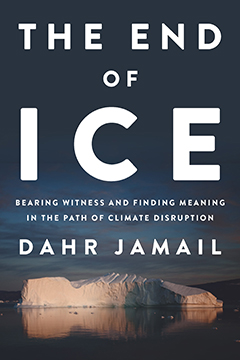
The End of Ice: Bearing Witness and Finding Meaning in the Path of Climate Disruption is a work of investigative journalism by Dahr Jamail, conducted during the period April 2016 to July 2017 on the front lines of human-caused climate disruption. Having lived in Alaska for ten years (1996-2006), Jamail had witnessed the dramatic impact of global warming on the glaciers there.

Jamail’s original aim was to alert readers about “the urgency of our planetary crisis through firsthand accounts of what is happening to the glaciers, forest, wildlife, coral reefs, and oceans, alongside data provided by leading scientists who study them.” His reporting took him to climate disruption hot spots in Alaska, California, Florida, and Montana in the United States; Palau in the Western Pacific Ocean; Great Barrier Reef, Australia; and the Amazon Forest in Manaus, Brazil. His grief at what was happening to nature made him realize that “only by having this intimacy with the natural world can we fully understand how dramatically our actions are impacting it.”

Below are excerpts of assessments expressed to the author by scientists and other professionals working on the front lines.
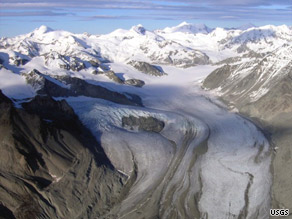
Gulkana Glacier – Alaska – USA
Photo Credit: U.S. Geological Survey (USGS)

The magnitude of change in Alaska is easy to miss because Alaska is such a massive state, and largely undeveloped. That is why you’ve had no idea that Alaska’s glaciers are losing an estimated 75 billion tons of ice every year.
~ Dr. Mike Loso, a physical scientist with the Wrangell-St. Elias National Park and Preserve, Alaska.

[The rate of melting of Montana’s glaciers] is an explosion, a nuclear explosion of geologic change. This is unusual, it is incredibly rapid and exceeds the ability for normal adaption. We’ve shoved it into overdrive and taken our hands off the wheel.”
~ Dr. Dan Farge, a U.S. Geological Survey (USGS) research ecologist and director of the Climate Change in Mountain Ecosystems Project, Montana.

This last summer [2015], the Gulf [of Alaska] warmed up 15℃ [59℉] warmer than normal in some areas… And it is now, overall, 5℃ [41℉] above normal in both the Gulf of Alaska and Bering Sea, and has been all winter long.
~ Bruce Wright, a senior scientist with the Aleutian Pribilof Islands Association (APIA) and former section chief for the National Oceanic and Atmospheric Administration (NOAA) for eleven years.

St. Paul Island – Pribilof Islands – Bering Sea – Alaska
Photo Credit: St. Paul Island Tour

We hardly eat seals anymore, or the birds, and people now get food stamps and social handouts and welfare and shop at the store. When I grew up, we didn’t need any of that because we always had seals and birds and fish to eat. If the fur seals aren’t here, neither will we be.
~Jason Bourdukofsky Sr., the president of TDX, Alaska’s native corporation on St. Paul Island, Pribilof Islands, Bering Sea.
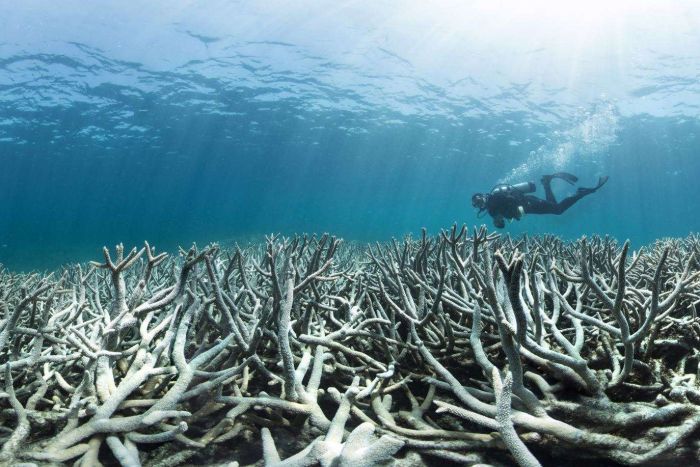
Bleached Coral – Great Barrier Reef – Australia
Photo Credit: Great Barrier Reef Legacy

The warming [of the oceans] we’re seeing now is happening far too fast to allow for [coral] evolution…. So what we’re seeing now is death. That’s what [coral] bleaching is…. Right now the largest ecosystem on Earth is undergoing its death throes and no one is there to watch it.
~ Dr. Dean Miller, a marine scientist and director of science and media for Great Barrier Reef Legacy, Australia.

Even if your home [in South Florida] may be elevated, all the infrastructure and freshwater and sewage treatment and getting rid of the sewage…all of this infrastructure is critically vulnerable to sea level rise.
~ Dr. Ben Kirtman, one of the leading sea level experts in the world and program director for the Climate and Environmental Hazards program at the University of Miami’s Center for Computational Science.

Sea level rise is going to accelerate faster than the models, and it’s not going to stop. So the government [of the State of Florida] has to have a plan that includes buyouts. It’s cheaper to buy this area [Coral Gables] out than it is to maintain the infrastructure.
~ Dr. Harold Wanless, professor and chair of the Department of Geological Science, University of Miami, Coral Gables campus.
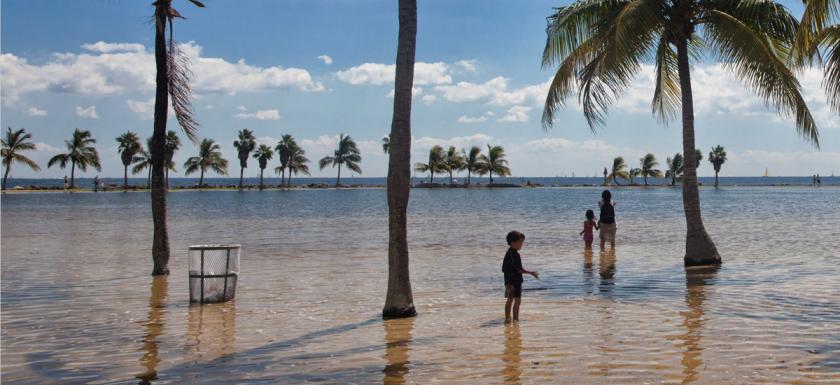
Sea Level Rise – Matheson Hammock Park – Coral Gables – Florida (2016)
Photo Credit: Union of Concerned Scientists (UCSUSA)

You know what the burden is? It’s looking up through the political hierarchy above me to the state legislature, to the governor, U.S. Congress, U.S. Senate, the White House, and you ask, Who is minding the shop? Who else knows what I know?… What kind of morality allows them to ignore what is going to happen?
~ Dr. Philip Stoddard, mayor of South Miami and a professor in the Department of Biological Sciences, Florida International University.

We need to educate people about what is really going on with climate disruption…. I made a personal decision to not have kids, because I don’t have a future to offer them. I don’t think we are going to win this battle. I think we are really done.
~ Dr. Rita Mesquita, a biologist and researcher with Brazil’s National Institute of Amazonian Research (INPA), Manaus, Amazonas.

The dire position we’re in now is solid evidence of the fact that the predominant civilization does not have a handle on all the interrelationships between humans and what we call the natural world. If it did, we wouldn’t be facing this dire situation.
~ Stan Rushworth, elder of Cherokee descent who has taught Native American literature and critical thinking classes focused on Indigenous perspectives.

Jamail concludes that we are already facing mass extinction. We can’t remove the heat now stored in the oceans, yet we keep on pumping 40 billion tons of carbon dioxide into the atmosphere every year. Our future is uncertain. Writing this book was his attempt to bear witness to what we have done to the Earth. “I am committed in my bones to being with the Earth,” he writes, “no matter what, to the end.”

DAHR JAMAIL
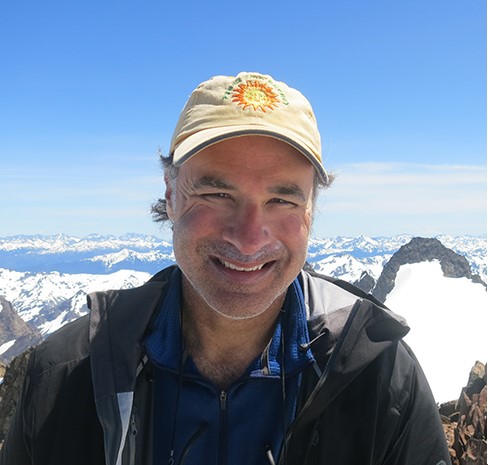
Dahr Jamail, a reporter for Truthout, is the author of Beyond the Green Zone: Dispatches from an Unembedded Journalist in Occupied Iraq, The Will to Resist: Soldiers Who Refuse to Fight in Iraq and Afghanistan, and The Mass Destruction of Iraq: Disintegration of a Nation (co-authored with William Rivers Pitt). Over the past fifteen years, Jamail has also reported from Lebanon, Syria, Jordan, and Turkey. An accomplished mountaineer who has worked as a volunteer rescue ranger on Denali, Alaska, he won the Martha Gellhorn Prize for Journalism and is a 2018 winner of the Izzy Award for excellence in independent journalism. Jamail is also the recipient of the James Aronson Award for Social Justice Journalism, the Joe A. Callaway Award for Civic Courage, and five Project Censored Awards. 
“The Leash” – Poem by Ada Limón

03 Sunday Mar 2019

Posted by Rosaliene Bacchus in Poetry

≈ 37 Comments

Tags

America’s National Anthem, American poet Ada Limón, “The Leash” by Ada Limón, Infertility, The Carrying: Poems by Ada Limón (2018), Womanhood/Motherhood

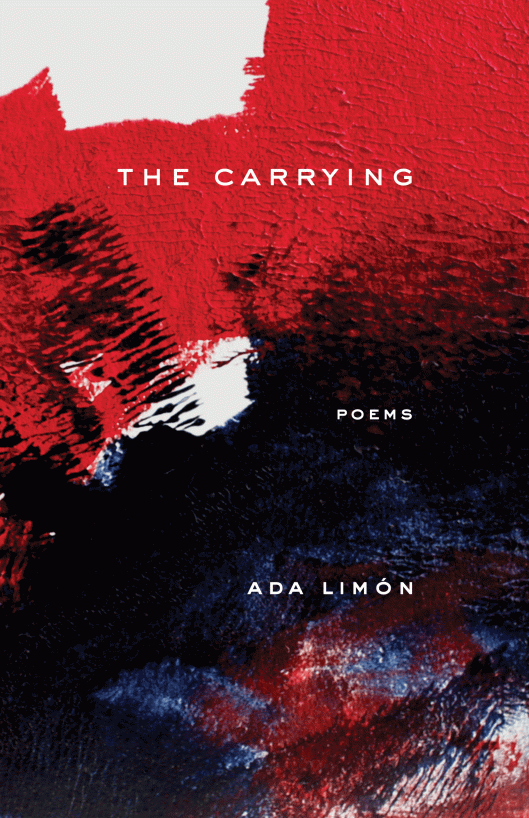
Front Cover The Carrying: Poems by Ada Limón
Milkweed Editions – Minnesota/USA – August 2018
Photo Credit: Ada Limón


My Poetry Corner March 2019 features the poem “The Leash” from the poetry collection, The Carrying: Poems, by Ada Limón. Native of Sonoma, California, Limón is a poet, writer, and teacher. After earning an MFA in creative writing from the University of New York, she spent the next ten years working for various magazines, such as Martha Stewart Living, GQ, and Travel + Living. In 2011, she moved to Lexington, Kentucky, to be close to her now-husband, Lucas, a business owner in the horse racing industry. In addition to working as a freelance writer, she serves on the faculty of the low-residency MFA program at Queens University of Charlotte (NC) and the online and summer programs for the Provincetown Fine Arts Work Center (MA).

In an interview with the Lexington Herald-Leader magazine (August 2018), Limón says that The Carrying, her fifth book of poetry, “is incredibly personal. It’s more political than my other books… It deals with the body, with fertility. It also deals with what it is to do the day-to-day work of surviving.”

In her poem, “The Vulture & The Body,” she shares her struggle with infertility. In coming to terms with the failure of fertility treatment, she asks:

What if, instead of carrying
a child, I am supposed to carry grief? Continue reading →

The Green New Deal: Are Americans ready for bold action?

10 Sunday Feb 2019

Posted by Rosaliene Bacchus in Anthropogenic Climate Disruption, United States

≈ 50 Comments

Tags

Co-Sponsors of Green New Deal Resolution, Five goals of Green New Deal, Green New Deal Resolution, November 2018 Fourth National Climate Assessment: Volume II Impacts Risks and Adaptation in the United States, October 2018 Special Report on Global Warming of 1.5℃ by the Intergovernmental Panel on Climate Change (IPCC), Rep. Ocasio-Cortez (D-New York), Sen. Edward Markey (D-Massachusetts), Sunrise Movement

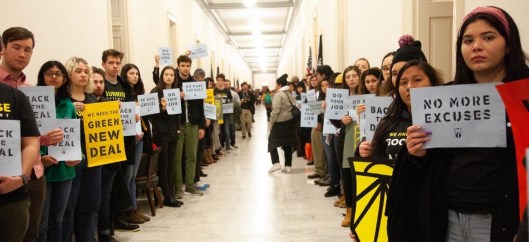
Sunrise Movement protesters outside then Rep. Nancy Pelosi’s Office – December 10, 2018
Photo Credit: Sunrise Movement


While our president is fixated on building a wall along our southern border to keep us safe from the invasion of “bad hombres,” he refuses to acknowledge our greatest existential threat: climate change disruption. Young climate change activists, clamoring for bold action, have found a champion in the newly elected Rep. Alexandria Ocasio-Cortez (D-New York). At twenty-nine years, she is the youngest member of the US House of Representatives.

On February 7, 2019, Rep. Ocasio-Cortez and Sen. Edward Markey (D-Massachusetts) introduced a nonbinding resolution that sets out the framework for the Green New Deal. The proposal has gathered 64 House and nine Senate Co-Sponsors, including presidential hopefuls Sen. Cory Booker, Sen. Kirsten Gillibrand, Sen. Kamala Harris, Sen. Bernie Sanders, and Sen. Elizabeth Warren. In an interview with Politico, House Speaker Nancy Pelosi (D-California), not present at the unveiling, referred to the proposal as a mere suggestion.

“It will be one of several or maybe many suggestions that we receive,” Pelosi said. “The green dream or whatever they call it, nobody knows what it is but they’re for it right?”

The Green New Deal Resolution – List of Co-Sponsors
Photo Credit: Sunrise Movement


In the preamble, the Green New Deal Resolution cites the critical findings of the October 2018 “Special Report on Global Warming of 1.5℃” by the Intergovernmental Panel on Climate Change (IPCC) and the November 2018 Fourth National Climate Assessment: Volume II Impacts, Risks, and Adaptation in the United States. Continue reading →

“There are Many Traps in the World” by Brazilian Poet Ferreira Gullar

03 Sunday Feb 2019

Posted by Rosaliene Bacchus in Poetry

≈ 44 Comments

Tags

Brazil Military Dictatorship (1964-1987), Brazilian poet Ferreira Gullar (1930-2016), Inequality, Jeff Bezos, No Mundo Há Muitas Armadilhas (There are Many Traps in the World) by Ferreira Gullar, Oppression and Injustice, Poema Sujo (Dirty Poem) by Ferreira Gullar, São Luís/Maranhão/Northeast Brazil

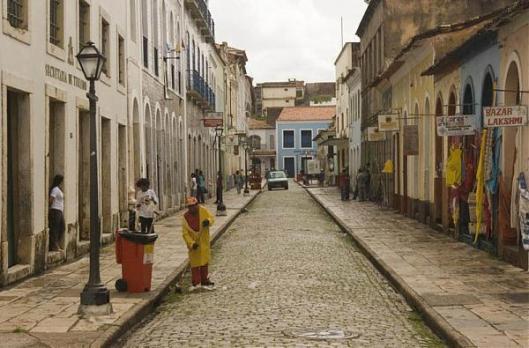
Historical Center of São Luís – Maranhão – Brazil
UNESCO World Heritage Site: Portuguese colonial architecture
Photo Credit: Kamaleao


My Poetry Corner February 2019 features the poem “There are Many Traps in the World” (No Mundo Há Muitas Armadilhas) by Ferreira Gullar (1930-2016), a Brazilian poet, playwright, art critic, and essayist. Born in São Luís, capital of the northeastern state of Maranhão, he was the fourth child of eleven siblings of a poor, working-class family.

As a young man, while earning a living as a radio announcer and editor of literary magazines, Gullar frequented poetry readings and devoured books of poetry by the best of Brazilian and foreign poets. At nineteen, he published his first poetry collection. But he saw no future in his suffocating, small-town life in the impoverished northeast region. He fled to Rio de Janeiro in the early 1950s, where he worked as a journalist for magazines and newspapers.

Beginning in 1962, his work reflected his concern about combating oppression and social injustice. After becoming a member of the communist party, he joined the struggle against the military dictatorship (1964-1985). Following his arrest and imprisonment in 1968, he went into exile in 1971. For the next six years, he lived in Moscow, Santiago, and Buenos Aires. In Buenos Aires in 1975, fearful for his safety in the wake of Argentina’s military takeover (1976-1983), he wrote his best-known work, “Dirty Poem” (Poema Sujo).

Ferreira Gullar among millions of students and other demonstrators gathered to protest against military dictatorship – Rio de Janeiro – Brazil – June 26, 1968
Photo Credit: Folha de São Paulo


In the opening stanza of the featured poem, “There are Many Traps in the World,” Gullar makes a simple declaration:

There are many traps in the world
and what is a trap could be a refuge
and what is a refuge could be a trap 

Some traps that we humans perceive as refuge come to mind: religion, cults, Facebook, and narcotic drugs. Continue reading →

The Empire’s Fading Light

13 Sunday Jan 2019

Posted by Rosaliene Bacchus in Poetry by Rosaliene Bacchus, United States

≈ 38 Comments

Tags

Earth's Dispossessed, Fading Empire, Fear & Intolerance, Freedom & Inclusion, Lady Liberty, Moral decay, USA-Mexico border wall


The Great Wall of China and Hadrian’s Wall
surviving projections of great power
of ancient dynasties and empires
defense against barbarian attacks
breached by invaders and internal strife.

East Germany’s Berlin Wall of our times
projection of fear and intolerance
of the communist Soviet Union
defense against divergent policies
razed by cries for freedom and inclusion.

The USA-Mexico border wall
projection of fear and intolerance
defense against criminal invaders
withdrawal from global alliances
to stoke dispersion of moral decay.

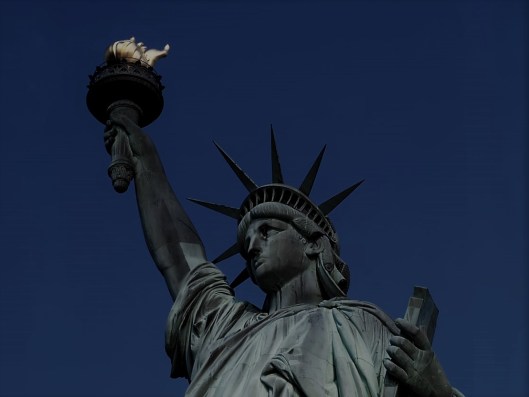
The flame of Lady Liberty sputters
a refuge no more for Earth’s dispossessed
freedom, inclusion, human dignity
hostages of cries for former glory
strangled in the empire’s fading light.

“Unwritten Poem” – Poem by Barbados’ First Poet Laureate Esther Phillips

06 Sunday Jan 2019

Posted by Rosaliene Bacchus in Poetry

≈ 39 Comments

Tags

“Unwritten Poem” by Esther Phillips, Barbados/Caribbean Region, Barbados’ First Poet Laureate Esther Phillips, Caribbean Poetry, Human Relationships, Mother/Son-in-law relationship, The Stone Gatherer by Esther Phillips

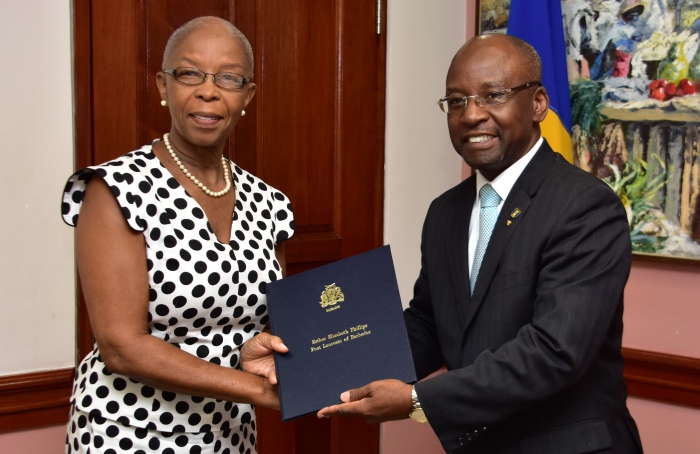
minister of culture appoints poet esther phillips as barbados' first poet laureate - february 2018

Minister of Culture appoints Poet Esther Phillips as Barbados’ first Poet Laureate – February 2018
Photo Credit: Barbados Government Information Services


My Poetry Corner January 2019 features the poem “Unwritten Poem” from the poetry collection, The Stone Gatherer, by Esther Phillips, a poet and educator born in Barbados, where she still resides. In February 2018, she was appointed the first Poet Laureate of the Caribbean island-nation.

After attending the Barbados Community College at the University of the West Indies Cave Hill Campus, she won a James Michener fellowship to the University of Miami where, in 1999, she gained an MFA degree in Creative Writing. Her poetry collection/thesis won the Alfred Boas Poetry Prize of the Academy of American Poets.

In 2001, she won the leading Barbadian Frank Collymore Literary Endowment Award. Years later, the third of her three well-received poetry collections, Leaving Atlantis (2015), won the Governor General’s Award for Literary Excellence.

Phillips is a Sunday columnist of the Nation newspaper and editor of Bim: Arts for the 21st Century, a 2007 revival of the seminal Caribbean literary and arts magazine, first published in 1942. In 2012, she formed Writers Ink Inc. and, together with its members, the Bim Literary Festival & Book Fair. Continue reading →

Year 2018: Reflections

30 Sunday Dec 2018

Posted by Rosaliene Bacchus in The Writer's Life, United States

≈ 63 Comments

Tags

Legal & Illegal US immigrants, Refugees from Central America, US Immigration, Writer’s block, Writers' Critique Group, Year 2018


Year 2018 was filled with disappointments, self-doubt, and loss of direction. After completing my second novel, The Twisted Circle, in September 2017, I failed to grab the attention of literary agents or publishers.

“Not quite the right fit for us,” respondents said.

“You’re not good enough,” my inner critic said.

Drowning in self-doubt, I clung to the recognition that my yet-to-be-published first novel, Under the Tamarind Tree, had received when shortlisted for the 2014 Dundee International Book Prize.

Each attempt to get started on my third novel, to be set in Brazil, fizzled out. The Top Boss in the White House held my afflicted heart in his grip. My mind became a barren landscape of shifting sand dunes. In September, I abandoned my writing project.

Where do I go from here? The answer still evades me. Continue reading →

“Revolutionary Suicide”: Remembering the Jonestown Massacre

18 Sunday Nov 2018

Posted by Rosaliene Bacchus in Guyana, Human Behavior, United States

≈ 44 Comments

Tags

Children of Jonestown, Jonestown/Guyana, Mass-murder-suicide, Peoples Temple Agricultural Project/Guyana, Peoples Temple Church, Reverend Jim Jones, Revolutionary Suicide, Youth Climate Activists

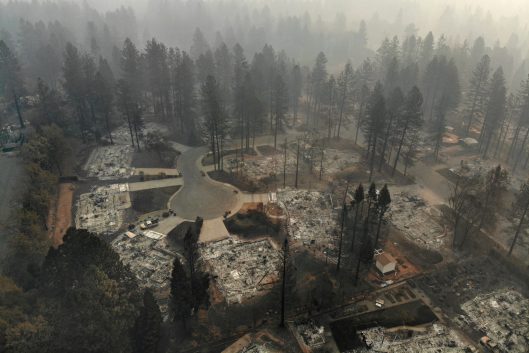
Aerial view of Paradise off of Clark Road – Camp Fire, Northern California
November 15, 2018
Photo Credit: San Francisco Examiner (Carolyn Cole/Los Angeles Times)


As California burns and super-storms ravage our southern and eastern coastal states, I’ve been thinking a lot about the Reverend Jim Jones and the People’s Temple. Today, November 18th, is the fortieth anniversary of the mass murder-suicide of 916 Americans at the People’s Temple Agricultural Project at Jonestown in the northwest forested region of Guyana.

The 276 dead American children had no choice.

Teacher with Children Singing – Jonestown – Guyana
Photo Credit: California Digital Library


Victim of his own megalomania and alternate reality, the Pentecostal leader coerced his followers into ingesting cyanide-laced, grape-flavored Flavor Aid.

“Revolutionary suicide,” the Reverend Jim Jones called his final, defiant act. Continue reading →

We want our country back

11 Sunday Nov 2018

Posted by Rosaliene Bacchus in Poetry by Rosaliene Bacchus, United States

≈ 51 Comments

Tags

Charlottesville/Virginia, Displaced peoples, Divisiveness in America, Fear and hate in America, Honduran migrants, Make America Great Again, Pittsburgh Synagogue Shooting, We reap what we sow, White nationalists

White NATIONALISTS in Charlottesville – Virginia – August 2017
Photo Credit: Vox (Samuel Corum/Anadolu Agency)

We want our country back
rile white nationalists
goose-stepping through the streets
of Americaville
waving tiki torches
emboldened and blinded
by their chosen fuhrer
ruling in the White House.

Homo sapiens. Wise man. Where is the wisdom, our superior intelligence, when we know not that we know not? How soon we forget that we live on the ancestral lands of conquered Native Americans: over 500 tribes occupying these lands for more than 15,000 years. How soon we forget that the good life we have enjoyed for generations has come with the sacrifice of non-white bodies to the gods of greed, plunder, and dispossession. Continue reading →

“Humanity” by Afro-Brazilian Writer & Poet Carolina Maria de Jesus

04 Sunday Nov 2018

Posted by Rosaliene Bacchus in Brazil, Poetry

≈ 72 Comments

Tags

Afro-Brazilian writer & poet, Carolina Maria de Jesus, Child of the Dark by Carolina Maria de Jesus, Favela de Canindé/São Paulo, Minas Gerais/Brazil, Poem “Humanity” by Carolina Maria de Jesus, Poema “Humanidade” por Carolina Maria de Jesus, Quarto de Despejo (Trash Room) by Carolina Maria de Jesus, São Paulo/Brazil

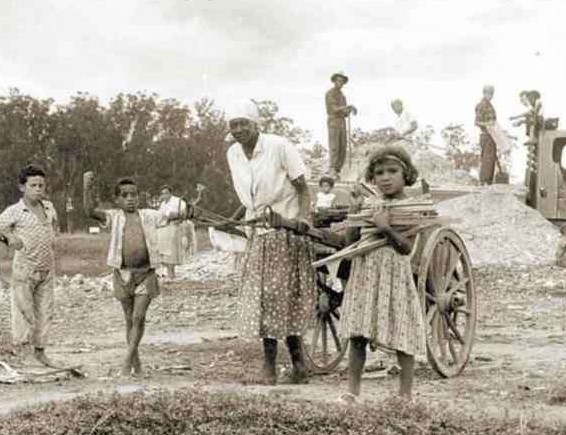
Carolina Maria de Jesus - Favela of Caninde - Sao Paulo - Before publication of first book

Carolina Maria de Jesus with cart – Favela of Canindé – São Paulo (circa 1958)
Photo Credit: Jornal Estado de Minas (Collection Audálio Dantas)


My Poetry Corner November 2018 features the poem “Humanity” (Humanidade) by Afro-Brazilian writer and poet, Carolina Maria de Jesus (1914-1977), born in a rural community in Minas Gerais, Southeast Brazil.

An illegitimate child of a sharecropping family, Carolina was treated as an outcast. After just two years in primary school, when she learned to read and write, she developed a love for reading. She dreamed of becoming a writer.

“The book…fascinates me,” de Jesus writes in My Strange Diary (Meu Estranho Diário). “I was raised in the world. Without maternal guidance. But books guided my thinking. Avoiding the abysses that we encounter in life. Blessed the time I spent reading. I came to the conclusion that it’s the poor who must read. Because the book, it’s the compass that we have to guide man into the future…”

In 1930, de Jesus moved with her family to the State of São Paulo, where she worked as a washerwoman and, later, as a housemaid. After her mother’s death in 1937, she moved to the state capital, an industrial megalopolis. In 1948, she became pregnant for a Portuguese sailor. After he abandoned her, she moved to the favela (slum) of Canindé. Two other children followed, for different fathers.

De Jesus eked out a living: working as a housemaid and scavenging for paper and scrap metal around Canindé. An independent woman, she refused to marry because of the domestic violence she witnessed around her. Writing on blank pages of used notebooks she found in trash cans, she began recording her day-to-day existence as one of society’s “discarded” and marginalized people.

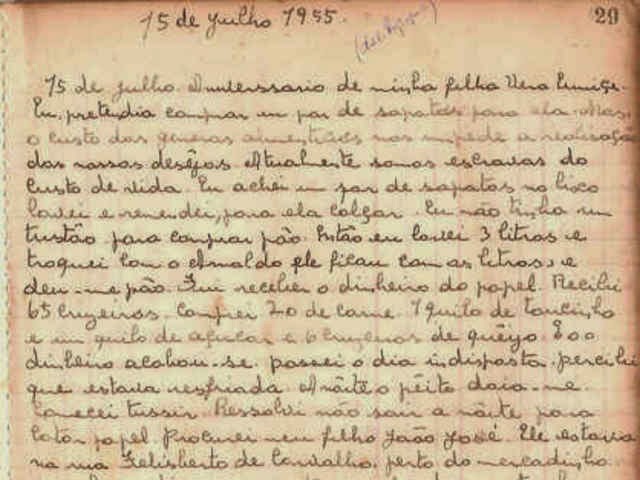
In her first entry, she writes: “July 15, 1955. The birthday of my daughter Vera Eunice [born 1953]. I wanted to buy a pair of shoes for her, but the price of food keeps us from realizing our desires. Actually we are slaves to the cost of living…”

Carolina Maria de Jesus - Manuscript 15 July 1955

Carolina Maria de Jesus – Manuscript of Journal – July 15, 1955
Photo Credit: Templo Cultural Delfos


Her stories, poems, and journal entries describe her struggle to rise above poverty and the ever-present specter of hunger. She calls attention to the social problems they face—prostitution, adultery, incest, alcoholism, physical violence, and foul language—and the consequences in their lives. She writes of the racial injustice and discrimination heaped on the poor and blacks in the favelas. She notes the empty promises made by politicians.

In an untitled poem from her journal, de Jesus requests:

Don’t say that I was trash,
that I lived on the margin of life.
Say that I was looking for work,
but I was always slighted.
Tell the Brazilian people
that my dream was to be a writer,
but I did not have money
to pay for a publisher.

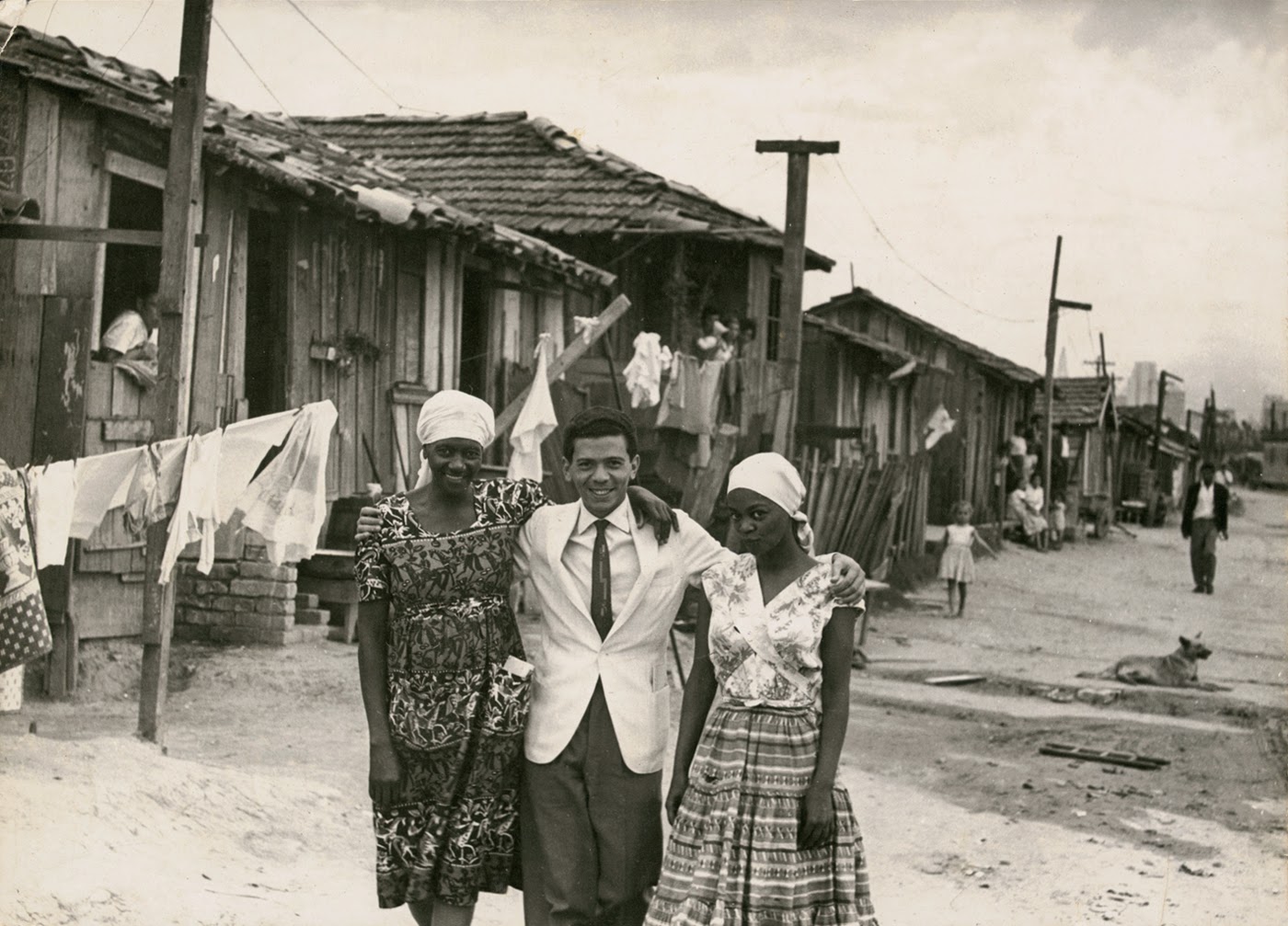
A breakthrough came in 1958 when Carolina de Jesus met the young journalist, Audálio Dantas, during his visit to the favela for an assignment. On learning about her journal, he recognized its uniqueness and sociological importance. Through Dantas’ influence, edited excerpts were published in a magazine. Their popularity among readers led to the publication of her journal in 1960 as a book titled, Quarto de Despejo (Trash Room).

Carolina Maria de Jesus, Audálio Dantas e Ruth de Souza na Favela do Canindé. São Paulo, 1961

From left to right: Carolina Maria de Jesus, Journalist Audálio Dantas, and Actress Ruth de Souza – Favela of Canindé – São Paulo – 1961
Photo Credit: Collection Audálio Dantas


When asked about the idea for the name of her book, de Jesus told the interviewer: “In 1948, when they began to demolish one-story houses to construct apartment buildings, we, the poor, that lived in collective housing units, were trashed and we began living under bridges. That’s why I call the favela the trash room for a city. We, the poor, are old junk.”

Trash Room became an instant bestseller, selling 10,000 copies within the first three days and 90,000 more copies over the next six months. The English version, Child of the Dark, followed in 1962. The book soon drew international attention. But, to the Brazilian literary elite, it lacked linguistic quality. Three more books published in the 1960s received little attention.

Carolina Maria de Jesus durante noite de autógrafos do lançamento de seu livro Quarto de Despejo, São Paulo, em 1960.

Carolina Maria de Jesus signing her book Quarto de Despejo – São Paulo – 1960
Photo Credit: Templo Cultural Delfos


In her poem, “Many fled on seeing me,” published posthumously (1996) in Personal Anthology, a poetry collection, de Jesus laments:

It was paper I collected
To pay for my living
And in the trash I found books to read
How many things I wanted to do
I was hindered by prejudice
When I die I want to be born again
In a country where blacks predominate

With her book royalties, Carolina de Jesus bought a house in a middle-class neighborhood. Admiration turned to envy. Some accused her of being ambitious and uncharitable.

The featured poem, “Humanity,” published posthumously in My Strange Diary, is composed of four stanzas with a rhyme scheme aabccb. De Jesus expresses her disillusions with humankind: the perversity, wickedness, greed, tyrannical…egoists, and hypocrisy.

After knowing humanity
its perversities
its ambitions
I have been getting older
and losing
the illusions

[…]

When I die…
I don’t want to be born again
It’s horrible, to endure humanity
that has a noble appearance
that conceals
its worst qualities

Unable to adjust to life among the middle-class, de Jesus moved to the countryside where she lived in poverty until the end of her life. Her passing in 1977 went virtually unnoticed. She left behind more than 5,000 handwritten pages that contained seven novels, over 60 texts of chronicles, fables, autobiography and stories, over 100 poems, and four plays.

To read the featured poem in its original Portuguese and learn more about the work of Carolina Maria de Jesus, go to my Poetry Corner November 2018.

NOTE: All translations from Portuguese to English done by Rosaliene Bacchus.


← Older posts
Newer posts →

Subscribe

  • RSS - Posts
  • RSS - Comments

Archives

  • March 2026
  • February 2026
  • January 2026
  • November 2025
  • October 2025
  • September 2025
  • August 2025
  • July 2025
  • June 2025
  • May 2025
  • April 2025
  • March 2025
  • February 2025
  • January 2025
  • December 2024
  • November 2024
  • October 2024
  • September 2024
  • August 2024
  • July 2024
  • June 2024
  • May 2024
  • April 2024
  • March 2024
  • February 2024
  • January 2024
  • December 2023
  • November 2023
  • October 2023
  • September 2023
  • August 2023
  • July 2023
  • June 2023
  • May 2023
  • April 2023
  • March 2023
  • February 2023
  • January 2023
  • December 2022
  • November 2022
  • October 2022
  • September 2022
  • August 2022
  • July 2022
  • June 2022
  • May 2022
  • April 2022
  • March 2022
  • February 2022
  • January 2022
  • December 2021
  • November 2021
  • October 2021
  • September 2021
  • August 2021
  • July 2021
  • June 2021
  • May 2021
  • April 2021
  • March 2021
  • February 2021
  • January 2021
  • December 2020
  • November 2020
  • October 2020
  • September 2020
  • August 2020
  • July 2020
  • June 2020
  • May 2020
  • April 2020
  • March 2020
  • February 2020
  • January 2020
  • December 2019
  • November 2019
  • October 2019
  • September 2019
  • August 2019
  • July 2019
  • June 2019
  • May 2019
  • March 2019
  • February 2019
  • January 2019
  • December 2018
  • November 2018
  • October 2018
  • September 2018
  • August 2018
  • July 2018
  • June 2018
  • May 2018
  • April 2018
  • March 2018
  • February 2018
  • January 2018
  • December 2017
  • November 2017
  • October 2017
  • September 2017
  • August 2017
  • July 2017
  • June 2017
  • May 2017
  • April 2017
  • March 2017
  • February 2017
  • January 2017
  • December 2016
  • November 2016
  • October 2016
  • September 2016
  • August 2016
  • July 2016
  • June 2016
  • May 2016
  • April 2016
  • March 2016
  • January 2016

Categories

  • About Me
  • Anthropogenic Climate Disruption
  • Brazil
  • Economy and Finance
  • Family Life
  • Festivals
  • Guyana
  • Health Issues
  • Human Behavior
  • Immigrants
  • Nature and the Environment
  • People
  • Philosophy
  • Poetry
  • Poetry by Rosaliene Bacchus
  • Recommended Reading
  • Relationships
  • Religion
  • Religion & Spirituality
  • Reviews – The Twisted Circle: A Novel by Rosaliene Bacchus
  • Reviews – Under the Tamarind Tree: A Novel by Rosaliene Bacchus
  • Save Our Children
  • Social Injustice
  • Technology
  • The Twisted Circle: A Novel by Rosaliene Bacchus
  • The Writer's Life
  • Uncategorized
  • Under the Tamarind Tree: A Novel by Rosaliene Bacchus
  • United States
  • Urban Violence
  • Women Issues
  • Working Life

Blogroll

  • Angela Consolo Mankiewicz
  • Caribbean Book Blog
  • Dan McNay
  • Dr. Gerald Stein
  • Foreign Policy Association
  • Guyanese Online
  • Writer's Digest
  • WritersMarket: Where & How to Sell What You Write

Meta

  • Create account
  • Log in
  • Entries feed
  • Comments feed
  • WordPress.com

Enter your email address to subscribe to this blog and receive notifications of new posts by email.

Join 3,232 other subscribers

Blog at WordPress.com.

Privacy & Cookies: This site uses cookies. By continuing to use this website, you agree to their use.
To find out more, including how to control cookies, see here: Cookie Policy
  • Subscribe Subscribed
    • Three Worlds One Vision
    • Join 3,232 other subscribers
    • Already have a WordPress.com account? Log in now.
    • Three Worlds One Vision
    • Subscribe Subscribed
    • Sign up
    • Log in
    • Report this content
    • View site in Reader
    • Manage subscriptions
    • Collapse this bar
 

Loading Comments...