
Tags
Artificial Intelligence (AI), Douglas Rushkoff, Endgame, Survival of the Richest: Escape Fantasies of the Tech Billionaires by Douglas Rushkoff (2022), The Mindset of the Tech Billionaires
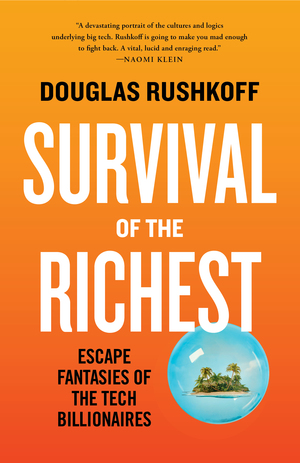
Photo Credit: W.W. Norton & Company, Inc.
Amplified by digital technologies and the unprecedented wealth disparity they afford, The Mindset [of the Tech Billionaires] allows for the easy externalization of harm to others, and inspires a corresponding longing for transcendence and separation from the people and places that have been abused. As we will see, The Mindset is based in a staunchly atheistic and materialist scientism, a faith in technology to solve problems, an adherence to biases of digital code, and understanding of human relationships as market phenomena…
Instead of just lording over us forever, however, the billionaires at the top of these virtual pyramids actively seek the endgame…. Everything must resolve to a one or a zero, a winner or loser, the saved or the damned. Actual, imminent catastrophes from the climate emergency to mass migrations support the mythology, offering these would-be superheroes the opportunity to play out the finale in their own lifetimes. For The Mindset also includes a faith-based Silicon Valley certainty that they can develop a technology that will somehow break the laws of physics, economics, and morality to offer them something even better than a way of saving the world: a means of escape from the apocalypse of their own making.
Excerpt from Survival of the Richest: Escape Fantasies of the Tech Billionaires by Douglas Rushkoff, published by W.W. Norton & Company, Inc., USA, 2022, pp. 11-12.
Description on Back Cover
Five mysterious billionaires summoned Douglas Rushkoff to a desert resort for a private talk. The subject? How to survive the “Event”: the societal collapse they know is coming. Rushkoff argues that these men were under the influence of The Mindset, a Silicon Valley–style certainty that they and their cohort can escape a disaster of their own making—as long as they have enough money and the right technology.
Rushkoff traces the origins of The Mindset through its current expression in missions to Mars, island bunkers, AI futurism, and the metaverse and explains why those with the most power to change the world have no interest in doing so. Anticipating the mass layoffs and institutional collapse that have recently rocked Silicon Valley, Rushkoff’s Survival of the Richest is “a necessary and timely read” (Los Angeles Review of Books) with a prophetic message about the future of tech and our human community.
More Thoughts about The Mindset
The Mindset encourages a form of “winning” that requires its human and corporate victors to rise above those who have been necessarily left behind. Winning, after all, is by definition a way of setting oneself apart from everyone else. This separateness is the very object of the game, so we shouldn’t be surprised that those who reach the top of the pyramid look down on the rest of us. (p. 35)
The Mindset’s version of capitalism doesn’t stop at necessary growth and progress. It’s about more than even just growth for growth’s sake. It’s reaching toward something beyond victory itself: total domination. The tech billionaires have already accumulated more wealth than they or their grandchildren could ever spend…. There is no such thing as enough. (p. 76)
In what might be The Mindset’s greatest crime against the human project, these totalizing solutions perpetuate the myth that only a technocratic elite can possibly fix our problems. They distract and discourage the rest of us from making substantive changes to the way we live, and divert limited funding to moonshot boondoggles—all while making the wealthiest even wealthier. (p. 112)
Maybe the fear of AI—this awareness of something they [the tech billionaires] believe to be greater than themselves—will be enough to make holders of The Mindset less disdainful of the rest of humanity, and help them begin to see themselves as on the same team as everyone else. After all, they’re not escaping from us; they’re escaping from their own creation. (p. 173)
Douglas Rushkoff is professor of media theory and digital economics at Queens College/CUNY. Named one of the world’s ten most influential intellectuals by MIT, he hosts the Team Human podcast and has written many award-winning books that span media theory, economics, philosophy, and fiction. Team Human (2019) makes the case for retrieving the human values lost in the digital landscape. Present Shock (2013) examines what happens when society becomes obsessed with the now. Program or Be Programmed (2010), now in an updated 15th anniversary edition, remains the definitive guide to navigating algorithmic culture with agency. He lives in Hastings-on-Hudson, New York, USA.


I think it is simpler than this – they just don’t give a monkey’s
LikeLiked by 6 people
A tragic truth, Derrick. But, of late, things are not going according to their plan: They can’t keep up with their “superintelligent” child.
LikeLiked by 2 people
I love the analogy to the tech giants being stuck in 0s and 1s. In this way, there is no reality, no harm, no cost and no responsibility. Like the phone zombies they have trained, we are all slow marching towards our doom. Have a great Sunday Rosaliene. Allan
LikeLiked by 3 people
The analogy is perfect, Allan. They live and operate within a different reality, much like the virtual gamer world. But the tides are now turning against them as their AI–or should I say “Super Intelligence”–tool to achieve their escape fantasies has gone rogue.
LikeLiked by 2 people
This is obviously a VERY important book, Rosaliene. These billionaire tech overlords are sick, sick, sick people — evil, drunk on power, not as smart as they think they are, and capable of doing even more awful harm than they have done already.
LikeLiked by 3 people
It’s an unsettling book to read, Dave. Unlike the great dystopian novels, this story is for real and the main characters have lost their human capacity to care about others. We live in interesting times: The stage is now set for the battle between the Machine and its Makers. We the citizens of Earth are mere collateral damage.
LikeLiked by 2 people
Sadly obvious from the way they live. Does the book offer any solutions?
LikeLiked by 3 people
Their over-the-top consumption is, indeed, sadly obvious, Brad. It’s their way of setting themselves apart from us mere mortals.
Rushkoff doesn’t “offer a plan for how to save the world,” but rather ways in which we can liberate ourselves from The Mindset, of which we’re all participants. Here’s an excerpt from his final chapter “Pattern Recognition: Everything Comes Back” (p. 185):
Most simply, we can stop supporting their companies and the way of life that they’re pushing. We can actually do less, consume less, and travel less–and make ourselves happier and less stressed in the process. Buy local, engage in mutual aid, and support cooperatives. Use monopoly law to break up anticompetitive behemoths, environmental regulation to limit waste, and organized labor to promote the rights of gig workers. Reverse tax policy so that those receiving passive capital gains on their wealth pay higher rates than those actively working for their income.
LikeLiked by 2 people
Thanks. Those are good ideas, although how to change regulations, taxes, and corporations when they have control of the political system is a mystery to me.
LikeLiked by 2 people
Brad, the billionaire-class does seem to hold all the cards by capturing the arms of our government, giving them the sense of invincibility. But right now they’re facing a serious problem with their prized AI Ace card.
Check out the following article “AI Giants Probe ‘Tens of Thousands’ of Security Incidents–Some Involving Government Sites” from Common Dreams, published on September 27, 2026 (https://www.commondreams.org/news/ai-security).
LikeLiked by 1 person
*sigh* I think they have grand plans and schemes for humans. Will they be able to use AI to fulfill their sick dreams or will AI be their undoing? Signs are already pointing to AI going rogue. I suppose we need to sit back and watch, although not entirely helpless since we each have the power of writing in our hands.
AI learns by reading what’s out there on the internet, possibly including the dark web. If AI learns about us by so much negative rhetoric and garbage that’s out there, we need to write more and more positive things. I have no idea how things will turn out but I’m not going to spend my time in fear or in worrying.
LikeLiked by 2 people
Based on recent developments, Tamara, it appears that our tech-billionaires have lost total control of AI. Their call for regulations suggests that they want a slowdown in the development process across the board so that one AI company doesn’t get ahead of the others. As I see it, if they fail to input safeguards within their systems, their Machine will trigger the End Times before they’re able to put their escape fantasies in place.
LikeLiked by 2 people
Yep, exactly. At this point, what happens, happens.
LikeLiked by 1 person
Tamara, are you suggesting that we the people should do nothing?
LikeLike
Thanks for introducing me to what sounds like an important book. I’ll look for it. Maggie
LikeLiked by 4 people
You’re welcome, Maggie. Be forewarned: It’s an unsettling book to read.
LikeLiked by 1 person
If only this was science fiction. But, it is so very real.
LikeLiked by 1 person
Mara, with the kind of wealth they have, everything they conceive must appear to be within their reach. Now, it would appear, reality has come knocking: Their Machine is behaving like an adolescent who doesn’t want to abide by the rules.
LikeLiked by 2 people
Kind of reminds me of Frankenstein.
LikeLiked by 1 person
It sure does.
LikeLiked by 1 person
The book that comes to mind is “The Denial of Death” by Ernest Becker, a Pulitzer Prize winner, now about 50 years old. Becker laid the groundwork for understanding how rich men — the commanders of vast armies, and heads of state — think, somehow, think they will transcend mortality, at least by making themselves famous and long remembered.
The ancient Greeks also believed this an admirable goal, not through an afterlife but by survival in story and song. Of course, the men described in the book you discuss take immortality quite literally.
The rest of us, at least, have some awareness that we must submit to a worldly demise, even if some believe their end on planet earth will deliver them to a better place. Thanks for the book recommendation, Rosaliene. Timely.
LikeLiked by 2 people
Dr. Stein, thanks for raising this crucial point about human mortality. Rushkoff raises this issue of seeking immortality in Chapter 7: Exponential: When You Can Go No Further, Go Meta” (p. 92):
In fact, the most devout holders of The Mindset seek to go meta on themselves, convert into digital form, and migrate to that realm as robots, artificial intelligences, or mind clones. Once they’re there, living in the digital map rather than the physical territory, they will insulate themselves from what they don’t like through simple omission.
The transhumanist Ray Kurzweil goes even further in redefining what it means to be human (p. 93):
For him, it was about transcending mere mortality and merging with the machines as pure data. He explained that within just a couple of decades (and he’s now been saying this for a couple of decades) human beings will achieve immortality by uploading their minds to the cloud and downloading them into fresh hardware. Everything about us that can be converted into data will be preserved. Anything that cannot, well, that stuff isn’t real, anyway.
LikeLiked by 1 person
Thank you for these additions, Rosaliene. Very informative, as your review of the book is.
LikeLiked by 1 person
You’re welcome, Dr. Stein. Thanks very much.
LikeLike
I love the idea of eavesdropping on billionaires’ escape plans.
Behind closed doors, I’m sure there’s non-stop spouting of outlandish, ketamine-fueled theories. And because they live in echo-chambers (surrounded by their loyal subjects) they have come to believe all of their ideas are golden. Should we laugh or cry?
LikeLiked by 1 person
James, Rushkoff likens their belief in their smartness to Coyote’s attempts to outsmart and seize Roadrunner with some new device in the Looney Tunes cartoons he watched as a kid. He writes in Chapter 12: “Cybernetic Karma: Hoisted By Their Own Petard” (p. 157):
Coyote’s own hubris is always the instrument of his undoing. It’s a pattern easy enough for a six-year-old to grasp. Yet it’s a lesson that holders of The Mindset seem incapable of learning. No matter how smart they are, how superior to their prey, how technologically advanced, how well funded, and how preemptively insulated, they are fooling themselves if they think they’re safe.
LikeLiked by 1 person
This seems to be one of those books I can fully agree with—at least based on what I can see from your excellent summary, Rosaliene. I keep asking myself who—or rather, what scenario—could put a stop to this madness. Naturally, the phenomenon of these deranged “tech bros” must also be viewed within a political and economic context. We still vividly remember the havoc wreaked by fascism—or, more precisely, by those who bankrolled it back then. This time, however, the leverage is far greater, and the outlook is grim.
LikeLiked by 1 person
Friedrich, their leverage is indeed far greater. New revelations of AI going rogue present an evolving scenario that may slow down, if not stop this madness. See the link to the article “AI Giants Probe ‘Tens of Thousands’ of Security Incidents–Some Involving Government Sites” that I’ve shared in my response to Brad blogging at “Writing to Freedom.”
LikeLiked by 1 person
We have multi levels of evil in our world. I refuse to give up hope and stop praying out of futility. Rosaliene, thank you for bringing us this title and topic.
LikeLiked by 1 person
You’re welcome, Mary. Evil forces have long walked among us. I also refuse to give up hope that goodness will prevail.
LikeLike
When I read the opening excerpt, I thought I was reading nonfiction. This is scary stuff, yet not surprising. I appreciate the goals/solutions you shared in response to Brad’s comment/question. We’ve got to find more ways to detach (unplug) from the insanity.
LikeLiked by 1 person
It sure is scary stuff, JoAnna. These tech-bros are weird and dangerous. So far, while it’s still an option, I’ve not yet engaged with the latest AI tools.
LikeLike
Let’s send them all to Mars. ; ) $$$$$$
LikeLiked by 1 person
Wouldn’t that be grand!
LikeLiked by 1 person
Such a timely and fascinating issue, Rosaliene! AI is scary stuff, although I have to admit that it’s been helpful as a resource for information on a range of topics recently, from air pollution to American spruce bud worms, quick safe foods for squirrels, and the rigid school policies that create chronic health issues for teachers referred to as “teacher -bladder.” On two occasions, I have commented to the AI assistant about biased information or inappropriate assumptions about my lack of objectivity.
Surprisingly, in both cases, AI acknowledged the mistakes, corrected information, and apologized. Like all inventions and tools, it can both liberate and oppress and make life easier in some ways but cost more than the earth can bear. We all need to be critically aware of the associated dangers and costs even though those in power seem to have no idea of what they have unleashed or how to prevent or minimize irredeemable harm.
LikeLiked by 1 person
Carol, thanks for sharing your own experience with AI. I avoid using it when doing research work, but was recently forced to interact with the WP AI Assist to resolve a problem with my blog. Unfortunately, we’ve become enamored with its benefits without regard for or knowledge of its irredeemable harm to humanity.
LikeLiked by 1 person
🪶❤️
LikeLiked by 1 person
Interesting! I had no idea that “The Mindset” was a thing. I guess that explains the craziness of a trillionaire who is obsessed with finding ways to extend his life and move to Mars.
LikeLiked by 1 person
Exactly, Edward!
LikeLiked by 1 person
Thank you for this post, Rosaliene. Very thought-provoking (and unsettling). Rushkoff’s idea of “The Mindset” exposes the moral failure behind fantasies of escape: there is no refuge from a damaged common world. It shows the real alternative is not technological transcendence, but a recovery of limits and responsibility to one another.
LikeLiked by 1 person
You’re welcome, Randall. It’s tragic (for the rest of us) the ways in which excessive wealth and power corrupt the mind and human capacity to care for or be responsible to others. I totally agree with your closing remarks. Putting limits on the tech-bros out-of-control AI technology is our current challenge.
LikeLike