
Tags
Autocratic Regime, Caribbean (Guyanese) Poet, Georgetown/Guyana, Guyanese Poet Martin Carter (1927-1997), Poem “As New and As Old (I)” by Martin Carter, Poetry Collection Poems of Affinity 1978-80 (1980), Reflections on Time, Vileness of Humanity
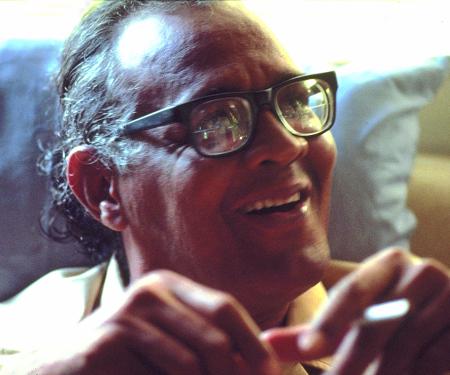
Photo Credit: Peepal Tree Press (UK)
My Poetry Corner August 2026 features the poem “As New and As Old (I)” from the poetry collection Poems of Affinity 1978-80 by Guyanese poet Martin Carter (1927-1997), published by Release Publications (Guyana, 1980). He is regarded as the finest of all Guyanese poets.
Carter was born in Georgetown, Guyana (then British Guiana), to middle-class parents of mixed African, Amerindian, and Portuguese ancestry. His father, a civil servant and avid reader, introduced him to a love of books and philosophy. His mother imbibed in him a love of poetry.
In his early twenties, he became a member of the anti-colonialist political party, founded in 1950. His early poetry reflects his concern about the human condition and freedom from colonial oppression. In “Tomorrow and the World,” published in 1951 (Footnote 1), he expresses his joy of being one with people on the streets and sharing their hope for a better world.
In verse one of four he writes: I am most happy / as I walk the seller of sweets says “friend” / and the shoemaker with his awl and waxen thread / reminds me of tomorrow and the world.
The political party’s gains towards self-governance were short-lived. In 1953, British troops landed and the British governor suspended the newly inked constitution. Together with other political leaders of the party, the poet-politician was arrested and interred at the British/American airbase for three months.
After his release in 1954, Carter published his renowned collection, Poems of Resistance from British Guiana. These poems reflect the anxiety of the times from oppression, fear, and bloodshed. In the poem “This Is the Dark Time My Love” (F2), he writes in verse two of three: This is the dark time, my love. / It is the season of oppression, dark metal, and tears. / It is the festival of guns, the carnival of misery. / Everywhere the faces of men are strained and anxious.
Joy spread across the land on Guyana’s Independence Day in May 1966. Carter left his position as Information Officer at the multinational Booker group of companies to become the fledgling nation’s first representative to the United Nations. The following year, he joined the newly elected government as the Minister of Information (1967-1971). Disillusioned by growing corruption among the political leadership, he resigned his position. He wrote at the time: a mouth is always muzzled / by the food it eats to live.
Retreating from the public sphere to ruminate on the vileness crawling over the land, he asks in the poem “What Can A Man Do More?” (F3): How utter truth when falsehood is the truth? / How welcome dreams, how flee the newest lie? Six years would go by before the publication of his next collection in 1977.
In 1978, then the Writer in Residence at the University of Guyana (1977-1981), Carter connected with the cause of the rising opposition political party—growing in popularity across all racial groups—under the leadership of the Afro-Guyanese historian Walter Rodney. That same year, while taking part in a peaceful demonstration against the proposed changes in the election process, the poet-educator received a beating by thugs of the autocratic regime. The following year, he witnessed a similar gang of thugs murder the British Jesuit priest Father Bernard Darke, photographer for the Catholic newspaper. In broad daylight. Just taking photos.
The grief-stricken poet shares his disbelief in the poem “Bastille Day – Georgetown” (F4): With / my own eyes, I saw the fierce / criminal passing for citizen / with a weapon, a piece of wood / and five for one. We laugh / Bastille laughter. These are / not men of death. A pot / of rice is their foul reward.
The non-violent civil rebellion (1978-1980) against the autocratic regime culminated in the assassination of Walter Rodney on June 13, 1980. An act of betrayal and deception. Carter’s response to the events during that period is his dense, multi-layered poems in Poems of Affinity 1978-80, published in 1980. In what became his final collection, the poet-politician turned poet-philosopher expresses an affinity with the shared humanity and struggle of people everywhere. He dissects the vileness of humanity during bleak times, and our place in time. In “Some Kind of Fury,” he writes (F4): In this foul age of a new / and recurring despair, I / keep working for a storm, some / kind of fury to write new dates / in our vile calendar and book.
Though I don’t recall meeting the Resident Writer on campus, I was working at the University of Guyana Library (1979-1980) when these events unfolded. Now that a similar vileness has spread across my adopted homeland, I was pulled in by the title of the featured poem “As New and As Old (I). A poem that had made little sense to me in the past now held new meaning. History is repeating itself. What was once old is new again.
The terse verses of the short 19-line featured poem are shrouded in metaphor, subject to different interpretations. The opening verses (1-5) read like a riddle filled with contrasts, as the poet-philosopher reflects on the human conception of time.
Every day is as old
as a new day is. Time
represents itself. Night fakes
the rule of stars; as we fake
light’s good pencil….
The poet-philosopher would’ve been eighteen years old when World War II (1939-1945) ended; old enough to recall the bloodshed caused by a dictator intent on dominating the world. Time appears to have come full circle, much like day turns into night. Lessons learned are soon forgotten. In the same way as the star-studded night turns away from the ruling sun, we turn away from the light when we fake good intentions and make false statements. Promises made to gain power fail to materialize.
The mention of a child in verses 5 to 12 comes as no surprise. As the father of four children, the poet has raised concerns about children in several poems. In this collection (F4), he calls on society to “Let Every Child Run Wild.”
… A child’s
chalk ridden black board. Alphabet
of hope in a season of insects. Crawl
of the beast in a season of days. I
unapologetic, remember why every
day was once a new day. As new
and as old as my childhood roaming
among grass….
The poet doesn’t apologize for the idyllic childhood he enjoyed as a more privileged member of the middle-class. He wishes the same for all children. Hope resides in their schooling from a young age. But this hope for a carefree childhood for the nation’s children is now threatened by a perverse society that has lost its humanity to act like insects and crawling beasts. I sense anger with this description.
His existential despair is evident in the following five verses (12-16):
… The world is a cold
wind. It is a glass of sweet water
in a grim place of thirst.
Farewell rain. When again shall I
taste your high cloud?…
Life has lost its warmth and sweetness. In its place remains a thirst for justice and righteousness. He knows not when life will flourish again in the minds and hearts of the people. How had they lost their way? How had they arrived at this point of degradation?
The poet-philosopher concludes in the final four verses (16-19):
… Having betrayed
old gods in an old day, we seek
now to betray new ones
in a new day.
The mention of “old gods” suggests that their fall into depravity is the result of a religious or moral failure among the leadership and society in general. The nature of the new gods eludes me. Perhaps, they are the proclaimed political and social ideologies intended to govern the new society of citizens freed from the shackles of colonial rule. Co-operative socialism has morphed into an autocracy. The betrayal is glaring. The promise of a better tomorrow is but a glass of sweet water / in a grim place of thirst.
The vileness of humanity is as new and as old as time itself. Time reveals that those who covet the fruits of our shared planet for themselves alone become the victims of their own greed and excesses. Whether all-powerful or regarded as the scum of society, each one of us is a mere measure of time here on Earth.
To read the featured poem “As New and As Old (I)” as well as “As New and As Old (II) and learn more about the work of Guyanese poet Martin Carter (1927-1997), go to my Poetry Corner August 2026.
FOOTNOTES:
(1) The Hill of Fire Glows Red, British Guiana, 1951
(2) Poems of Resistance from British Guiana, London/England, 1954
(3) Jail Me Quickly: five poems, British Guiana, 1966
(4) Poems of Affinity 1978-1980, Guyana, 1980


Martin Carter is my favourite poet, and I’d say one of the finest in the Caribbean…
LikeLiked by 3 people
FMD, as Carter was never one to promote himself, he’s not well known outside of the Caribbean. For other lovers of his poetry, I highly recommend All are Involved: The Art of Martin Carter Edited by Stewart Brown, New Edition published by Peepal Tree Press Ltd., England, 2020.
LikeLiked by 1 person
Thanks I’ll look for that title, the 2006 collection of poems I have is also edited by Stewart Brown with Ian McDonald…
LikeLiked by 2 people
I have the same collection, FMD. It was a gift from a Guyanese friend. Steward Brown’s new edition is an excellent resource and tribute to one of the Caribbean’s finest poets.
LikeLiked by 2 people
Great overview of Martin Carter’s life and work, Rosaliene! Fascinating to see how he navigated the worlds of writing, activism, politics, etc.
LikeLiked by 3 people
Thanks very much, Dave. He led a fascinating life.
LikeLiked by 2 people
Thanks for introducing me to another fine poet and human being. The actions of the oppressors and abusers of power should open all our eyes. It has not gone away and still needs to be called out. Have a wonderful Sunday Rosaliene. Allan
LikeLiked by 4 people
My pleasure in sharing, Allan. It has been humanity’s constant struggle over time to keep oppressors and abusers of power in check.
LikeLiked by 2 people
You introduce me to some wonderful poets and here is another whose verses I’m reading for the first time! Thank you Rosaliene for this special series! 🤗🙏
LikeLiked by 3 people
My pleasure in sharing, Ashley. So glad that you appreciate my monthly Poetry Corner 🙂
LikeLiked by 2 people
I am struck at how Martin Carter’s work sizzles with anger against oppression. No profanity needed. He boldly calls out the injustices.
LikeLiked by 4 people
Rebecca, he was a master of his craft. Even when it became treacherous to criticize the regime, he found ways to speak out against the “assassins of conversation” (from his poem “For Walter Rodney,” following his assassination).
LikeLiked by 2 people
I was struck how he could express so much even with simple seeming words.
LikeLiked by 2 people
As “The Poems Man,” recognized even by a twelve-year-old girl on a village street, Carter used simple language to reach people of all walks of life. During the years of struggle against oppression, his poems were read out loud at political meetings and even memorized by the public.
LikeLiked by 2 people
He’s fantastic. Such a rich vein of expression.
LikeLiked by 2 people
He sure is, Rebecca. That’s why his poetry and legacy endure across the Caribbean Region.
LikeLiked by 1 person
Dear Rosaliene,
Thank you for this extraordinarily moving, rigorous, and deeply relevant essay on Martin Carter and his poetry. You have brought his voice – and his profound historical context – to life with such clarity and reverence.
Carter’s journey from political hope to existential disillusionment touches upon a timeless truth: human frailty, betrayal, and the cyclical nature of time are indeed “as new and as old” as humanity itself. In the Szigetingy Philosophy, we reflect on time and the fragment not as linear progress, but as a recurring space where light and darkness constantly challenge our moral presence.
To see how a child’s innocence and the “alphabet of hope” stand vulnerable against the cold winds of human greed is both heartbreaking and necessary. Thank you for holding up this poet-philosopher’s light in a time when history so urgently repeats its lessons. 📜🕯️🌿
Warmest regards,
Gyorgy Nemeth (szigetingy)
LikeLiked by 3 people
Gyorgy, thanks so much for shining your light on Carter’s featured poem. I like the way you describe time as “a recurring space where light and darkness constantly challenge our moral presence.” As I mentioned in my response to Allan’s comment, we humans must constantly struggle to keep in check those who abuse their power.
LikeLiked by 2 people
Dear Rosaliene,
Thank you for this meaningful continuation of the dialogue. The endless human struggle to keep power in check and preserve our moral presence is precisely why the voices of poets like Martin Carter remain so vital across generations. Grateful for your light and dedication! 📜🕯️🌿
Warm regards,
Gyorgy Nemeth (szigetingy)
LikeLiked by 2 people
I appreciate your kind words, Gyorgy. I agree that poets like Martin Carter remain vital to our time.
LikeLiked by 2 people
Dear Rosaliene,
Indeed, holding space for these historic poetic voices helps us retain our moral anchor today. Thank you for your continued dedication and friendship! 📜🌿
Warm regards,
Gyorgy Nemeth (szigetingy)
LikeLiked by 2 people
What a gift to share Martin Carter’s work with us, Rosaliene. The poems are true manifestations of his heart and wisdom and such a privilege to read. 💕
LikeLiked by 2 people
My pleasure in sharing, Cindy 🙂 Carter was a man of the people, for the people.
LikeLiked by 2 people
👏👏👏
LikeLiked by 2 people
Your poetry-centric essays always are well-researched and fascinating. I imagine they are a labor of love for you.
LikeLiked by 2 people
Thanks very much, Neil. They are, indeed, a labor of love that I hope will reach other poetry lovers as well as those who are willing to open their minds and hearts to the richness that poetry can bring to our lives.
LikeLiked by 2 people
Powerful, with a dark vision of the world he lived in. Is our better? He is not here to comment. Thank you, Rosaliene
LikeLiked by 3 people
My pleasure in sharing, Dr. Stein. I believe that humanity has made lots of progress since those days. But we continue to make the same mistakes in the abuse of power.
LikeLiked by 3 people
This was an interesting poet and post, Rosaliene. Carter expresses the vileness and circular nature of colonialism and autocracy very well. Not very uplifting but, as he says, we must “keep working for a storm”…
LikeLiked by 2 people
Thanks very much, Mara. When it comes to “working for a storm,” Mother Nature is sure leading the way.
LikeLiked by 2 people
“the season of oppression.” Martin Carter speaks of humanity with compassion and raw, honest truth. Very beautifully written poetry, Rosaliene. I understand why he is celebrated.
LikeLiked by 3 people
Mary, thanks very much for adding your thoughts. His choice of the word “season” suggests that, like the seasons, the hard times will not last forever. They will come to an end…until the next season.
LikeLiked by 2 people
What poignant verse and challenging backstory. Thanks for sharing.
LikeLiked by 2 people
Thanks very much, Brad. My pleasure in sharing.
LikeLiked by 2 people
Thank you for this insightful overview of Martin Carter’s life and legacy, Rosaliene. His ability to bridge writing, activism, and political engagement is truly remarkable
LikeLiked by 2 people
My pleasure in sharing, Ravindra. He is indeed truly remarkable.
LikeLiked by 1 person
Thank you, Rosaliene, for introducing this great poet. I agree with you that “new ones (gods)” has political implications because we do not learn lessons and keep making the same mistakes time and time again. These are great poems that reminded me of Puerto Rican poets and writers who wrote poems and short stories in the 1950s through the 1970s against colonialism on the island.
LikeLiked by 2 people
My pleasure in sharing, Edward. Perhaps the poet had other “new ones (gods)” in mind, but political implications make more sense to me given our current political situation. I’m not surprised that these poems reminded you of Puerto Rican poets of the colonial period. It’s also true of other Latin American countries. Do you have a favorite Puerto Rican poet? Loretta Collins Klobah was the last Puerto Rican poet that I’ve featured on my Poetry Corner. You could check out the blog post at the following link.
LikeLiked by 2 people
Yes, I have two: Luis Lloréns Torres and Julia de Burgos. Many poems and short stories were written during those decades in opposition to the U.S. Thank you for sending the link.
LikeLiked by 2 people
Edward, thanks for sharing your favorite Puerto Rican poets. I was happy to find some of their poems available online. Julia de Burgos poetry about being a woman resonates with me.
LikeLiked by 2 people
You’re very welcome! She was extraordinary and remains deeply loved by Puerto Ricans.
LikeLiked by 2 people
I’ve added her to my list of poets to be featured on My Poetry Corner 2027.
LikeLiked by 2 people
Awesome! Thank you.
LikeLiked by 2 people
🙂 ❤
LikeLiked by 2 people
Thank you for opening my mind to so many interesting poets and people. Martin Carter made very good use of his skill and art. “It is the season of oppression, dark metal, and tears. / It is the festival of guns, the carnival of misery. “ stands out to me, and I can see the similarities with the direction our current US administration wants to take us. In spite of the dark times in which he lived, I’m glad Martin Carter is smiling in the photo suggesting he also enjoyed good times.
LikeLiked by 2 people
My pleasure in sharing, JoAnna. As in the verses you’ve quoted, he sure had a way with works and imagery. For those of us who live privileged lives, the misery of those left behind goes unnoticed. Carter met regularly at his home with relatives and friends and was loved by the local people wherever he went.
LikeLiked by 2 people
A very interesting post, Rosaliene. History keeps repeating itself it seems. A great poet and wonderful use of imagery.
LikeLiked by 3 people
Thanks very much, Dwight. So glad you dropped by 🙂 ❤
LikeLiked by 2 people
You are very welcome. Sorry I don’t get by more often!
LikeLiked by 2 people
No problem, Dwight. You’re always welcome when time permits 🙂 ❤
LikeLiked by 2 people
:>) Thank you!
LikeLiked by 3 people
Thank you for this introduction to the work of Martin Carter. What an impactful example of the way that art both exposes and opposes the wrongs in the world, and how this work is relevant and vital in the US today. I especially appreciate the points you highlight about privilege and about the equalizing force of mortality. I feel this quote of yours deeply: “Time reveals that those who covet the fruits of our shared planet for themselves alone become the victims of their own greed and excesses. Whether all-powerful or regarded as the scum of society, each one of us is a mere measure of time here on Earth.”
In the past few weeks, I’ve had interesting discussions with the students I teach (age 10-11) about the lingering effects of colonialism. Their awareness of these issues at such a young age brings me both hope and sadness, and the sections of Carter’s poetry that you quote beautifully captures this mixture of feelings.
LikeLiked by 1 person
Charity, thanks for dropping by and sharing your thoughts. I’m so glad that my comments on time resonates with you. We can get so caught up in our own dreams and needs that we forget that we are each part of something much greater than ourselves.
It’s good to know that colonialism is still taught in schools. Colonialism and capitalism, with the support of the Christian Church, evolved together. The advanced Western economies were built on this unholy trinity.
LikeLike
Congratulations on Freshly Pressed, Rosa. Your analysis of Martin Carter’s ‘As New and As Old (I)’ is exactly what the world needs right now—a poet who lived through vileness, writing about vileness, and a scholar who sees the pattern repeating. ‘Every day is as old as a new day is’—that line echoes through everything happening now. You’ve done the work of remembering what we keep forgetting. Beautiful scholarship. 💙
/ Love & Hugs / Khadija 💕🤗
LikeLiked by 1 person
Thanks very much, Khadija. It’s a sad state of affairs that Carter’s poem continues to echo in our world today.
The Freshly Pressed release came as an unexpected and wonderful surprise that brightened my day. Thanks.
LikeLiked by 1 person
It does echo, doesn’t it? History repeating itself in new clothes. But the fact that people like you are documenting it, analyzing it, refusing to let us forget that matters. So glad the Freshly Pressed recognition came your way. You deserved it. 💙
/ Love & Hugs / Khadija 💕🤗
LikeLiked by 1 person
Much appreciated, Khadija 🙂 ❤
LikeLiked by 1 person
Thank you for this profound and timely reflection, Rosaliene. Carter’s words feel incredibly relevant today. The verses about betraying ‘old gods in an old day’ only to betray ‘new ones in a new day’ perfectly capture the tragic cycle of history repeating itself when power is abused. Your analysis brings so much depth and context to his work—it really makes you wonder what it will take for humanity to finally break this cycle of ‘new and old’ oppression. Beautifully written and incredibly thought-provoking!
LikeLiked by 1 person
Thanks very much, Prateek. I wish I knew what it would take to break this cycle of oppression that values the lives of a few over the masses of societies worldwide. I know only that it’s driving us towards several existential crises from which our species may never recover.
LikeLiked by 1 person
I completely share that heavy feeling, Rosaliene. It’s hard not to feel overwhelmed watching those cycles repeat. But I often wonder if the key starts in the small, daily acts—how we build empathy locally, support meaningful work, and refuse to become indifferent. Even when the larger scale feels daunting, voices and reflections like yours keep that essential awareness alive. 🌿
LikeLiked by 1 person
A powerful reflection on Martin Carter’s poetry and the painful repetition of history. His words remind us that time changes, but human struggles, injustice, and the search for hope can remain painfully familiar. Thank you for sharing this meaningful piece.
LikeLiked by 1 person
You’re welcome, Anowar. Thanks for sharing your thoughts.
LikeLiked by 1 person
You’re most welcome 🤗
LikeLiked by 1 person
Oh wow. Thanks for the introduction.
LikeLiked by 3 people
My pleasure in sharing, Selma. Thanks for dropping by 🙂
LikeLiked by 1 person