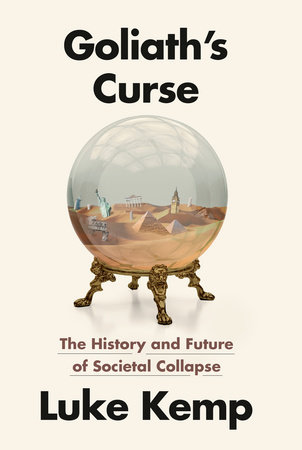
Front Cover Goliath’s Curse: The History and Future of Societal Collapse by Luke Demp (USA, 2025) Photo Credit: Penguin Random House
Looking at both the long-run trajectory of Goliath and current trends, our Global Goliath appears destined to hurtle down one of three paths. The first, and most likely, is self-termination. The second is a world in chains. The third is a world in which we somehow manage to shackle and control it. Reversing inequality and establishing deep democracy in a lasting fashion has unfortunately been a rarity throughout history. It is a highly unlikely outcome, which makes it worth fighting for even more desperately. While throughout history the collapse of a Goliath was usually temporary and a liberation, in the future it threatens to be permanent and take us and much of the planet with it. We are passengers on a journey that looks likely to end in chains or evolutionary suicide. Our Global Goliath will die explosively unless we kill it first.
Excerpt from Goliath’s Curse: The History and Future of Societal Collapse byLuke Kemp, published by Penguin Random House, New York, USA, 2025, p. 406.
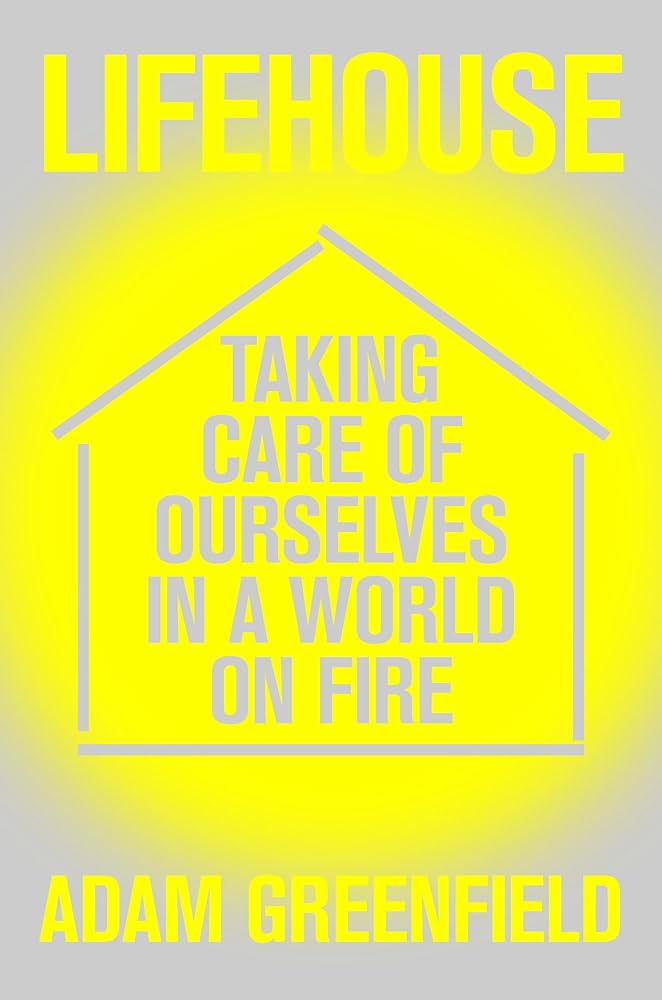
Front Cover: Lifehouse: Taking Care of Ourselves in a World on Fire by Adam Greenfield Photo Credit: Verso Books (UK/USA, 2024)
The fundamental idea of the Lifehouse [in a disaster zone] is that there should be a place in every three- or four-city block radius where you can charge your phone when the power’s down everywhere else, draw drinking water when the supply from the mains is for whatever reason untrustworthy, gather with your neighbors to discuss matters of common concern, organize reliable childcare, borrow tools it doesn’t make sense for any one household to own individually and so on—and that these can and should be one and the same place. As a foundation for collective resourcefulness, the Lifehouse is a practical implementation of the values we’ve spent this book exploring.
Excerpt from Lifehouse: Taking Care of Ourselves in a World on Fire by Adam Greenfield, Verso Books, UK/USA, 2024 (p. 167).
Lifehouse: Taking Care of Ourselves in a World on Fire is an urgent and practical guide to community resilience in the face of climate catastrophe and the collapse of late-stage capitalism. Greenfield recovers lessons from the Black Panther survival programs (USA), the astonishingly effective Occupy Sandy disaster-relief effort (NYC/USA), the solidarity networks of crisis-era Greece, as well as municipalist Spain and autonomous Rojava (Syria), to show how practices of mutual care and local power can help shelter us from a future that often feels like it has no place for us or the values we cherish.
Adam Greenfieldis an American best-selling author, urbanist, and critical futurist, based in London since 2013. He has spent the past quarter-century thinking and working at the intersection of technology, design and politics with everyday life. Selected in 2013 as Senior Urban Fellow at the LSE Cities center of the London School of Economics, he previously taught in New York University’s Interactive Telecommunications Program and the Urban Design program at the Bartlett School of Architecture, University College London. His books include Everyware: The Dawning Age of Ubiquitous Computing, Urban Computing and Its Discontents, and the bestsellers Against the Smart City and Radical Technologies: The Design of Everyday Life.
Born in Philadelphia, Pennsylvania, in 1968, he graduated with a degree in cultural studies at New York University in 1989. Between 1995 and 2000, he served as a Psychological Operations Specialist in the U.S. Army Special Operations Command.
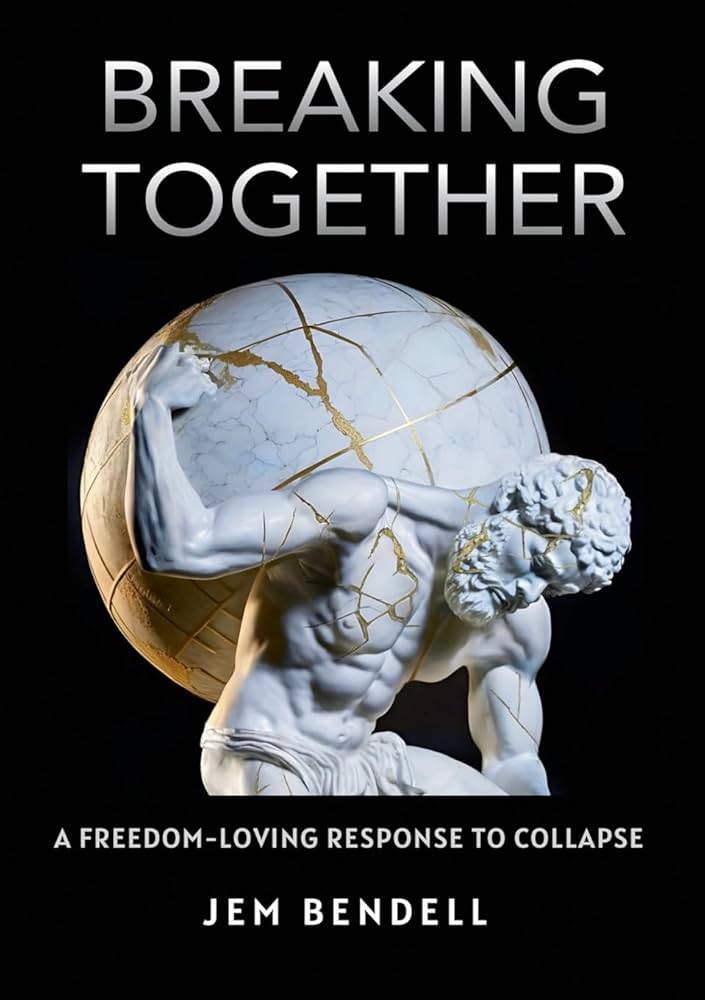
Front Cover: Breaking Together: A Freedom-Loving Response to Collapse by Jem Bendell (UK, 2023)
This month, I will not be sharing “Chapter Seventeen: Set Adrift in Shark-infested Waters” from my work-in-progress. To tell the truth, I’ve not yet completed this chapter. Like Chapter Sixteen, this period of my life has been difficult to revisit. After leaving the convent, I lost purpose and direction in my life. I was set adrift. I floundered. I’m still working on forgiving that younger self for losing her way.
Fifteen months have passed since I read Breaking Together: A Freedom-Loving Response to Collapse by Jem Bendell, released in June 2023. His findings shook my world. Our climate and ecological crises are far more critical than we’ve been led to believe. We’re now living on a planet where every year is hotter than the year before. My work-in-progress, though important in calling attention to women’s issues, became meaningless in the face of the collapse of industrial consumer societies. I lost focus.
How could I share Bendell’s findings? No one wants to hear bad news. Yet, to look away means we will not be prepared when our world as we know it begins to fall apart around us. The recent victory of the minority elite ruling class, under their chosen authoritarian leader, will only serve to accelerate societal collapse. The picks for his cabinet speak volumes of their plans to execute The Heritage Foundation’s Mandate/Project 2025.
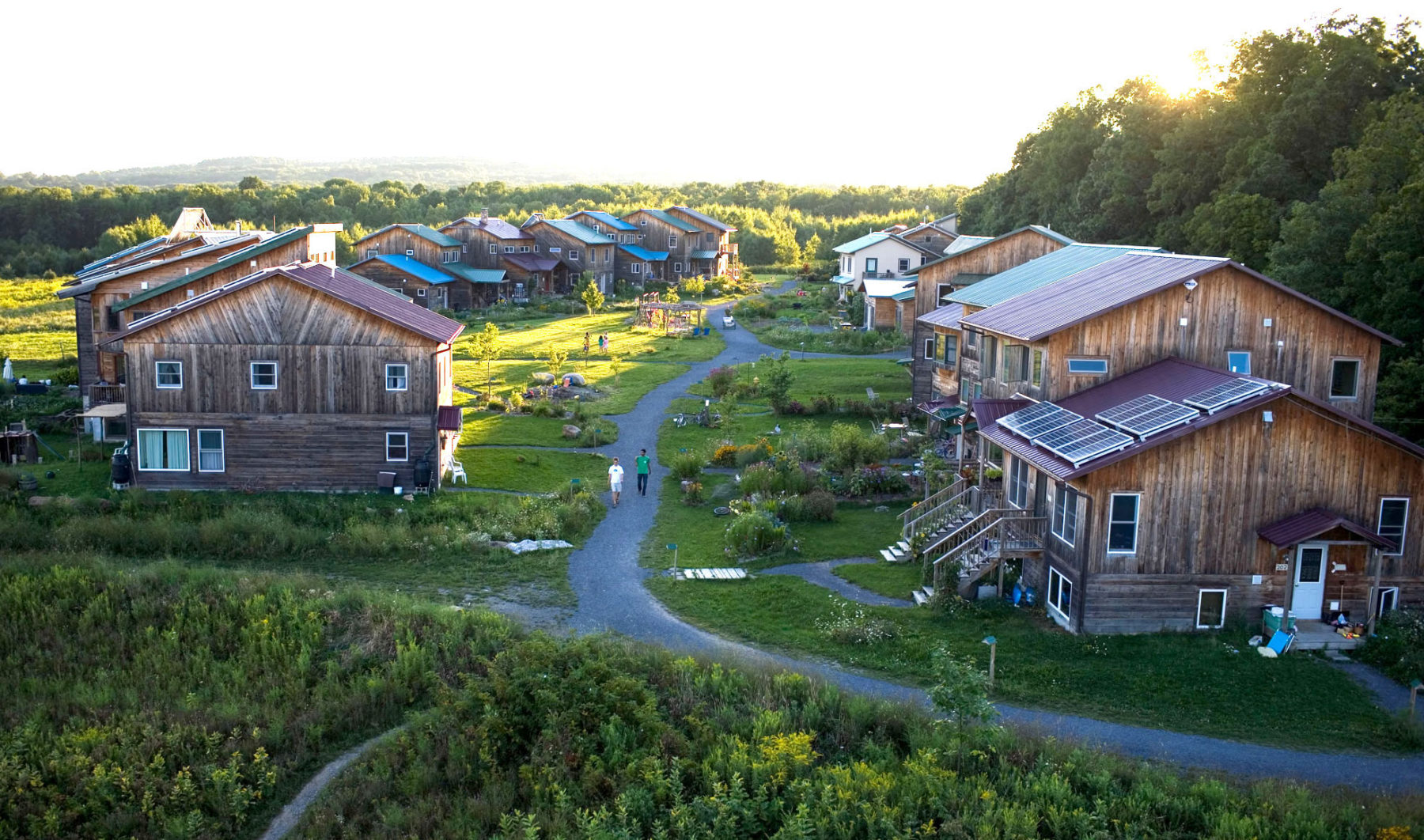
EcoVillage – Ithaca – New York – USA Photo Credit: EcoVillage Ithaca
This is Part III and final overview of the book, Deep Adaptation: Navigating the Realities of Climate Chaos, editors Jem Bendell & Rupert Read (UK/USA 2021). Part III explores some of the ‘shifts in doing’ that occur when people anticipate societal collapse. Here are the links to Part I: “Climate Chaos: Humanity’s Predicament” and Part II: Climate Chaos: “Shifts in Being.”
In his article “Leadership and Management in a Context of Deep Adaptation,” British leadership scholar Professor Jonathan Gosling observes that leadership in periods of collapsing social structures requires maturity to tolerate, contain, and transform anxiety in constructive ways. Leadership of adaptation helps us to reconcile with the situation, evaluate the risks, grieve when we suffer loss, weigh our shrinking options, and choose pragmatic and courageous change. Success relies upon collaboration, partnerships, sharing, and organization. Political, media, and business leaders must also play their part in facilitating the policies and strategies to support deep adaptation.
This is the second of a three-part series of overviews of the book, Deep Adaptation: Navigating the Realities of Climate Chaos, Edited by Jem Bendell & Rupert Read (UK/USA 2021). Here’s the link to Part I: “Climate Chaos: Humanity’s Predicament.”
Part II (chapters 4 to 8) of the book explores the ‘shifts in being’ that can occur and be supported in the event of a societal collapse due to the planetary climate and ecological crises. In Chapter 4, psychologist and co-founder of the Climate Psychology Alliance (CPA) Dr. Adrian Tait describes the ways in which psychotherapists are beginning to change in response to growing public distress, giving rise to the terms ‘climate-distress’ or ‘eco-distress.’
The CPA came into being in the United Kingdom during 2009-2012 following the mobilization of psychotherapists and academics in the field concerned about increasing evidence of climate and ecological destabilization due to human activities. The alliance has two main objectives:
To promote understanding of the way our minds work in preventing us from acting in the face of climate chaos, and
To develop support systems for those of us who are committed to persistent engagement in dealing with humanity’s predicament.
“Support is essential,” Dr. Tait notes. “If we have not been racked by grief over what is happening, then we are shutting its meaning out of our hearts and bodies. But if we remained immersed in grief alone, we would become part of the wreckage. The loss is continuous and mounting, which prevents us from moving on as in normal mourning. We need relief from the pain” (p.106).

 Three Worlds One Vision