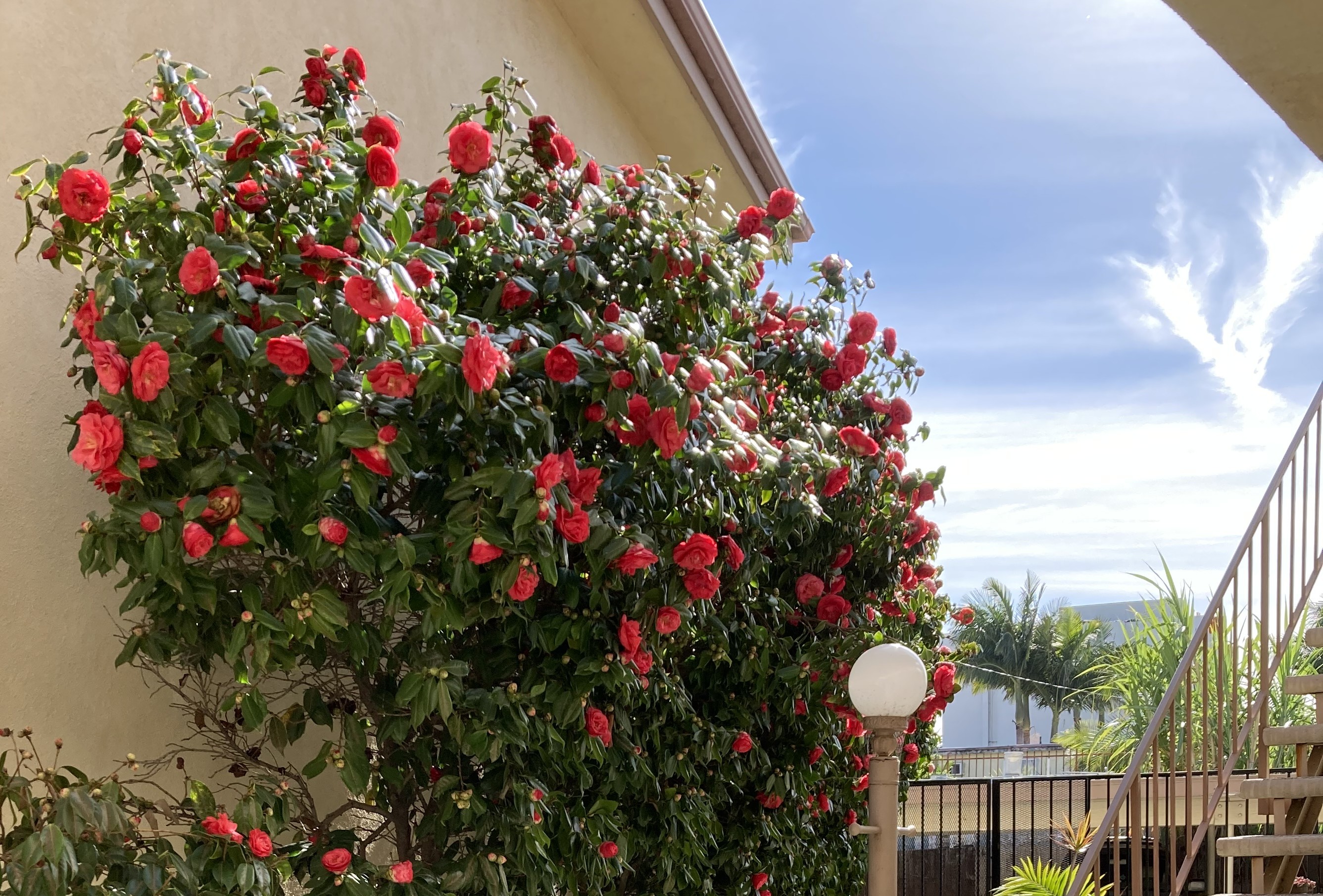
Camellia Trees – Overlooking Footpath to Parking Lot – Los Angeles – California – January 25, 2026
Our Peace Maker has launched war on Iran: Operation Epic Fury. While insanity continues to be the order of the day under political leadership lacking in moral courage, I do what is in my power to avoid contagion. I draw on lessons learned in my youth during the turbulent years in the pre- and post-independent years of my native land, when the grown-ups had found ways to keep joy alive in our lives. As in those days, I brighten my workday by playing the radio in the background. KOST 103.5 is my preferred local radio channel for bringing me my favorite songs of yesteryear as well as today’s top hits.
“Is war,” says Jamaican reggae singer Bob Marley (1945-1981).
Back in the day, weekend get-togethers with our extended family members and close friends relieved distress from the violence seeping into our day-to-day lives. I remember the bottom-house parties with music and dance: birthdays, weddings, wedding anniversaries, arrival of a new baby. Every achievement, school or job-related, was cause for a celebration, adding more joy to our lives. We also went all out with Christmas and year-end festivities. What a joyful time of the year! My happiest memories of growing up in Guyana.
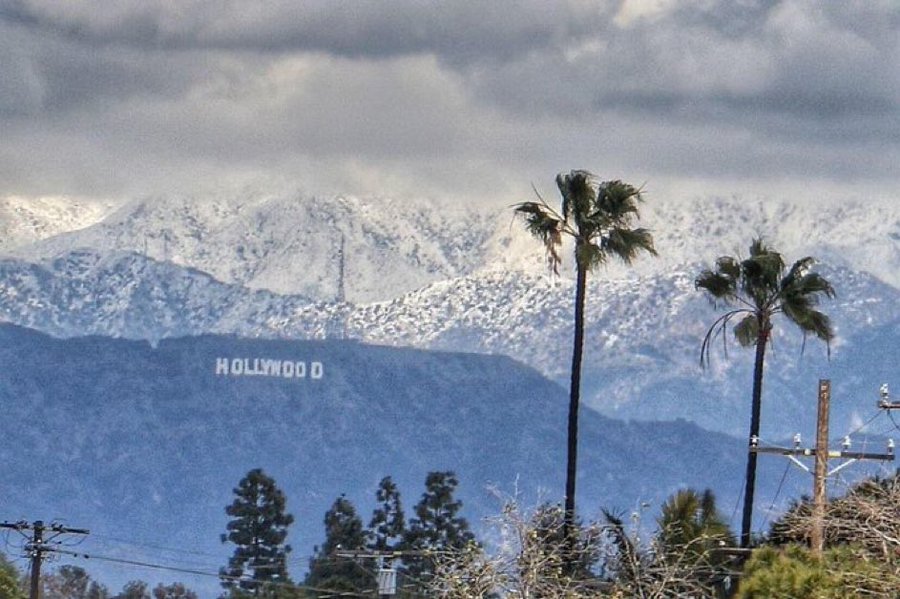
Snow-capped Santa Monica Mountains – Los Angeles – March 2, 2023 Photo Credit: Citizen Free Press
Forgive me, Mother Gaia. I come before you with my head bent in shame. How could I ever believe that it was okay for humanity to destroy so much life and treat Earth’s oceans and atmosphere as dumping grounds? I have pondered our beliefs that have brought our species to a global climate and ecological catastrophe: entitlement, surety or certainty, control, autonomy, progress, and exceptionalism. Jem Bendell refers to these assumptions as humanity’s e-s-c-a-p-e ideology. Our great human enterprise stands on pillars of The Dead. I share in the plunder. I must also share the guilt.
I hear you, Mother Gaia. Your signs of distress are everywhere, even in my home state of California. I admit that my way of being is detrimental to the preservation of our planet’s web of life. I know that a shift of being is essential. Am I up to the task? Destructive practices and attitudes have become second nature to me. Beliefs have become sacrosanct.
I have begun the work of letting go of my sense of entitlement and exceptionalism. I acknowledge that I hold no divine right of dominion over the non-human lives with whom I share this planet. As you have made clear, Mother Gaia, my well-being depends upon their well-being. When I harm the condor, the Monarch butterfly, and the great forests, I harm myself.
Through my succulent and vegetable garden, I work at reconnecting with other threads in nature’s web of life. In our chaotic world of conflicting interests and desires, the flowering trees and plants, birds, and butterflies bring joy to each new day. Not so, the caterpillars that gorged on the leaves of my young cucumber plants. My inner conflict got intense: This year, I will not be planting cucumbers. Then, there is a wild cat that roams our apartment complex at night, leaving unwelcome mounds of poop in my garden beds. I know, Mother Gaia, you never promised it would be easy.
When it comes to my consumption of durable and disposal goods, I adhere to a simple and frugal lifestyle. With adult children, I no longer contend with pressure to buy the latest stuff that kids and teenagers crave. Plastic products remain a challenge. They are everywhere, cajoling me with their convenience, durability, and usefulness. I struggle, in vain, for control, Mother Gaia.
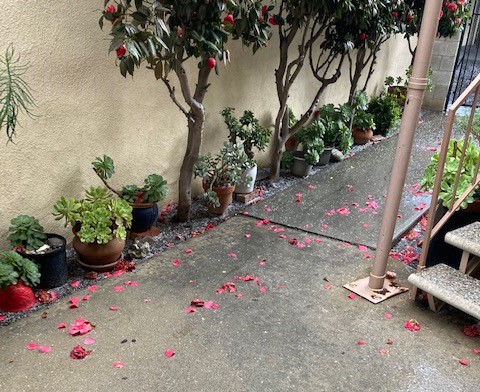
Our mistaken belief that humankind could control Nature and carve it into our own image has led us to existential crises. Extreme weather has become my new reality. Beginning on February 23rd, record-breaking severe winter storms struck our state. That afternoon shortly after 4:00 p.m., I was seated at my desk when I heard a strange pounding on the windowpane. Outside, hailstones the size of green peas littered the ground. I rushed outdoors to witness and record the rare event (see my photo below). Is this yet another sign of more extreme weather to come, Mother Gaia?
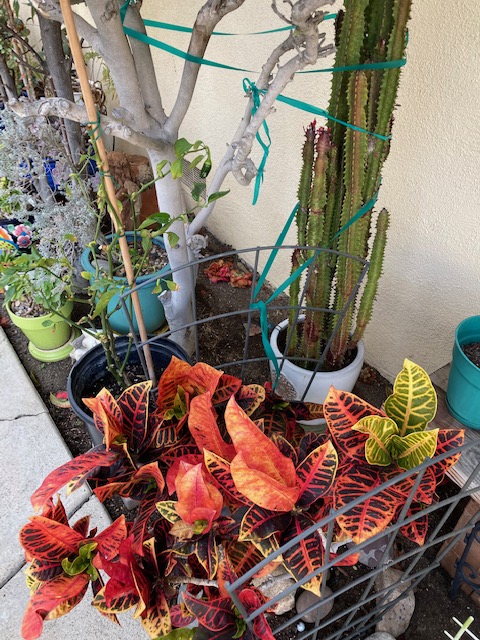
The storm brought destructive winds, much-needed rainfall, blizzards, and heavy snowfall, including low-elevation snow to areas unaccustomed to snow, like the Hollywood Sign on Mount Lee in the Santa Monica Mountains overlooking the City of Los Angeles. I give thanks that my garden suffered minor damage. The wind knocked over the potted Red Cactus and partly uprooted the Petra Croton plant from the ground. With warnings of another storm on the way, I secured both plants as best as I could (see photo below). Our apartment complex got off easy with just a little flooding. For how much longer will we escape Nature’s wrath, Mother Gaia?
Towns in the mountain regions have been hit hardest with record levels of up to ten feet deep of snowfall, trapping people in their homes. On March 1st, Governor Gavin Newsom declared a state of emergency in thirteen counties, including Los Angeles County. As temperatures have dropped by ten to twenty degrees Fahrenheit below normal for our area, I must be diligent in staying warm while still conserving on energy and gas usage. We have only ourselves to blame, Mother Gaia. We ignored your early warning signs of distress. We thought that we could keep on pumping our carbon waste into the atmosphere without adverse consequences.
Our destructive e-s-c-a-p-e narrative no longer works in favor of humankind, except for a tiny minority who profit from disaster and chaos. Until the day that they, too, will perish. We need a new narrative that recognizes our oneness with Nature’s web of life and with each other. Jem Bendell has proposed the c-o-s-m-o-s remedy: compassion, openness, serenity, mutuality, oneness, and solidarity. I will explore his proposed remedy over the next six months. I invite you to join me.
Jem Bendell uses the word “progress” in e-s-c-a-P-e ideology to describe the assumption that material progress is possible and good for the advancement of human civilization. This assumption or narrative of progress, he argues, means that new technologies and ideas are given the benefit of the doubt, and the hidden or unforeseen costs of those ideas tend to be downplayed or fixed with even less tested ideas (Bendell, pp. 134-135). In prioritizing our drive for progress, we humans push ahead to use technologies that disrupt Earth’s natural systems and unravel the Web of Life upon which human societies depend. The Men of Progress reject any alternative way of organizing society that does not guarantee them material or financial gains. Capital accumulation reigns.
Without a doubt, I have benefited from humanity’s technological progress. Thanks to this progress, I enjoy a comfortable life with all my needs met for energy, food, shelter, and water. With just a click, I can connect with others worldwide. Motor vehicles, trains, and planes make getting together with loved ones so much easier and less time-consuming. Advances in medicine lengthen my lifespan. What is there not to love about human progress?
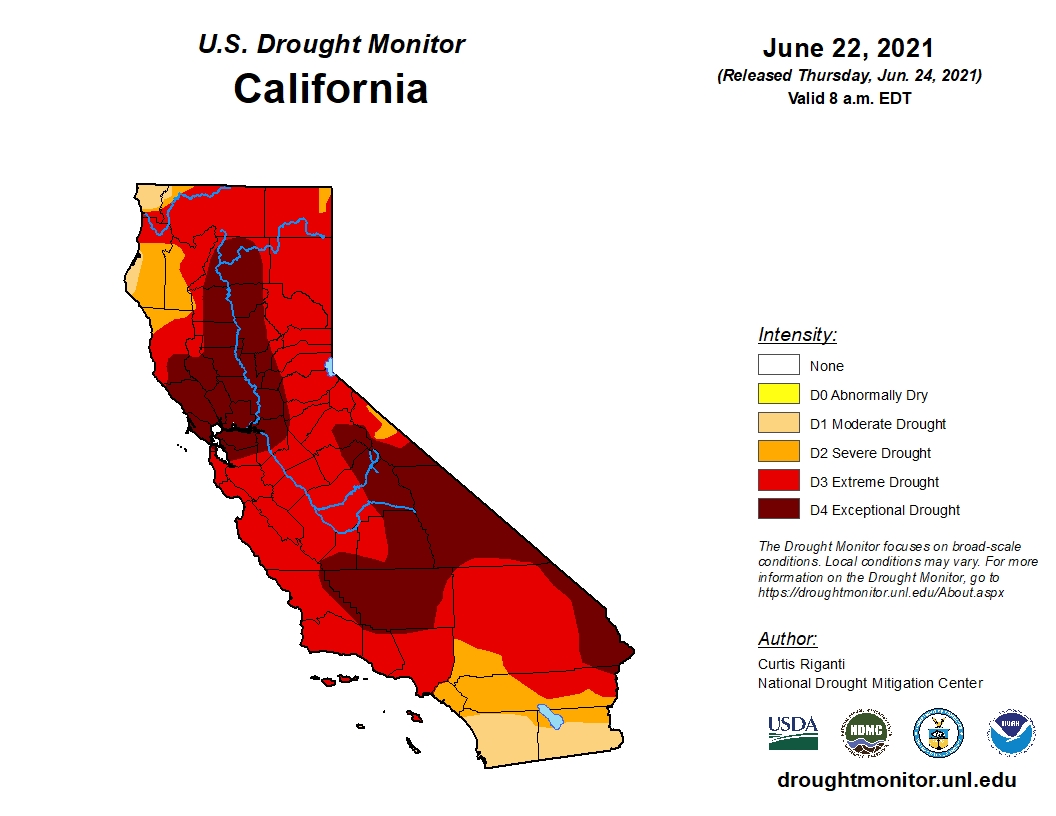
I was so consumed with the COVID-19 pandemic that I paid no attention to the lack of rainfall in the early months of 2020 and 2021. To tell the truth, I enjoyed the dry winter months. I got to spend more time gardening. Cold and damp days kill the joy of being outdoors. Then, on May 10, California Governor Newsom grabbed my attention when he placed 41 counties, 30 percent of our state’s population, under a drought state of emergency.
“With the reality of climate change abundantly clear in California, we’re taking urgent action to address acute water supply shortfalls in northern and central California while also building our water resilience to safeguard communities in the decades ahead,” said Governor Newsom. “We’re working with local officials and other partners to protect public health and safety and the environment, and call on all Californians to help meet this challenge by stepping up their efforts to save water.”
Learning that water storage in Lake Mead and Lake Powell has now fallen to about 35 percent of their capacity is also alarming. America’s two largest reservoirs, created by dams along the Colorado River, provide water to 40 million Americans and irrigation for more than 4 million acres of farmland across California and six other states—Arizona, Colorado, Nevada, New Mexico, Utah, and Wyoming. Twenty-nine Native American Tribes also depend upon theColorado River Basin for their water supply and preserving fish and wildlife habitats. The Bureau of Reclamation has forecast that the Lake Mead reservoir will hit a historic low of 1,065 feet by the end of 2021. The future of this reliable water resource is now at risk.

 Three Worlds One Vision