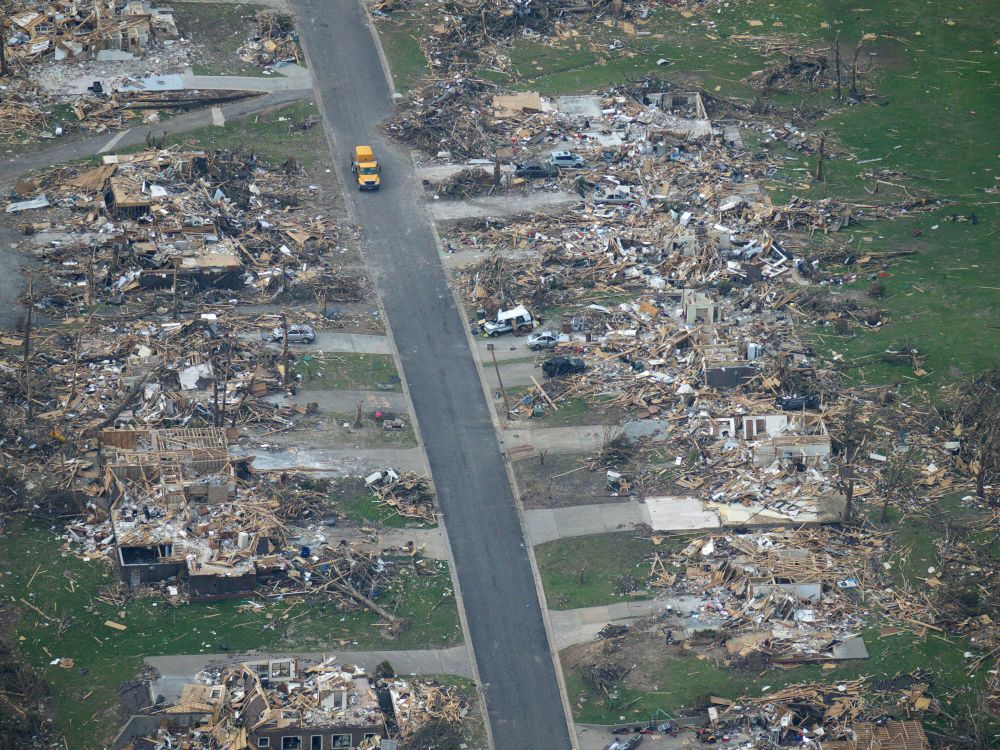
As a resident of Southern California, I’ve yet to come face-to-face with one of those terrifying tornadoes I’ve seen in movies. Tornadoes don’t occur often in our state. Whenever they do occur, they are weak, ranked EF-0 in the Enhanced Fujita Scale, causing little damage. The reality of being pummeled by a violent tornado is a devastating, life-changing, traumatic experience. Such was the case for people living in Joplin, Missouri, on May 22, 2011, featured in the Netflix Documentary The Twister: Caught in the Storm, released on March 19, 2025.
The tornado that struck Joplin in 2011 was rated EF-5 on the Enhanced Fujita Scale, with maximum winds over 200 mph (320 kph). Ranked seventh among the top ten deadliest tornadoes in United States history, it is the deadliest so far in the 21st century.
With a population of more than 50,000 and a population density near 1,500 people per square mile, Joplin suffered extensive damage amounting to US$2.8 billion. According to the account recorded in President Obama White House Archives, the tornado first touched down in the southern part of the city at 5:41 p.m. local time. During the following 32 minutes, it headed eastward across the city, demolishing everything in its path for 13 miles (21 kilometers) and extending as much as a mile (1.6 kilometers) wide at its widest extent.
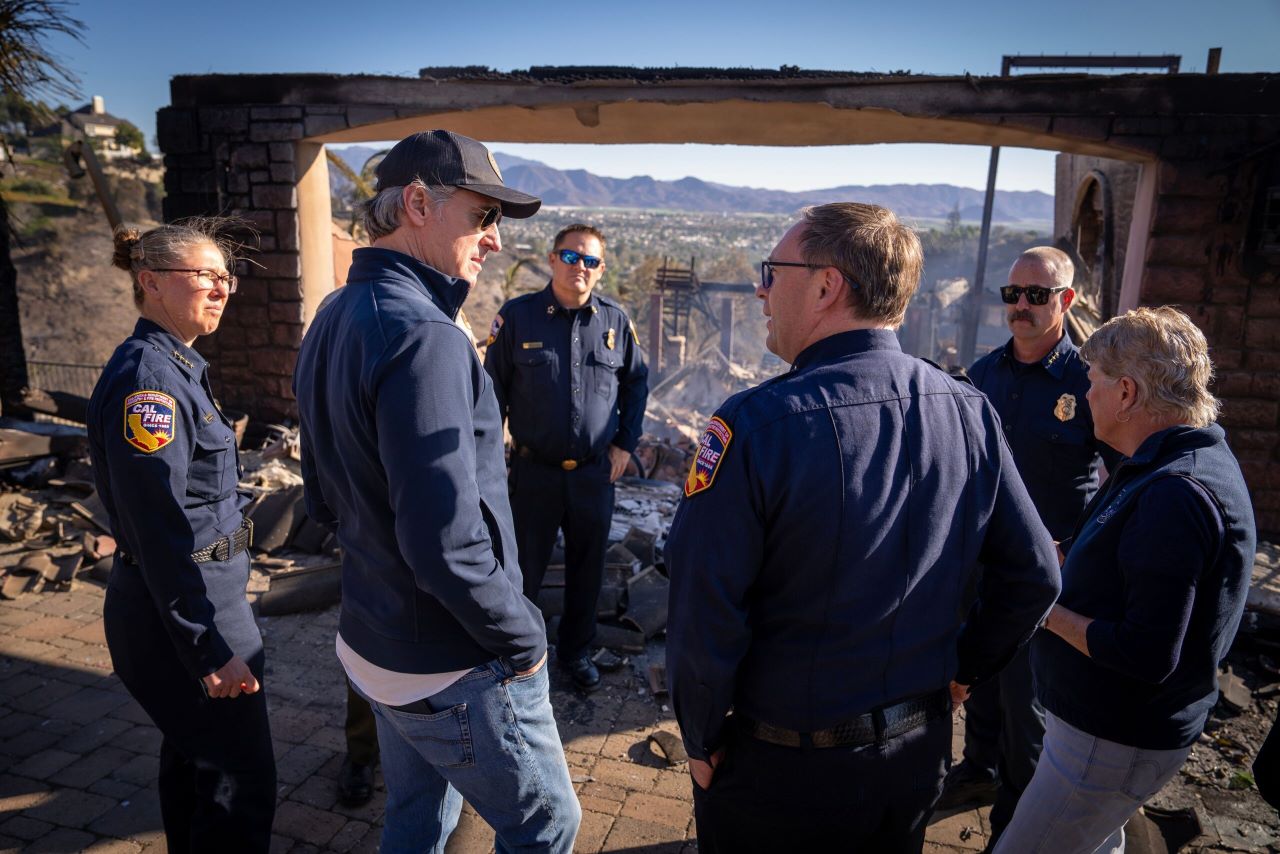
California Governor Gavin Newson (second from left) visits the Mountain Fire disaster area – Ventura County – Southern California – November 7, 2024 Photo Credit: Official Website of Governor Gavin Newsom
“We are on the brink of an irreversible climate disaster,” they warn. “This is a global emergency beyond any doubt. Much of the very fabric of life on Earth is imperiled. We are stepping into a critical and unpredictable new phase of the climate crisis.”
Why the bleak prognosis? Of the 35 “planetary vital signs” they use to track the climate emergency, 25 are at record extremes. These include U.S. heat-related mortality, fossil fuel subsidies, coal and oil consumption, carbon dioxide emissions, per-capita meat production, global tree cover loss due to fires, ocean acidity and heat content change, glacier thickness change, and ice mass change in Antarctica and Greenland.
As demonstrated in “Table 1: Recent Climate Disasters from November 2023 to August 2024,” they emphasize the rapidly escalating climate-related impacts of our global failure to support a rapid and socially just fossil fuel phasedown. Not included in this list are the supercharged Hurricanes Helene and Milton that developed in the Gulf of Mexico in late September during publication of their report. Unforeseen, too, are the flash floods in Spain on October 29th triggered by an “extraordinary deluge” that dumped twenty months of rain in just eight hours. Sounds familiar?
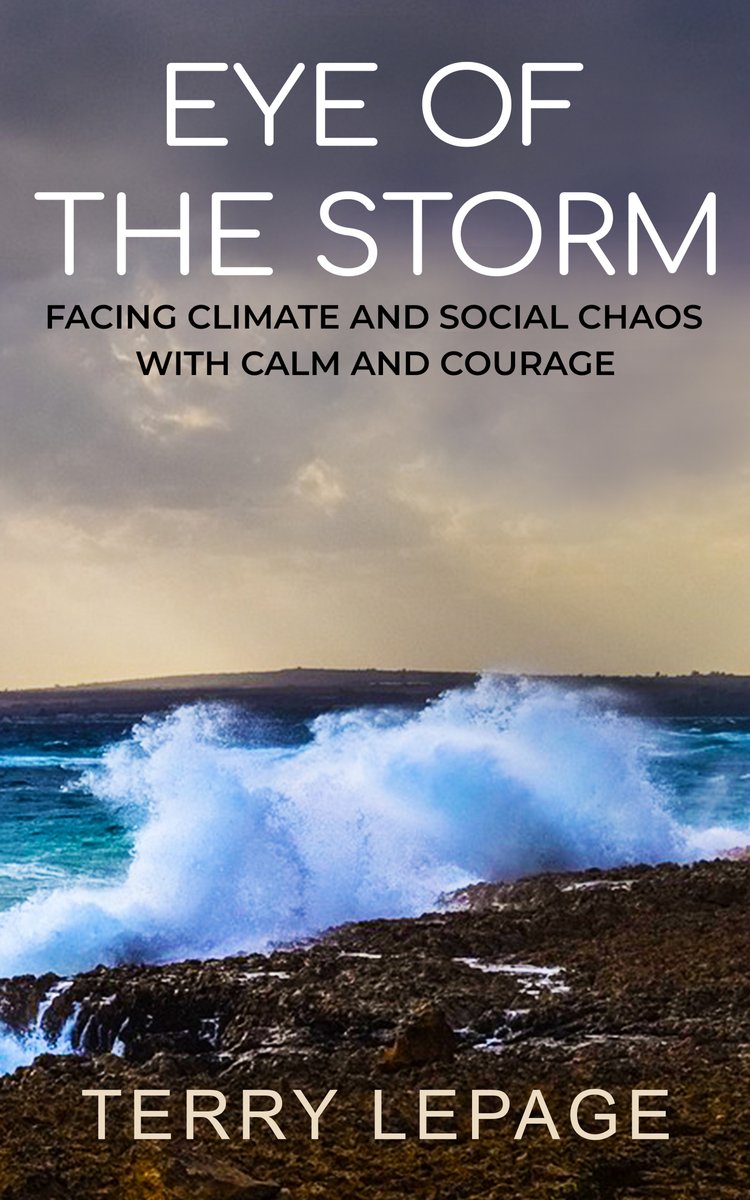
Front Cover: Eye of the Storm: Facing Climate and Social Chaos with Calm and Courage by Terry Lepage Photo Credit: Open Door Communication (USA, 2023)
[D]ue to the baked-in heating of the planet, we are experiencing ever-increasing regional catastrophes across the globe from storms, fires, floods, droughts, crop failures, and heat waves. A barrage of local, regional, and specific collapses on an uncertain time frame against a background of more general decline seems to be in store, rather than one grand collapse…. This is the storm we face.
Fear is contagious, calm is contagious, and courage is contagious. Those of us who have some idea of what is unfolding can prepare ourselves mentally, emotionally, and spiritually to be (as we are able) centers of calm, compassion, and courage. We can be ready to coach others to hold onto their values in hard times. Because we will have pre-processed some of the loss that others will deny for a while longer, we will be able to support them when they finally face what comes.
Excerpt from Eye of the Storm: Facing Climate and Social Chaos with Calm and Courage by Terry Lepage, Open Door Communication, California, USA, 2023 (pp. 11 & 12).
Terry LePage creates spaces for connection, healing, insight, and inspiration. With a PhD in chemistry and a Master of Divinity, she combines heart and head with her clear and insightful writing, speaking, and facilitation. She has worked as a research chemist, transitional minister, and hospice chaplain. She currently lives in Southern California and facilitates Nonviolent Communication practice groups, grief circles, and social justice groups both locally and for the international Deep Adaptation Forum.
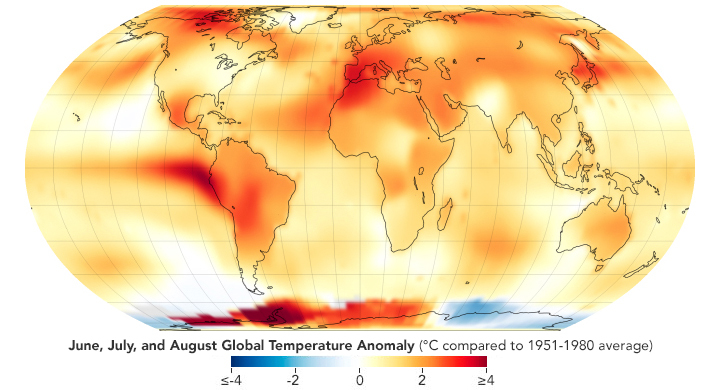
NASA Earth Observatory image by Lauren Dauphin, based on data from NASA’s Goddard Institute for Space Studies.
Summer of 2023 was Earth’s hottest since global records began in 1880, according to scientists at NASA’s Goddard Institute of Space Studies (GISS) in New York.
The months of June, July, and August combined were 0.41 degrees Fahrenheit (0.23 degrees Celsius) warmer than any other summer in NASA’s record, and 2.1 degrees F (1.2 C) warmer than the average summer between 1951 and 1980. August alone was 2.2 F (1.2 C) warmer than the average. June through August is considered meteorological summer in the Northern Hemisphere.
This new record comes as exceptional heat swept across much of the world, exacerbating deadly wildfires in Canada and Hawaii, and searing heat waves in South America, Japan, Europe, and the U.S., while likely contributing to severe rainfall in Italy, Greece, and Central Europe.
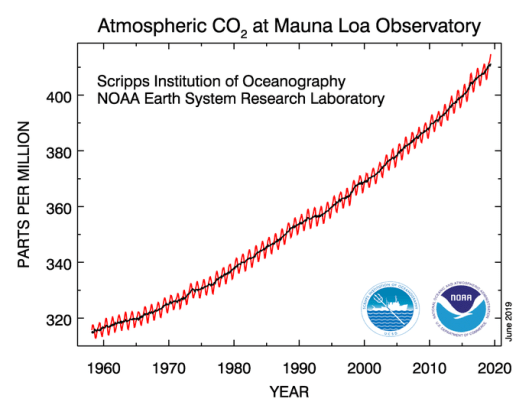
Atmospheric carbon dioxide continued its rapid rise in 2019, with the average for May peaking at 414.7 parts per million (ppm) at NOAA’s Mauna Loa Atmospheric Baseline Observatory.
The measurement is the highest seasonal peak recorded in 61 years of observations on top of Hawaii’s largest volcano and the seventh consecutive year of steep global increases in concentrations of carbon dioxide (CO2), according to data published June 4, 2019, by NOAA and Scripps Institution of Oceanography.
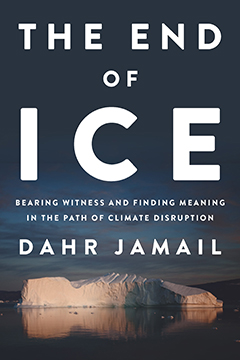
The End of Ice: Bearing Witness and Finding Meaning in the Path of Climate Disruption is a work of investigative journalism by Dahr Jamail, conducted during the period April 2016 to July 2017 on the front lines of human-caused climate disruption. Having lived in Alaska for ten years (1996-2006), Jamail had witnessed the dramatic impact of global warming on the glaciers there.
Jamail’s original aim was to alert readers about “the urgency of our planetary crisis through firsthand accounts of what is happening to the glaciers, forest, wildlife, coral reefs, and oceans, alongside data provided by leading scientists who study them.” His reporting took him to climate disruption hot spots in Alaska, California, Florida, and Montana in the United States; Palau in the Western Pacific Ocean; Great Barrier Reef, Australia; and the Amazon Forest in Manaus, Brazil. His grief at what was happening to nature made him realize that “only by having this intimacy with the natural world can we fully understand how dramatically our actions are impacting it.”
Below are excerpts of assessments expressed to the author by scientists and other professionals working on the front lines.
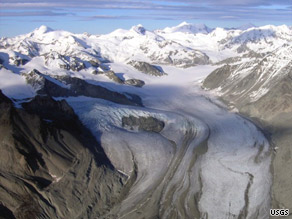
Gulkana Glacier – Alaska – USA Photo Credit: U.S. Geological Survey (USGS)
The magnitude of change in Alaska is easy to miss because Alaska is such
a massive state, and largely undeveloped. That is why you’ve had no idea that
Alaska’s glaciers are losing an estimated 75 billion tons of ice every year. ~ Dr. Mike Loso, a physical scientist
with the Wrangell-St. Elias National Park and Preserve, Alaska.
[The rate of melting of Montana’s glaciers]
is an explosion, a nuclear explosion of geologic change. This is unusual, it is
incredibly rapid and exceeds the ability for normal adaption. We’ve shoved it
into overdrive and taken our hands off the wheel.” ~ Dr. Dan
Farge, a U.S. Geological Survey (USGS) research ecologist and director of the
Climate Change in Mountain Ecosystems Project, Montana.
This last summer [2015], the Gulf [of Alaska]
warmed up 15℃ [59℉] warmer than normal in some areas… And it is now, overall,
5℃ [41℉] above normal in both the Gulf of Alaska and Bering Sea, and has been
all winter long. ~ Bruce
Wright, a senior scientist with the Aleutian Pribilof Islands Association
(APIA) and former section chief for the National Oceanic and Atmospheric
Administration (NOAA) for eleven years.
St. Paul Island – Pribilof Islands – Bering Sea – Alaska Photo Credit: St. Paul Island Tour
We hardly eat seals anymore, or the birds,
and people now get food stamps and social handouts and welfare and shop at the
store. When I grew up, we didn’t need any of that because we always had seals
and birds and fish to eat. If the fur seals aren’t here, neither will we be. ~Jason
Bourdukofsky Sr., the president of TDX, Alaska’s native corporation on St. Paul
Island, Pribilof Islands, Bering Sea.
The warming [of the oceans] we’re seeing now
is happening far too fast to allow for [coral] evolution…. So what we’re seeing
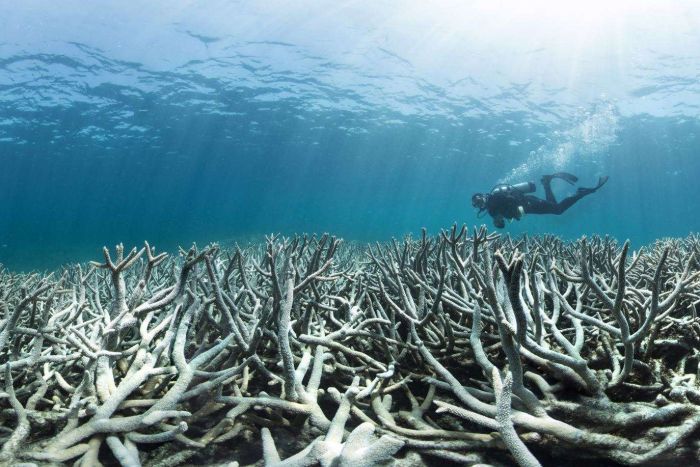
now is death. That’s what [coral] bleaching is…. Right now the largest
ecosystem on Earth is undergoing its death throes and no one is there to watch
it. ~ Dr. Dean
Miller, a marine scientist and director of science and media for Great Barrier
Reef Legacy, Australia.
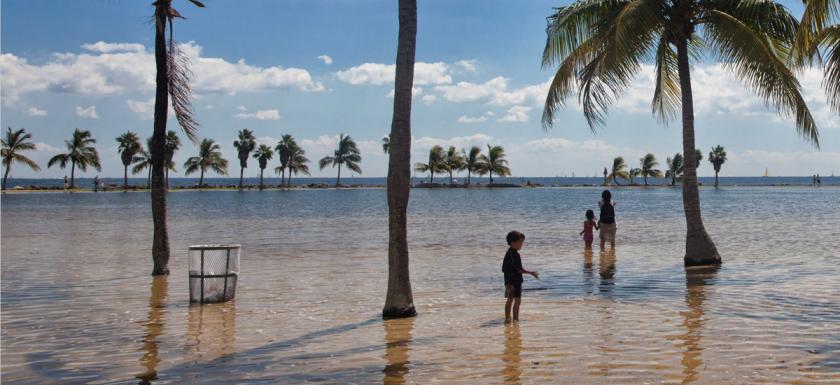
Even if your home [in South Florida] may be
elevated, all the infrastructure and freshwater and sewage treatment and
getting rid of the sewage…all of this infrastructure is critically vulnerable
to sea level rise. ~ Dr. Ben
Kirtman, one of the leading sea level experts in the world and program director
for the Climate and Environmental Hazards program at the University of Miami’s
Center for Computational Science.
Sea level rise is going to accelerate faster
than the models, and it’s not going to stop. So the government [of the State of
Florida] has to have a plan that includes buyouts. It’s cheaper to buy this
area [Coral Gables] out than it is to maintain the infrastructure. ~ Dr.
Harold Wanless, professor and chair of the Department of Geological Science,
University of Miami, Coral Gables campus.
You know what the burden is? It’s looking up
through the political hierarchy above me to the state legislature, to the
governor, U.S. Congress, U.S. Senate, the White House, and you ask, Who is
minding the shop? Who else knows what I know?… What kind of morality allows
them to ignore what is going to happen? ~ Dr.
Philip Stoddard, mayor of South Miami and a professor in the Department of
Biological Sciences, Florida International University.
We need to educate people about what is
really going on with climate disruption…. I made a personal decision to not
have kids, because I don’t have a future to offer them. I don’t think we are
going to win this battle. I think we are really done. ~ Dr. Rita
Mesquita, a biologist and researcher with Brazil’s National Institute of
Amazonian Research (INPA), Manaus, Amazonas.
The dire position we’re in now is solid
evidence of the fact that the predominant civilization does not have a handle
on all the interrelationships between humans and what we call the natural
world. If it did, we wouldn’t be facing this dire situation. ~ Stan
Rushworth, elder of Cherokee descent who has taught Native American literature
and critical thinking classes focused on Indigenous perspectives.
Jamail concludes that we are already facing mass extinction. We can’t remove the heat now stored in the oceans, yet we keep on pumping 40 billion tons of carbon dioxide into the atmosphere every year. Our future is uncertain. Writing this book was his attempt to bear witness to what we have done to the Earth. “I am committed in my bones to being with the Earth,” he writes, “no matter what, to the end.”
DAHR JAMAIL
Dahr Jamail, a reporter for Truthout, is the author of Beyond the Green Zone: Dispatches from an Unembedded Journalist in Occupied Iraq, The Will to Resist: Soldiers Who Refuse to Fight in Iraq and Afghanistan, and The Mass Destruction of Iraq: Disintegration of a Nation (co-authored with William Rivers Pitt). Over the past fifteen years, Jamail has also reported from Lebanon, Syria, Jordan, and Turkey. An accomplished mountaineer who has worked as a volunteer rescue ranger on Denali, Alaska, he won the Martha Gellhorn Prize for Journalism and is a 2018 winner of the Izzy Award for excellence in independent journalism. Jamail is also the recipient of the James Aronson Award for Social Justice Journalism, the Joe A. Callaway Award for Civic Courage, and five Project Censored Awards.
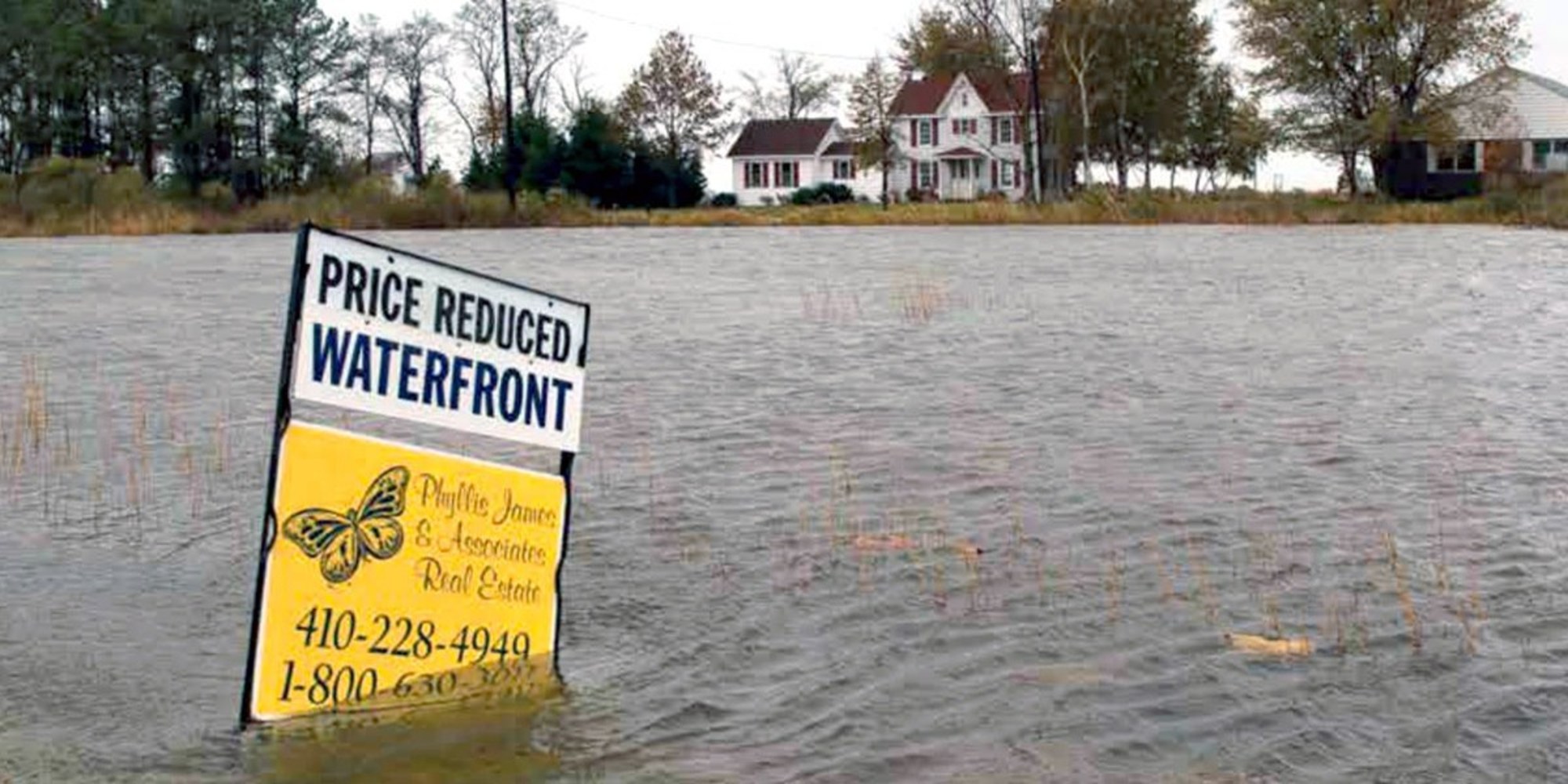
Price Reduced Waterfront Property – East Coast USA
Photo Credit: Union of Concerned Scientists (UCS) June 2018 Report
On September 14th, Hurricane Florence hit the North Carolina coast. With warmer oceans driven by climate change, the massive, slow-moving storm dumped more than 20 inches of rain on its arrival. The storm surge reached levels of 9 to 13 feet. Hundreds of inundated home owners may never recover from the damages.
Ten years ago, on September 15, 2008, another kind of disaster struck our nation with the collapse of Lehman Brothers and the insurance giant AIG. The worst financial crisis since the Great Depression sent rogue waves across our nation and worldwide. The fallout—foreclosures, shrinking home values, and millions of job losses—battered Americans.
With rising sea levels—the result of ongoing heating of our oceans and atmosphere—another massive, slow-moving crisis is brewing. Hundreds of thousands of coastal properties will increasingly face chronic high-tide flooding. Their falling property values will threaten local and regional real estate markets that could cascade nationwide into a coastal real estate bust. Continue reading →
U.S. 2017 Billion-Dollar Weather and Climate Disasters
Photo Credit: NOAA
Earlier this month, while the Trump administration quietly cancelled NASA’s Carbon Monitoring System (CMS), concentrations of carbon dioxide at the Mauna Loa Observatory averaged above 410 parts per million (ppm) throughout April. With such irresponsible action, we-the-people must prepare ourselves for more extreme weather.
Extreme Weather & the Climate Crisis: What You Need to Know, published by the Climate Reality Project (March 2018), helps us to understand the challenges we now face. As the captioned NOAA chart shows, climate-related and other natural disasters are costly. Total damages in 2017 left the U.S. with a bill of $306 billion. Families who were hit are still recovering from their loss. Families in poor communities may never recover.
Here’s what we need to know about our extreme weather and the climate crisis. Bear in mind that weather refers to short-term atmospheric changes in temperature, humidity, precipitation, wind, cloud cover, and visibility. Climate is the average of weather patterns over a longer period of 30 or more years.
Hurricanes – With average global sea surface temperatures becoming warmer, hurricanes can become more powerful. A warmer ocean also means an increase in evaporation, thereby feeding hurricanes with much more water to dump on those of us who live in their path. It gets worse. As melting ice caps and glaciers raise sea levels, storm surges caused by hurricanes will be stronger and carry water farther and farther inland.
Flooding – As air temperatures increase, more water evaporates into the atmosphere. Because warmer air holds more water vapor, some places get more rain and snow than their average annual amounts; other places may experience intense rainstorms. At the same time, rising sea levels are worsening coastal flooding worldwide.
Drought – Soils dry out when evaporation increases over land. When the rain comes, the hard, cracked ground absorbs little water. The run-off carries pollutants in the dry soil into our streams, rivers, and lakes. Drought also worsens forest fires.
Wildfires – Droughts kill plant life. Dried out, dead vegetation can ignite with a spark. Once started, these fires are harder to contain. With warm weather arriving earlier and extending further into the fall, we now face longer fire seasons. To make matters worse, pests like the mountain pine beetle thrive in the warm, dry weather. The dead trees dry out, adding to the fury of our forest fires.
Extreme Heat – Of the 18 hottest years on record, 17 have occurred this century. If we don’t reduce the greenhouse gases heating up our atmosphere, more and more of us will face the deadly threshold of extreme heat on our fragile human bodies.
Extreme Cold – As global temperatures rise and the Arctic continues to warm, the jet stream is slowing and becoming more wavy. This causes bone-chilling Arctic air to linger longer in northern regions and spread much farther south than usual.
While we cannot prevent climate-related natural disasters from occurring, it’s our responsibility to do everything we can to prevent the worst of it. And it certainly could get much worse.
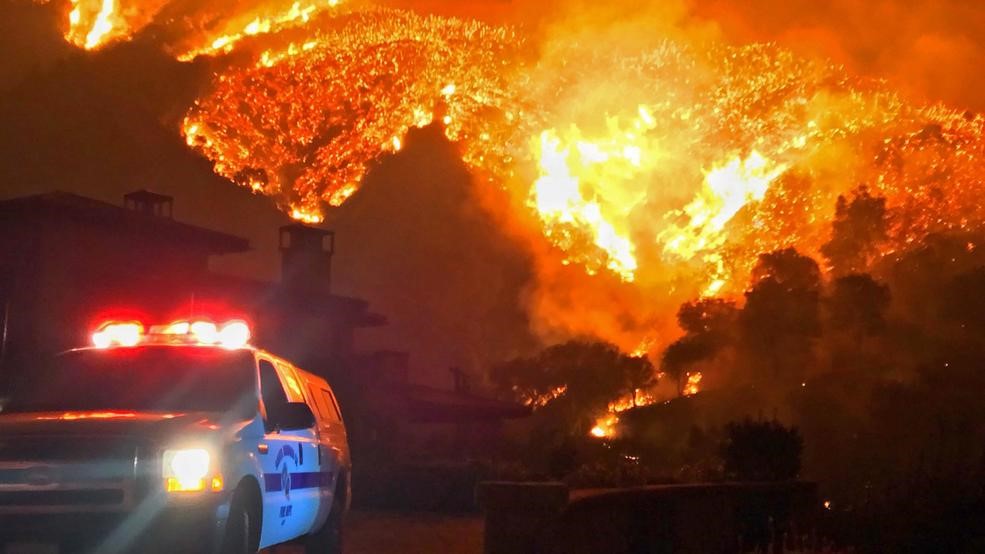
Here in California, after years of drought, ferocious wildfires have consumed the tinder and everything in their path. Ignited on December 4, 2017, the Thomas Fire was not fully contained until January 12, 2018. Now ranked as the largest fire in California’s modern history, it burned about 281,900 acres, equivalent to the size of Dallas and Miami combined. It destroyed 1,063 structures and damaged another 280.
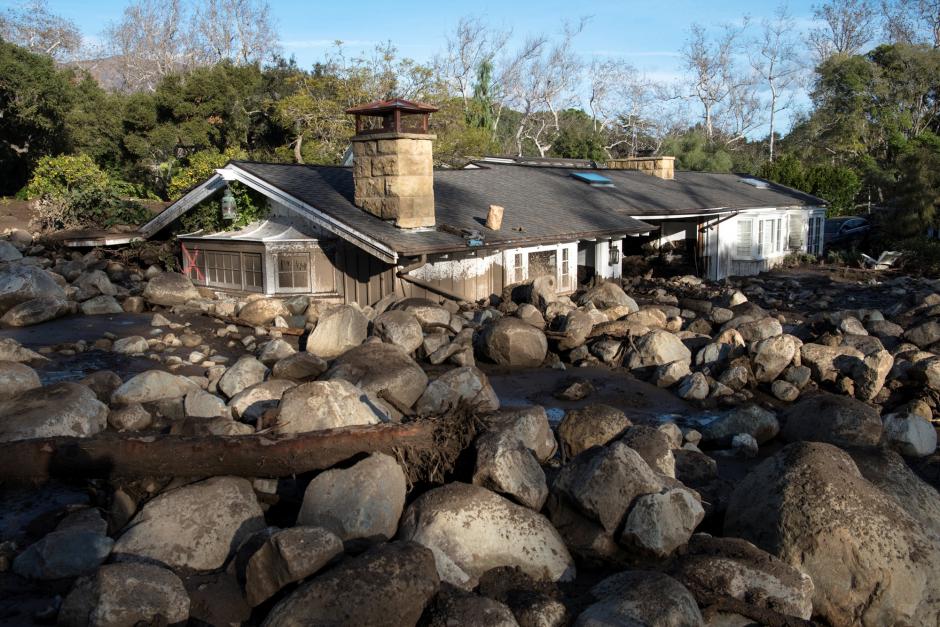
Torrential rainfall on January 9, a welcome respite for firefighters, brought more distress to residents in the area. Mudslides roared down fire scarred slopes, destroying and damaging hundreds of homes, as well as commercial property. Twenty people lost their lives; three are still missing.
Home damaged by mudslides – Montecido – Santa Barbara County – Southern California
January 10, 2018
Photo Credit: Kenneth Song/Santa Barbara News
Meanwhile, extreme winter weather on America’s East Coast provides vindication for climate change deniers. But, as world-renowned climate scientist Dr. Michael Mann explains, this is “an example of precisely the sort of extreme winter weather we expect because of climate change.” What’s happening is the collision of increasingly warm Atlantic Ocean waters with cold Arctic air masses. To make matters worse, the warmer oceans also mean more moisture in the atmosphere to fuel the storm and produce larger snowfalls.
Woman walks down street in East Boston – Massachusetts – January 4, 2018
Photo Credit: Michael Dwyer/AP
In November 2017, the U.S. Global Change Research Program released its 477-page Climate Science Special Report (CSSR), in compliance with regulations issued by the Department of Commerce/National Oceanic and Atmospheric Administration (NOAA). The CSSR is “designed to be an authoritative assessment of the science of climate change, with a focus on the United States, to serve as the foundation for efforts to assess climate-related risks and inform decision making about responses.”
Dotard & Rocket Man play nuclear war games while Frankenstorms rage.
Bill Moyers, managing editor of Moyers & Company and BillMoyers.com, recently sat down with 91-year-old Robert Jay Lifton, a renowned American psychiatrist and historian. They talked about his just published book, The Climate Swerve: Reflections of Mind, Hope, and Survival. Lifton borrowed the term “swerve” from Harvard humanities professor Stephen Greenblatt who used the term to describe a major historical change in human consciousness. Lifton has turned his attention to climate change, which, he says, “presents us with what may be the most demanding and unique psychological task ever required of humankind.”
I share with you some excerpts from Lifton’s responses to Moyers during the interview. Continue reading →




 Three Worlds One Vision
