
Tags
Climate Crisis, Lifehouse: Taking Care of Ourselves in a World on Fire by Adam Greenfield (UK/USA 2024), Mutual Care, Practical Guide to Urban Community Resilience, Societal Collapse
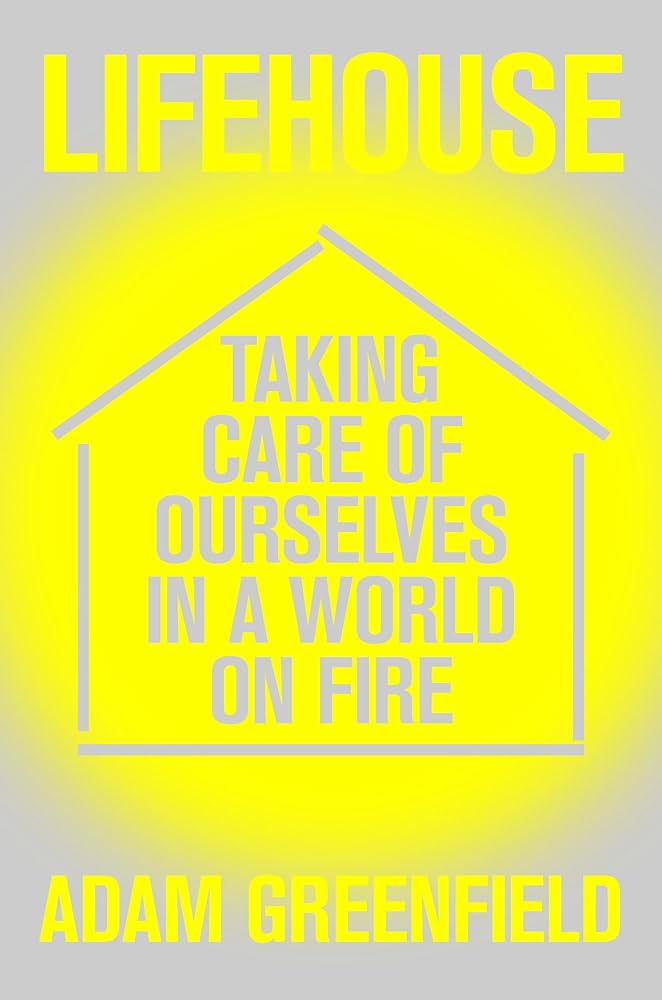
Photo Credit: Verso Books (UK/USA, 2024)
The fundamental idea of the Lifehouse [in a disaster zone] is that there should be a place in every three- or four-city block radius where you can charge your phone when the power’s down everywhere else, draw drinking water when the supply from the mains is for whatever reason untrustworthy, gather with your neighbors to discuss matters of common concern, organize reliable childcare, borrow tools it doesn’t make sense for any one household to own individually and so on—and that these can and should be one and the same place. As a foundation for collective resourcefulness, the Lifehouse is a practical implementation of the values we’ve spent this book exploring.
Excerpt from Lifehouse: Taking Care of Ourselves in a World on Fire by Adam Greenfield, Verso Books, UK/USA, 2024 (p. 167).
Lifehouse: Taking Care of Ourselves in a World on Fire is an urgent and practical guide to community resilience in the face of climate catastrophe and the collapse of late-stage capitalism. Greenfield recovers lessons from the Black Panther survival programs (USA), the astonishingly effective Occupy Sandy disaster-relief effort (NYC/USA), the solidarity networks of crisis-era Greece, as well as municipalist Spain and autonomous Rojava (Syria), to show how practices of mutual care and local power can help shelter us from a future that often feels like it has no place for us or the values we cherish.
Adam Greenfield is an American best-selling author, urbanist, and critical futurist, based in London since 2013. He has spent the past quarter-century thinking and working at the intersection of technology, design and politics with everyday life. Selected in 2013 as Senior Urban Fellow at the LSE Cities center of the London School of Economics, he previously taught in New York University’s Interactive Telecommunications Program and the Urban Design program at the Bartlett School of Architecture, University College London. His books include Everyware: The Dawning Age of Ubiquitous Computing, Urban Computing and Its Discontents, and the bestsellers Against the Smart City and Radical Technologies: The Design of Everyday Life.
Born in Philadelphia, Pennsylvania, in 1968, he graduated with a degree in cultural studies at New York University in 1989. Between 1995 and 2000, he served as a Psychological Operations Specialist in the U.S. Army Special Operations Command.



 Three Worlds One Vision