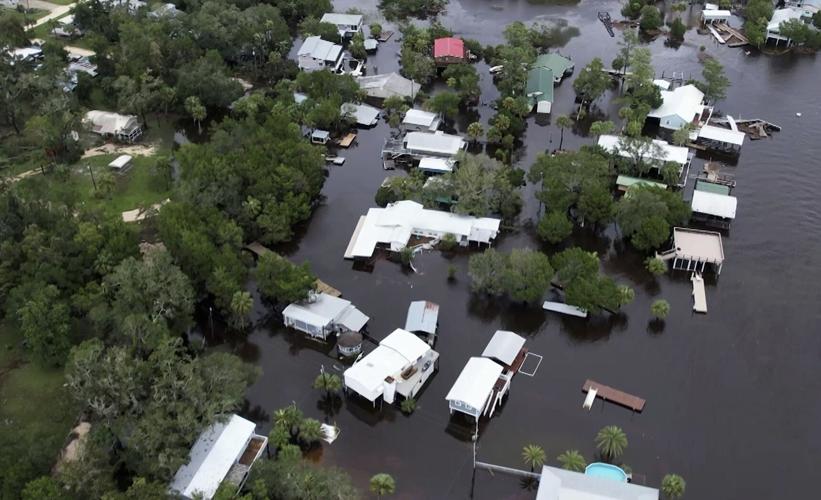
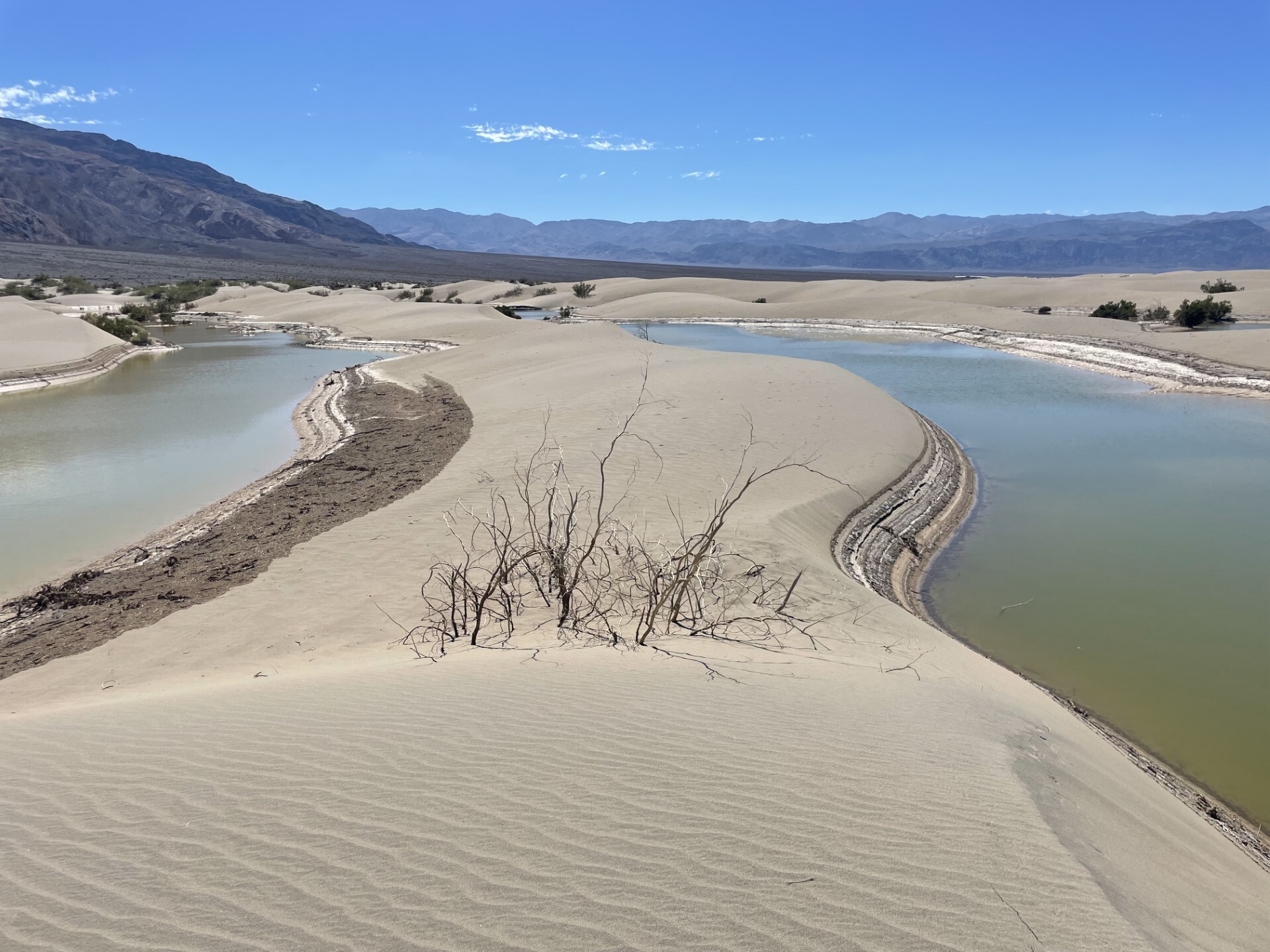
Flooding following Tropical Storm Hilary – Death Valley National Park – California/USA – August 2023 Photo Credit: USA National Park Service (NPS/ N. Bernard)
This is the fifth in my six-part series of reflections on the “c-o-s-m-o-s remedy” proposed in opposition to the “ideology of e-s-c-a-p-e” by Jem Bendell in Deep Adaptation: Navigating the Realities of Climate Chaos (UK/USA 2021).
In contrast to the habit of Progress in e-s-c-a-p-e ideology, which involves thinking and feeling that ‘the future must contain a legacy from me, or make sense to me now, because if not, then when I die, I would die even more…,’ Bendell proposes that Oneness awareness involves sensing ‘what is important is how I live more lovingly right here and now, without needing to believe that I matter or am improving’ (pp.146-147).
Oneness is defined as the quality or state or fact of being one: such as singleness, integrity/wholeness, harmony, identity, and unity/union (Merriam-Webster Dictionary). The oneness that Bendell refers to is much deeper in meaning: that feeling of interconnectedness that expands our awareness of the inherent goodness of all beings. We feel part of something greater. We see beauty everywhere, in everyone, and everything.
This is the fourth in my series of reflections on the “c-o-s-m-o-s remedy” proposed in opposition to the “ideology of e-s-c-a-p-e” by Jem Bendell in Deep Adaptation: Navigating the Realities of Climate Chaos (UK/USA 2021).
In contrast to the habit of Autonomy in e-s-c-a-p-e ideology, which involves thinking and feeling ‘I must be completely separate in my mind and being, because otherwise I would not exist…,’ Bendell proposes that Mutuality involves remembering ‘as this world has produced me and societies have shaped me, I will question all my understandings and ways of relating with others’ (p.146).
Mutuality is defined as a positive, interactive relationship between two or more individuals. There’s a sense of giving and receiving in a reciprocal way. It also involves acknowledging the sameness or equality in the other person, while appreciating the difference in the other’s experience. As Bendell notes, mutuality calls us to understand the other.
In his article “The Importance of Mutuality,” American psychotherapist Dr. Jason B. Fischer notes: “To cultivate mutuality in a relationship, we have two main choices. We can either transform the way another person feels about us (by relating to them in a new way) or we can transform the way we feel about them.”
Reflecting on my relationships over the years, including my failed marriage, I have not done so well when it comes to mutuality of shared feelings and wants. Only six relationships fall into that special category. Since I have no control over the way others feel or think of me, I worked at understanding the other’s position and needs. In the past, such relationships were only successful for as long as I was willing to give freely under the terms of the individual or group.
While relationships of mutuality are not common in my life, I have found other ways to collaborate with others who share mutual interests and goals. I struggle to understand the lack of respect, anger, hate, and violence towards the “other.” I struggle to understand the beliefs and stance of those who deny mounting evidence that humanity is facing a global climate and ecological existential crises.
Is understanding the “other” enough to narrow the divide?
Over twelve years ago—during a tough time juggling our family budget, following the 2007-2008 Global Financial Crisis—an angel entered my life. Angeletta (fictitious name), a neighbor’s eighteen-month-old daughter, came running towards me across the lawn with arms outstretched like a swan in flight. Without thinking, I dropped to my knees and held her to my heart, now light as a butterfly.
From a distance, Angeletta’s mother looked on without a word. During the month that followed, my little angel remained housebound. What had I done wrong? Had I overstepped my boundaries by hugging her child? Was the white American mother racist?
Distressed, I called my white American friend for counsel. “Take it easy,” my friend told me. “Some mothers are very possessive, especially with their first child.”
With respect for her mother’s stance, I never again hugged my darling Angeletta. From behind their closed grill door, she would call out to me by name every time she saw me. Over time, with mutual understanding and shared interests, her mother and I became friends. Angeletta became my gardening companion. I was saddened when they moved out-of-state.
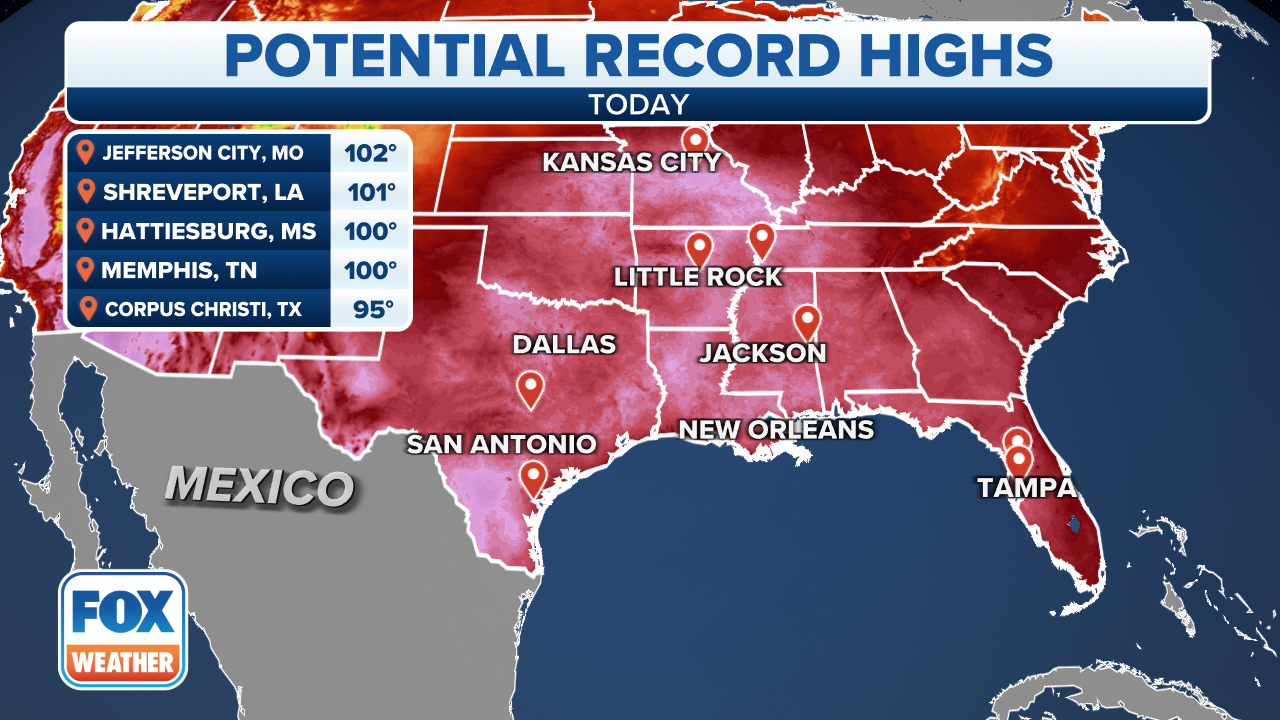
Potential Record High Temperatures Across the South & Southeast – United States – June 2023 Source Map: Fox Weather
This is the third in my series of reflections on the “c-o-s-m-o-s remedy” proposed in opposition to the “ideology of e-s-c-a-p-e” by Jem Bendell in Deep Adaptation: Navigating the Realities of Climate Chaos (UK/USA 2021).
In contrast to the habit of Control in e-s-c-a-p-e ideology, which involves thinking ‘I will try to impose on you and everything, including myself, so I feel safer,’ Bendell proposes that Serenity involves the feeling that ‘I appreciate the dignity of you, myself and all life, however disturbing situations might seem’ (p.146).
Serenity is defined as the state of being calm, peaceful, and untroubled. A look at the day’s headlines suggest that we are more generally inclined to feel the very opposite: fear, dread, anguish, and anxiety. Desperate for control over our lives, we often place our faith in powerful men to save us from drowning. In America, we pass laws to restrict the rights of others for control over their bodies.
Since childhood, fear has been a constant companion. Such is the nature of domestic violence. All I could control was fear itself. In high school, I learned the “Serenity Prayer” asking God for the wisdom to know the difference between things I could and could not change, and the courage to change what was within my power to change. I did what I could to improve communication between my parents, with no observable change.
New York City blanketed in smoke from Canadian wildfires – USA – June 7, 2023
This is the second in my series of reflections on the “c-o-s-m-o-s remedy” proposed in opposition to the “ideology of e-s-c-a-p-e” by Jem Bendell in Deep Adaptation: Navigating the Realities of Climate Chaos (UK/USA 2021).
In contrast to the habit of Surety or Certainty in e-s-c-a-p-e ideology, which involves thinking ‘I will define you and everything in my experience so that I feel calmer,’ Bendell proposes that Openness wishes ‘I will keep returning to be curious about as much as I can, however unnerving’ (p.146).
What is the openness that Bendell refers to?
According to Psychology Today: “Openness to experience, or simply openness, is a basic personality trait denoting receptivity to new ideas and new experiences. It is one of the five core personality dimensions that drive behavior—known as the five-factor model of personality, or the Big 5. People with high levels of openness are more likely to seek out a variety of experiences, be comfortable with the unfamiliar, and pay attention to their inner feelings more than those who are less open to novelty. They tend to exhibit high levels of curiosity and often enjoy being surprised. People with low levels of openness prefer familiar routines, people, and ideas; they can be perceived as closed-minded.”
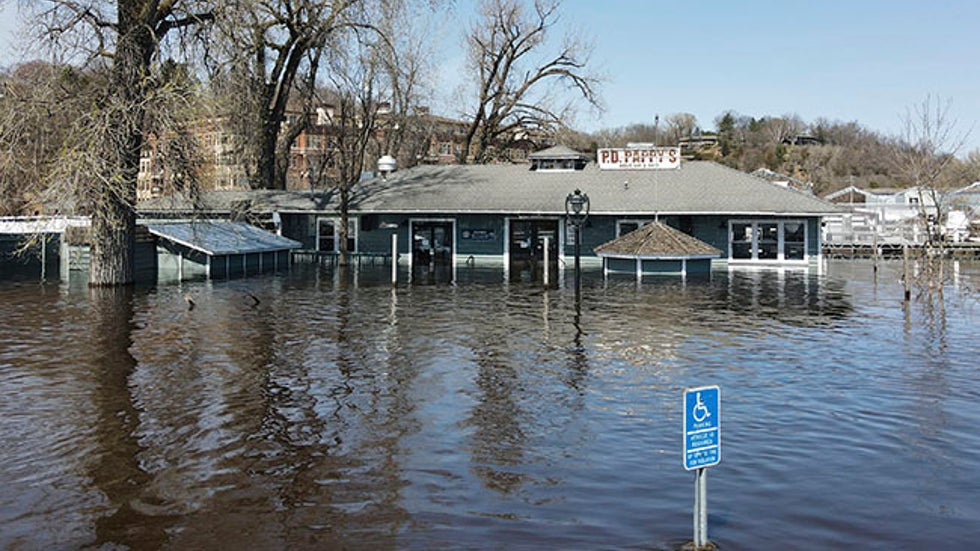
Flooding in the Upper Mississippi Valley – Stillwater – Minnesota – USA – April 18, 2023 Photo Credit: Weather Underground
This is the first in my series of reflections on the “c-o-s-m-o-s remedy” proposed in opposition to the “ideology of e-s-c-a-p-e” by Jem Bendell in Deep Adaptation: Navigating the Realities of Climate Chaos (UK/USA 2021).
In contrast to the habit of Entitlement in e-s-c-a-p-e ideology, which involves thinking ‘I expect more of what I like and to be helped to feel fine,’ Bendell proposes that Compassion, in this context, involves sensing that ‘I feel an active responsibility for any of my contribution to your suffering, without expecting to feel right, better or worse’ (p.146).
What is compassion?
In her book Atlas of the Heart: Mapping Meaningful Connection and the Language of Human Experience (USA 2021), American research professor Brené Brown defines compassion as “the daily practice of recognizing and accepting our shared humanity so that we treat ourselves and others with loving-kindness, and we take action in the face of suffering” (p. 118). Buddhist Zen Master Thich Nhat Hanh (1926-2022) describes it simply in Zen and the Art of Saving the Planet (USA 2021, p. 109): “Compassion is a powerful energy that allows us to do anything we can to help reduce the suffering around us.”
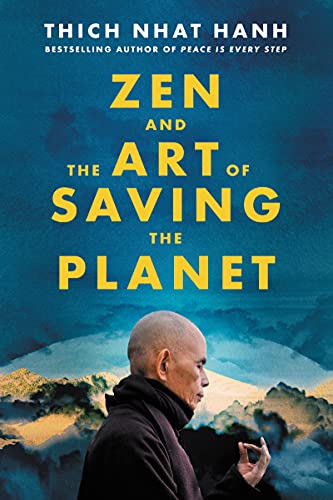
Front Cover: Zen and the Art of Saving the Planet by Thich Nhat Hanh Photo Credit: HarperCollins Publishers (USA, 2021)
If you want to save the planet and transform society, you need brotherhood and sisterhood; you need togetherness. Whenever we speak about the environment, or peace and social justice, we usually speak of non-violent actions or technological solutions, and we forget that the element of collaboration is crucial. Without it, we cannot do anything; we cannot save our planet. Technical solutions have to be supported by togetherness, understanding, and compassion.
In order to collaborate, we need to know how to listen deeply and how to speak skillfully, how to restore communication, and how to make communication easier so we can communicate with ourselves and with each other…. Restoring communication is an urgent practice. With good communication, harmony, understanding, and compassion become possible between individuals, different groups, and even nations.
Excerpt from Zen and the Art of Saving the Planet by Thich Nhat Hanh, Edited and With Commentary by Sister True Dedication, HarperCollins Publishers, New York, USA, 2021 (pp. 187-188).
THICH NHAT HANH (1926-2022) was a world-renowned Buddhist Zen master, poet, author, scholar, and activist for social change. He was nominated for the Nobel Peace Prize in 1967 by Dr. Martin Luther King Jr. He remains a preeminent figure in contemporary Buddhism, offering teachings that are both deeply rooted in ancient wisdom and accessible to all.
SISTER TRUE DEDICATION is a former journalist and monastic Dharma Teacher ordained by Thich Nhat Hanh.
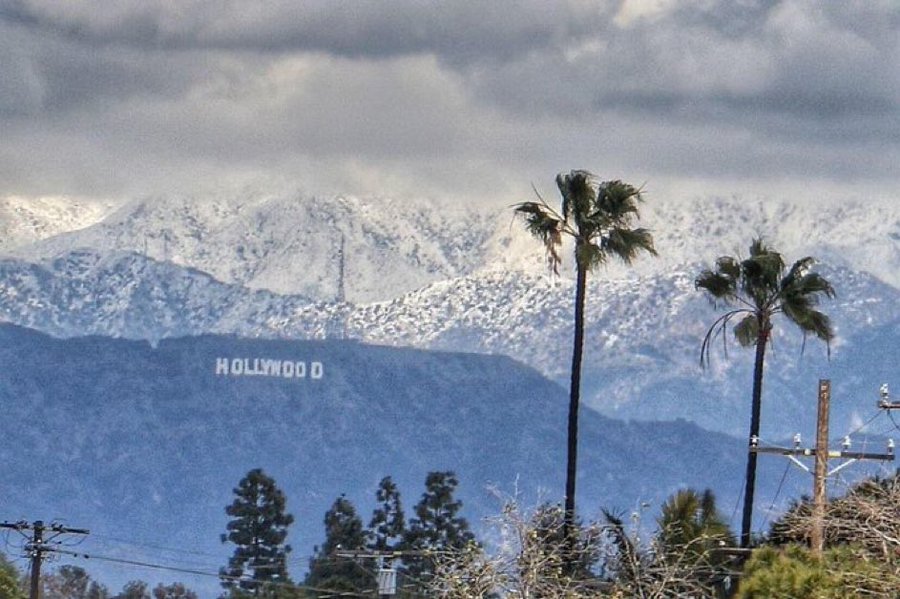
Snow-capped Santa Monica Mountains – Los Angeles – March 2, 2023 Photo Credit: Citizen Free Press
Forgive me, Mother Gaia. I come before you with my head bent in shame. How could I ever believe that it was okay for humanity to destroy so much life and treat Earth’s oceans and atmosphere as dumping grounds? I have pondered our beliefs that have brought our species to a global climate and ecological catastrophe: entitlement, surety or certainty, control, autonomy, progress, and exceptionalism. Jem Bendell refers to these assumptions as humanity’s e-s-c-a-p-e ideology. Our great human enterprise stands on pillars of The Dead. I share in the plunder. I must also share the guilt.
I hear you, Mother Gaia. Your signs of distress are everywhere, even in my home state of California. I admit that my way of being is detrimental to the preservation of our planet’s web of life. I know that a shift of being is essential. Am I up to the task? Destructive practices and attitudes have become second nature to me. Beliefs have become sacrosanct.
I have begun the work of letting go of my sense of entitlement and exceptionalism. I acknowledge that I hold no divine right of dominion over the non-human lives with whom I share this planet. As you have made clear, Mother Gaia, my well-being depends upon their well-being. When I harm the condor, the Monarch butterfly, and the great forests, I harm myself.
Through my succulent and vegetable garden, I work at reconnecting with other threads in nature’s web of life. In our chaotic world of conflicting interests and desires, the flowering trees and plants, birds, and butterflies bring joy to each new day. Not so, the caterpillars that gorged on the leaves of my young cucumber plants. My inner conflict got intense: This year, I will not be planting cucumbers. Then, there is a wild cat that roams our apartment complex at night, leaving unwelcome mounds of poop in my garden beds. I know, Mother Gaia, you never promised it would be easy.
When it comes to my consumption of durable and disposal goods, I adhere to a simple and frugal lifestyle. With adult children, I no longer contend with pressure to buy the latest stuff that kids and teenagers crave. Plastic products remain a challenge. They are everywhere, cajoling me with their convenience, durability, and usefulness. I struggle, in vain, for control, Mother Gaia.
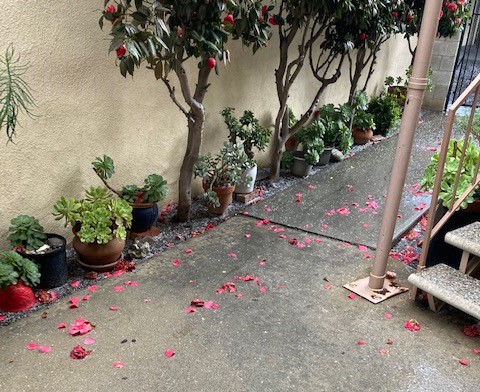
Our mistaken belief that humankind could control Nature and carve it into our own image has led us to existential crises. Extreme weather has become my new reality. Beginning on February 23rd, record-breaking severe winter storms struck our state. That afternoon shortly after 4:00 p.m., I was seated at my desk when I heard a strange pounding on the windowpane. Outside, hailstones the size of green peas littered the ground. I rushed outdoors to witness and record the rare event (see my photo below). Is this yet another sign of more extreme weather to come, Mother Gaia?
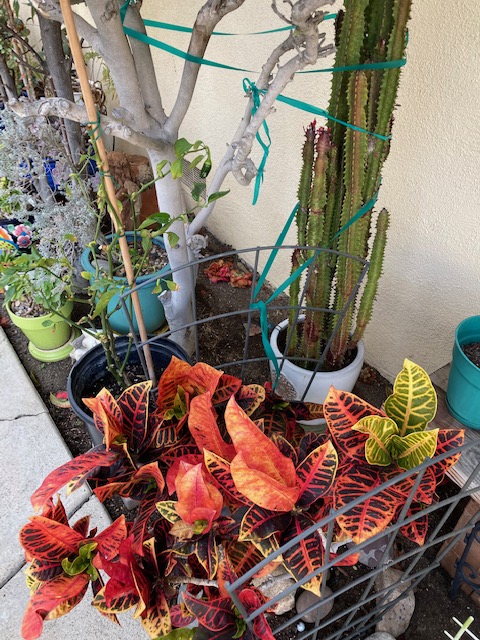
The storm brought destructive winds, much-needed rainfall, blizzards, and heavy snowfall, including low-elevation snow to areas unaccustomed to snow, like the Hollywood Sign on Mount Lee in the Santa Monica Mountains overlooking the City of Los Angeles. I give thanks that my garden suffered minor damage. The wind knocked over the potted Red Cactus and partly uprooted the Petra Croton plant from the ground. With warnings of another storm on the way, I secured both plants as best as I could (see photo below). Our apartment complex got off easy with just a little flooding. For how much longer will we escape Nature’s wrath, Mother Gaia?
Towns in the mountain regions have been hit hardest with record levels of up to ten feet deep of snowfall, trapping people in their homes. On March 1st, Governor Gavin Newsom declared a state of emergency in thirteen counties, including Los Angeles County. As temperatures have dropped by ten to twenty degrees Fahrenheit below normal for our area, I must be diligent in staying warm while still conserving on energy and gas usage. We have only ourselves to blame, Mother Gaia. We ignored your early warning signs of distress. We thought that we could keep on pumping our carbon waste into the atmosphere without adverse consequences.
Our destructive e-s-c-a-p-e narrative no longer works in favor of humankind, except for a tiny minority who profit from disaster and chaos. Until the day that they, too, will perish. We need a new narrative that recognizes our oneness with Nature’s web of life and with each other. Jem Bendell has proposed the c-o-s-m-o-s remedy: compassion, openness, serenity, mutuality, oneness, and solidarity. I will explore his proposed remedy over the next six months. I invite you to join me.
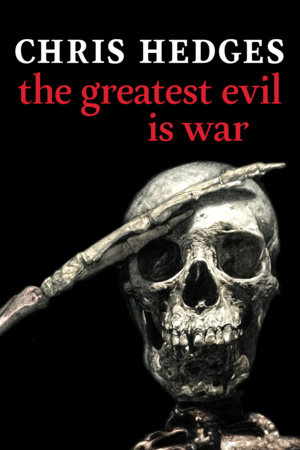
Front Cover: The Greatest Evil is War by Chris Hedges Photo Credit: Seven Stories Press (USA, 2022)
The crisis faced by combat veterans returning from war is not simply a struggle with trauma and alienation. It is often, for those who can slice through the suffering to self-awareness, an existential crisis. War exposes the lies we tell ourselves about ourselves. It rips open the hypocrisy of our religions and secular institutions. Those who return from war have learned something which is often incomprehensible to those who have stayed home. We are not a virtuous nation. God and fate have not blessed us above others. Victory is not assured. War is neither glorious nor noble. And we carry within us the capacity for evil we ascribe to those we fight.
Excerpt from The Greatest Evil is War by Chris Hedges, Seven Stories Press, New York, USA, 2022 (p. 77).
CHRIS HEDGES was a war correspondent for two decades in Central America, the Middle East, Africa, and the Balkans, including fifteen years with the New York Times, where he was awarded the Pulitzer Prize. He is the author of fourteen books, including War Is a Force That Gives Us Meaning and What Every Person Should Know About War. He holds a Master of Divinity from Harvard University and has taught at Columbia University, New York University, Princeton University, and the University of Toronto.
Jem Bendell uses the word “exceptionalism” in e-s-c-a-p-E ideology to describe two kinds of exceptionalism that cause him concern: firstly, that we and our kin are different and better, or at least more entitled than others and their kin; secondly, that humans are an exceptional species in natural history (Bendell, p. 135). He notes that, throughout history, we humans have acted as though our family, community, country, race, or religion are more important than others outside our sphere. These assumptions continue to create conflicts between us at home and worldwide. We rarely question our participation in systems of oppression and our complicity in the suffering they inflict on others. The degradation and destruction under colonialism of ‘ordinary’ humans and non-human lifeforms persist to this day.
Bendell observes that this exceptionalism also manifests in another detrimental way when people think that their difference as ‘exceptional’ beings will spare them from suffering the same fate as the rest of humanity. They act as though building bunkers, moving to New Zealand, buying farmlands, and such like, will give them an edge over the rest of us when catastrophe strikes. In this way, they lose opportunities for collaboration with ‘ordinary’ humans for solutions to our shared predicament.
The grandest exceptionalismis our story of humanity being separate, and completely different, from the natural world (Bendell, p. 137). This assumption is evident in some religions and in secular cultures. When we believe this to be true, we open the door to the destruction of non-human lifeforms and the natural world. Bendell invites us to answer the question ‘Why did humanity destroy so much life on earth?’