
Tags
Adversity, Autocracies, Brazilian Poet Carlos Drummond de Andrade, Hope, Minas Gerais/Brazil, Poema “City Foreseen / Cidade Prevista” by Carlos Drummond de Andrade, Poetry Collection The People’s Rose / A Rosa do Povo (1945) by Carlos Drummond de Andrade, Rio de Janeiro/Brazil, War Poems
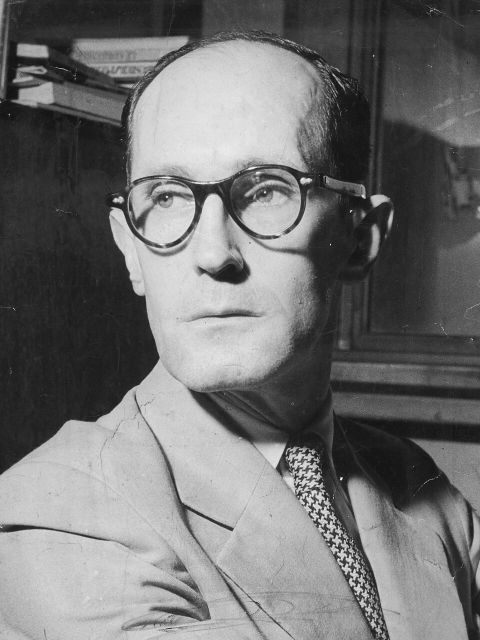
Photo Credit: Brazilian National Archives 1970 (Wikipedia)
My Poetry Corner March 2026 features an excerpt from the poem “City Foreseen / Cidade Prevista” from the 1945 poetry collection The People’s Rose / A Rosa do Povo by Brazilian poet, journalist, and literary critic Carlos Drummond de Andrade (1902-1987). All excerpts of poems cited below are from this collection.
Born in Itabira, in the Southeast State of Minas Gerais, the ninth child of a farmer, Drummond remains one of the most influential and beloved Brazilian poets of the twentieth century. He has left an extensive body of work of intellectual relevance and human value.
Drummond started his writing career in 1921 as a columnist for the Diário de Minas newspaper. Though he received a degree in pharmacy in 1925, he never practiced in the profession. After entering the public service in 1934, he was transferred to Rio de Janeiro where he worked in the Ministry of Education & Public Health until 1945. He then worked at the National Historical and Artistic Heritage Service of Brazil until his retirement in 1962.
Drummond died of coronary complications in Rio de Janeiro on August 17, 1987, ten days after the loss of his only daughter to cancer.
Published between 1940 and 1945, the featured poems reflect Drummond’s response to the destructive forces unleashed during World War II (1939-1945), arising from the ascension of authoritarian regimes. Cities are reduced to rubble. People are persecuted and forced from their homes. Within his own country, they face political repression and censorship under the authoritarian regime of the New State of Brazil (1937-1945).
In the 25-stanza poem “Vision 1944,” the poet expresses his incapacity to absorb the utter destruction and death unfolding on the frontlines of the war. The verse my eyes are too small to see echoes throughout the poem. Each verse also serves as a denouncement of the atrocities that dehumanize the populations under attack. The following excerpts are stanzas 3, 5, and 6:
My eyes are too small to see / the general with his gray overcoat / selecting a city on the map / that tomorrow will be dust and pus on the wire.
My eyes are too small to see / the transport of food crates, / of clothing, of medicine, of bandages / to a port in Italy where men go to die.
My eyes are too small to see / the sticky bodies of women / who once were beautiful—a kiss canceled / amidst the production of tanks and grenades.
In the final stanza, despite the darkness that engulfs the world, the poet expresses his hope for reconstruction and a new world:
My eyes are too small to see / the world that drains away in filth and blood, / and another world that sprouts, like a lotus / —yet they see, they marvel, they bow down, dazzled.
Since World War II, new autocracies have gained ascendence. Ignoring international humanitarian laws of warfare, the world’s most powerful nation has gone rogue in its forever wars of terror. In my Vision 2026, their eyes are too small to see their folly. Arrogance, callousness, greed, narcissism, nihilism, and lust for dominance blur their vision.
For Drummond, hope also rises from the ruins of Stalingrad with his vision of its reconstruction in the poem “Telegram from Moscow.” It’s an endeavor that will demand collective effort.
Stone by stone we will rebuild the city. / House and more houses will cover the ground. / Street and more street traffic will resurge. / […] Only a few trees remain, / scarred like soldiers. / The snow has fallen, covering the wounds. / The wind has swept away the harsh memory. / But the wonder, the legend / etches into the air the phantom of the old city, / which will permeate the body of the new. / Here it was called / —and will always be called—Stalingrad / —Stalingrad: Time answers.
May time answer for the cities leveled during our forever wars of terror: Aleppo, Gaza, Mosul, and many more.
In the excerpt of the featured poem “City Foreseen,” Drummond calls on all poets and people everywhere to dream and work towards creating a better city, a better country, a better world. Though he will not live to realize this dream, it is worth striving for. As I see it, we cannot achieve what cannot first be conceived in our minds.
Brothers, sing of this world
that I will not see, but will come
one day, within a thousand years,
perhaps more… I am in no hurry.
The city or world foreseen is one without repressive laws and violence—where there’s freedom of movement, harmony, shared beliefs, healthcare for all, equality, and richness in diversity.
A world finally in good order,
a homeland without borders,
without laws and regulations,
a land without flags,
without churches or barracks,
without pain, without fever, without gold,
a single way of living,
but in that way the variety,
all the multiplicity
that exists within each one.
It’s a wondrous city/country that welcomes strangers, where one is safe in their homes, and laughter fills the air.
A city without doors,
of houses without traps,
a country of laughter and splendor
like none that has ever existed.
This country is not mine
nor yours yet, poets.
But it will one day be
the country of every man.
What is hope if not the capacity to visualize a better world for ourselves, our loved ones, all of humanity, against all the odds? What are a thousand years for those who came before us and will come after us? The freedom to live, to be treated with equality and respect, and to have a place to call home should all be natural human rights.
Regeneration is the greatest gift of Mother Earth. With spring upon us, we are reminded of the glory and delight of this wondrous gift of rebirth. Hope lives.
To read the excerpt of the featured poem “City Foreseen / Cidade Prevista” in its original Portuguese, and to learn more about the work of Carlos Drummond de Andrade, go to my Poetry Corner March 2026.


Thank you Rosaliene.
I was particularly struck by this stanza:
My eyes are too small to see / the transport of food crates, / of clothing, of medicine, of bandages / to a port in Italy where men go to die.
In these lines the madness and nihilism of all wars is expressed to perfection. Rather than prevent men to go somewhere to die or end up maimed for life, we rationally organize the necessary supplies in anticipation of their suffering.
Is this better than for a commander in chief to say in public that he may order bombings to be carried out “just for fun”?
I don’t think so. It’s a less elaborate way to express that human life does not enter the equation when a war is being fought.
LikeLiked by 3 people
My pleasure in sharing, Dingenom. Thanks for sharing your insight about stanza 5 of “Vision 1944.” The tragedy is that we humans continue to send our loved ones into this hellscape.
LikeLiked by 2 people
So very, very, apt. Rosaliene
LikeLiked by 2 people
Thanks very much, Derrick.
LikeLiked by 2 people
Great post about a great poet, Rosaliene. The repeating line “My eyes are too small to see…” and what follows are very powerful.
LikeLiked by 2 people
Thanks very much, Dave. I wish our leaders had the sensibility to see the inhumanity of warfare as Drummond did.
LikeLiked by 2 people
Wars, endless wars started over someone’s desire for property, wealth or fame and defended with the statement “people will die, that is the cost of war” are so self serving. I know we all hope that the perpetrators of mass murder due to their own ambitions will get their recompense one day. I hope it every day, as I watch all this craziness unfold around our world. Have a great Sunday Rosaliene. Allan
LikeLiked by 2 people
Self-serving, indeed, Allan, especially when their lives or their loved ones are not on the line. The historical records reveal that recompense always comes in some form, even for the self-proclaimed Roman dictator for life Julius Caesar on the “Ides of March” (March 15th).
LikeLiked by 1 person
A timely post of timeless poetry. Thank you, Rosaliene. To die just after the death of a loved one. One wonders if, in the end, the world was too much for Drummond.
I am reminded of Picasso’s 1937 oil painting in response to the German and Italian fascist forces’ bombing of Guernica during the Spanish Civil War.
LikeLiked by 1 person
Thanks very much, Dr. Stein. You may be right. The Brazilian dictatorship regime from 1964 to 1985 was also another challenging period for poets and writers. According to the biographical record, his daughter Maria Julieta, born in March 1928, was an important presence throughout his life. Also a writer, Maria married an Argentinian writer and lawyer in 1946 and moved to Buenos Aires where she promoted Brazilian literature.
Picasso’s Guernica painting is a powerful visual image of human mass cruelty.
LikeLiked by 1 person
“But it will one day be
the country of every man.” —- I hope so!
LikeLiked by 1 person
It’s my hope, too, Neil! However long it may take.
LikeLiked by 1 person
Drummond certainly captures the insanity of war, Rosaliene. Our leaders do not seem to see what they’re doing. But, I did hear that this is the least popular war in US history so maybe Americans aren’t completely in the dark. I agree with his vision of hope except I don’t think churches are all bad and I’d change that last line from “everyman” to everyone. Hope lives!
LikeLiked by 1 person
Mara, he does, indeed, capture the insanity of war. Our leaders are blinded by their own self-interests. In our historical record, differences in religious beliefs have also led to brutal wars.
I’ve noted your comment about Drummond’s use of “everyman.” In the 1940s, the use of the masculine for collective nouns was the norm. As a translator, I try to remain true to the original language (Brazilian Portuguese) used.
LikeLiked by 1 person
I guess I was saying that if I wrote the poem, I’d say everyone. I’m glad you stay true to the original language. I also agree that religious beliefs can lead to wars, as religion, just like our laws and constitution, can be interpreted to justify injustice, something that has gone on throughout the history of our country. “Beliefs” can be a problem. It’s almost like he’s promoting anarchy which might not be a bad thing. Anyhow, sorry to go on and on on a Monday morning. It’s probably only because you share such thought provoking work. 🙂
LikeLiked by 1 person
Mara, I love that you find my work thought provoking 🙂 It means that I’m doing something right. Drummond was not an anarchist. He did not promote violence as a means of creating a better city/country/world.
LikeLiked by 1 person
You’re definitely doing something right, Rosaliene. Your blog promotes both thought and conversation. For example, I was unaware that anarchy involved violence. I thought it just meant no gov. Now I know. And, now I don’t think anarchy is a good idea. 🙂
LikeLiked by 1 person
🙂 ❤
LikeLiked by 1 person
Powerful poetry. Thank you for sharing, Rosaliene. His “eyes… too small to see” saw a lot.
LikeLiked by 1 person
Thanks very much, Michele. My pleasure.
LikeLiked by 1 person
Wow, such a powerful poem that chilled my bones. Thank you truly for sharing, Carlos Drummond Rosaliene! ❣️
LikeLiked by 1 person
My pleasure, Cindy. So glad that you see the power in Drummond’s poem.
LikeLiked by 1 person
❤️💕💫🔥
LikeLiked by 1 person
You and Carlos Drummond de Andrade have clear vision of the horrible realities of war and the hope of a peaceful future where we live up to our potential. We must acknowledge the reality while keeping the vision of hope alive.
LikeLiked by 1 person
Thanks very much, JoAnna. I totally agree with your closing comment.
LikeLiked by 1 person
Thank you for profiling the work of this remarkable poet, Rosaliene. More than anything, the world needs more dreamers, envisioning a future as he saw it, a beautiful thing as it was created to be.
LikeLiked by 2 people
My pleasure in sharing, Steve. Drummond’s poem “City Foreseen” brought to mind the 1971 song “Imagine” by John Lennon. It was used as the theme song for the 1984 movie The Killing Fields that highlights the atrocities of the Cambodian genocide (1975-1979) under Pol Pot’s Khmer Rouge regime.
LikeLiked by 1 person
Yes, of course “Imagine.” Not sure why I didn’t get that on the first reading. And it has been so long since I saw the film; I remember little of the details but recall the utter heartbreak of the story.
LikeLiked by 1 person
Rosaliene, I think of you frequently. Now wondering about Iran and its new leader. You mention rogue states. I think I know what you mean. Even though Brazilian Carlos Drummond died almost 40 years ago, his small eyes can see far ahead.
LikeLiked by 2 people
Thanks for dropping by and sharing your thoughts, Katharine. Humanity’s great poets, like Carlos Drummond, are the hearts and souls of societies worldwide. They are able to see the world as it is with all its brutality and beauty.
LikeLiked by 1 person
I think my comment went into the stratosphere, but I’ll try again, Rose. I don’t understand how someone who writes so beautifully is not recognized internationally — or maybe it’s just here that he is not so recognized — and how we are doomed to repeat the past again and again because we just don’t care what went before; we are too mesmerized with all the shiny objects in front of us today. And that is exactly how small minds take over the world.
LikeLiked by 2 people
Pam, I’m sorry to hear that you had a problem in posting your comment. WordPress has a way of acting up at times.
Drummond’s work is known internationally and has been translated into several languages. In the USA, two of his poetry collections have been translated into English by Elizabeth Bishop and Mark Strand.
I agree that we are doomed to repeat the errors of the past again and again because we ignore the historical record. We’re also well-skilled in re-writing history to suit our current narratives. In our latest “excursion” into Iran, we’ve already forgotten the lessons learned in Afghanistan and Iraq.
LikeLiked by 2 people
Ah, yes, we have, and we will forget again and again because the only driver we have is capitalism and that line of thinking respects no boundaries or authority either physical or divine, Rose.
LikeLiked by 2 people
Tragically true, Pam 😦
LikeLike
This post hits hard, Rosaliene. I gasped when reading the “My eyes are too small to see” lines. And I felt a profound resonance with your words: “As I see it, we cannot achieve what cannot first be conceived in our minds.” Thank you for helping us expand our perspectives and ways of seeing the world.
LikeLiked by 1 person
Tracy, thanks very much for your kind closing comment. Drummond’s poem “Vision 1944” is a powerful commentary on World War II. I decided not to make it the main feature as it’s very long (25 stanzas).
LikeLiked by 1 person
25 stanzas IS a lot. 🙂
LikeLiked by 1 person
This is a lovely post, but you assume that all people are good and have good intentions. You assume that your idealistic vision of the world is realistic and doable, when in fact, human nature always undermines such ideals. These are lovely dreams and fantasies. We all wish the world were different, but it never has been and probably never will be. Human nature never changes. Still, we need these dreams to keep going.
LikeLiked by 1 person
Dawn, thanks for dropping by and sharing your thoughts. There is evidence everywhere that evil exists within the hearts of the human species. That we have not yet self-destructed indicate that the good within us prevails.
LikeLike
“Drummond died of coronary complications in Rio de Janeiro on August 17, 1987, ten days after the loss of his only daughter to cancer.”
One could say he died of a broken heart. Indeed broken heart syndrome has been noted as a real thing.
Thanks for sharing his poetry with us!
LikeLiked by 1 person
My pleasure in sharing, Tamara. A broken heart may well be the case. Dr. Stein shared a similar thought.
LikeLike
The timing seems to point to it. These things happen.
LikeLiked by 1 person
They do, indeed, Tamara. I’ve witnessed two cases of elderly couples.
LikeLiked by 1 person
Truth. This happened to a family member’s in-laws.
LikeLiked by 1 person
❤
LikeLiked by 1 person
Thanks for sharing these words of freedom and hope, Rosaliene. Great poet.
LikeLiked by 1 person
My pleasure in sharing, Rebecca. So glad that you like Drummond’s poetry.
LikeLiked by 1 person
Thanks for sharing this review and story about Carlos Drummond de Andrade, an amazing poet Rosaliene! Hope really does live! 🙏🏼💖🙏🏼
LikeLiked by 1 person
My pleasure in sharing, Kym 🙂 ❤
LikeLiked by 1 person
😍💖😘
LikeLiked by 1 person
Carlos Drummond de Andrade is incredibly talented as well as educated and experienced. His poems are magnificently written, as well, Rosaliene. Thank you for bringing another outstanding person to our attention, my friend.
LikeLiked by 2 people
My pleasure in sharing, Mary. So glad that you appreciate his poetry.
LikeLiked by 1 person