
Tags
Indigenous knowledge and wisdom, Indigenous Voices, Juristac/California/USA, Land Conservation, Stewardship, The Changing Earth
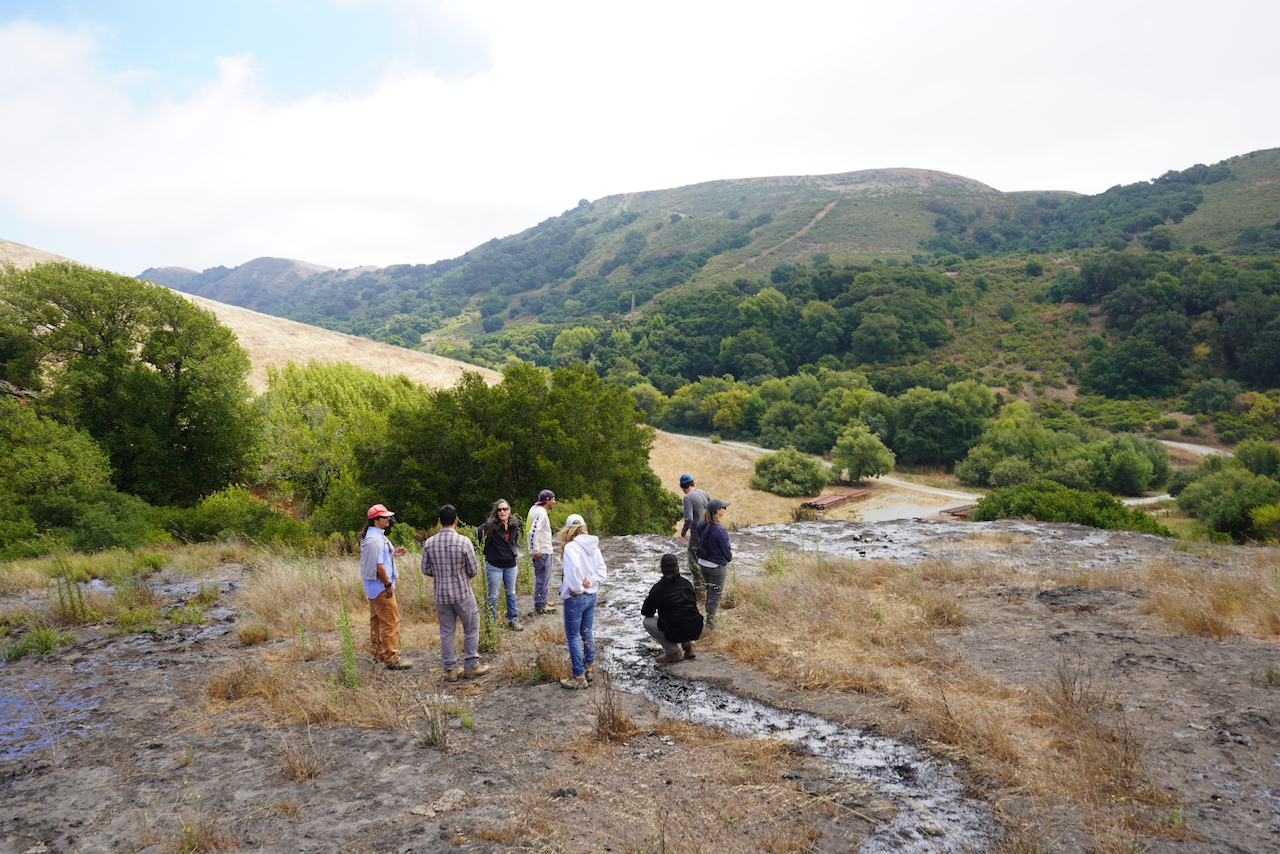
Photo Credit: Protect Juristac Website
This is the second article in my series about our changing Earth from interviews with Native Americans shared in We Are the Middle of Forever: Indigenous Voices from Turtle Island on the Changing Earth, edited by Dahr Jamail and Stan Rushworth (USA 2022). My presentation does not follow the order of the interviews.
#2: Alexii Sigona (Amah Mutsun) – Stewardship
(Chapter 12, pp. 180-192)
Alexii Sigona is a member of the Amah Mutsun Tribal Band. At the time of the interview in 2020, he was a candidate for a PhD in environmental science focusing on Indigenous land conservation and food sovereignty at the University of California, Berkeley.
The stated Conservation Mission of the Amah Mutsun Tribal Band is:
We are Amah Mutsun, of the lands known to us as Popeloutchom.
Home to our four-legged, winged, finned, and plant kin;
they have provided us with all that we needed for millennia—we will care for them.
Resting place of those that came before us and cradle of those yet to come,
they are sacred—we will protect them.
For thousands of years, their ancestral lands lay in the southern foothills of the Santa Cruz Mountains in California. They call it Juristac (pronounced Huris-tak). The area covers cultural sites and natural features, such as volcanic tar pits, of significant spiritual importance for the tribal band.
At the time of the 2020 interview, the owners of the land, an investor group in San Diego, had plans to develop a 320-acre open pit sand and gravel mine. As stewards of their ancestral land, the Amah Mutsun Tribal Band opposed this plan.
I’m happy to report that, on January 29, 2026, together with a coalition of environmental and Indigenous rights advocates, they succeeded in ending the planned mining project at Juristac. The purchase of the property by the Peninsula Open Space Trust (POST) ensures that the heart of the Juristac Tribal Cultural Landscape will be protected in perpetuity.
During the interview, Alexii explained their relationship with the land where they lived.
Native plants that were important for us were important because they had an essence that was important, but also because we managed it and were the stewards of it. So when I see a really important cultural plant growing somewhere that I’ve never been, I don’t necessarily think it’s the same type of relationship or importance as in the place that I’ve been from, because I’ve not stewarded that plant in that particular location.
The introduction of fences and the concept of private property, integral to the American colonist culture, prevented his people from accessing Juristac to conduct their ceremonies. Private property ownership also severed their close relationship with the plants on their ancestral land. How can one truly be a steward of the land where they live without an active relationship, Alexii wondered. Furthermore, he noted:
If you’re tending a certain plant population for the past four decades, you may notice a change corresponding to climate change in the ecosystem. And if you notice that, then maybe your management systems would change slightly. You’d adapt, and that relationship would be able to let you carry on stewarding it in a good way.
Alexii considers the assumption of ownership over the land, started 150 years ago in his region and expanded worldwide, as the cause for humanity’s disconnection from Mother Earth. Without a deep connection to the place where we live, and which sustains our lives, we will not take care of it.
Another aspect of private property rights presents a bind for the Amah Mutsun: “The right to exclude.” As Alexii explained:
The closest things we have to property rights are rights to exclude through memoranda of understanding [MOUs], conservation easements, and other agreements with public park or state agencies. We do have property rights in that sense, and with those, the right to exclude other people and to have these practices and ceremonies on top of the hill where our creation story took place, without other people around.
Even with the MOUs, they still need permission, such as from the California State Parks, to exercise those rights to hold a ceremony within Juristac without other people around. These access rights, Alexii pointed out, says nothing about responsibility for the land. Under these constraints, the tribal band must find ways of caring for their sacred ancestral lands.
We have loads of culturally significant places in Amah Mutsun territory, and some of them are owned by private property folks. And we have to mount all these campaigns just to keep sites from being destroyed. And that is a form of stewardship. And then on the other side is when there is an important site in state parks. And so what we have to do is we advocate for us stewarding it, and we steward it and we protect it and we actually do conservation work on it.
In obtaining his doctorate, Alexii aims to help his people get more rights and add his voice for the marginalized people in his community who he believes deserve to be heard. He is aware of the challenges he will face as he navigates a White world.
Taking care of Mother Earth is a lot of responsibility. It takes a lot of work. But if you’re talking to people about your tribe, stewardship, and researching, you’re not necessarily the one doing that work. You’re working with other people who are doing that work.
Concerned about the converging and accelerating crises, already upon us, Alexii pointed out that there are only six hundred Amah Mutsun left who know how to take care of their territory. There are still areas of relatively undeveloped land or land being challenged by development requiring attention. Degraded landscapes, that have been developed and exploited, require special attention. Without the existence of the former native rare ecosystems, restoration is not possible. Restoration of their relationship with the land is also compromised.
What I worry about is the future generations. If we don’t work hard on keeping these culturally significant landscapes tended and okay, open and undeveloped, then what will we have? Maintaining our culture, restoring our ways, having the traditional practices would just be impossible. Then, with climate disruption and sea level rise and the catastrophic wildfires, it puts that even more into question. That is unsettling, and maybe a reason why we need to have more stewardship right now on the ground than ever before in order to get more people to feel that way.
* * * * * *
Here in the Americas and the Caribbean Region, we are all occupying ancestral lands of the Indigenous peoples. While Alexii may be advocating for the rights of his people, I also hear his call to join them in caring for the precious places we now occupy.
I don’t own the land upon which my home stands. Moreover, it’s located in what is now a dense urban landscape. Unlike Alexii, I don’t share the same deep connection to this land as he does with his sacred ancestral lands. On the other hand, I do enjoy a close relationship with the plants I care for in our collective residential garden. Many of you also have your own way of connecting with Mother Earth.
I agree with Alexii that we only care for what truly matters to us. Our loved ones, like my sons, fall into this category. Yet we take Mother Earth for granted. We ignore the fact that, without her, we would have no life-giving air to breathe, water to quench our thirst, and nutriment to grow and reproduce. To enjoy life.
Alexii makes clear that each one of us is called upon to be stewards of the places we occupy. He reminds us that taking care of Mother Earth is a lot of responsibility. A lot of work, requiring lots of hands. Depending upon our lifestyle and where we live, there are several changes and actions we can each make as stewards of the planet we call home.
How can I end the harm I inflict with my choices of foods and beverages, keeping up with the latest fashion trends, and all the other trappings of my lifestyle? What can I do to protect other lifeforms—from the mighty forests to the lowly insects—that have no rights or voice?
Let’s get moving. Mother Earth is undergoing radical changes. Let’s counter the hate and violence with kindness and peace towards others. We’re all in this together.
Click on links below for previously featured interviews:
 Three Worlds One Vision
Alexii and his kind have much to teach us that greed prevents us learning
LikeLiked by 1 person
So true, Derrick.
LikeLiked by 1 person
We could learn so much from those who were here first and yet we choose not to listen, because it interferes with our greed. Nature is like a museum that must and should be conserved for the future benefits of all. Have a great day Rosaliene. Allan
LikeLiked by 2 people
Allan, we sure do have a lot to learn from Indigenous peoples who have millions of years of experience of living in harmony with Nature. The sad part is that extinct species can only be viewed in museums. The number of endangered species keeps on growing.
LikeLiked by 1 person
Sadly, one day humans will join the extinct list. Good news for nature, I am sure.
LikeLiked by 1 person
I believe we will, Allan. We’ve become cancerous. Added to that, we now face a real threat of a nuclear World War III.
LikeLiked by 1 person
Ending that planned mining project — nice to hear some rare good news these days, Rosaliene.
LikeLiked by 2 people
It is, indeed, good news, Dave. But it was no easy struggle. According to the Project Juristac Website, their campaign to stop the mining project began in 2016. It took a coalition with dozens of environmental, faith-based, human rights, Indigenous rights, and civil rights organizations to finally achieve their goal.
LikeLiked by 1 person
A great point, Rosaliene. Rare victories like that usually take a LOT of time and communal effort against very powerful and ruthless forces.
LikeLiked by 1 person
A significant victory for the stewards of land, water and air, Rosaliene. Though at the same time, it seems so small in the scheme of all that is going on. But my experience of Indigenous Peoples is one of patience and what we settlers would call long-term vision. I so admire this spirit, which has been indomitable in the face of a half millennia of colonialism and genocide.
I was particularly affected by the discussion on how ownership precludes pure connection to that which we are here to steward for future generations – and in that sense, it belongs to those in the future to whom we are not leaving a very good legacy.
Your last two paragraphs sum up the article succinctly; turning the responsibility on to us, those who have the most influence and making a difference.
LikeLiked by 2 people
Steve, it is for sure a significant victory for the stewards of Juristac. As I mentioned in my comment to Dave, it was a joint effort that lasted over a decade. Lots of patience and lots of people worked together to make it happen. Persistence and commitment. I agree that it’s a small achievement, but we cannot forget that similar struggles are taking place worldwide.
We’re definitely not leaving a good legacy for future generations. Yet, we have to go on working to save what can still be saved.
LikeLiked by 1 person
We need so many more efforts like those of the Juristac stewards, to be sure.
LikeLiked by 1 person
Steve, thanks for recommending my blog ❤
LikeLike
Thank you Rosaliene for this amazing report and I have to admit that I care very much for my little garden and take care of it as well as I can and so it should also be for the whole mother Earth!
LikeLiked by 1 person
You’re welcome, Martina. I’m so glad to hear that you also have a garden for connecting with Mother Earth.
LikeLike
:):)
LikeLiked by 1 person
I know I’ve talked about this before: When I was a kid, there were three billion people on Earth. Now there are way beyond eight billion. Overpopulation is a driving force for many problems.
LikeLiked by 1 person
I totally agree, Neil. Our population explosion has definitely put strains on ecosystems for increased production of food, consumer items, and energy. Plus the need to clear more land for housing and cultivation/production. Then, there’s handling our waste, notably our plastic waste and heat-trapping gases.
LikeLike
A noble effort by Alexii and for you, Rosaliene, to be a model and spread the word. Time is short. The earth, our home, matters.
LikeLiked by 1 person
Thanks very much, Dr. Stein. Time is running out to slow down irreversible changes to planetary life-giving systems.
LikeLike
Yay for the court victory! We need to take many more destroyers to court. Important post. Thank you.
LikeLiked by 1 person
Thanks very much, Cindy. Every victory, however small, needs to be celebrated.
LikeLike
What a gift and steward of the earth Alexii is which I applaud! We must each do our part to follow suit. Great post, Rosaliene❣️
LikeLiked by 1 person
Thanks very much, Cindy. We’re all involved.
LikeLiked by 1 person
You’re so very welcome.. Yes, we are!!❣️
LikeLike
This shows that we can learn much from those who were here first; what an informative and important post, Rosaliene!
LikeLike