
Tags
Native American poet, Poem “How It Goes” by Abigail Chabitnoy, Poetry Collection In the Current Where Drowning is Beautiful by Abigail Chabitnoy (USA 2022), Violence against women and nature
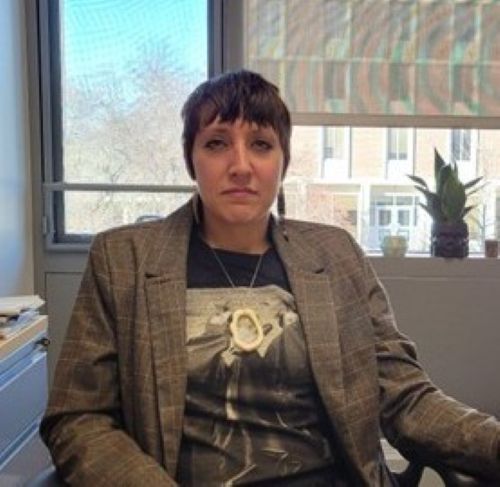
Photo by Kalana Amarasekara for Massachusetts Daily Collegian (2024)
My Poetry Corner October 2025 features an excerpt of the ten-part poem “How It Goes” from the poetry collection In the Current Where Drowning is Beautiful (USA, 2022) by Native American poet Abigail Chabitnoy. Of mixed race (Aleutian-German), she is a Koniag descendant and member of the Tangirnaq Native Village in Kodiak, Alaska. She grew up in Pennsylvania where she earned a BA in English and anthropology from Saint Vincent College. She later obtained an MFA in Creative Writing from Colorado State University where she was a Crow-Trembley Fellow, a 2016 Peripheral Poets Fellow, and received the John Clark Pratt Citizenship Award from the University.
In 1901, Chabitnoy’s great grandfather was separated from his family in Kodiak and sent to the Carlisle Indian Industrial School in Pennsylvania, the first federally funded boarding school established to assimilate Native American people into Euro-American culture. Their family’s Russian Chabitnoy surname is the legacy of Russian control of Alaska until the United States purchased the territory in 1867.
Chabitnoy describes her second poetry collection, In the Current Where Drowning is Beautiful, as “a poetic re-visioning of narratives of violence against women and nature.” In poems filled with imagery that moves in waves and use of Alutiiq language, she links the treatment of indigenous women in the United States with harm toward immigrant families and the environment.
Written during the first administration of our current president, “How It Goes” is the longest poem in the collection (pp. 51-56). In the book’s end notes (pp. 93-95), we learn that the title of the poem is taken from the words of a white teenage boy in a red hat during a protest on January 18, 2019, in the Capitol. Smirking in the face of a tribal elder, he reportedly shrugs and says: “Land gets stolen, that’s how it works.” To the poet’s dismay, the boy somehow becomes the victim in the media.
“While I am not convinced the boy meant no harm or disrespect,” Chabitnoy says in the end notes, “I can readily believe he didn’t know any better. After all, this country has fantastic powers of amnesia.”
Although the speaker in the featured poem questioned in earlier poems the wisdom of bringing children into this world, especially a girl child, we learn in the opening lines of Part I that she is open to the possibility: I’d want you to be a girl, even now. / Ashley-Olivia-Akelina-Nikifor—you would have / too many names to go missing. If only one’s name could work as a charm against evil!
Part II presents the numbers of the separated. / detained. / buried. / missing. murdered. prone / to be incorrectly labeled. / massacred (p. 52). To achieve greater impact, the numbers stand on their own, with details provided in the footnotes. Numbered among them are Central American immigrant children forcibly separated from their families, many of whom are also indigenous.
John says he is listening to your concerns.

8-year-old Franklin of Guatemala was
reunited with his father and watching them
embrace right now it is possible to forget
the latest counts

250 or 559 or more than 400
at least 2,000¹				(maybe 14,000)²
186, or more than 10,000³
500 or 2,000			        as many as 15,000⁴
btw 200 or 300 and 500, or 2,000⁵

Jakelin-Albertha-Savanna-

colonies of birds are already in decline. cite predation.⁶

(alternatively, such facts vary—by the time you read this
we will have forgotten how many. the list grows. but who’s
counting?)
_______________
¹ separated.
² detained.
³ buried.
⁴ missing. murdered. prone
⁵ to be incorrectly labeled.
⁶ massacred
After all, the speaker continues, this violence has been the American way since the European conquistadors’ first encounter with indigenous populations (p. 53):
This is America and it is (year-of-our-supposed-lord) ___.
This is America since 1492.
This is America, we were born taking children from their mothers and their fathers.
This is America and we’ve been taking babies from mothers with too many babies
(I.Y.O.) in your lifetime.
This is America and I want to tell you too it is beautiful
                                                                                          but
                                            —vindictive or entombed—
Part IV quotes the smirking white teenager in a red hat, adding a footnote in tiny print (p. 53): “Yeah, well, [kids]* get stolen. That’s how it goes.”
*he might have said “land.” he might have said “women.” he might have been smiling respectfully to diffuse the situation.
Part VIII cites the ways in which indigenous women were killed (p. 55): “by fire, by water, by hanging in air, burying in earth, / by asphyxiation, penetration, striking, piercing, crushing / in a thousand / and one ways.” // You forgot exposure (which Patricia knows in Montana may include stabbing).
Part X gives voice to indigenous girls and women lost to violence:
Now you don’t see us
Now you don’t

I’m not going to play
your blackout games

                            but know:
my teeth still shine
in the dark.

a body buried still
speaks.

above or
below

don’t imagine there is nothing at the bottom.
Chabitnoy concludes in the end notes (p. 94): “The same narratives that facilitate violence against women facilitate violence against the landscape facilitate violence against indigenous people and other nonwhite populations. And the same hypocrisy, bureaucratic ineptitude, and cultural amnesia allow these violences to continue.”
Learn more about the “Missing and Murdered Indigenous People Crisis” at the official website of the U.S. Department of the Interior: Indian Affairs.
To read the complete excerpt (Parts II-III-IV) of the featured poem “How It Goes” and learn more about the work of Native American poet Abigail Chabitnoy, go to my Poetry Corner October 2025.
 Three Worlds One Vision