
Tags
Dual Identity, Fatherhood, Language and Identity, Paraguayan American Poet, Poem “Inheritance” by Diego Báez, Poetry Collection Yaguareté White by Diego Báez (USA 2024)
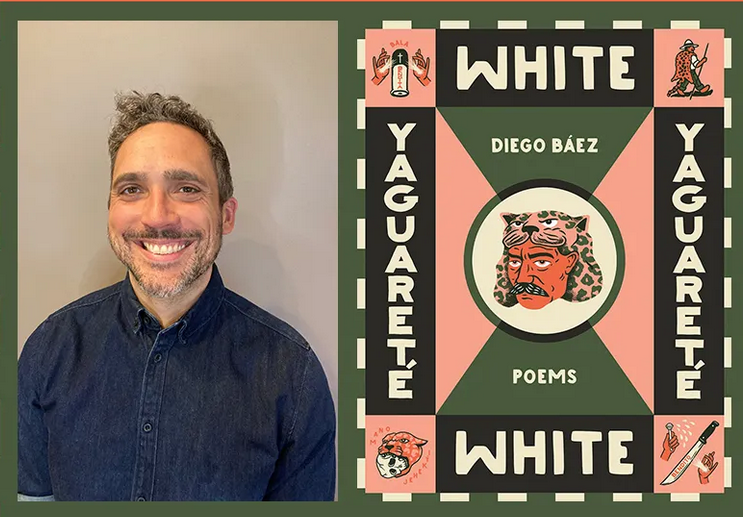
Photo Credit: The University of Arizona Press
My Poetry Corner July 2025 features the poem “Inheritance” from the debut poetry collection Yaguareté White (USA, 2024) by Paraguayan American poet Diego Báez. The collection was the finalist for The Georgia Poetry Prize and a semi-finalist for the Berkshire Prize for Poetry.
Son of a Paraguayan father and a white, Pennsylvanian mother, Báez grew up in Central Illinois in a community devoid of families that resembled his own. His brown skin betrayed his otherness to his classmates. On family visits to Paraguay, his broken Spanish marked him as a gringo. This reminder that he wasn’t quite Paraguayan or American infuses his poetry.
Báez lives in Chicago with his wife and daughter. He teaches poetry, English composition, and first-year seminars at the City Colleges, where he is an Assistant Professor of Multidisciplinary Studies.
Rigoberto González, an American poet, writer, and book critic, notes in his Foreword to Yaguareté White: “Diego Báez [is] the first Paraguayan American poet to publish a book originally in English in the United States.” He adds that Báez is transparent in his debut poetry collection about his struggles understanding his own dual identity. “[H]e didn’t grow up speaking Spanish; and the lack of connection to a Paraguayan community in the United States excludes him from the social and cultural foundations that other South American diasporas provide for their respective immigrant populations and subsequent generations.” His memories of his Paraguayan origin arise from visits to his abuelo’s farm outside the village of Villarrica.
Nevertheless, Paraguay is ever-present throughout the poetry collection in which Báez weaves its colonial history of violent militant whiteness together with its three languages: English, the language of US imperialists; Spanish, the language of the colonizers; and Guaraní, the dialect of the indigenous peoples. In combining the Guaraní word for jaguar, yaguareté, and white in the book’s title, the poet also hints at his dual identity.
Continue reading
 Three Worlds One Vision