
Tags
Evolutionary Suicide, Existential Risks, Goliath’s Curse: The History and Future of Societal Collapse by Luke Demp (USA 2025), Societal Collapse
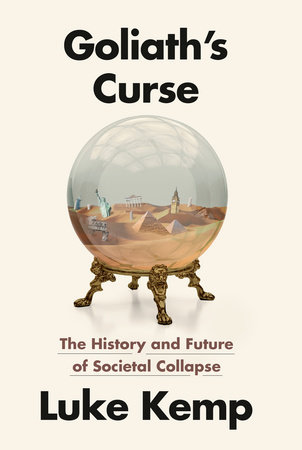
Photo Credit: Penguin Random House
Looking at both the long-run trajectory of Goliath and current trends, our Global Goliath appears destined to hurtle down one of three paths. The first, and most likely, is self-termination. The second is a world in chains. The third is a world in which we somehow manage to shackle and control it. Reversing inequality and establishing deep democracy in a lasting fashion has unfortunately been a rarity throughout history. It is a highly unlikely outcome, which makes it worth fighting for even more desperately. While throughout history the collapse of a Goliath was usually temporary and a liberation, in the future it threatens to be permanent and take us and much of the planet with it. We are passengers on a journey that looks likely to end in chains or evolutionary suicide. Our Global Goliath will die explosively unless we kill it first.
Excerpt from Goliath’s Curse: The History and Future of Societal Collapse by Luke Kemp, published by Penguin Random House, New York, USA, 2025, p. 406.
Synopsis from book jacket – Goliath’s Curse is a vast and unprecedented survey of societal collapse—stretching from the Stone Age to the age of silicon—that digs through the ruins of fallen societies to understand the root causes of their downfall and the most dire consequences for our future.
GLOSSARY OF SELECTED TERMS USED IN BOOK
Authoritarian impulse – The psychological tendency for individuals to be more accepting and supporting of authoritarian structures and leaders when faced with a threat to their safety and security.
Civilization – A social structure characterized mainly by non-hierarchical, democratic cooperation.
Collapse – The relatively rapid contraction and fragmentation of different power systems. This results in large-scale losses in hierarchy, population density, and energy capture.
Democracy – A spectrum of (more or less) equal and inclusive political practices. Democracies can be hierarchical (ancient Athens for adult males) or non-hierarchical (egalitarian forages such as the Hadza).
Dominance hierarchy – A social-ranking system in which one group or individual is placed above others owing to their ability to impose penalties, including violence.
Evolutionary suicide – Short-term evolutionary pressures lock the population into a path of self-destruction. Short-term adaptation leads to long-term extinction.
Global Goliath – A collection of interconnected hierarchies across the entire world in which some individuals dominate others to control energy and labor. In our modern world this includes hierarchies such as the state, patriarchy, rich and poor (based on a capitalist global economy), and myths about the need for hierarchy.
Goliath – A collection of interconnected hierarchies in which some individuals dominate others to control energy and labor.
Goliath fuel – Ecological and technological conditions that allow for the establishment of a Goliath. These include lootable resources, monopolizable weapons, and caged land.
Lootable resources – Resources that can easily be seen, stolen, and stored. A form of Goliath fuel.
Stories of subjugation – Myths, ideologies, and religions that justify the domination of the many by the few.
Luke Kemp is a senior research associate at the Centre for the Study of Existential Risk at the University of Cambridge (UK). He has lectured in the fields of economics and human geography, and has advised the World Health Organization, the Australian Parliament, the UN Convention on Biological Diversity, and many other institutions. His research has been covered by media outlets such as The New York Times, the BBC, and The New Yorker.
 Three Worlds One Vision
Unfortunately this is unquestionably sound.
LikeLiked by 1 person
I agree, Derrick. Yet, we persist in our ways 😦
LikeLiked by 1 person
Doesn’t exactly paint a picture of humanity becoming increasingly selfless and humane, does it? Still, that’s what I work for.
LikeLiked by 3 people
It sure doesn’t, Mitch, yet we must continue working at being more selfless and humane. Kemp noted that our better angels evolved during the Palaeolithic period when our hunter-gatherer pre-historic ancestors learned that their survival after a disaster depended upon providing mutual aid, food, shelter, and love to those in need. This gradually changed with the emergence of inequality and dominance hierarchies, bringing out the worst in us (pp. 425-426).
LikeLiked by 1 person
This movie has played out many times before, but never with so much danger of total destruction. The trouble is that the Global Goliaths see themselves as saviours, not destroyers. Have a good Sunday Rosaliene. Allan
LikeLiked by 2 people
Allan, it’s frightening how much power we now have in our arsenal. AI is the latest addition. As I see it, they would like the masses of humanity to believe that they are the saviors. The destruction is just collateral damage in the name of progress.
LikeLiked by 1 person
Its the old adage with the dictators these days, “The one with the most toys (bombs) at the end wins.” Yup and everyone else loses.
LikeLiked by 1 person
This is undoubtedly a book VERY relevant to today’s world, Rosaliene. 😦 Trump is the latest in a long line of rulers hell-bent on collapsing society for spite, power, and money.
LikeLiked by 1 person
Dave, I think that Kemp’s historical research is a valuable contribution to other books on societal collapse. This current administration knows that we’re in the endgame and are ensuring that they remain in control.
LikeLiked by 1 person
II read about this in NYT and The Guardian. The NYT review is rather shallow. The Guardian piece is in interview form. I recommend The Guardian piece, if only (for those partial to such things) for Kemp’s photo in that article (he’s Australian, and very handsome). There are things he says that I definitely do not agree with, such as: “I’m pessimistic about the future, but I’m optimistic about people.” It is the exact opposite for me. Well, if they were all like Kemp, I might be moderately optimistic about people, too. The quote I like better goes: “Collapse isn’t just caused by structures, but also people. If you want to save the world then the first step is to stop destroying it. In other words: don’t be a dick. Don’t work for big tech, arms manufacturers or the fossil fuel industry. Don’t accept relationships based on domination and share power whenever you can.” Except that I would have left out a few words in the first sentence, which would then go like this: “Collapse isn’t caused by structures, but people.”
LikeLiked by 1 person
Dingenom, I’ve haven’t read the reviews in the NYT and The Guardian. The excerpt you cite is from Kemp’s “Epilogue: Slaying Goliath” (pp. 442-443). He calls on us to hold ourselves to a higher standard. “Don’t let the darker angels of your nature win. If you find yourself atop a hierarchy, democratize it and distribute your power among your peers. Every year, try to make sure that your actions leave the world a little freer than it otherwise would have been.” This applies not only to individuals but also to institutions and corporations.
LikeLiked by 1 person
Link attached. https://www.theguardian.com/environment/2025/aug/02/self-termination-history-and-future-of-societal-collapse?CMP=Share_AndroidApp_Other. The quotes are from this article. Anyway, I guess my point is, it is never about structures, or corporations, or the occasional tyrant or mogul that societies and nations keep coughing up from time to time. It is always about people. At a certain level of abstraction there are hardly victims and perpetrators. There are only perpetrators. Only when we descend into the actual day-to-day, where the cards have been dealt for that particular moment in time (a brief and fleeting moment by definition) do we see the granular pattern of wolves and prey. (And yes, the reference to Hobbes is intentional). Thank you, Rosalien, for so much food for thought, again!
LikeLiked by 1 person
Thanks for sharing the link to The Guardian’s review, Dingenom. Ultimately, it does come down to the perpetrators/abusers/oppressors and their collaborators among our species. But let us not forget that they use human-designed structures/institutions/hierarchies to chain/control/dominate the masses of humanity.
LikeLiked by 1 person
We definitely are in big trouble. SOS!
LikeLiked by 1 person
We are, for sure, Neil! As I see it, societal collapse is inevitable given our track record. What matters now is how we prepare for and navigate the fallout. In his chapter “Endgame,” Kemp notes that our tech-billionaires have invested in the most luxurious doomsday bunkers, many of which are located in New Zealand. I share Kemp’s view that “this bunker mentality is a flawed strategy…. To prepare for a societal breakdown, you are better off stockpiling friends, favors, and skills rather than guns and canned beans.” (p. 417)
LikeLiked by 1 person
Sounds like an interesting book, Rosaliene. I like the non traditional definitions. Reminds me a bit of a book, “The Dawn of Everything” by David Graeber which talks about different forms of “civilization” that happened long before the history I was taught in school. So much more interesting. Anyhow, it seems as society collapses, we and our so called leaders are going to have to make some major adjustments in order to survive and seems like this book has some good ideas for doing that.
LikeLike
Mara, Kemp’s book is also informative, insightful, and thought-provoking. In the “Epilogue: Slaying Goliath” (pp.434-445), Kemp proposes four actions we would need to take in order to become like David and defeat Goliath, as told in the biblical story:
1. Don’t Be a Dick
2. Practice Democracy
3. Vote Against the Apocalypse
4. Don’t Be Dominated
LikeLiked by 1 person
Very though provoking actions, Rosaliene, especially #1. 🙂 I think with collective action we can do amazing things but it’s very hard to mobilize in a fragmented society.
LikeLiked by 1 person
Precisely, Mara. That’s why the Goliaths of our world work tirelessly to keep us divided.
LikeLiked by 1 person
Sobering, Rosaliene. In my best moments, I believe we can avoid the worst, though the climate issues reduce our chances. I fear for my children and grandchildren.
LikeLiked by 1 person
Dr. Stein, I don’t believe that we can avoid the worst, given the current undoing of our environmental protections by the current administration in order to increase the profits of the billionaire class. With our children and grandchildren in mind, I’ve taken on the task of changing the narratives regarding what Jem Bendell describes as “a freedom-loving response to collapse” in his book Breaking Together (UK, 2023).
Thanks for bringing Kemp’s book to my attention.
LikeLiked by 1 person
You are welcome and, I fear, you are also right. But I am glad to have your dear presence on the globe.
LikeLiked by 1 person
I can say the same for your presence, Dr. Stein 🙂 ❤
LikeLiked by 1 person
Dr. Stein, I don’t believe that we can avoid the worst, given the current undoing of our environmental protections by the current administration in order to increase the profits of the billionaire class. With our children and grandchildren in mind, I’ve taken on the task of changing the narratives regarding what Jem Bendell describes as “a freedom-loving response to collapse” in his book Breaking Together (UK, 2023).
Thanks for bringing Kemp’s book to my attention.
LikeLike
wonderful raising of awareness, Rosaliene. We continue raising our voices in hope and to be heard. Thanks for sharing this! xx
LikeLiked by 1 person
You’re welcome, Cindy. We cannot tire in pushing back.
LikeLike
Funny for me to come across this now. I recently heard, twice, about books dealing with societal collapse throughout history. From what I remember the main premise of those being: it began with the removal of sexual morals, leading to the collapse of the family… or something. I didn’t read the books, but the premises were interesting. Both seemed to say that, if history repeats, we are headed toward another collapse because the basic unit of society–the family–has been utterly hijacked in our permissive, everything goes approach to living, which makes people more empty and depressed than fulfilled and free. I think there’s something to that. And, actually, maybe it was two places talking about the same book, come to think of it. Next time I come across it, I should pay closer attention! 😛
LikeLiked by 1 person
Ilsa, that sounds like a male-centric talking point. Societal collapse goes way beyond the collapse of the family.
LikeLike
Yes, it does. But I think the idea was that intact family structures are good for society. Don’t quote me. 😛 It was a while ago.
LikeLiked by 1 person
Ugh! This is a real fear at the present time. I believe in miracles and will keep praying, Rosaliene.
LikeLiked by 1 person
I also believe in miracles, Mary. But we must also remember that prayer and action go hand-in-hand.
LikeLiked by 1 person
This reminds me of the dystopian films that have become more popular in the past couple of decades, though the first Mad Max movie was in 1979. Collapse (and starting over) might be better than a world in chains, but who knows? I still have hope for us but suspect we’ll go through any number of transitions and phases. I’m wondering what countries, even if rare, have reversed inequality and established deep, lasting democracy. I often read good things about Sweden which has been a parliamentary democracy for 100 years.
LikeLiked by 1 person
JoAnna, thanks for adding your thoughts. Kemp notes (p. 422) that “the one bright spot [of the historical record of collapse] is that the deeper the fall, the more likely it is that we’ll rise again as democratic equals.”
I’ve also read good things about living in the Nordic countries. In 2025, according to the World Population Review, Sweden was the fourth happiest country in the world after Finland, Denmark, and Iceland. Norway held the 7th place.
LikeLiked by 1 person
Thank you for that bright spot! It makes sense when we consider hard lessons. And the bright spots of Nordic countries, too.
LikeLiked by 1 person
JoAnna, we’ve both had to overcome some hard lessons to get to a brighter place today. Stay strong ❤
LikeLiked by 1 person
Amen. Stay strong ❤
LikeLiked by 1 person
Thanks you for posting this, Rosaliene. I had read a review of the book in the Guardian, and your additions were very helpful. Can people (other than Scrooge) become “ungreedy” ? What would make humans have more empathy? If today, the majority of the world began to fight inequality, would it be enough to stop the autocrats?
LikeLiked by 1 person
You’re welcome, Julie. My post is not intended to be a review. Inequality in all its manifestations–gender (male/female), skin color (white/non-white), and income (rich/poor)–are responsible for several, if not all, of the ills in our societies worldwide. Kemp believes that the simplest way of reversing inequality is through taxation. He adds (p. 440): “Other measures include placing a cap on wealth,… or capping the income of the highest earners within companies at five times that of the lowest-paid workers.” Building characters with more empathy and less greed are another story.
LikeLike
Ah, yes, I see what you mean. Sorry for missing that. I guess that sadly, I don’t ever see a tax on wealth being put in place, and my perspective comes from an educational point of view. As a retired teacher who had classes of 20+ for dozens of years, I’ve had a long time to ponder those who are or aren’t greedy/empathic in any class, and to wonder why. It’s not a surprise to me anymore to see how institutions including educational ones, have folded to the “money”, but when did greed go into overdrive?
LikeLiked by 1 person
Julie, based on my understanding of Kemp’s analysis, greed went into overdrive with the emergence of what he calls the “Silicon Goliath” in which data is a crucial new lootable resource (p. 400). “That data is being used to automate cognition and to speed up and scale up all the existing global systems, whether it be the search for fossil fuels, the production of novel entities, mass surveillance, or the organization of robust-yet-fragile global supply chains.”
LikeLiked by 1 person
“Evolutionary suicide”—interesting concept. I wonder if that’s the path we’re on in this country.
LikeLiked by 1 person
Edward, based on my own observations of our inability/unwillingness to stop heating up our planet, I believe that we’re on the path of evolutionary suicide.
Kemp considers evolutionary suicide as the most likely fate of the Global Goliath. Our climate and environmental crises are not the only factors in play. He notes (p. 394): “Bigger, more interconnected populations mean worse disease outbreaks; stronger militaries mean more damaging arms races; and barbarism is the economic backbone of the systems that produce carbon, weapons, and dangerous technology.”
LikeLiked by 1 person
He has a good point, and I must say that I agree with him. We have just observed how quickly COVID spread across the world because it is so interconnected. Thank you for sharing that note. I’ve added the book to my reading list.
LikeLiked by 1 person
You’re welcome, Edward.
LikeLiked by 1 person
You read hard hitting books, Rosaliene. I like his definition of civilization. I hope we can reach it, rather than implode.
LikeLiked by 1 person
I guess I do, Rebecca. It’s my way of finding answers to humanity’s maladies. Considering the rise of Christian white nationalism in the USA and the push-back against gender equality, any hope of reaching “a social structure characterized mainly by non-hierarchical, democratic cooperation” remains out of reach.
LikeLiked by 1 person
I admire and learn from your reading selections. thanks
LikeLiked by 1 person
I appreciate your feedback, Rebecca.
LikeLiked by 1 person