
Tags
A Leaf in His Ears: Collected Poems by Mahadai Das (UK 2010), Guyana/Caribbean Poet, Guyana’s Authoritarian Regime (1974-1992), Guyanese Poet Mahadai Das (1954-2003), Poetry Collection My Finer Steel Will Grow by Mahadai Das (1982)
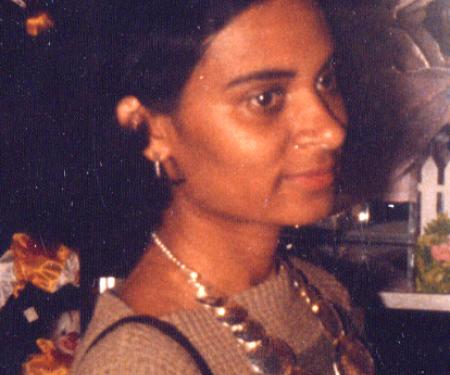
Photo Credit: Peepal Tree Press (UK)
My Poetry Corner November 2025 features the poem “The Day of Revolution” from the poetry collection My Finer Steel Will Grow (1982) by Guyanese poet and teacher Mahadai Das; included in the posthumous publication of her work (1976-1994) A Leaf in His Ears: Collected Poems by Peepal Tree Press (UK, 2010). All excerpts of her poems are taken from the Peepal 2010 publication.
Born in 1954 in Eccles on the East Bank Demerara, Guyana, Mahadai’s father was a rice farmer. She attended the prestigious Bishops High School for girls in the capital, Georgetown, where she began writing poetry. Then in 1971, her mother died while giving birth to her tenth child, leaving Mahadai, then seventeen, with responsibility for her siblings. Later that year (November), she was crowned as the “Miss Diwali” beauty-queen. What a boost that must’ve been for the adolescent Mahadai!
In the early 1970s, while taking care of her siblings, Das earned her BA at the University of Guyana and became a volunteer member of the Guyana National Service.
Disillusioned with the corruption and authoritarianism of Burnham’s regime (1974-1985), she became involved with the Working People’s Alliance (WPA), co-founded by Walter Rodney (1942-1980), an African historian and political activist. In the poem “Militant” from her debut poetry collection I Want to be a Poetess of My People (1977), Das declares her commitment to joining the fight for change in Guyana (pp. 39-40):
Militant I am / Militantly I strive. / I want to march in my revolution, / I want to march with my brothers and sisters. / Revolution firing my song of freedom. / I want my blood to churn / Change! Change! Change!… // Child of the revolution! I want to grow… grow… grow! / I want to grow for my revolution. / I want to march for my country!
In her quest to grow professionally to better serve her country, Das left Guyana to obtain her MA at Columbia University, New York. After earning her MA, she began a doctoral program in Philosophy at the University of Chicago, Illinois. While there, she became critically ill and never completed the program.
Das was living in the USA when Walter Rodney was assassinated on June 13, 1980. She laments and mourns his loss in the poem “For Walter Rodney & Other Victims,” published in her second collection My Finer Steel Will Grow (1982, pp. 54-55):
Tears fall / where I sit. / All the leaves of the trees are falling away: / naked stems stand alone; charred, / strung-out limbs / seeking to span the bitter wind that comes.
The revolution of the people died that day. Resistance to the authoritarian regime became even more dangerous. Though she felt safe from attack in the USA, Das avoided overt criticism of the regime in her 1982 poetry collection. Denise de Caires Narain Gurnah notes in the Introduction (pp. 15-16): “Exuberant “vision” is replaced by a guarded watchfulness and the poems become knotty, secretive and introspective with no clear sense of who is being addressed.”
The poetic persona in the title poem “My Finer Steel Will Grow” laments (p. 49): There is no place to rest / my accidental head. / It is a dog’s life. Today there are no bones…. Yet, hope lives that the day will come when the sun / will shine its brazen face / upon my heart, gone dark / like night and rotted blood…. / Whilst the hammering arm / in rhythmic falter flags, / my finer steel will grow. / My heaven. Such is the nature of resilience.
The poem “My Final Gift to Life” gives voice to the suffering of the people and lives already cut down by his rotting sceptre beaded / with murder in their struggle for freedom from tyranny. The murderous oppressor is not named (p. 53):
The night is pierced by strange cries of woe, / but he who stirs their tears / in the cauldron on his vanity, / preparing for a feast and a night of loud song, / little knows he of we who / sharpen our spears in night’s / naked hours. / Death be my final gift to life.
The Civil Rebellion of 1979-1980 ended prematurely with the assassination of the revolutionary opposition leader. In the featured poem “The Day of Revolution,” the poetic persona dreams of a renewed mass uprising against the authoritarian regime (p. 61):
I dreamt that the day of revolution would come;
that thousands would storm the city streets
screaming for justice.
Who can hold back the climbing sun in the sky?
Children hate the trapped darkness of the night.
Soon the crowd advanced and raised
a further cry.
Students skip classes to join their parents in the streets. Soldiers, ordered to hold back the protestors storming the presidential palace, refuse to turn their weapons on children. Instead, they came / bearing in the stems of their guns, flowers / for the children of freedom’s / new regiment.
The counterfeit general, left wingless
in the hostile air, clothed in the tarnished
brooches of his vanity, unprepared
for the sudden speech of freedom,
continued to spin his illusions
with the rotten yarn of his life.
Last night
I dreamed that the day of revolution would come.
The revolution did not come as Das had dreamed. On August 6, 1985, the 62-year-old counterfeit general died of heart failure during a throat surgery. Years later, the Peaceful Revolution in the Soviet Eastern Bloc brought down the Berlin Wall on November 9, 1989, eventually leading to the dissolution of the Soviet Union on December 31, 1991. It’s no coincidence that Guyana’s authoritarian regime ended with free and fair elections in October 1992.
We the people of Earth are all connected through time and space.
Over the last decade of Das’ life, debilitating health problems curtailed her writing career. In April 2003, while in Barbados for medical treatment, she died of a heart attack. She was 49 years old.
To read the complete featured poem “The Day of Revolution” by Guyanese poet Mahadai Das, go to my Poetry Corner November 2025.

 Three Worlds One Vision
What a tough life she had – and so pertinent her poetry to today
LikeLiked by 2 people
She did, indeed, and died too soon. When re-reading her collection for this month’s poetry corner, I was struck by the uncanny similarities to our current reality.
LikeLiked by 1 person
Indeed. Me, too
LikeLiked by 1 person
The difficult life of a great spirit. A pity she did not live longer. Thank you, Rosaliene.
LikeLiked by 1 person
My pleasure, Dr. Stein. Adversity strengthens the human spirit. As she expressed so well in her poem “My Finer Steel Will Grow”: Whilst the hammering arm / in rhythmic falter flags, / my finer steel will grow (p. 49).
LikeLiked by 1 person
Compelling post, Rosaliene, about a very talented poet who lived a difficult life. Many great socially conscious lines by Mahadai Das, including “Who can hold back the climbing sun in the sky?”
LikeLiked by 1 person
Thanks very much, Dave. I’m so glad that you can see the light that shines throughout her work. Her line-verse “Who can hold back the climbing sun in the sky?” is a reminder of the power of the human spirit to triumph over the adversities that life throws at us.
LikeLiked by 1 person
A tough, brave woman who had so much to say, but so little chance to say it. What is wrong with people that they have to suppress action and thought to retain control. Why can government simply not just govern for the people? Have a good day Rosaliene. Allan
LikeLiked by 2 people
Allan, although her life was cut short too soon, I believe that she succeeded in shining her light across space and time. As I see it, we humans have a long way to go yet in our evolution as enlightened beings. We are trapped in the beguilement of material wealth and the power it wields. A good day to you, too 🙂
LikeLiked by 1 person
Thank you for introducing us to another fine poet and human, Rosaliene. Americans have a new understanding of the need for a country to reform, to eliminate corruption, and racism. Poets such as Das are more relatable than ever.
LikeLiked by 1 person
My pleasure, Mary. Who would’ve thought that what the Guyanese people faced in the 1970s and 1980s would come to pass in the world’s most powerful nation?
LikeLiked by 1 person
If she were alive today, with all the craziness in the world, she’d be writing powerful works
LikeLiked by 1 person
I totally agree, Neil.
LikeLiked by 1 person
Oooo. I like these words. “Who can hold back the climbing sun in the sky.” Yes! I also liked the part about the counterfeit general spinning illusions “with the rotten yarn of his life”. Das speaks the truth. May her dreams come true (in a good way). Thanks for sharing this, Rosaliene.
LikeLiked by 1 person
My pleasure, Mara. Powerful words, indeed! Isn’t it uncanny how her description of Guyana’s “counterfeit general,” who died in 1985, fits our own to a tee (pun intended)?
LikeLiked by 1 person
As that guy from Hogan’s Heroes use to say, “I know nothing.” But, yeah, sadly, I guess there’s been a lot of counterfeit generals throughout history.
LikeLiked by 1 person
Powerful! Is it safe to comment or to like a post on revolution? This is what I ask myself.
LikeLiked by 1 person
Tamara, I also questioned myself about featuring this poem by Mahadai Das. Dare I take the risk? Then, I reconsidered her message sent to us through time. Our dream of revolutionary change may never be realized as we imagine. It may take years. As happened for the Guyanese people, the day of revolution change came about in an unexpected way…without bloodshed. I had already moved to Brazil with my husband and two sons.
I understand your wariness. I self-censor myself every time I write a post. But this is not just about us here on the flagship, preparing for war on the people of Venezuela. This is a global existential crisis. Only the gods know the day and from whence the revolution of the people of Earth will arise.
LikeLiked by 1 person
Very true!
LikeLiked by 1 person
She was so young. How sad though her legacy lives on through her writing. Tragic loss of her mom, too. Thank you for sharing another impactful poetic voice.
LikeLiked by 1 person
My pleasure, Michele. How often we ignore good health as a measure of success.
LikeLiked by 1 person
Peace and health are the true measures of success. 🕊️
LikeLiked by 1 person
I always appreciate how your posts provide history, context and analysis, complemented by your Poetry Corner site, which shares the complete work. It is so tragic that, like her mother’s, Das’s life was cut so short and that her dream remained only that in her lifetime.
There is much potency in the poem, and this line in particular resonated, reminding me of one of the “Flower Power” era photos depicting the same thing: “Ordered to march, the soldiers, my brothers, came / bearing in the stems of their guns, flowers.”
We are indeed all connected through time and space, Rosaliene. Thank you for sharing this important work.
LikeLike
Thanks very much, Steve. It’s likely that Das had the Flower Power Movement (1960s-1970s) in mind when she shared that imagery.
LikeLiked by 1 person
You’re welcome, Rosaliene. That makes sense… it was a powerful symbol of the times.
LikeLiked by 1 person
What rich and challenging life for this woman of vison and spirit. I’m sorry she left us much too early and hope her spirit smiled from beyond when the free election came. Her poetry inspires me. When I read, “of his vanity, unprepared for the sudden speech of freedom, continued to spin his illusions with the rotten yarn of his life…” naturally, I thought of a current wanna be dictator. Revolutions can come in a variety of ways.
LikeLiked by 1 person
JoAnna, I’m so glad that you find her poetry inspirational. It’s incredible how the quoted excerpt is a perfect fit for our time. We’re already facing an AI revolution that will change our lives in ways we cannot yet imagine.
LikeLike
And the internet has already done that! It feels like technology is moving too fast in some ways.
LikeLiked by 1 person
I agree, JoAnna. It’s difficult keeping up.
LikeLike
Aaah, I’ve been away too long from your regular posts of poets and thinkers outside my usual diet. Thanks for providing the menu.
LikeLiked by 2 people
So glad you dropped by, Rusty 🙂
LikeLike
Someone that was not known to me. What a full and difficult life! And sadly, how appropriate for our out of control times today.
LikeLiked by 1 person
Thanks for dropping by and adding your thoughts 🙂 A reminder of how much autocrats share in common.
LikeLiked by 1 person
Brilliant poet, Rosaliene and so sad she died so young! Thanks for sharing her story and work! 💕
LikeLiked by 1 person
My pleasure, Cindy 🙂 So glad that you like her work.
LikeLike
Mahadai was an extraordinary poet, and it’s heartbreaking that she passed away so early. Appreciate you sharing her stories and poetry!
LikeLiked by 1 person
Thanks very much, Ravindra.
LikeLike
Thanks for the introduction to Mahadai Das. It’s sad that due to illness she was never able to finish the degree she began. Glad her poetry lives on.// I wasn’t able to comment on the previous post because comments were already closed. I’d like to say that all the billionaires can go live on Mars. We’ll work on saving the planet without them. But if humans can’t make it here on earth, we won’t make it anywhere else.
LikeLiked by 1 person
My pleasure, Rebecca. I do my small part in keeping her poetry alive.
It was disheartening to learn that our techno-billionaires live in an alternate reality.
LikeLiked by 1 person
Thanks for your promotion of wonderful poets. As for the billionaires wanting to get off the planet, maybe we should tax them 50% as an exit tax and put that money into saving the earth’s environment.
LikeLiked by 1 person
Rebecca, if we the people could pull that off, that would be great.
LikeLiked by 1 person
“We the people of Earth are all connected through time and space.” – I believe this to be true. Best wishes for the rest of this year and 2026. Linda xx
LikeLiked by 3 people
Linda, thanks for dropping by and sharing your thoughts 🙂 See you in the New Year.
LikeLiked by 1 person
Thank you lovely
❤️💚
LikeLiked by 1 person