
Tags
Native American poet, Poem “How It Goes” by Abigail Chabitnoy, Poetry Collection In the Current Where Drowning is Beautiful by Abigail Chabitnoy (USA 2022), Violence against women and nature
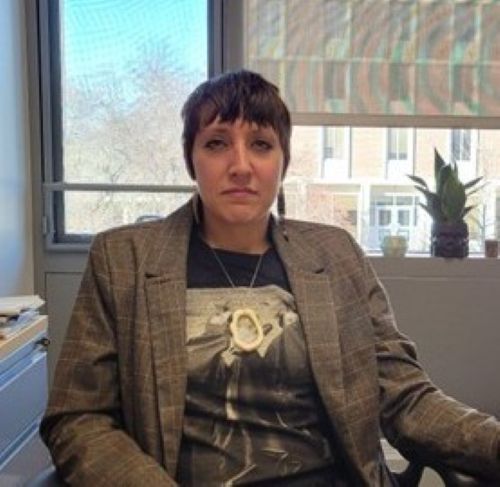
Photo by Kalana Amarasekara for Massachusetts Daily Collegian (2024)
My Poetry Corner October 2025 features an excerpt of the ten-part poem “How It Goes” from the poetry collection In the Current Where Drowning is Beautiful (USA, 2022) by Native American poet Abigail Chabitnoy. Of mixed race (Aleutian-German), she is a Koniag descendant and member of the Tangirnaq Native Village in Kodiak, Alaska. She grew up in Pennsylvania where she earned a BA in English and anthropology from Saint Vincent College. She later obtained an MFA in Creative Writing from Colorado State University where she was a Crow-Trembley Fellow, a 2016 Peripheral Poets Fellow, and received the John Clark Pratt Citizenship Award from the University.
In 1901, Chabitnoy’s great grandfather was separated from his family in Kodiak and sent to the Carlisle Indian Industrial School in Pennsylvania, the first federally funded boarding school established to assimilate Native American people into Euro-American culture. Their family’s Russian Chabitnoy surname is the legacy of Russian control of Alaska until the United States purchased the territory in 1867.
Chabitnoy describes her second poetry collection, In the Current Where Drowning is Beautiful, as “a poetic re-visioning of narratives of violence against women and nature.” In poems filled with imagery that moves in waves and use of Alutiiq language, she links the treatment of indigenous women in the United States with harm toward immigrant families and the environment.
Written during the first administration of our current president, “How It Goes” is the longest poem in the collection (pp. 51-56). In the book’s end notes (pp. 93-95), we learn that the title of the poem is taken from the words of a white teenage boy in a red hat during a protest on January 18, 2019, in the Capitol. Smirking in the face of a tribal elder, he reportedly shrugs and says: “Land gets stolen, that’s how it works.” To the poet’s dismay, the boy somehow becomes the victim in the media.
“While I am not convinced the boy meant no harm or disrespect,” Chabitnoy says in the end notes, “I can readily believe he didn’t know any better. After all, this country has fantastic powers of amnesia.”
Although the speaker in the featured poem questioned in earlier poems the wisdom of bringing children into this world, especially a girl child, we learn in the opening lines of Part I that she is open to the possibility: I’d want you to be a girl, even now. / Ashley-Olivia-Akelina-Nikifor—you would have / too many names to go missing. If only one’s name could work as a charm against evil!
Part II presents the numbers of the separated. / detained. / buried. / missing. murdered. prone / to be incorrectly labeled. / massacred (p. 52). To achieve greater impact, the numbers stand on their own, with details provided in the footnotes. Numbered among them are Central American immigrant children forcibly separated from their families, many of whom are also indigenous.
John says he is listening to your concerns.

8-year-old Franklin of Guatemala was
reunited with his father and watching them
embrace right now it is possible to forget
the latest counts

250 or 559 or more than 400
at least 2,000¹				(maybe 14,000)²
186, or more than 10,000³
500 or 2,000			        as many as 15,000⁴
btw 200 or 300 and 500, or 2,000⁵

Jakelin-Albertha-Savanna-

colonies of birds are already in decline. cite predation.⁶

(alternatively, such facts vary—by the time you read this
we will have forgotten how many. the list grows. but who’s
counting?)
_______________
¹ separated.
² detained.
³ buried.
⁴ missing. murdered. prone
⁵ to be incorrectly labeled.
⁶ massacred
After all, the speaker continues, this violence has been the American way since the European conquistadors’ first encounter with indigenous populations (p. 53):
This is America and it is (year-of-our-supposed-lord) ___.
This is America since 1492.
This is America, we were born taking children from their mothers and their fathers.
This is America and we’ve been taking babies from mothers with too many babies
(I.Y.O.) in your lifetime.
This is America and I want to tell you too it is beautiful
                                                                                          but
                                            —vindictive or entombed—
Part IV quotes the smirking white teenager in a red hat, adding a footnote in tiny print (p. 53): “Yeah, well, [kids]* get stolen. That’s how it goes.”
*he might have said “land.” he might have said “women.” he might have been smiling respectfully to diffuse the situation.
Part VIII cites the ways in which indigenous women were killed (p. 55): “by fire, by water, by hanging in air, burying in earth, / by asphyxiation, penetration, striking, piercing, crushing / in a thousand / and one ways.” // You forgot exposure (which Patricia knows in Montana may include stabbing).
Part X gives voice to indigenous girls and women lost to violence:
Now you don’t see us
Now you don’t

I’m not going to play
your blackout games

                            but know:
my teeth still shine
in the dark.

a body buried still
speaks.

above or
below

don’t imagine there is nothing at the bottom.
Chabitnoy concludes in the end notes (p. 94): “The same narratives that facilitate violence against women facilitate violence against the landscape facilitate violence against indigenous people and other nonwhite populations. And the same hypocrisy, bureaucratic ineptitude, and cultural amnesia allow these violences to continue.”
Learn more about the “Missing and Murdered Indigenous People Crisis” at the official website of the U.S. Department of the Interior: Indian Affairs.
To read the complete excerpt (Parts II-III-IV) of the featured poem “How It Goes” and learn more about the work of Native American poet Abigail Chabitnoy, go to my Poetry Corner October 2025.


Thanks, Rosaliene, for the introduction to Abigail Chabitnoy’s excellent/powerful work. The U.S. — now and during its history — certainly gives her plenty of infuriating material.
LikeLiked by 1 person
My pleasure, Dave. Sadly true.
LikeLiked by 1 person
Such powerful work which it is appalling for her to have to write
LikeLiked by 1 person
Appalling, indeed, Derrick.
LikeLiked by 1 person
What a wonderful post on native American poet Abigail Chabitnoy! Her work seems very relevant and powerful! Thanks for the into, Rosaliene💜
LikeLiked by 1 person
My pleasure, Ada. So glad that you like her work!
LikeLiked by 1 person
“After all, this country has fantastic powers of amnesia.” —
This is absolutely and shamefully true!
LikeLiked by 1 person
Neil, it’s also shameful that our current administration seeks to erase their stories from the historical record.
LikeLiked by 1 person
Great grandfather stolen and taken 3000 miles away from his family. So much trauma. Thank you for introducing me to Abigail Chabitnoy, a powerful poet. The “Now you don’t see us. Now you don’t.” verse really hit hard.
LikeLiked by 1 person
My pleasure, Rebecca. The final segment (Part X) of her poem is so deeply layered that I’ve left it up to readers to unpack its full meaning for us as a nation. Our current administration continues “to play…blackout games” with the erasure of their stories and trauma from the historical record.
LikeLiked by 1 person
The cruelties that Native Americans have endured are terrible. I’m glad she expresses the history so well to educate and liberate.
LikeLiked by 1 person
“Cultural amnesia.” This phrase, by itself, makes the poet worth knowing. The reference to the Carlisle School also carries the history of Jim Thorpe, the greatest athlete of the first half of the twentieth century. His Olympic medals were taken from him, another example of bigotry.
LikeLiked by 1 person
Dr. Stein, thanks for mentioning Jim Thorpe (1887-1953). I’ve now learned that he was the first Native American to win an Olympic gold medal for the United States.
LikeLiked by 1 person
What a gifted writer with so much history and pain to uncover, Rosaliene. Thank you for sharing Abigail with us and her powerful poems. 💕
LikeLiked by 1 person
My pleasure, Cindy. I’m so glad that you can also appreciate her poetry.
LikeLiked by 1 person
I sure can!!! xo
LikeLiked by 1 person
I hope she and other Americans keep speaking out. It is the only way to push back against this troll.. Happy Monday Rosaliene. Allan
LikeLiked by 1 person
Thanks for adding your thoughts, Allan. So much has happened during the five-plus years since Chabitnoy penned the featured poem.
LikeLiked by 1 person
Thanks for sharing Chabitnoy’s work, Rosaliene. She tells the real truth of our nation. Our leaders (whoever they are) have created an extremely destructive narrative. Chabitnoy’s words help to kill it.
LikeLiked by 1 person
My pleasure, Mara. The extremely destructive narrative is tearing our nation apart.
LikeLiked by 1 person
It sure is, Rosaliene.
LikeLiked by 1 person
I appreciate poetic voices that speak their truth and history. This sounds fascinating, Rosaliene.
LikeLiked by 1 person
Thanks very much, Mary.
LikeLiked by 1 person
“…a body buried still
speaks.” jumped out at me. I am thankful that Chabitnoy adds her voice with passion and compassion to speak for those lost and killed. I appreciate how she connects violence against women to violence to the landscape and others. It’s the same narrative that normalizes dominance and destruction of what is natural and sacred. Thank you for continuing to bring these voices to us.
LikeLiked by 1 person
My pleasure, JoAnna. As I see it, all violence is connected in humanity’s pursuit for dominance in all its forms.
LikeLiked by 1 person
Rosaliene, this is such a powerful piece you’ve put together, to interpret a complicated, multi-layered poem that I found I had to very slowly digest it to not be overwhelmed by all the horror Chabitnoy captures in it. There’s a sense of scatteredness in the poem, that I believe is a tool of the poet to get her message across as the people she writes of cannot settle into place like many of us of European heritage and privilege do, without even thinking.
The shameful legacies of both our countries in the forced assimilation of First Peoples, the purging of culture, and the kidnapping of children as prisoners of residential schools to strip away their culture and family connections have left a race of people so disconnected from their past that they are vulnerable victims often preyed upon for sex and cast aside like garbage. Chabitnoy captures all this and so much more. I thank you for highlighting her important work, amplifying her voice in a society stilted by its wilful amnesia and, on top of that, glorification of the thieves who raped and plundered these lands, waters and air.
LikeLiked by 2 people
Steve, thanks very much for reading and adding your thoughts. As inhabitants of the USA and Canada, we have, indeed, inherited shameful legacies, resulting in continual trauma and injustice of our marginalized indigenous peoples.
LikeLiked by 1 person
You’re welcome, Rosaliene, and thank you for linking to your Poetry Corner page. I was glad I could read the full excerpts there.
While we have made some strides with reconciliation, it is saddening to see Indigenous people still falling behind in areas of basic need, such as the many remote communities that have boil-water advisories due to unclean drinking water sources, despite federal government promises (by both Liberals and Conservatives while in power) to do better.
LikeLiked by 1 person
A powerful introduction to Chabitnoy’s work, Rosailene. Her poetry cuts through layers of history and denial, giving voice to truths that should not be forgotten. Thank you, for highlighting this important and moving piece.
LikeLiked by 1 person
My pleasure, Randall. I’m so glad that you appreciate her featured poem.
LikeLike
This is such a wonderful, soul-stirring, and powerful feature you’ve written on Abigail Chabitnoy’s voice, reflecting the brutality of the truth and violence against indigenous people in this country. I’m reading a book about the Lumbee’s in North Carolina, and “disturbing” is an understatement to what colonialism inflicted to the mass historical violence so many want to brush under the rug that Native Americans endured! 😡 Thanks so much for sharing her story sis. 🙏🏼💖🙌🏼
LikeLiked by 2 people
My pleasure, Kym. I’m happy to share their truth.
LikeLiked by 1 person
Honey Rosaliene, now we see why some folks are so determined to retell a different narrative of lies and deception.
I am so glad that more voices like hers and many other cultures are beginning to speak up about the atrocities they and their ancestors experienced. Don’t stop feeding us these stories sis. 😊🙏🏼😘
LikeLiked by 1 person
Kym, as I see it, it’s our role as poets and writers to not only give voice to the voiceless, but also to change the narrative.
LikeLiked by 1 person
AMEN sis. I agree with you 100%! Our literary commitment is our Super Power! 🙌🏼😍💪🏼
LikeLiked by 1 person