
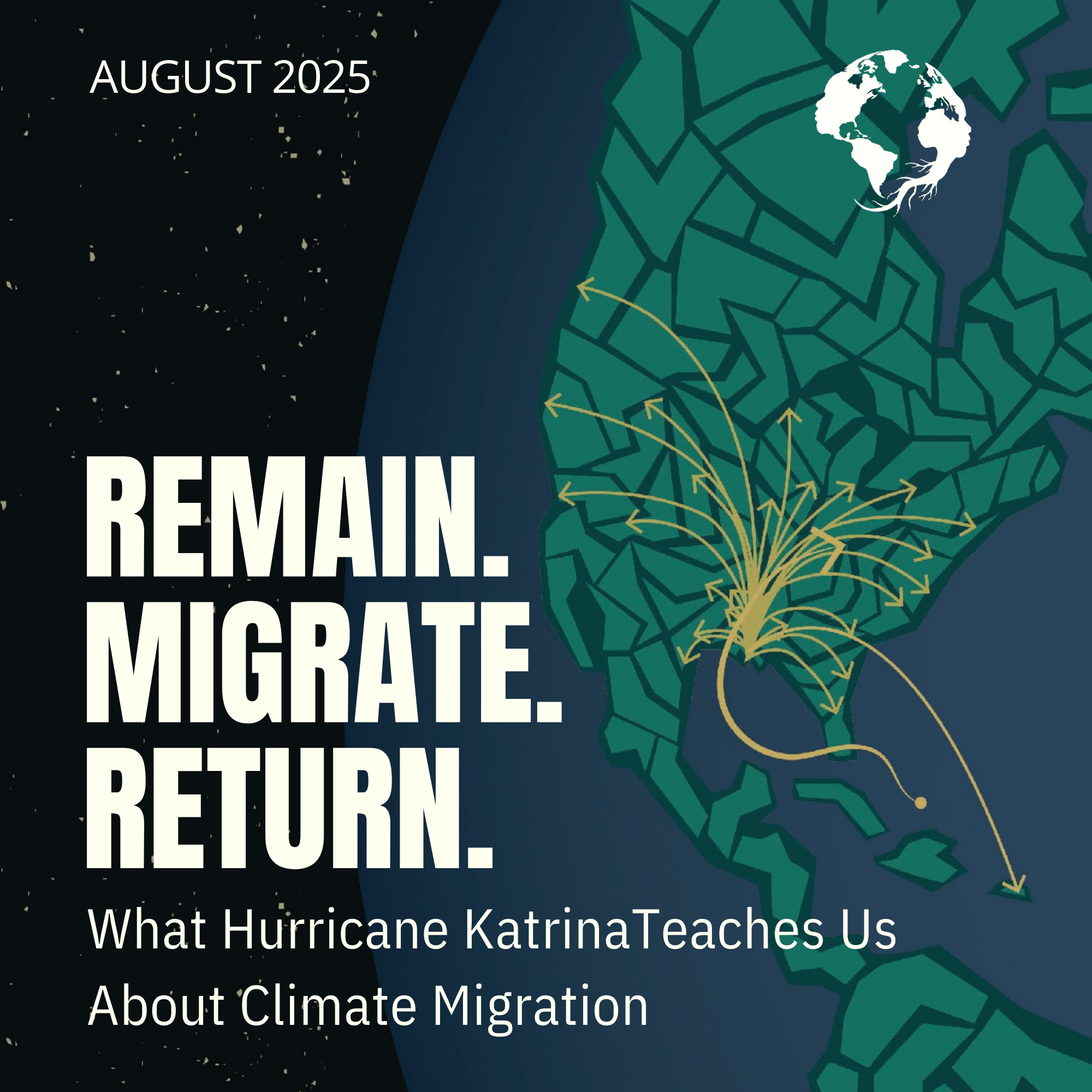
Photo Credit: Taproot Earth
On August 29, 2005, Hurricane Katrina caused record-breaking devastation across a 144 mile swath of Louisiana, Mississippi, and Alabama. A less often told story is that Hurricane Katrina sparked a mass migration of people. More than 1.5 million Hurricane Katrina survivors evacuated to all 50 states representing one of the largest and most abrupt relocations of people in U.S. history. As of 2015, Center for American Progress reported that 40% of the 1.5 million evacuees, or 600,000 people, were not able to return home. While the idea of “climate migration” is often talked about as an issue that exists only outside of the United States, Hurricane Katrina teaches us that climate migration is also a domestic issue that is already underway.
Excerpt from Remain. Migrate. Return.: What Hurricane Katrina Teaches Us About Climate Migration, PDF publication by Taproot Earth, USA, August 22, 2025, p. 6.
In the featured 2025 Taproot Earth report, Remain. Migrate. Return.: What Hurricane Katrina Teaches Us About Climate Migration, the term “climate migration” refers broadly to the movement of people because of climate change—whether gradual or sudden, voluntary or involuntary, temporary or permanent (p. 8).
Community responses to Hurricane Katrina (2005) taught them that the standards for climate migration are rooted in the Right to Remain, the Right to Migrate, and the Right to Return.
The Right to Remain is grounded in the principle that people have self-determination, power, and resources to remain on their lands and in their communities (pp. 9-11).
The Right to Migrate includes the principles of cooperation and solidarity, as well as legal protections (pp. 12-13).
The Right to Return includes principles of reclaiming power and culture, repairing and restoring the land, plus re-awakening and repairing the spirit (pp. 14-15).
Taproot Earth is a nonprofit organization, registered in Slidell, Louisiana, USA. Their work is rooted in the community responses to Hurricane Katrina (2005), BP Deepwater Horizon Oil Drilling Disaster in the Gulf (2010), and Hurricane Ida (2021). They honor and build on the efforts of Black and Indigenous communities by invoking accountability, abundance, and justice. Together, they are forging connections that strengthen and sustain frontline climate leaders across the Gulf and Global South.
 Three Worlds One Vision
I certainly hadn’t realised this
LikeLiked by 3 people
Same here, Derrick. I recall watching the disaster unfold on national TV, but didn’t realize its catastrophic impact until reading this report.
LikeLiked by 2 people
An enlightening article, thank you Rosaliene! Instead of listening to science and aligning ourselves accordingly, we are starving these scientists or turning them into pariahs. Was there anything about climate targets?
LikeLiked by 2 people
Friedrich, this report by the Taproot Earth grassroots organization does not consider climate targets. Rather, it’s focused on solutions for survival and recovery of climate-displaced people following extreme weather events.
LikeLiked by 1 person
I’m sorry, Rosaliene, that my abbreviated comment caused confusion. I know about Taproot Earth’s role.
My criticism is directed at the government, and I should have written: The government, instead of listening to science and aligning ourselves accordingly, they are starving these scientists or turning them into pariahs. Didn’t governments once set climate targets?
LikeLiked by 1 person
Thanks for the clarification, Friedrich. Governments, including our own, did set targets for reducing carbon emissions and transitioning to more sustainable forms of energy production. Sad to say, the fossil fuel industry has been sabotaging efforts here in the USA and worldwide. As I see it, we the masses of humanity will be on our own as more and more regions of our planet become inhabitable for our species.
LikeLike
Thank you very much, Rosaliene, for this very informative report! It seems to be much easier to write and speak about the problems of others than the proper one’s!
LikeLiked by 2 people
You’re welcome, Martina!
LikeLiked by 1 person
I know only broadly of climate induced migration. This is important, inevitable, ongoing, and increasing. With your help, Rosaliene, I will know more of what the world is moving toward and, I expect, the profound consequences that include human suffering, starvation, dehydration, and water wars. Thank you.
LikeLiked by 4 people
Dr. Stein, our future is bleak with regards to extreme weather events that will continue to impact our lives. The work of grassroots organizations like Taproot Earth remind us that we the people have agency.
LikeLiked by 1 person
We watched the Netflix series on Katrina on learned a lot. What happened was truly devastating to the city and the people. Imagine being unwilling or unable to go back home. That must have broke their hearts. These swings are going to get wilder and more frequent. Thanks for posting on this Rosaliene. Allan
LikeLiked by 5 people
You’re welcome, Allan. I also watched the three-part documentary series “Katrina: Come Hell and High Water,” released this August to commemorate the 20th anniversary. Readers interested in watching the series can learn more at the following link:
https://www.netflix.com/title/81676595
According to the Taproot Earth report (p. 14):
Hurricane Katrina showed who had the Right to Return and who did not. The historic dismantling of public educational systems, the destruction of public housing, the closing of Charity Hospital, and the lack of equitable payouts to support rebuilding homes drew a stark line along race and class.
You’re right in saying that it must’ve broken their hearts. In her report “When You Can’t Go Home: The Gulf Coast 10 Years After Katrina,” published in American Progress on August 18, 2025, Danielle Baussan noted that there was a threefold increase in heart attacks among survivors and that the next generation was impacted by trauma and displacement.
LikeLiked by 2 people
Interesting Rosaliene, and let’s not forget the huge internal migration to the west from the ravages of the dust bowl in the 1930s. And isn’t your president one of the wealth set who have migrated to Florida?
LikeLiked by 1 person
Thanks very much, Denzil. I’m glad you mentioned the Dust Bowl in the 1930s. Unlike Hurricane Katrina, the climate migration of roughly 2.5 million people from the Dust Bowl states–Oklahoma, Texas, Kansas, Colorado, and New Mexico–occurred at a slower pace of three to four years. As far as I know from national news reports, our current president relocated from New York (Democratic) to Florida (Republican) for tax reasons.
LikeLike
It’s not something we think of, but I know of it happening from the increasing number of wildfires in northern Manitoba. The book sounds interesting. Maggie
LikeLiked by 2 people
Thanks very much, Maggie.
LikeLike
I love hearing about nonprofits that are helping local communities and indigenous communities to rebuild what had been taken from them. Thank you for sharing this.
LikeLiked by 2 people
You’re welcome, Tamara. I also find such news heartening as they remind me that we the people are not powerless when disaster strikes.
LikeLiked by 1 person
Exactly! There are still things we can do to help one another.
LikeLiked by 1 person
That’s an insane number of people forced to leave their home and thanks for bringing that to our attention, Rosaliene. Yes, migration is happening everywhere with increased drought, storms and fires not to mention other things I won’t mention. No place is really safe but Taproot Earth seems to have the right ideas for dealing with all.
LikeLiked by 2 people
You’re welcome, Mara. Your comment that “migration is happening everywhere” prompted a search for human migration data in the USA and worldwide. I’ll explore the data available for presentation in a future post. Thanks 🙂
LikeLiked by 1 person
That sounds like a fascinating research project and I’m looking forward to learning the results.
LikeLiked by 1 person
Rosaliene my dear, we do hold the power and we have to remember that. I’ve seen too many times where people uproot themselves because they do not receive the proper help after a disaster occurs, then someone with money will come along and swoop the property up! Talk about highway robbery! 😠 Thanks for sharing information about Taproot Earth! 🌍🙏🏼🌏
LikeLiked by 2 people
You’re welcome, Kym! The injustice you mention occurs with each new disaster. The Taproot Earth report raises this injustice under the section “The Right to Remain” (p. 9):
During and after Hurricane Katrina, poor and Black people living on high-ground in publicly supported housing were forced to leave in a number of ways, including through the wholesale demolition of still-viable public housing units and repressive regulation of public housing residents’ behavior. In some instances during and immediately after the storm, police removed people from their homes by force even though they had adequate supplies to remain.
LikeLiked by 1 person
Yes Rosaliene…”The Right to Remain” is our war cry! 🙌🏼🙆🏻♀️💪🏼
LikeLiked by 1 person
Climate induced migration will be a central issue of this century. Thank you for your reminder that we too are part of the weather torn world and will be affected by the changes in habitable spaces.
LikeLiked by 2 people
You’re welcome, Rebecca. With so many other pressing challenges facing us today here in the USA, we can forget about this ongoing existential threat to humanity.
LikeLiked by 1 person
What an enlightening post, Rosaline! Migration due to climate issues is an extremely relevant and important topic, which I’d never actually considered before! If people feel they have agency, then that can only be a positive thing, in my opinion.
LikeLiked by 2 people
Thanks very much, Ada! Unless our area has been hit by a severe weather disaster, as happened early this year with the Palisades and Eaton Fires in Los Angeles County, we rarely get news of how survivors have been impacted.
LikeLiked by 1 person
Thanks for sharing this eye opening report, Rosaliene! 🙏🏼
LikeLiked by 1 person
You’re welcome, Cindy!
LikeLiked by 1 person
💗
LikeLiked by 1 person
Looking at their website and skimming the report, I’m impressed and grateful for the vision and work of Taproot Earth. Thank you for bringing this to our attention.
LikeLiked by 2 people
You’re welcome, JoAnna. I find it encouraging that our most vulnerable communities are finding ways to recovery.
LikeLiked by 1 person
A belated thank-you for this post, Rosaliene. Taproot Earth is doing vital work, as are you. Solidarity!
LikeLiked by 1 person
You’re welcome, Tracy. They are, indeed. Solidarity!
LikeLiked by 1 person
I was going to ask why the 1.5 million evacuees were not able to return, but I found the answer among your comments.
(According to the Taproot Earth report (p. 14):
Hurricane Katrina showed who had the Right to Return and who did not. The historic dismantling of public educational systems, the destruction of public housing, the closing of Charity Hospital, and the lack of equitable payouts to support rebuilding homes drew a stark line along race and class.)
Thank you for the link too.
LikeLiked by 1 person
You’re welcome, Dawn. The report makes clear that, when disaster strikes, there is no equity in the treatment of black and other marginalized communities.
LikeLiked by 1 person
I see. Thank you for the additional explanation. Sadly, no surprises there unfortunately!
LikeLiked by 1 person
One of the advantages of our large country is the ability to move around more easily. I love these rights, Rosaliene. Yes, the right to return, as well.
LikeLiked by 2 people
Very true, Mary. Such mobility will change as more regions are impacted by severe weather disasters.
LikeLike