
Tags
Abutilon ‘Tiger Eye’ plant, African Milk Bush, California Summer Garden 2025, Dragon Fruit Cactus, Ficus benjamina ‘Samantha’ Tree, Firestick Succulent, Los Angeles/California, Tiny Leaf Tree, Urban Succulent Garden

I give thanks that, this summer, temperatures in West Los Angeles did not rise into the upper nineties (Fahrenheit) and more. While I enjoy the privilege of staying indoors during the hottest parts of the day, there were times I had to brave the heat for medical visits. On August 19th, I also began weekly sessions of physical therapy for what my young new doctor determined, after X-rays of my knees and ankles, is osteoarthritis. Thankfully, on my return trip home around 11:15 a.m. after my physical therapy session, I can take refuge from the heat under a tree near to the bus stop. What’s more, I stay hydrated with coconut water.
After a year of suffering with intense pain in my heels after an hour’s walk, I now know the cause and I’m getting help to strengthen the muscles in my hips, glutes, and thighs. Except for a setback after doing 30 repetitions of squats during my third session—now reduced to ten—I’m making progress. Last weekend, for the first time in a long while, I did not have to limp indoors with aching feet after just two hours of gardening.
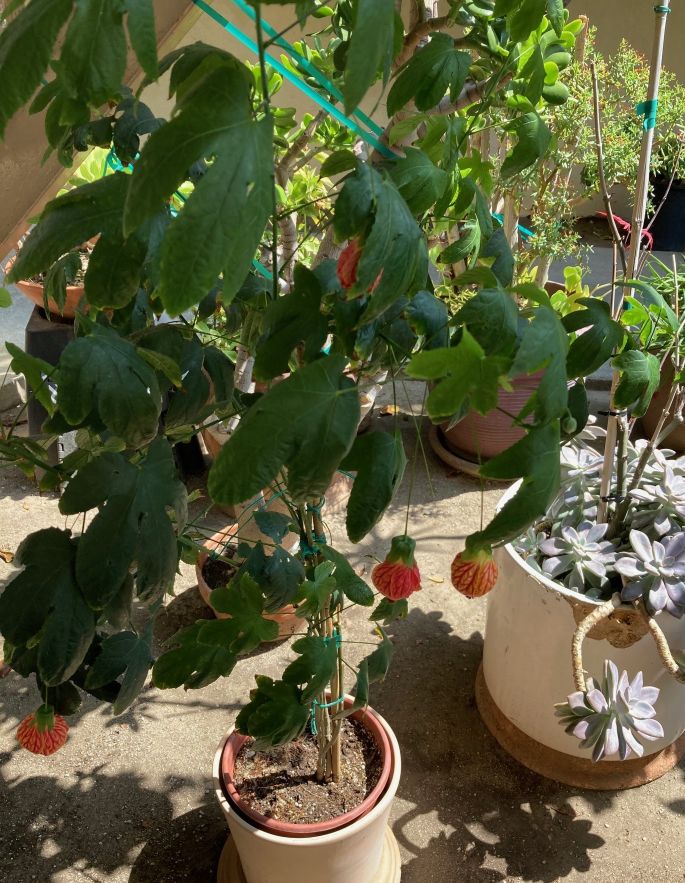
To avoid the hottest times of the day, I’ve been gardening from four to six in the afternoon. At this time of the year, it’s still light outdoors as the sun sets a little after 7:00 p.m. Most of the plants have been happy with watering twice a week: the gardener waters on Tuesday; I water on Saturdays. With the hotter summer temperatures, my son’s Tiger Eye flowering plant needed watering every two days. It looks like it’s happy with my care. After a month without producing flowers, it began flowering again last week (see photo below).
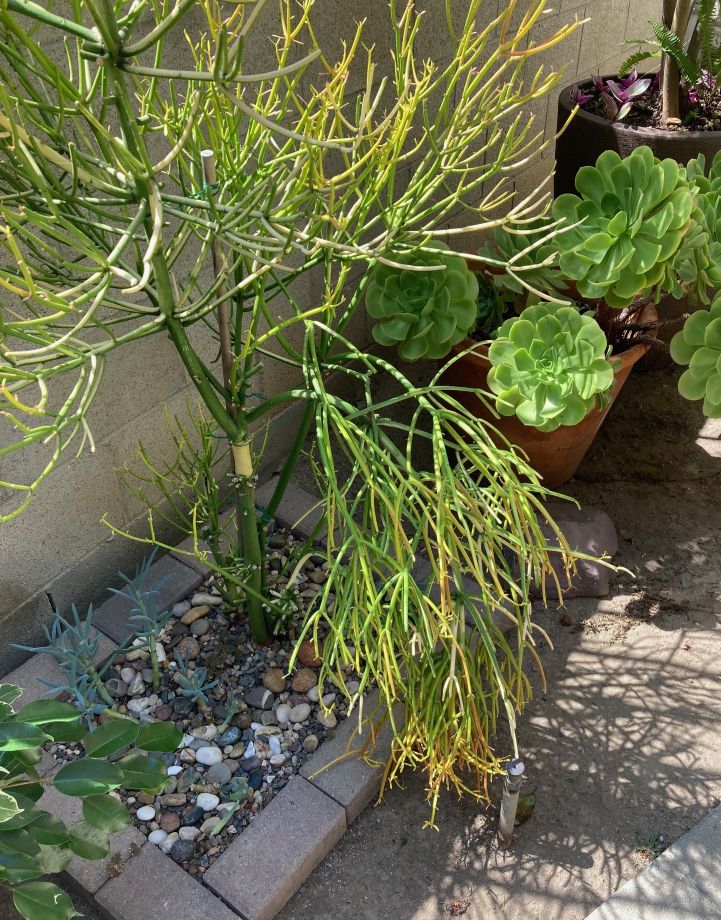
The firestick succulent, planted in the ground near the wall adjacent to our parking garage, partially collapsed on Friday, September 12th (see photo above). Had I known that it was suffering from heat stress, I would have watered it with more frequency.
When it comes to taking care of the diversity of plants, I don’t always get it right. This is especially the case with regards to pruning. Over the years, I’ve observed that pruning encourages new growth. But there are times when I make a drastic cutback, as happened during the spring of 2024 after receiving a potted Ficus benjamina ‘Samantha’ plant from the landlord’s son (referred hereafter as Sonny).
On discovering that it was infested with white blight or mealybugs, I sprayed it with my home-made pesticide of neem oil, baking soda, and liquid soap. After that failed, I set about removing all the branches. To avoid spreading the infestation to other plants, I took care not to disturb the invaders. Had I been too drastic?
Summer and Fall 2024 came and went by. Not a single leaf appeared on the naked and mutilated Ficus plant. Thinking that I had killed Sonny’s plant, I considered buying another Ficus when my son took me to buy plants on Mother’s Day this year.
“Give it time,” my son told me. “It will grow back.”
And it did.
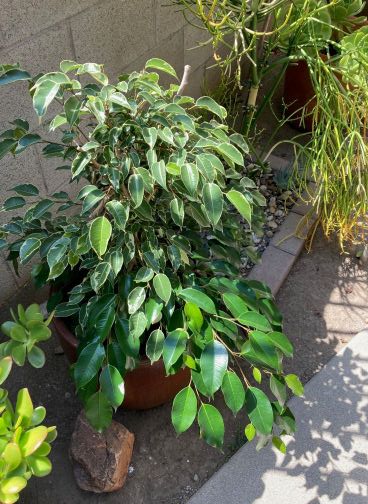
The first tiny leaves appeared in the final days this spring. New branches and shiny leaves sprouted with new vigor of rebirth. What a relief! Samantha lives! (The photo below was taken on September 13th.)
The Euphorbia umbellate or African Milk Bush semi-succulent tree, a gift from one of my son’s clients, also underwent drastic pruning. For over a year now, the twenty-foot-tall potted tree had shown signs of ailing with sparse leaf growth in the summer. In early spring, I cut off the tall slender branches, leaving only a new branch. When the pruned branches lost their sap, I knew that there would be no regrowth. Only the new branch showed some life. What had I done?
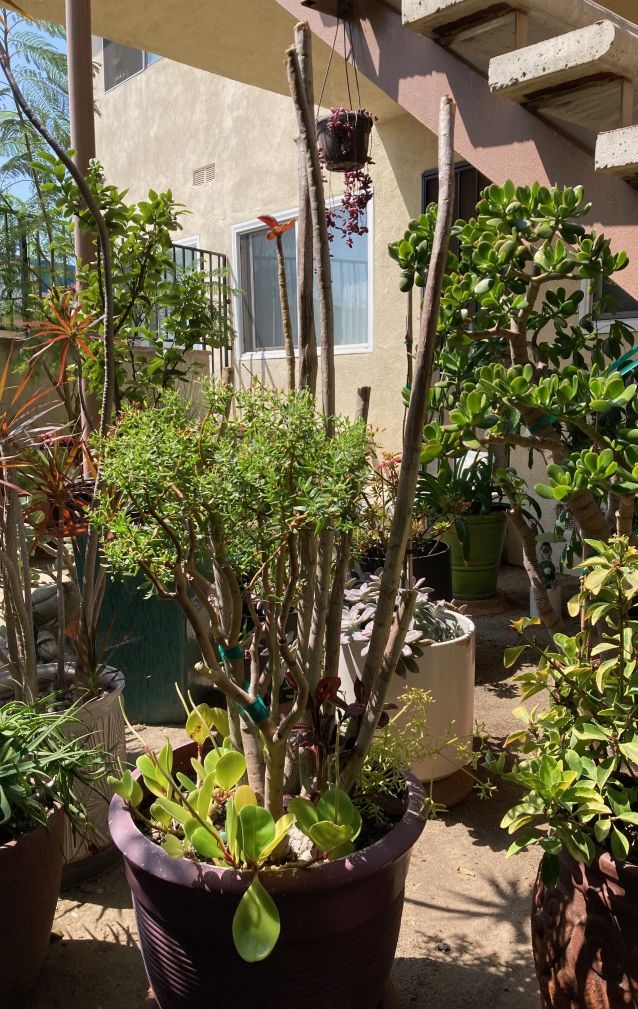
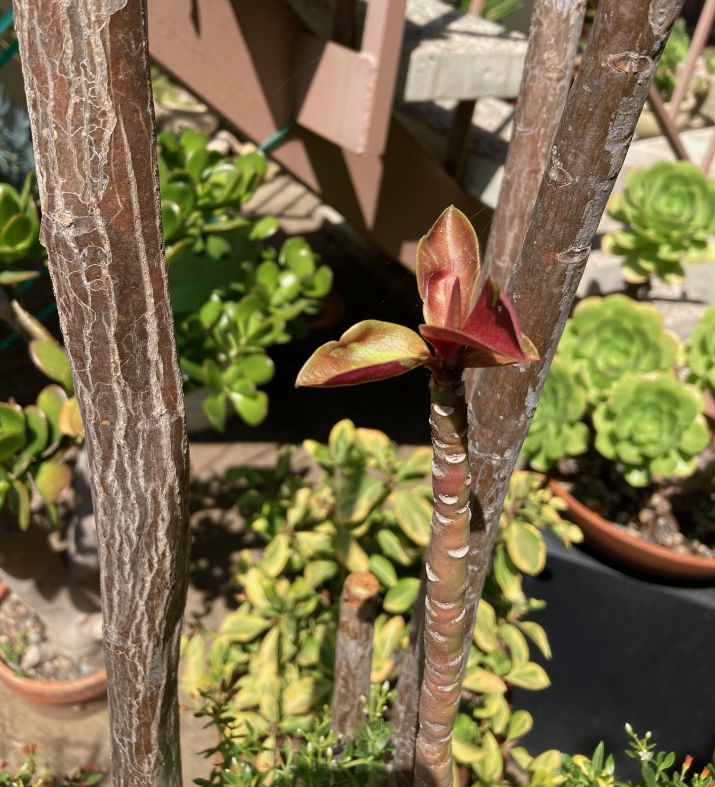
Salvation lay in the new potted plant that I had successfully cultivated from a tiny clipping three years ago. As shown in the captioned photo (the green/rust red, leafy plant), the new African Milk Bush is now three feet tall.
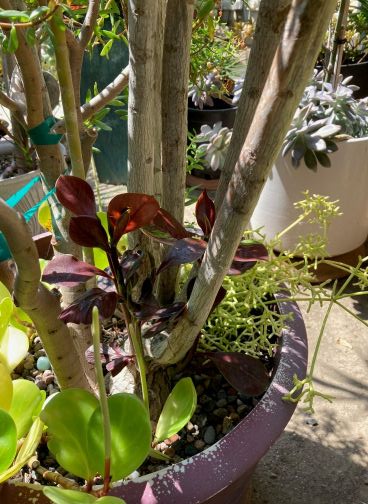
Wonder of wonders! The mother Milk Bush did not die. During August, the first signs of new life appeared at the base of the Milk Bush, as shown in the photo below taken on September 13th.
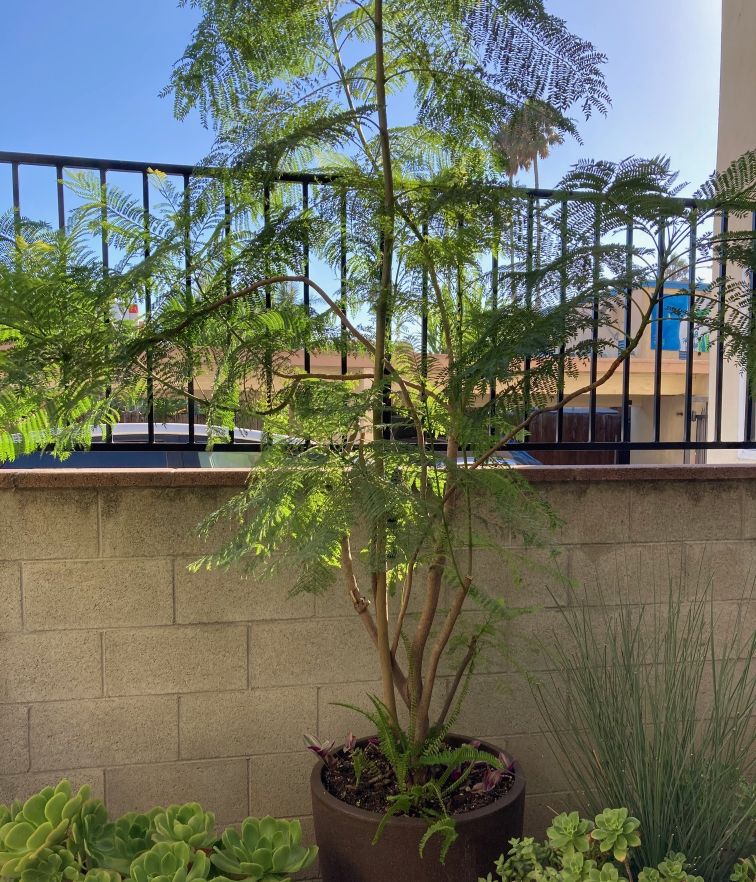
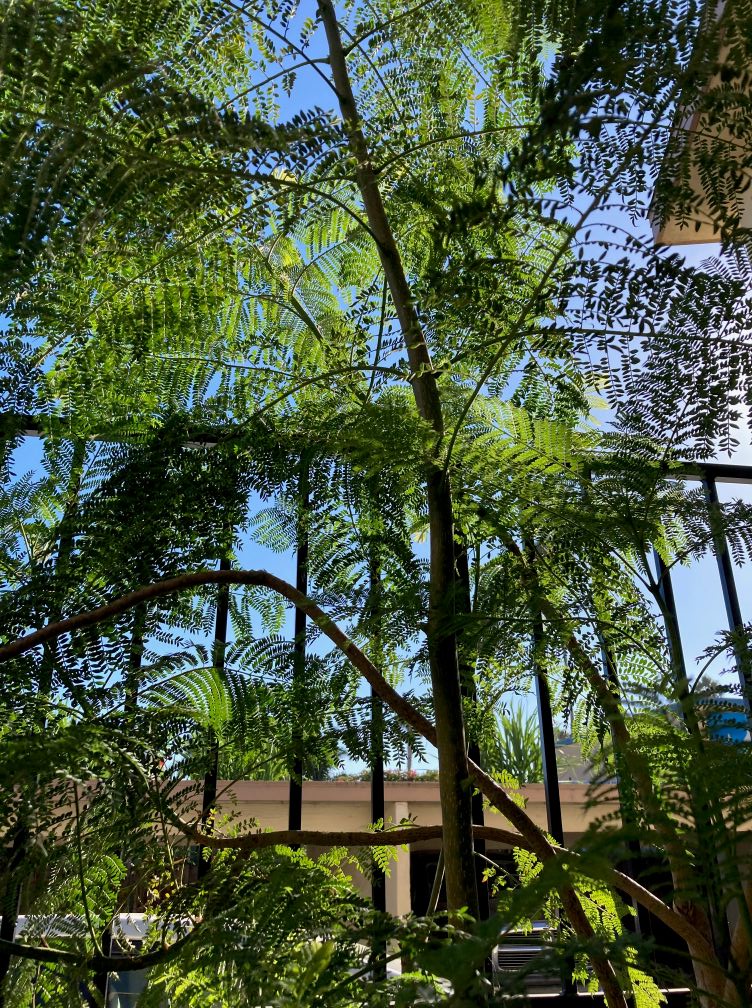
During early spring, I also decided to prune three branches of the tiny leaf tree that were hanging down into an adjacent pot. (Please share if you know the name of this tree.) The exuberant response of this delicate beauty was unexpected. What a gift! The photos below were taken on September 4th.
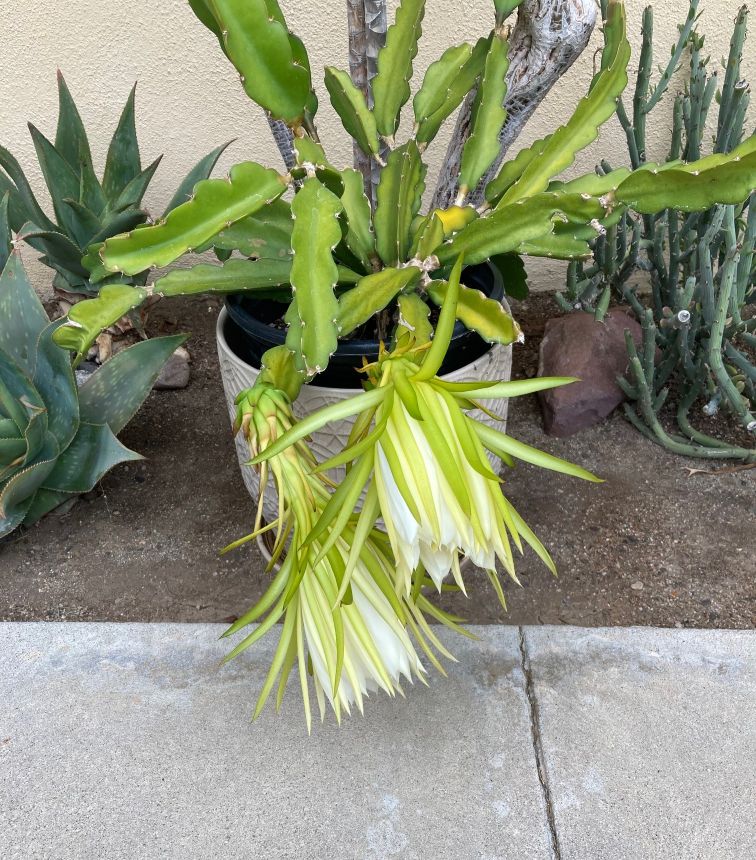
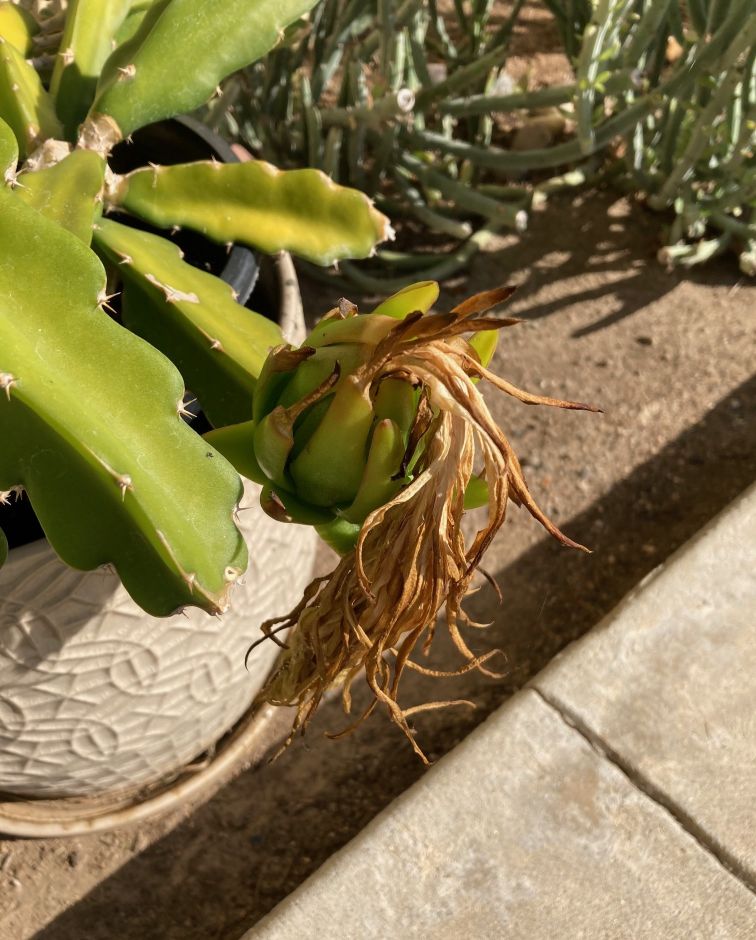
Although I continue to prune the dragon fruit cactus to contain its spread, it surprised me this summer with two delicate white flowers (shown in the photo on the left below). Considering that few pollinators visit our urban garden, it’s a miracle that one of the flowers is evolving into a fruit (shown in the photo on the right below). I suspect that the pollinator is the large black-with-red spider that lives nearby. As a first-time observer, I’m reluctant to remove the crisp-dried flower that’s still firmly attached.
As with pruning our plants, letting go of ways of being that no longer serve our individual growth comes with risk. More so, when we must let go of our toxic relationships. Recovery and a positive new way of being may take time, but it’s worth the pain of letting go. Rejuvenated, we can reach for the sky like the tiny leaf tree.
While we humans continue to fight and kill each other over conflicting beliefs and political ideologies, Mother Nature quietly reminds us of the beauty and strength in diversity. We have only to be still for a moment and pay attention. She keeps me grounded and connected to what is essential. I give thanks for her gifts and lessons learned in my small urban garden.


It is good to see your garden and the lessons it has taught you – especially that recovery is possible when all is thought lost. I really do hope your joints will continue to ease.
LikeLiked by 2 people
Thanks very much, Derrick.
LikeLiked by 1 person
Sorry to hear about your osteoarthritis; I hope the exercises help and the pain is manageable. Your garden rocks! I love hearing about the plants you nurture, especially since I live in the (cold) UK, where many of these cannot thrive in the garden! 💜🍂
LikeLiked by 2 people
Thanks very much, Ada. For me, nothing compares to the English garden 🙂 So far, the exercises are helping to reduce the pain.
LikeLiked by 1 person
Knowing you, Rosaliene, I was not surprised by the first sentence of the last paragraph. L’ chaim!
LikeLiked by 1 person
Dr. Stein, I’m so glad that you made the Fiddler on the Roof connection with my use of the words “wonder of wonders” 🙂 To life!!!
LikeLiked by 1 person
Plants live in a symbiotic relationship. Your garden is beautiful. It is getting colder in the UK, but I love the golden colours it brings.
LikeLiked by 1 person
Thanks very much, Diana. I also love the golden colors of autumn.
LikeLiked by 1 person
🙂
LikeLiked by 1 person
So glad you are getting some relief from osteoarthritis and heel pains Rosaliene. My Patty has osteoarthritis and is headed for knee replacements when the medical system catches up. I like your analogy between pruning plants and pruning the deadwood our of our thoughts and minds. What is happening in your country and around the world right now is shocking to say the least. All the empathic progress from the last few years is being wiped out by the pendulum swinging too far back. Such is life. All we can do is hope some day we humans get it. In the meantime, I like to associate with nature where logic still exists. Happy Sunday dear friend. Allan
LikeLiked by 1 person
Allan, I’m amazed to learn that Patty also has osteoarthritis. She puts me to shame with her uphill hiking during your outdoor adventures. The secret, it seems, is to keep moving.
As a nation, we’ve got a lot of deadwood to prune if we are to end the divisiveness. Ingrained ways of being and doing are not easy to let go.
LikeLiked by 1 person
She is a gamer. She also suffers from fibromyalgia.
It seems the pruning going on right now is all the healthy branches, with just the deadwood remaining.
LikeLiked by 1 person
You have an amazing wife, Allan. Take care of each other ❤ You're spot on about pruning the healthy branches!
LikeLiked by 1 person
The plants are looking REALLY good, Rosaliene! Sorry about your health issues; glad physical therapy is helping somewhat.
LikeLiked by 1 person
Thanks very much, Dave. Aging comes with its health challenges. I’m doing my best to adapt to the cries of wear.
LikeLiked by 1 person
“Aging comes with its health challenges” — it does indeed, Rosaliene. 😦 (I can personally relate. 🙂 )
LikeLiked by 1 person
😀
LikeLiked by 1 person
Nature in my garden is my refuge from a crazy volatile world we live in. And in my garden are birds, squirrels, frogs, and lizards, the occasional bunny and who knows what else.
LikeLiked by 1 person
Mary, I’m there with you. How wonderful that your garden is filled with so much of life! Gone are the days when birds made their home in our camellia trees. Even the hummingbirds seem to have moved out 😦
LikeLike
Dear Rosaliene, what wonderful plants in your garden, thank you for sharing your stories about them here. It is good that you are getting some relief from osteoarthritis; not a pleasant condition. Keep moving! 🤗😊
LikeLiked by 1 person
Thanks very much, Ashley. I doing my best to keep moving 🙂
LikeLiked by 1 person
I’m sorry to hear, Rosaliene, that you’ve had such a painful time! I hope your recovery is progressing in leaps and bounds. It’s wonderful to hear that your plants are doing so well. Yes, Mother Nature is a great teacher, and being able to let go can be richly rewarding. All the best!
LikeLiked by 1 person
I appreciate your well wishes, Friedrich. Thanks!
LikeLike
Glad to hear that your feet problems are diminishing. I hope you’ll improve much more than you already have.
LikeLiked by 1 person
Thanks very much, Neil. I’ve got to be diligent in doing the exercises.
LikeLiked by 1 person
So glad to read you’re finding relief, dear Rosaliene. Thank you for sharing your beautiful garden space. A joy to spend time there… viewing and reading about your garden journeys and discoveries. 💚
LikeLiked by 1 person
Thanks very much, Michele ❤
LikeLiked by 1 person
❤
LikeLiked by 1 person
I’m loving how you’ve connected pruning and caring for plants with what we need to do in relationships. So true.
I have osteoarthritis too in a few joints. Sucks, but gentle exercises are good for us!
LikeLiked by 1 person
So glad that you can relate to the connection, Tamara.
For many of us, arthritis comes with aging. May our weak joints be kind to us 🙂
LikeLiked by 1 person
Yes, may our joints be kind to us! I find taking uric acid cleanse capsules helps to keep the pain away or minimal.
LikeLiked by 1 person
Thanks for the tip, Tamara. I’ll talk to my doctor about it during my next visit.
LikeLiked by 1 person
Good plan!
LikeLiked by 1 person
Your garden and your son’s are looking very healthy. So glad you have PT to help yourself heal.
LikeLiked by 1 person
Thanks very much, Rebecca. It’s a blessing to receive medical approval for physical therapy sessions.
LikeLiked by 1 person
Your plants look strong and healthy, Rosaliene. With a little care, our plants give us much joy, don’t they? And I’m happy that physical therapy is giving you some relief. I’ve gone through therapy several times for different issues, and all but one helped tremendously. Be strong and happy, my friend.
LikeLiked by 1 person
Thanks very much, Mary. My plants do, indeed, give me much joy 🙂
I appreciate your well wishes, my friend. Blessings ❤
LikeLiked by 1 person
Wonderful post and message! So much of gardening seems to be trial and error, patience and finding out what works. Mother nature is resilient and an excellent teacher. The leaves of the tiny leaf tree remind me of a mimosa, I’m thankful you’ve made progress in physical therapy which as often helped me, too. Now, I should do some squats! Thanks for the nudge. 🙂
LikeLiked by 1 person
Thanks very much, JoAnna! Over the years, I’ve lost many plants through trial and error.
Our tiny leaf tree does resemble the mimosa with a slight difference. It has never borne any flowers.
Deep squats are not easy for me, but they do build strong leg muscles.
LikeLiked by 1 person
We do what we can. My squats aren’t very deep.
LikeLiked by 1 person
JoAnna, at my session yesterday, I was assigned to a different assistant. After I explained my difficulty, he set up an overhead bar that helped me to make deeper squats with less pressure on my knees. Now, I’ve just got to find a substitute support at home 🙂
LikeLiked by 1 person
Good for you for explaining the difficulty. I’m glad he made the reasonable accommodation. I hope you find something safe and helpful to hold on to at home. Maybe it doesn’t have to be overhead.
LikeLiked by 1 person
That’s true. I’ll find a way.
LikeLiked by 1 person
Gardening benefits one both physically and emotionally. When one’s health starts to restrict one’s gardening, it comes as a double blow. Glad to hear the physiotherapy is turning things around for you.
LikeLiked by 1 person
You’re so right, Jasper. I’ve had to reduce my gardening hours, but keep pushing forward.
LikeLiked by 1 person
Sorry to hear about your arthritis, Rosaliene. Unfortunately, gardening probably isn’t the best for that. Too many awkward positions. ha ha. That said, your plants are beautiful and loved. You have mutual relationship.
LikeLiked by 1 person
Thanks very much for your kind comments, Mara ❤
So true about the awkward positions 😀 I use a low stool and also have a cushioned pad for kneeling. Leaning forward for too long is brutal on my back.
LikeLiked by 1 person
I was going to suggest using a stool but then I figured they say sitting is the worst thing for arthritis. Anyhow, sounds like you’re doing the right things and adapting to your predicament just like your plants are adapting to theirs. 😀 ❤
LikeLiked by 1 person
Mara, I already do too much sitting during the course of my work day. (Sighing.) Adaptation to my new reality is definitely in order 😀
LikeLiked by 1 person
I hear you, Rosaliene. You’re on the right track.
LikeLiked by 1 person
❤
LikeLike
Sending love and healing thoughts, dear friend. 💜🌻
LikeLiked by 1 person
Thanks very much, Carol. Much appreciated ❤
LikeLiked by 1 person
💜
LikeLiked by 1 person
Sending you warm thoughts!
LikeLiked by 1 person
Thanks very much, Belladonna ❤
LikeLiked by 1 person
This is a beautiful post, Rosaliene. Reading your words and admiring your photos was balm for my soul. I’m so glad you’ve gotten help for your heel pain! I’m also very glad those plants you pruned have rejuvenated and are thriving in your beautiful urban garden. Thank you for all of this, especially your final paragraph that deeply resonated with me.
LikeLiked by 1 person
Thanks very much, Tracy. I’m making progress with the exercises. Each session brings a new challenge.
I’m so glad that my closing comments resonated with you. There is unspeakable suffering in our world.
LikeLiked by 1 person
So glad you’re taking care of yourself amidst all the pain and suffering.
LikeLiked by 2 people
WOW Rosaliene, your garden is AMAZING. 😁 I love the tiger eye and your succulents are kicking! Girl, do take care of your feet. I had similar issues with my feet too but not as severe as the pain you endured.
This also mimics our life as it does with the plants:“Recovery and a positive new way of being may take time, but it’s worth the pain of letting go. Rejuvenated, we can reach for the sky like the tiny leaf tree.”Beautiful life lesson from your garden!
LikeLiked by 1 person
Thanks very much, Kym! We have to hold onto hope with the crazy going on around us. Blessings, sistah ❤
LikeLiked by 1 person
Yes ma’am Rosaliene, you got that one right! Much love my sistah! 🥰💖🤗
LikeLiked by 1 person
Plants are amazing and you have some beautiful ones and you take good care of them too!
LikeLiked by 4 people
Thanks very much, Cindy. So glad that you stopped by 🙂 ❤
LikeLike
A beautiful post, Rosaliene. I often have many of the same “what have I done?” thoughts that you have after pruning, overwatering, etc. I really appreciate your closing paragraph. Hoping your pain continues to subside.☀️
LikeLiked by 2 people
Thanks very much, Lisa 🙂 I’m hoping my diligence in strengthening my muscles will make a difference.
LikeLiked by 1 person