
Tags
A Matter of Survival: Organizing to Meet Unmet Needs and Build Power in Times of Crisis by Shailly Gupta Barnes & Jarvis Benson (March 2025), Community Building, Poor People’s Organizing, Survival Strategies, The Kairos Center for Religions Rights and Social Justice
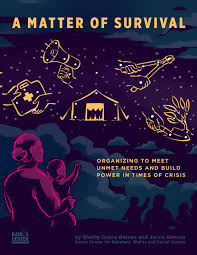
Cover of A Matter of Survival: Organizing to Meet Unmet Needs and Build Power in Times of Crisis by Shailly Gupta Barnes & Jarvis – PDF Publication March 5, 2025
Photo Credit: Kairos Center
Since the onset of the COVID-19 pandemic, survival organizing has continued en masse, in response to ongoing effects of the pandemic, as well as climate crisis, hunger, housing insecurity, the denial of health care, police violence, deportation defense, increasing militarism and other systemic failures of our society. As Vilchis from Union de Vecinos remarked, “Health crisis, housing crisis, all of these crises are still there. The material conditions have not changed, we just have less money and are more disorganized. The risk of losing your life to COVID is less, but your job doesn’t pay enough to cover rent or other costs of living. For many of us, life has gotten worse, but we’re not coughing as loud.”
This is particularly true for poor, low-income and marginalized communities. Cosecha will be “depending on projects of survival even more,” said Adorno, especially as it anticipates more intense attacks on undocumented people. Sycamore Collaborative is expecting hunger to continue to grow in its community. “We will hit the ‘million meal’ mark soon,” said Rev. Tañón-Santos, “and there has to be a way that we can foresee this happening and figure out how to prepare.” In Kansas City, the Bethel Neighborhood Center does not want to be “surprised…we need to be more prepared than ever,” said Sonna. Under a second Trump administration, these and other communities are also facing dramatic cuts to social welfare programs, precipitous climate breakdown, greater repression from militarized police and law enforcement and a regressive, anti-democratic political movement.
In this context, a vast network of projects of survival can play an increasingly essential role in keeping our communities safe, while politicizing and preparing grassroots communities to take coordinated action together as part of a broader social movement. Whether through mutual aid, ministry or community organizing, meeting material needs is an act of resistance in a society that punishes the poor for their poverty and misery — and prioritizes billionaires over the rest of us. If and when these efforts can be connected, scaled up and strategically organized, projects of survival can anchor the call for a society where all of our needs are met, today, tomorrow and for generations to come.
Excerpt from the Conclusion of A Matter of Survival: Organizing to Meet Unmet Needs and Build Power in Times of Crisis by Shailly Gupta Barnes & Jarvis Benson, PDF publication by The Kairos Center for Religions, Rights, and Social Justice, New York, USA, March 5, 2025, p. 73.
A Matter of Survival: Organizing to Meet Unmet Needs and Build Power in Times of Crisis is a bold and urgent report that unearths the extraordinary networks of care that have sustained communities through the pandemic and beyond. Drawing on insights from more than 40 leaders and 35 grassroots organizations, the report offers a framework for “projects of survival,” as well as recommendations for activism, organizing, social justice ministry and philanthropy today.
Both a roadmap and a rallying cry, the report reveals how survival organizing can transform into a powerful movement for systemic change. Indeed, as political extremism threatens democracy and economic inequality deepen, amid climate breakdown and escalating violence, this report challenges us to see beyond mere survival—to reclaim power, mobilize communities, and demand a just future for all.
This isn’t just a reflection on the past—it’s a call to action for the battles ahead.
The Kairos Center for Religions, Rights, and Social Justice is a national organization committed to building a movement to end poverty, led by the poor. Originally named the Poverty Initiative, the Center was founded in 2004 by a group of students, organizers, educators, and community leaders at Union Theological Seminary in New York City. Drawing on the power of religions and human rights, they are a center for movement strategy, coordination, and education among the poor across all lines of division. Among other projects, they co-anchor the Poor People’s Campaign: A National Call for Moral Revival, representing the 140 million, poor and dispossessed Americans who live just one crisis away from disaster.
Kairos is an ancient Greek word, describing a time of great change, when the old ways of the world are dying and new ones are struggling to be born. During a Kairos moment, existing systems and structures fall apart, leaving havoc and misery in their wake, while also creating the possibility for a new kind of leadership to emerge, one that can move society in a different direction.
We are living in a Kairos moment today. Our economic, political, and social institutions are unable to adequately respond to the crises of our times, relying instead on fear, force, and violence to maintain social control. This has emboldened a regressive political movement that has gained influence and power. Since the Covid-19 pandemic, we have seen another way to respond to these crises, one grounded in the extraordinary commitment of those taking on the ordinary responsibilities of meeting our unmet needs.


A necessary positive approach in “a society that punishes the poor for their poverty and misery”
LikeLiked by 3 people
As I see it, Derrick, as more of us become jobless and homeless due to the numerous crises we now face, here in the USA and worldwide, we will need to expand the network of such projects for survival.
LikeLiked by 1 person
An important post, Rosaliene. Survival organizing unfortunately sounds VERY necessary in these dismaying times.
LikeLiked by 1 person
Dave, I’m glad that you also see the importance of survival strategies for these times we live in. For 90 percent of we the people, the foundations of our lives are no longer secure.
LikeLiked by 1 person
Rosaliene, “regaining power,” as you write, will be a difficult undertaking, because a lot of money is at stake. While the Covid years were an unprecedented “bottom-up money” project, I believe this time the money will really be reaped. Yes, it’s already flowing. Don “Whatever” and his clan have already done all the necessary preparatory work. While much of it was hidden back then, today it’s happening in front of the cameras.
LikeLiked by 1 person
Friedrich, as presented in the report by Barnes & Benson, the framers of the “projects of survival” consider political education
as the catalytic force to unleash the power potential of the poor: “the collective process whereby people connect their individual experiences of injustice to systemic, root causes and develop a shared analysis of power and social change” (p. 65).
I believe that the rise of Socialist Democratic nominee, Zohran Mamdani, as the New York City mayoral frontrunner is a result of this grassroots movement of political empowerment. Will working-class New Yorkers succeed? As you point out, there’s a lot of money at stake for us to achieve meaningful change. The blatant corruption is immoral.
LikeLiked by 1 person
Rosaliene, yes, that sounds good in principle, but I have certain doubts about the long-term, sustainable success of such efforts. (The current genocide and the global powerlessness to prevent it demonstrate the power of money best.)
As you know, I live in a social democratic country, and I’m very happy. But it’s an organically grown structure, in which Northern European countries like Sweden were also pioneers. And yet we, too, fear that the power of capital is eroding the system. Superbro, J.D., and even Musk are leaving no stone unturned to interfere and undermine our system.
LikeLiked by 1 person
Friedrich, for all the reasons you’ve mentioned and more, I see societal collapse for our species. Given that the super-rich are determined to have it all, regardless of the dire consequences for all human and non-human life on our planet, this collapse may occur sooner than predicted by our climate/ecological scientists. Poor and marginalized populations, already dealing with crises of neglect, are leading the way in creating grassroots community-based networks for their survival.
LikeLiked by 1 person
Rosaliene, I hope you haven’t read any fundamental criticism of “community-based networks for survival” into my few lines – quite the opposite. We must find our way back to a more just order, that’s clear. As history has shown so far, this can occasionally be very painful, for example, when an empire collapses, but the world won’t end because of it.
I think that when, for example, the AI bubble bursts, there will be a mega-crash massive enough to bring down a government.
My (your?) generation has fallen on the bright side of history: we’ve never known hunger, never experienced war, and we’ve been able to live largely carefree (historically speaking) for decades. Now, we’ve overstepped the bounds for some time, and the pendulum is swinging in the other direction, as it has been for ages. How can/should I react? Trust in yourself, keep a cool head, see things from a distance, read helpful books, question everyone and everything…and try to stay healthy, especially mentally.
LikeLiked by 1 person
I appreciate your clarification, Friedrich. The rise of AI is yet another human existential event. It’s difficult to see things from a distance while living in the belly of the beast.
LikeLiked by 1 person
Sounds like a fascinating book! What you say about the U.S living in a Kairos moment today is so insightful, and got me thinking.
LikeLiked by 2 people
Thanks very much, Ada. A Matter of Survival is more of a report than a book. The 78-page PDF publication is available for free download online at the link provided in my post.
LikeLiked by 1 person
Governments thrive on chaos, civilizations are not always so lucky. Right now humans in charge seem to have very little humanity left. It is very important that we all do our best to stick together for our very survival. Have a good Sunday Rosaliene. Allan
LikeLiked by 1 person
I agree with you on all counts, Allan. It’s just a matter of time before all of us are hit by some calamity not of our making. On the other hand, as consumers in our globalized capitalist economy, we are all complicit in some form for what we now face on numerous fronts.
LikeLiked by 1 person
“A rallying cry for the battles ahead” is on point Rosaliene! 🤜🏼🤛🏼
“Our economic, political, and social institutions are unable to adequately respond to the crises of our times, relying instead on fear, force, and violence to maintain social control.” I agree with you, we are living in a Kairos moment! 🥰💖🤗
LikeLiked by 1 person
Thanks very much, Kym! I was heartened to learn of the serious grassroots movement underway by the Kairos Center for Religions, Rights, and Social Justice. The framework the featured report provides for building a network of “projects of survival” is invaluable in these calamitous times.
LikeLiked by 1 person
Oh gosh Rosaliene, we are certainly underfed with valuable projects for survival. We desperately need these resources, especially for people who have given up hope. Thank you for raising our awareness level sistah! 😊🙏🏼🥰💖😘
LikeLiked by 1 person
You’re welcome, Kym. Hope lives ❤
LikeLiked by 1 person
Oh yes sis, hope continues to live for sure! 💖🙏🏼💖
LikeLiked by 1 person
Rosaliene, you find excellent resources. I appreciate you taking the time to find and read these books and then pass on your evaluations to us. Have the most wonderful week.
LikeLiked by 1 person
Thanks very much, Mary. The 78-page PDF publication is more of a report than a book. Should you be interested in learning more, it’s available for free download online at the link provided in my post.
LikeLiked by 1 person
Lots of good, progressive and pragmatic info in this post. Thanks.
LikeLiked by 1 person
Thanks very much, Neil.
LikeLiked by 1 person
At this time in history we can choose to feed, clothe and house everyone if we have the will. Thanks for sharing this resource on how to accomplish this.
LikeLiked by 1 person
So true, Rebecca.
LikeLiked by 1 person
Thank you for this important information, Rosaliene. Collective care is vital and this post is a good reminder of all that’s being done in these intentionally chaotic times. I’m going to check out the rest of the publication and also want to share something that landed in my inbox this morning from Indivisible in case any of your readers are interested:
Our next Solidarity in Action speaker series event is a two-parter. Join us on Monday, September 15 and then again on Monday, September 29 to learn about mutual aid and community response teams with special guest Stephanie Rearick.
Solidarity!
LikeLiked by 1 person
Thanks for sharing this information, Tracy. With the slow death of FEMA, our state and local governments will be on their own in dealing with all forms of natural disasters. Solidarity!
LikeLiked by 1 person
Looks like an interesting report, Rosaliene. These networks are going to be invaluable as the broken ladder falls from under us.
LikeLiked by 1 person
Mara, your metaphor of “the broken ladder” perfectly describes the end of the American dream for millions of Americans.
LikeLiked by 1 person
Thanks, Rosaliene.
LikeLiked by 1 person
Such people and organizations remind us of the decent people active in the world, so much needed now. Kairos, indeed. As the old gospel song goes, “We shall overcome.” Thank you, Rosaliene.
LikeLiked by 1 person
You’re welcome, Dr. Stein. As long as compassion exists in the hearts of humankind, “we shall overcome.”
LikeLike
A practical and much needed book. Seeing mutual aid, ministry or community organizing, and meeting material needs as acts of resistance will inspire me to do more.
LikeLiked by 1 person
I feel the same, JoAnna.
LikeLiked by 1 person
Community organizing is not one of my strengths, but I admire those I know who put heart and soul into that essential work. It’s easy to fall into hopelessness at the dizzying list of systemic failures you highlight here, Rosaliene, but similar to what you’ve said elsewhere we must focus on being the light, not the dark.
The naivety in me just can’t get over the fact that so much of this collapse is intentional. Thank you for continuing to draw attention to issues of social justice, an articulate voice for the voiceless.
LikeLiked by 3 people
Steve, I’m also not a community organizer. But there’s a place for each one of us when building a community for survival. As I see it, the collapse was already underway. Our leaders’ latest policies have served only to accelerate the collapse.
LikeLiked by 1 person
Indeed, there are roles for everyone to contribute in community. It is unfortunate that policies do not match the needs of the world and people.
LikeLiked by 1 person
Steve, I’ve come to the conclusion that our ruling elite really don’t care about the masses of humanity.
LikeLike