
Tags
Auto Industry, Climate Change, Climate Change and the Escalation of Global Extreme Heat, Climate Shift Index, Extreme Heatwaves, Fossil fuel industry, US Environmental Protection Agency (EPA), US Solar for All Program
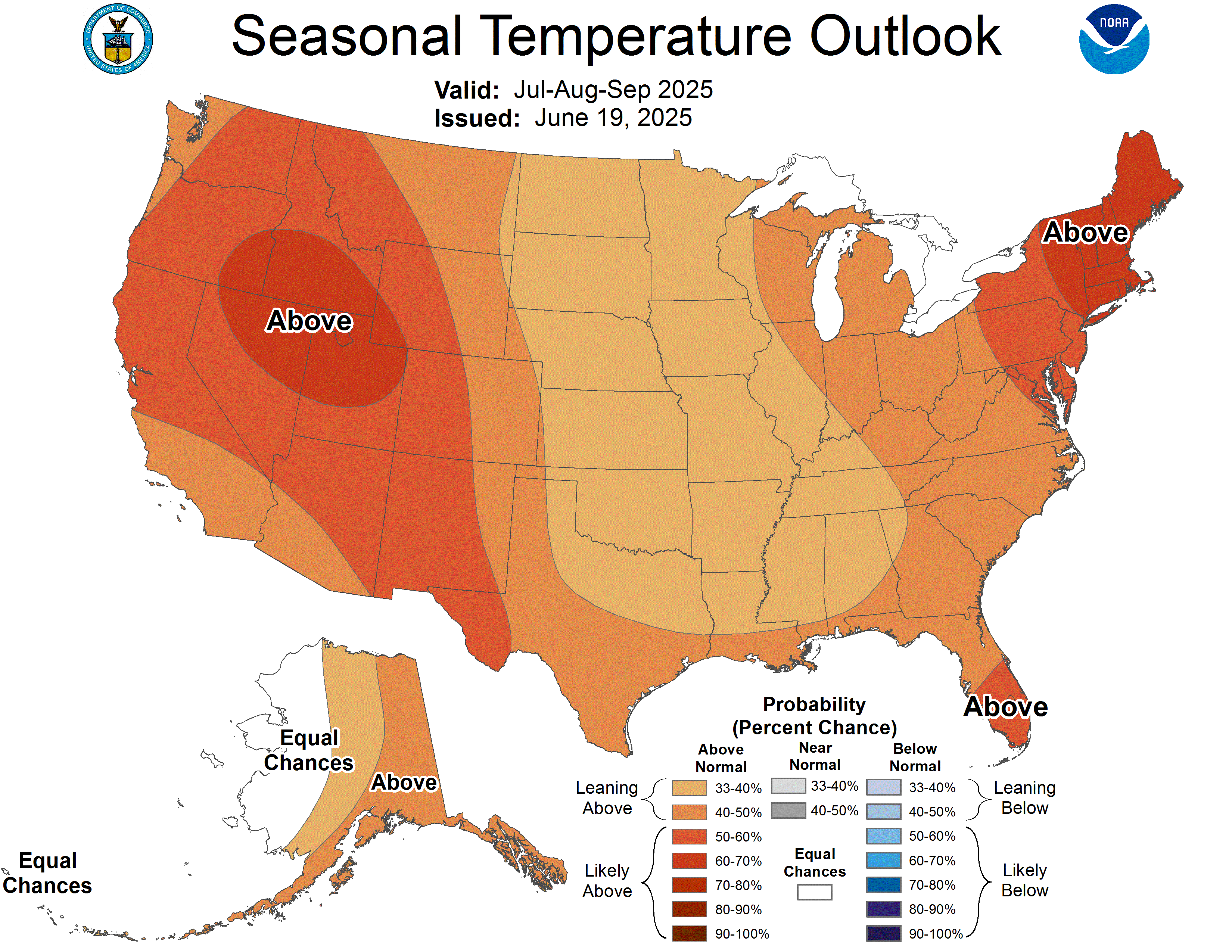
Source Credit: NOAA National Centers for Environmental Information
When you sell your soul to the highest bidders, your new masters will exact payment in diverse currencies. One such payment was made on July 29, 2025. Intent on turning back the tides of change, the said Master of Industry seeks to rescind the 2009 Endangerment Finding regarding greenhouse gases under section 202(a) of the EPA Clean Air Act.
On that day in July at an auto dealership in Indiana, the Environmental Protection Agency (EPA) Administrator Lee Zeldin made the grand announcement. Also present were US Secretary of Energy Chris Wright, as well as several Indiana officials: the Governor, Attorney General, and Secretary of Energy and Natural Resources. If finalized, the proposal would repeal all greenhouse gas emissions regulations for motor vehicles and engines, and other sources.
“With this proposal, the Trump EPA is proposing to end sixteen years of uncertainty for automakers and American consumers,” said EPA Administrator Zeldin.“In our work so far, many stakeholders have told me that the Obama and Biden EPAs twisted the law, ignored precedent, and warped science to achieve their preferred ends and stick American families with hundreds of billions of dollars in hidden taxes every single year. We heard loud and clear the concern that EPA’s GHG [Greenhouse Gases] emissions standards themselves, not carbon dioxide which the Finding never assessed independently, was the real threat to Americans’ livelihoods. If finalized, rescinding the Endangerment Finding and resulting regulations would end $1 trillion or more in hidden taxes on American businesses and families.” [Emphasis is mine.]
[Note to readers: Carbon dioxide comprises over 79% of all greenhouse gas emissions.]
For their part, the auto industry promises to give us “more safe and affordable cars.” The American Trucking Association promises a decrease in “the cost of living on all products that trucks deliver.”
Meanwhile, millions of Americans are feeling the heat. Intense heatwaves are becoming more frequent not only in the West but also across the country. Happy are those who can stay cool with air-conditioning. The electric fan is no longer enough. Just ask the more than 100 million people across much of the central and eastern US states who suffered record-setting temperatures during a widespread heatwave from June 22nd to 25th.
The trend persisted in July and, according to the National Centers for Environmental Information (NCEI), will continue during the remainder of summer. They forecast that conditions favor above-normal temperatures throughout the lower 48 contiguous states, especially impacting the Great Basin, New England, much of the Great Plains, and the Mississippi Valley. Eastern and southern Alaska will also experience above-normal temperatures. (See the captioned NCEI/NOAA Map of US Seasonal Temperature Outlook Jul-Aug-Sep 2025.)
Americans were not the only ones feeling the heat. In June 2025, according to Europe’s Copernicus Climate Change Service, most of western and central Europe experienced warmer-than-average air temperatures. Many countries including Austria, France, Germany, Italy, Portugal, Switzerland, and the United Kingdom experienced extreme heatwave conditions. Some places in Portugal and Spain saw temperatures soar above 40°C (104°F). Over the past 64 years, France had its second-warmest June and Spain its warmest June. England broke its record as the warmest June since 1884.
During the last two months, those of us living along the coastlands in Southern California have enjoyed below-normal summer temperatures. Such good fortune will change in the week beginning August 17th when temperatures will rise to the upper 80 to 90 degrees Fahrenheit (26°C to 32°C). With temperatures in the mid-to upper 70 degrees (24°C and over) this past week, my son’s Tiger Eye plant already needs watering daily to stay happy. As for me, I’m privileged to have air-conditioning to keep my apartment cool.
On August 5, 2025, the Department of Public Health of Los Angeles County approved an amendment to our Public Health and Safety Code to establish a maximum indoor temperature threshold of 82 degrees Fahrenheit (28°C), to prevent heat-related health impacts, for rental housing units in our county. Rental property owners have until January 1, 2027, to comply with this ordinance. In my elder years, exposure to such a high threshold would lead to heat stress. I set my AC at 74 degrees Fahrenheit (23°C).
In their report “Climate Change and the Escalation of Global Extreme Heat: Assessing and Addressing the Risks,” released on May 28, 2024, collaborators Climate Central, World Weather Attribution, and the Red Cross Red Crescent Climate Centre found that human-caused climate change is boosting dangerous extreme heat for billions of people worldwide and making heat events longer and more likely.
Their analysis of the 12-month period – May 15/2023 to May 15/2024 – across the planet, using the Climate Shift Index, revealed the following key findings:
- About 78 percent of the global population (6.3 billion people) experienced at least 31 days of extreme heat (hotter than 90% of temperatures observed in their local area over the 1991-2020 period), at least twice more likely due to human-caused climate change.
- Human-caused climate change added an average of 26 days of extreme heat worldwide than would have occurred without a warmed planet.
- The five countries where the average person experienced the most days with extreme heat above their local heat level were Suriname (182 days), Ecuador (180 days), Guyana (174 days), El Salvador (163 days), and Panama (149 days).
- Using World Weather Attribution criteria, the study identified 76 extreme heatwaves that spanned 90 different countries. These events put billions of people at risk, including in densely populated areas of South and East Asia, the Sahel (Africa), and South America.
As illustrated in the interconnected pathways in Figure 3 below, extreme heat brings multifaceted impacts that compound and cascade across various sectors. These impacts are most evident for (but not limited to) health, water, agriculture, economy, livability, critical infrastructure, and the environment.
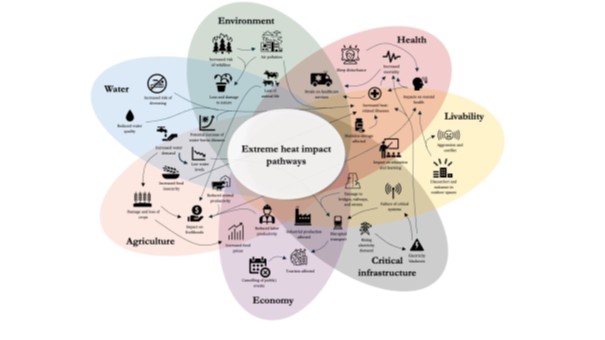
Source Credit: Climate Change and the Escalation of Global Extreme Heat: Assessing and Addressing the Risks, released May 28, 2024
In their study, “Accelerating increase in the duration of heatwaves under global warming,” published on July 7, 2025, in the Nature Geoscience journal, researchers led by the University of California Los Angeles (UCLA) and the Universidad Adolfo Ibañez in Santiago, Chile, also found that climate change makes heatwaves hotter and longer. What’s more, the lengthening of heatwaves will accelerate with each additional fraction of a degree of warming.
Our climate scientists still don’t fully understand why our planet is heating up must faster than their climate change models had predicted. Then, there’s the question of how these longer, extreme heatwaves will affect soil moisture and wildfire risk: Of special concern for us here in California.
Forget federal funds for continued research. Our Dear Leader, who has claimed that climate change is a Chinese hoax, and his former chainsaw-wielding enforcer have already debilitated the National Oceanic and Atmospheric Administration (NOAA).
“Addressing [the impacts of longer heatwaves] will depend on having high-accuracy weather and climate models, but the current federal budget is putting a pause on the United States’ capabilities and eliminating excellent young scientists from the field,” said senior author and UCLA climate scientist David Neelin. “Deprioritizing and defunding climate and science research will limit our capacity to make region-specific projections for risk management. Without that, we’ll have much less ability to adapt to climate change at the very time when we need to accelerate adaptation planning.” [The emphasis is mine.]
Now, the Masters of the Fossil Fuel Industry have their sights on shutting down NASA’s two Orbiting Carbon Observatories: a free-flying satellite launched in 2014, and an instrument attached to the International Space Station in 2019 equipped with technology used in the Hubble Space Telescope. These observatories can precisely show where carbon dioxide is being emitted and absorbed, and how well crops are growing. Kill the data; end the threat.
Before you read the two-page fact sheet from The White House FY 2026 Budget that eliminates funding for the Green New Scam, I would suggest that you take a deep breath.
Breathe in. Breathe out.
When the Masters of Industry are done with ending all the progress our country has made over the years in transitioning to more sustainable forms of energy, we the people will be on our own. If you’re a working-class homeowner and have plans to install solar power, think again. On August 5th, the Masters of the Fossil Fuel Industry moved, once again, to kill their competition. They’re now out to cancel US$7 billion in funding for the Solar for All program. During the previous administration, Independent Senator Bernie Sanders for Vermont introduced the program to provide loans or grants to working class families to help cover the cost of installing solar rooftops or participating in community-based solar projects.
“At a time when working families are getting crushed by skyrocketing energy costs and the planet is literally burning, sabotaging this program isn’t just wrong — it’s absolutely insane,” said Senator Bernie Sanders. “We will fight back to preserve this enormously important program.”
This is not America First. This is the billionaire Masters of Industry First. Do we roll over and let them have their way? As consumers, we don’t have to follow the billionaire playbook.
 Three Worlds One Vision
There’s only one word to describe the current administration’s attitude: nihilism. Its essence is its absolutism. Any arguments, science, and data, undermine its essence. Then, paradoxically, they are exactly what nihilists feed on to flaunt (among the huddled masses) what they see as the power of nihilism: that it is a primeval force that is licensed to destroy irrespective of any rationality and morality that nihilists themselves would acknowledge to exist outside the nihilistic paradigm. It’s sad, horrific, and primitive.
LikeLiked by 1 person
Dingenom, you may be quite right in describing their attitude as nihilism. As I see it, this is an attempt by the billionaire-class to destroy our institutions so that they could privatize everything for their further enrichment and dominance. They don’t care about us, the masses of humanity. We are dispensable.
LikeLiked by 1 person
Rosaliene, you deal in facts; the Trump regime deals in making the world worse. 😦
LikeLiked by 1 person
Dave, may the gods help us when the walls come crashing down upon us 😦
LikeLiked by 1 person
A majority of American citizens put Trump in power. In a very real sense, all of this is entirely their fault. They knew, or should have known, what Trump is like and what he stands for.
LikeLiked by 1 person
Neil, they were hoodwinked in believing that he could/would make their lives better.
LikeLiked by 1 person
Maybe some of them were hoodwinked, but they shouldn’t have been, considering that Trump didn’t make life better for them during his first term.
In my opinion, the USA is jam-packed with reactionaries. They support Trump and put him in power.
LikeLiked by 1 person
It’s complicated, Neil. Don’t forget his alliance with the extremist evangelical church who seek to unify the Church and State.
LikeLiked by 1 person
Hi. It’s complicated, for sure. As for me, I like people who, among other things, are open-minded, forward-thinking, and in favor of expanding personal and societal freedoms and rights. It annoys the heck out of me that vast numbers of my “fellow citizens” don’t have those viewpoints at all. Anyway, I’ve said enough. Have an excellent week!
LikeLiked by 1 person
Thanks for sharing, Neil. An excellent week to you, too!
LikeLiked by 2 people
Thanks for this horrendous progress???? update Rosaliene. The moment the man complained about not being able to rinse the shampoo from his hair or flush his toilet without flushing 5 times, the writing was on the wall. He is like Nero, fiddling while Rome burns. Narcissists care about nothing or nobody but themselves. As he stated, I will be your Retribution, I will be your Revenge. Funny how so many fell under the spell of this snake oil salesman. And now, he is about to give Ukraine to Putin…in Alaska…which Putin wants back. The Founding Fathers never saw this coming. Enjoy your Sunday. Allan
LikeLiked by 2 people
Allan, what’s happening is, for sure, horrendous. Working-class Americans who share his vision of retribution and revenge have no idea what the consequences will be for us as a nation and for the world. As for these extreme weather events, some northern American states are now suffering from poor air quality as a result of wildfires in Canada.
LikeLiked by 1 person
I know the Northern states want the smoke to stop, but, even if TACO D finds a way to tariff that, it is a difficult process. We are getting a smoke break here, but the Central and Eastern provinces are not. A sad state of affairs, but the heat waves and floods in your country are also sad. Perhaps part of a normal cycle, but made worse by human aided climate change.
LikeLiked by 1 person
Allan, your comment about the smoke and tariff made me laugh 😀 On a more serious note: The weaponization of tariffs will come back to bite us. It’s just a matter of time.
LikeLiked by 1 person
What an illuminating post. You’ve spotlighted an important issue here, Rosaliene. Thanks for sharing!
LikeLiked by 2 people
Thanks very much, Ada. You’re welcome.
LikeLiked by 1 person
So upsetting. 😢 What can we do? The individual consumer?
The environment is always my first concern when voting, and I do my best to research prior, yet I am skeptical about the entire political system and promises made. Thank you very much for the research and information you present.
Breathe in. Breathe out.
LikeLiked by 1 person
You’re welcome, Michele. It is, indeed, very upsetting 😦 Boycotting targeted products or services in a concerted effort does make an impact.
There’s also a new development. In July a landmark decision by a top UN court has cleared the way for countries to sue each other over climate change, including over historic emissions of planet-warming gases. You can learn more at the following link:
https://www.bbc.com/news/articles/ce379k4v3pwo
LikeLiked by 1 person
Oh wow, that sounds like progress. Thank you for the link and you’re right. Making informed purchases is something we do have control over. 🙏🏻
LikeLiked by 1 person
They want us to believe that we’re powerless.
LikeLiked by 1 person
I sometimes fall into the trap of believing them. I’d love to prove them wrong. Thank you, RB. 🙌🏻
LikeLiked by 1 person
Climate driven relocations are surely not far away. Only the need to find work will reinforce this trend and AI will have an impact on this, as it cuts down jobs done by people. The upper Midwest is considered a prime target for those relocating. Another excellent essay, Rosaliene.
LikeLiked by 1 person
Thanks very much, Dr. Stein. Climate driven relocations are already underway here in the USA. Jake Bittle draws attention to this in his 2023 book, The Great Displacement: Climate Change and the Next American Migration.” Check out my blog post featuring his book in June 2023: https://rosalienebacchus.blog/2023/06/04/thought-for-today-climate-change-displacement-in-america/
LikeLiked by 1 person
Rosaliene, thank you for this illuminating essay. It’s horrifying to read of the latest round of dismantling systems and protections. Even if these decisions are rolled back in four years, immense damage will have been done; and of course it takes far longer to build something up than tear it down. Ugh.
LikeLiked by 1 person
You’re welcome, Steve. These developments will set back the entire global effort to reduce our carbon emissions. There are no borders to the atmosphere encircling our planet. To take a current example: smoke from Canadian wildfires also affect American communities in bordering states.
LikeLike
Thank you for your incredibly insightful essay, Rosaliene. And you’re completely right, we truly are dispensable.
LikeLiked by 1 person
So glad you found my essay insightful, Angela.
LikeLiked by 1 person
Very depressing and very true, Rosaliene. We do have choices as consumers but as we’re dependent on this unsustainable economic system, I fear it will take some serious collective action to stop the bleeding. Are we up to the task?
LikeLiked by 1 person
I agree with you, Mara, that it will take collective action to break free from our unsustainable economic system. We’ve done it before. We can do it again.
LikeLiked by 1 person
Yes, we can.
LikeLiked by 1 person
We are in a time of extreme everything and no federal departments to oversee anything. How much damage can one man accomplish–again? Informative and important post, as always, Rosaliene.
LikeLiked by 2 people
Thanks very much, Mary. Sad to say, the damage is already extensive.
LikeLike
I have to agree with you Rosaliene, I don’t think people realize how much damage has already been done. 😫 These Masters of Lies and Deceit continue to spread unfound claims from previous administrations who were focused on the people and not padding their pockets. 💲💲💲
We are hemorrhaging justice, democracy, public health safety, our environment, our natural resources, and lets not even talk about financial stability for families like ours. It’s like a massive government wrecking ball swinging to and fro every minute to destroy the lives of so many innocent people. Recovery is going to take decades! 😥
LikeLiked by 1 person
Tragically true, Kym! I’ve only been focusing on our climate and ecological existential threats, but the threats to our safety and well-being touch every facet of our lives. It’s tough getting out of the way of the “wrecking ball.”
LikeLiked by 1 person
The “wrecking ball” has been out of control for a long time now Rosaliene. I just don’t understand how millions of people think this is ok. I believe in karma, I just wish it would hurry up! 😱😖😏
LikeLiked by 1 person
Kym, the gods of men have disappeared into the dust of history. In my short lifetime, I’ve seen the collapse of the British Empire and the rise/dominance of American imperialism. It will be no different for our latest band of gods. We humans have a limited view of space-time, the interwoven fabric of past-present-future, as Einstein termed it.
LikeLiked by 1 person
There you go Rosaliene. 💖 Well said! 👏🏼
LikeLiked by 1 person
What a well documented and eye opening post laid out perfectly, Rosaliene. It’s enough to heat the room up even more here, reading all of the nitty gritty. Thank you so much for sharing this. It’s eye opening and down right scary. I can never understand why and how smart people don’t see the stakes at hand! I’m sending this out to my family! 🙏🏼❤️🙏🏼💗
LikeLiked by 1 person
Thanks very much, Cindy, and also for sharing my post with your family! As I see it, some smart people refuse to accept that our lifestyles have created this problem, therefore we cannot do anything to slow down the overheating. Another group of smart people are too afraid to even consider what is at stake; they find refuge in denial.
LikeLike
Rosaliene, your writing always hits with clarity and conviction and this one’s no exception. It’s heartbreaking to see how much is being dismantled, especially when the planet is crying out for care.
LikeLiked by 1 person
Anna, thanks for dropping by and sharing your thoughts. I appreciate your feedback regarding the clarity of my writing. It’s a challenge to share scientific weather/climate data in an engaging and clear manner.
LikeLiked by 1 person
Hey Rosaliene.
We’ve been having a cooler summer up here in the Bay Area too. Your post is a timely reminder that everything is *not* back to normal.
Not that 2025 qualifies as normal in any other way, either
J
LikeLiked by 1 person
James, enjoy the cooler summer while it lasts. We are now living in a new “normal” in every possible way.
LikeLiked by 1 person
It’s truly worrying and shocking. Unfortunately, economic interests always prevail over common sense.
LikeLiked by 1 person
So tragically true, Luisa. Our Masters of Industry have forgotten that there would be no economy on a scorched planet.
[Why is it that the 1973 dystopian suspense thriller, Soylent Green, suddenly came to mind?]
LikeLiked by 1 person
🙏🙏🙏
LikeLiked by 1 person
People are leaving such thoughtful comments. I’m at a loss. All I have to say is: Ugh!
LikeLiked by 1 person
It’s an appropriate response, Ilsa, though I would prefer to scream out loud.
LikeLike
Haha. If it helps! 🙂 Sigh.
LikeLiked by 1 person
Whew! You’ve done a lot of research. Too bad facts don’t matter any longer, only enriching the 1%, who have gotten dastardly richer in the past 5 years alone. This summer was one of the hottest on record, guess we just have to get used to it! 😦
LikeLiked by 1 person
Tamara, keeping up with the facts has become quite a challenge. We also have to prepare for much worse in the years ahead.
LikeLiked by 1 person
Unfortunately you’re only too right. Buckle up, it’s going to be a bumpy ride.
LikeLiked by 1 person
Hmm, if the news is bad (greenhouse gasses), plug your ears, but your shoulders will still be roasting.
LikeLiked by 2 people
Rebecca, that’s an excellent way to describe the unwillingness of deniers to face reality. On Friday, I was forced to venture out into ninety-degree heat for my annual eye examination. Armed with ice-cold water for staying hydrated, I made it safely back home. But the heat exposure sapped my energy.
LikeLiked by 1 person
Hope you have recovered and that the appointment went well.
LikeLiked by 1 person
Rebecca, the appointment went well and I’m taking it easy this holiday weekend 🙂
LikeLiked by 1 person
Sounds great, enjoy relaxing. 🙂
LikeLiked by 1 person