
Tags
BRICS Data, BRICS Leaders’ Declaration 2025, BRICS Leaders’ Framework Declaration on Climate Change 2025, BRICS Member Countries & Partners, BRICS Summit Brazil 2025, Geopolitics
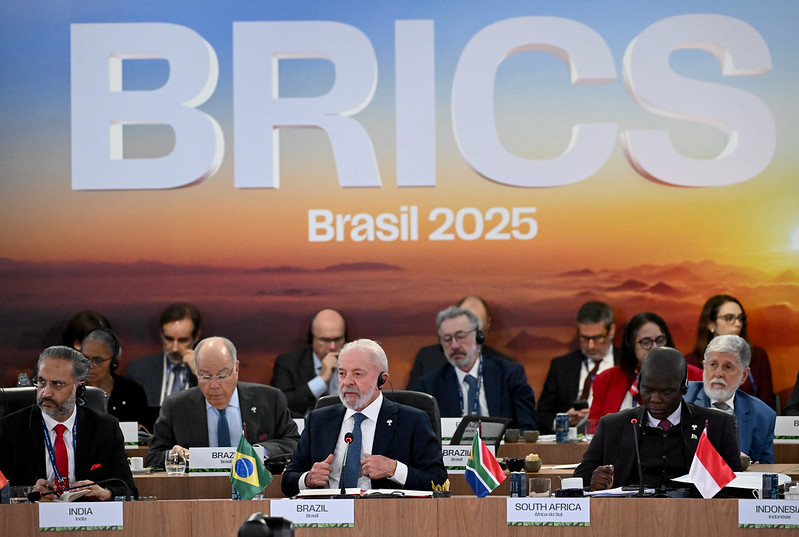
Photo Credit: Alexandre Brum / BRICS Brazil
I’ve been so focused on our climate-ecological crises and other pressing issues of our lives in the United States that it has been years since I’ve covered news of the BRICS group of countries. The 17th BRICS Summit 2025, held in Rio de Janeiro, Brazil, on July 6th to 7th, caught my attention. After all, the emerging and developing economies of the Global South* must be facing additional challenges with America’s disengagement from international cooperation on global issues as well as our government’s unilateral stance on trade tariffs worldwide. And much more.
Why should the BRICS group matter? It’s not a formal organization. There’s no constitutional treaty, budget, or a permanent secretariat. Rather, it serves only as a forum for economic and diplomatic coordination in diverse areas of mutual interest. The group also aims to offer an alternative to Western-dominated economic models. The presidency rotates annually with the incumbent responsible for organizing and sponsoring the group’s activities.
Our Dear Leader has no love for the BRICS plan to establish its own currency for intra-BRICS trade. “If they want to play games with the dollar, they’re going to be hit with a 100% tariff,” he told the press, ahead of his meeting with Indian Prime Minister Narendra Modi on February 13, 2025.
US international trade, once the hallmark of our economic greatness, is now weaponized. We the people of the world will all suffer the consequences.
Since the creation of the term BRICS—standing for the emerging economies of Brazil, Russia, India, China, and South Africa—the group expanded in 2023 with the admission of Egypt, Ethiopia, Iran, Saudi Arabia,** and the United Arab Emirates (UAE). After accepting the invitation to join the group, Indonesia became the eleventh member on January 6, 2025.
Seeking to expand its global influence, the group approved the creation of the “BRICS partner country” status during the 16th BRICS Summit in August 2024. Added to the group of ten or eleven members (depending on how one views the status of Saudi Arabia), there are now ten partner countries: Belarus, Bolivia, Cuba, Kazakhstan, Malaysia, Nigeria, Thailand, Uganda, Uzbekistan, and Vietnam. Partners can participate in BRICS summits and benefit from BRICS initiatives.
As a geographer, I love the visual impact of maps. Unfortunately, the best updated Map of the BRICS group, published by Geopolitical Economy (G/E) on December 25, 2024, is not available for download. You can view it here.
With its expanded membership and partnership, BRICS now has a larger voice on international forums. The data below was obtained from the BRICS Brazil website.
- BRICS represents 49.5 percent of the world’s population and 38.3 percent of global territory. Its members come from four continents: Africa, Asia, Europe, and South America.
- BRICS accounts for 43.6 percent of global oil production, 44 percent of the world’s oil reserves, 36 percent of global natural gas production, and 55 percent of the world’s natural gas reserves.
- BRICS holds approximately 72 percent of global reserves of rare earth minerals.
- According to the World Bank (2021), the ten BRICS countries control approximately 32 percent of the world’s agricultural land. With the addition of Indonesia, this share is expected to increase to around 33 percent.
- According to FAO data (2023), BRICS represented a significant portion of global food production: rice (61%), goat meat (61%), oranges (57%), pork (56%), soybeans (53%), potatoes (50%), wheat (47%), corn (43%), sheep meat (43%), poultry (41%), cow milk (34%), and beef (32%).
- BRICS accounted for approximately 40 percent of global GDP in 2023.
- BRICS accounted for 26 percent of global international trade in 2023.
- Intra-BRICS trade has grown significantly since the early 2000s from close to USD 17 billion to USD 334 billion by 2020.
The theme of the 17th BRICS Summit 2025 was “Strengthening Global South Cooperation for a More Inclusive and Sustainable Governance.” On Sunday, July 6, 2025, in their approved Leaders’ Declaration, the group also raised concerns about the global multilateral trading system in Article 13:
The multilateral trading system has long been at a crossroads. The proliferation of trade-restrictive actions, whether in the form of indiscriminate rising of tariffs and non-tariff measures, or protectionism under the guise of environmental objectives, threatens to further reduce global trade, disrupt global supply chains, and introduce uncertainty into international economic and trade activities, potentially exacerbating existing economic disparities and affecting prospects for global economic development. We voice serious concerns about the rise of unilateral tariff and non-tariff measures which distort trade and are inconsistent with WTO rules….
Among the 126 articles of the Leaders’ Declaration, the following articles address issues that conflict with US foreign policies and disengagement:
14. Condemnation of the imposition of unilateral economic and secondary sanctions that undermine international law and the principles and purposes of the UN Charter.
15. Underscore the role of the World Health Organization as the authority on international health and commitment to support efforts to strengthen the global health architecture.
19. Strongly condemn all violations of international humanitarian law, including deliberate attacks against civilians and civilian objects, including civilian infrastructure, as well as the denial or obstruction of humanitarian access and the targeting of humanitarian personnel.
21. Condemn the military strikes against Iran since June 13, 2025, as a violation of international law and the UN Charter.
24. Grave concern about the situation in the Occupied Palestinian Territory, with the resumption of continuous Israeli attacks against Gaza and obstruction of the entry of humanitarian aid into the territory. Condemn all violations of international humanitarian law, including the use of starvation as a method of warfare.
27. Reaffirm that a just and lasting solution to the Israeli-Palestinian conflict depends on the fulfillment of the legitimate rights of the Palestinian people, including the rights to self-determination and return.
38. Express concern about the growing risks of nuclear danger and conflict.
50. Finance ministers and central bank governors tasked with continued discussions on the BRICS Cross-Boder Payments Initiative. Welcome their report on preferences for facilitating fast, low-cost, more accessible, efficient, transparent, and safe cross-border payments among BRICS countries and other nations for supporting greater trade and investment flows.
64. Underscore the key role of the G20 as the premier global forum for international economic cooperation that provides a platform for dialogue of both developed and emerging economies on an equal and mutually beneficial footing for jointly seeking shared solutions to global challenges and fostering multipolar world.
81. Commitment to uphold multilateralism to address challenges threatening our shared planet and future, such as climate change. Call on all countries to uphold their existing commitment as Parties of the UNFCCC and its Paris Agreement and to maintain and scale up their effort to combat climate change.
83. Emphasize that accessible, timely and affordable climate finance for developing countries is critical for enabling just transitions pathways that combine climate action with sustainable development. [See the Leaders’ Framework Declaration on Climate Finance issued on July 7, 2025]
As reported by the Business Insider on July 7, 2025, our Dear Leader was quick to respond that Sunday night on Truth Social: “Any Country aligning themselves with the Anti-American policies of BRICS, will be charged an ADDITIONAL 10% Tariff. There will be no exceptions to this policy.”
On Friday, July 11, 2025, as reported in The Economic Times of India, the Global Trade Research Initiative (GTRI) criticized our Dear Leader’s call for an additional 10 percent tariff on BRICS countries trading in non-US Dollar currencies. The Indian think tank argued that US sanctions on countries like Russia, Iran, and Venezuela, denying them access to the global SWIFT banking network, forced these economies to seek alternative payment systems.
“This isn’t an anti-dollar strategy, it’s a survival mechanism triggered by US sanctions,” GTRI said.
In my view, US exorbitant, unilateral tariffs on all our trading partners will serve only to cement economic relationships between BRICS member and partner states and foster more intra-BRICS trade. On the other hand, long-standing bilateral and inter-regional tensions between some member countries stand in the way of challenging the Western-dominated economic order. These geopolitical conflicts include the China-India border dispute and the Egypt-Ethiopia dispute over the Nile River dam. Then, there is the Iran-UAE opposing stand towards Israel. Russia’s ongoing war with Ukraine further complicates the formation of a cohesive group. Such conflicts can undermine trust.
Time is running out on taking the actions necessary to slow down the worst consequences of our overheated planet. We the people of Earth are all in this together. It matters that the voices of our most vulnerable countries can find other ways of expression.
Footnotes:
*Global South refers to the group of developing countries primarily located in the Southern Hemisphere, including Africa, Latin America, Southeast Asia, and Southern Asia.
**Saudi Arabia has reportedly accepted membership, but has officially delayed joining without explanation.
 Three Worlds One Vision
Rosaliene, a terrific overview of BRICS, which I’m glad exists as a counterbalance of sorts to the throws-its-weight-around United States.
LikeLiked by 3 people
Thanks very much, Dave. We most surely need a counterbalance.
LikeLiked by 3 people
Thank you so much for this fascinating information Rosaliene, of which I was completely ignorant . The linked article also very interesting. Bless you.
LikeLiked by 1 person
You’re welcome, Dawn. I guess most people in the advanced Western economies pay little attention to the rest of the world, unless it impacts their lives. Bless you, too ❤
LikeLiked by 1 person
We don’t know what we don’t know until someone tells us. My son is flying to Brasilia next week.
LikeLiked by 1 person
Exactly, Dawn, or until Mother Nature puts us in our place.
I hope all goes well with your son’s trip. Brazil is now in our Dear Leader’s black book for their judicial action against former President Jair Bolsonaro. He has announced a 50% tariff hike on Brazilian imports, effective August 1, 2025. Here’s a New York Times report on how it will affect US coffee prices.
LikeLiked by 1 person
A good overview of the BRICS group, which we have all been told is a bad thing. You have shown that they do have a lot of thoughtful items on their agenda, as opposed to brute force tariffs and bully tactics. What is transpiring now is going to increase the number of BRICS members, making America more and more irrelevant. The strength being shown now makes no sense, but it does make enemies. I can speak to that as one of the targeted countries. Not sure when sanity will return to this poor world. Have a good evening Rosaliene. Allan
LikeLiked by 3 people
Thanks very much, Allan. An almighty-indispensable stance could well lead to irrelevance as former allies forge new alliances.
LikeLiked by 1 person
I now know far more about BRICS than before. In fact, about 98% more. Thanks for this informative article.
LikeLiked by 2 people
You’re welcome, Neil. Sanctions don’t work out as well as the US intends when there are ways around the embargo.
LikeLiked by 1 person
This is very interesting, Rosaliene. Thank you for bringing BRICS to my attention. World organizations are vital today. Hopefully, such groups work for global good.
LikeLiked by 3 people
Glad you found my post interesting, Mary. It’s definitely not light reading. It’s my hope, too, that BRICS is working for the good of the people they represent.
LikeLiked by 1 person
I can see why your Destructive Leader doesn’t like them
LikeLiked by 2 people
He knows not what he’s doing, Derrick 😦
LikeLiked by 3 people
This is a helpful overview of BRICS, really informative. Thanks for sharing!
LikeLiked by 1 person
Thanks very much, Ada. You’re welcome.
LikeLiked by 1 person
Thank you for educating us on BRICS, Rosaliene. I’m rooting big-time for the Global South!
LikeLiked by 1 person
You’re welcome, Tracy. They’re seeking meaningful action against all the crazy that’s going on.
LikeLiked by 1 person
Hi again, just wanted to share an interesting article about BRICS: https://therealnews.com/why-is-donald-trump-afraid-of-the-brics?utm_medium=email&utm_campaign=e1f905813e-EMAIL_CAMPAIGN_2025_07_16_08_15_BRICS&utm_source=The+Real+News+Network&utm_term=0_-e1f905813e-542702225
It ends with this: Trump wants to be the center of attention. That’s how he derails and wins debates, with ever-more shocking statements, actions, decrees, and threats. In Trump’s world, the United States—backed by the US dollar and the US military—should be first, with the rest of the countries of the world revolving around it. That is exactly what the BRICS countries want to change. And the more Trump pushes, the more they are going to look the other way.
“At the moment the United States declares ‘America First,’ the BRICS are saying ‘we all come first,’” international relations analyst Pedro Costa Junior told me at the summit. “The Global South comes first. The community comes first. Not for one. But for everyone.”
LikeLiked by 1 person
Tracy, thanks for sharing the link to the TRNN article published on July 16th. I was also struck by the closing comments, as you’ve quoted. Also of interest, is the reason why BRICS represents a threat to the USA (cited below):
“The BRICS represents a proposal against hegemony,” BRICS Policy Center Director Marta Fernandez told me at a cafe in Rio de Janeiro. “They are demanding multipolarity—financial, cultural, and political multipolarity. And the United States is fighting to maintain a hegemony that is in crisis. It’s US hegemony that is in crisis. And in that sense, the BRICS represents a threat to the US.”
LikeLiked by 1 person
Yes! I intended to quote that bit in addition to other quotes and then reined myself back in as I have a tendency to pull ALL the quotes from articles. HA Thank you for highlighting it here, Rosaliene!
LikeLiked by 1 person
Given the history of our Western Empire, it’s totally understandable why these countries are forming an alliance. The articles you’ve listed sound like what the world needs. We have a lot to learn here in the good ole USA.
LikeLiked by 2 people
Mara, when we’re on top of the world, we think we know it all and need no one.
LikeLiked by 2 people
I really hope we don’t find out the hard way how untrue that is.
LikeLiked by 2 people
I mean you’re exactly right, we as in our so called leaders think we know it all and need no one. Having a brain fart today. 🙂
LikeLiked by 1 person
My apologies, Mara, sometimes I’m too vague when I use the pronoun “we.”
LikeLiked by 1 person
No apology necessary, Rosaliene.
LikeLiked by 1 person
Thanks for sharing this global important organization, BRICS with us to further our understanding of the part they play. There is a lot here to digest. I’ll be referring back to this and appreciate the time it took you to share it with us. 🙏🏼💗
LikeLiked by 1 person
You’re welcome, Cindy. There is, indeed, a lot to digest. We in the USA share this planet with the inhabitants of other countries. Our consumption habits, energy use, and our foreign policies have an impact on their lives.
LikeLiked by 1 person
There certainly is and that is most true! We need to do better and we can but it’s not easy so we need louder voices 🩷!!
LikeLiked by 2 people
I found this post really interesting and informative, dear Rosaliene, as well as the discussions in the comments.
LikeLiked by 2 people
Thanks very much, Luisa. If interested, you can learn about the EU relationship with BRICS in a Briefing prepared for the European Parliament in 2024 (12 pages) at the link below:
Click to access EPRS_BRI(2024)760368_EN.pdf
LikeLiked by 1 person
Thank you so much for your kind reply and for the link you kindly sent me.
I found the reading really interesting.
LikeLiked by 1 person
You’re welcome, Luisa.
LikeLike
It’s good to know that other countries are continuing to work together in constructive ways.
LikeLiked by 2 people
I agree, JoAnna. Where would our world be if our leaders didn’t cooperate with each other?
LikeLiked by 1 person
Thank you, Rosaliene, for your wonderful and important contribution! I’ve been devoted to the BRICS topic for a long time, of course, and I’m always surprised by how little people in the West generally know about it. Many global decisions made by the US administration can only be understood if one has some familiarity with this topic, especially China’s role in it.
LikeLiked by 4 people
So glad that you appreciate my contribution, Friedrich. There’s so much more to BRICS and China’s role that I’m wasn’t able to cover in a blog post. Americans in general tend to be very insular when it comes to world affairs, unless it’s another war that we’re engaged in.
LikeLiked by 1 person
Thank you, Rosaliene! Yes, American egocentrism is unfortunately a big problem. For parts of the world, but of course for the population itself. With the additional cuts in education spending, it may get even worse. But perhaps this orange nightmare will soon be over, and the great rethinking will begin.
LikeLiked by 1 person
A very bleak situation, for sure, Friedrich. The gods were wise in numbering our days.
LikeLiked by 1 person
A voice in international forums…a forum for economic and diplomatic coordination in diverse areas of mutual interest.
Rosaliene, thank you so much for continuing to share such current events like the mission of BRICS that matter to the world. 🤗🙏🏼💖
LikeLiked by 2 people
You’re welcome, Kym. We in the USA too often forget that we are not alone on this planet. Other global voices matter.
LikeLiked by 3 people
AMEN girl. You got that one right on point! 🌎
LikeLiked by 2 people
Thanks for getting us up to date with BRICS, sounds like such an important forum for economic and diplomatic coordination. I am glad that the leaders of these countries band together to discuss important issues. Representing half of the world’s population is a job they are taking seriously.
LikeLiked by 3 people
You’re welcome, Rebecca. The challenges that leaders face in the Global South only intensify with our ongoing climate-ecological crises.
LikeLiked by 2 people
I admire their coalition building and responsible planning.
LikeLiked by 1 person
Spot on, Rosaliene. Your analysis is similar to a number of critics of US policy. As you underline, in a moment of the need for trust and working together, a sledgehammer has cracked the previous world order under US leadership.
LikeLiked by 3 people
And what a sledgehammer it is, Dr. Stein!
LikeLike