
Tags
Inner and Outer Transformation, Social Change, Spiritual Wisdom and Social Action, The Engaged Spiritual Life: A Buddhist Approach to Transforming Ourselves and the World by Donald Rothberg (USA 2006)
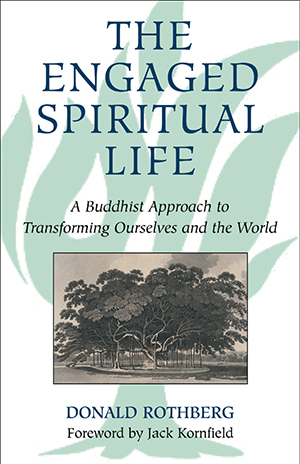
Photo Credit: Beacon Press (USA, 2006)
For Taigen Dan Leighton, a Zen teacher, scholar of Mahayana Buddhism, and activist, mindful awareness is the meeting point of inner and outer transformation.
Awareness is transformative. It happens on the level of working out the conflicts in our own hearts and minds, as well as in the culture. In meditation, we become aware of our own inner processes and the primal separation of self and other. We come to see the interdependence of self and other, how our identity is dependent on so many things, including what’s going on in society. Once we have some sense of any particular problem in society, then we can also look at it in terms of our own involvement. No one is pure and not part of the problem; we are in a web of connections. Even though I worked to oppose the invasion of Iraq, I am still connected to the murder of Iraqi civilians.
Excerpt from The Engaged Spiritual Life: A Buddhist Approach to Transforming Ourselves and the World by Donald Rothberg, Beacon Press, USA, 2006 (p. 52).
Dr. Donald Rothberg is a leading teacher and writer on meditation, the intersection of psychology and spirituality and socially engaged Buddhism in the United States. He has practiced Buddhist meditation for over 25 years and has been significantly influenced by other spiritual traditions, particularly Jewish, Christian, and indigenous. His teaching and training have helped to pioneer new ways of connecting inner and outer transformation. He is on the Teachers’ Council of Spirit Rock in Northern California and has been an organizer, teacher, and board member of the Buddhist Peace Fellowship. Dr. Rothberg has also served as director of the interfaith Socially Engaged Spirituality program at the Saybrook Graduate School in San Francisco. His book, The Engaged Spiritual Life: A Buddhist Approach to Transforming Ourselves and the World, was named one of the best spiritual books of 2006 by Spirituality and Practice. Dr. Rothberg lives and teaches in Berkeley, California.
 Three Worlds One Vision
Definitely adding this to my tbr list. Thank you, Rosaliene. ✨
LikeLiked by 2 people
My pleasure, Michele. It’s an enlightening read with practical exercises for our daily lives, such as exercises for cultivating wise speech in groups, organizations, and the larger society.
LikeLiked by 1 person
👍🏻
LikeLiked by 1 person
Nice post
LikeLiked by 1 person
Thanks very much, Satyam.
LikeLike
Interesting
LikeLiked by 1 person
Thanks very much, Derrick.
LikeLiked by 1 person
Thank you, Rosaliene, for this encouraging article, which I completely agree with! This probably comes as no surprise 🙂 For me, the opposite of people with mindful awareness are the living dead. There’s a certain range in between, and we have to be careful not to touch the other end.
LikeLiked by 3 people
My pleasure, Friedrich. I found his penultimate chapter on “Committed Action, Non-Attachment to Outcome” (pp. 186-204) of special interest as he draws upon the Taoist writings of “non-action” (wu wei).
LikeLiked by 2 people
Excellent. I have been enjoying the Plum Village app of Buddhist meditations
LikeLiked by 1 person
That’s great, Denzil.
LikeLike
Thanks for sharing this insightful article! Buddhist approaches and reflections have always intrigued me.
LikeLiked by 1 person
My pleasure, Ada. I incorporate their teachings and practices in my spiritual life.
LikeLiked by 1 person
Thank you Rosaliene for this post. I have arrived late to the Buddhists approach to life; learning now feels like it’s almost too late; I wish I’d begun earlier in my life. 🤗😊🙏
LikeLiked by 2 people
My pleasure, Ashley. It’s never too late to learn new ways of being and doing 🙂
LikeLiked by 2 people
There is something to be said for the Buddhist approach to light. I may give this one a look Rosaliene. Happy Sunday. Allan
LikeLiked by 2 people
Allan, one doesn’t have to become a Buddhist to learn new ways of dealing with the numerous crises we now face today.
LikeLiked by 1 person
Moral questions have become more complicated with our routine contact with those from other worlds, not to mention how intertwined our lives are with those involved with commerce. Our responsibility to self vs. others is a worthy idea to be found in both old and new testaments, but is not easily followed when we think of purchasing modestly price goods created by young people in sweat shops in countries far away.
LikeLiked by 2 people
Dr. Stein, I share your view of the complications of moral questions in our intertwined lives worldwide. It goes far beyond commerce to involve the disruptions of our planetary systems.
LikeLiked by 1 person
What a wonderful post, Rosaliene. I aspire to the Buddhist way and find great joy in the principles! Thanks for sharing this! ❤️
LikeLiked by 2 people
Thanks very much, Cindy. I’m so glad that Buddhist principles have been helpful in your life, as in mine ❤
LikeLiked by 1 person
You’re so welcome, Rosaliene! They truly have! 🩷
LikeLiked by 1 person
He’s a wise individual.
LikeLiked by 1 person
He is, indeed, Neil.
LikeLiked by 1 person
We are all connected and yet refuse to accept this. It’s painful to witness.
I really appreciated this portion: No one is pure and not part of the problem; we are in a web of connections. Even though I worked to oppose the invasion of Iraq, I am still connected to the murder of Iraqi civilians.
LikeLiked by 2 people
Tracy, it’s easier to see ourselves as separate individuals with responsibility only for ourselves and our loved ones. In his chapter on “Opening to Suffering, Opening to Compassion” (pp. 73-91), Rothberg raises the question: How can we be in touch with suffering and work to transform it, but not react in ways that lead to further suffering?” We’ve not been doing too well on that front.
LikeLike
Thanks for this great suggestion to deepen spiritual practice that is socially minded. Looks like an excellent book.
LikeLiked by 2 people
My pleasure, Rebecca. I’ve found the teachings and exercises of great help in my own engaged spiritual journey.
LikeLiked by 1 person
That is great to hear. I hope to look for the book soon.
LikeLiked by 1 person
Looks like an interesting book. I just started exploring some of Buddhism’s ideologies this year because I was seeing a lot about self awareness and thought that kind of sounded like being selfish or something. But it seems like it’s actually kind of the opposite. It’s good to be aware that we are as he says, in a web of connections. No one is pure, that’s for sure.
LikeLiked by 2 people
Mara, I can appreciate why you would consider self awareness as being selfish. Far from it. In the Introduction, Rothberg explains mindfulness practice that lies at the heart of Buddhist meditation (p. 6):
The practice involves cultivating the ability to be directly aware, moment by moment, of what is occurring in one’s experience–including both the inner experiences of bodily sensations, thoughts, and emotions, and the outer experiences of being with our world, with objects, or with other human beings. When such mindfulness is sustained over time, wisdom, the clear seeing into basic inner and outer patterns of experience, arises, guiding us in our choices.
LikeLiked by 1 person
Sounds very interesting. I’ll look for his book in our library. Anything that makes me calmer in these times is probably a good thing for everyone. 🙂
LikeLiked by 1 person
🙂 ❤
LikeLike
Thank you for bringing this fascinating book to our attention, Rosaliene. You find some great gems!
LikeLiked by 1 person
My pleasure, Mary. The book was recommended by a leader in the “Deep Adaptation” movement in response to our climate existential crisis.
LikeLiked by 1 person
A timely post, Rosaliene.
If nothing else comes out of this year, it may lead to many of us engaging spiritually – looking towards meditation, positive thoughts, a calm mindset, and letting go of outcomes.
(And not the kind of spirituality that spends it’s time pointing fingers at others).
Hope you are well!
J
LikeLiked by 1 person
Exactly, James! I’m well, thank you. I’m keeping my distance from the invasive and intimidating elements raiding our neighborhoods.
LikeLiked by 1 person
Wonderful! I’ve been really appreciating the Plum Village app for its Buddhist meditation practices.
LikeLiked by 1 person
Thanks very much, Mr. Ravindre. I’m so glad that you also appreciate the Buddhist meditation practices.
LikeLike
I’m learning that non-attachment is also a focus in A Course in Miracles. Thanks for sharing this, Rosaliene.☀️
LikeLiked by 1 person
My pleasure, Lisa. The challenge of acting without attachment to outcome is my greatest takeaway from his book. History shows us that real social change can take centuries. I guess it’s like planting and nurturing a tree that will mature long after we’re gone. We have to trust that what we’re doing today, despite the opposition and setbacks, will bring about the transformation we need in the years ahead.
LikeLiked by 2 people
Thank you for this perspective. It’s right on time for me, personally, and perhaps for all of us. I appreciate that the author who practiced Buddhist meditation for over 25 years, “has been significantly influenced by other spiritual traditions, particularly Jewish, Christian, and indigenous.” The more I learn, the more I realize, I still have much to learn and to not just look in one place, but to broaden my scope.
LikeLiked by 1 person
Thanks for sharing, JoAnna. I don’t believe that any one religious group has all the answers. The Divine remains a mystery.
LikeLiked by 1 person
I agree.
LikeLiked by 1 person
This is an awesome intro to Dr. Rothberg’s transformation of awareness Rosaliene. We need continued spiritual engagement for sure sis. 🤗🙏🏼😊
LikeLiked by 1 person
With all the crazy going on, Kym, I see no other way but continued spiritual engagement ❤
LikeLiked by 1 person
There you go Rosaliene. That is the one thing we can hold on to in the midst of this madness! Stay encouraged sistah! 😊💖😘
LikeLiked by 1 person
Insightful post 💓
LikeLiked by 2 people
Thanks very much.
LikeLike
Awareness requires great courage and humility.
LikeLiked by 3 people
It does, indeed, Dawn.
LikeLiked by 1 person