
Tags
Climate Change, Global warming, Joplin/Missouri/USA, Resilience after Severe Weather Disasters, Tornadoes in the USA, USA Tornado Alley
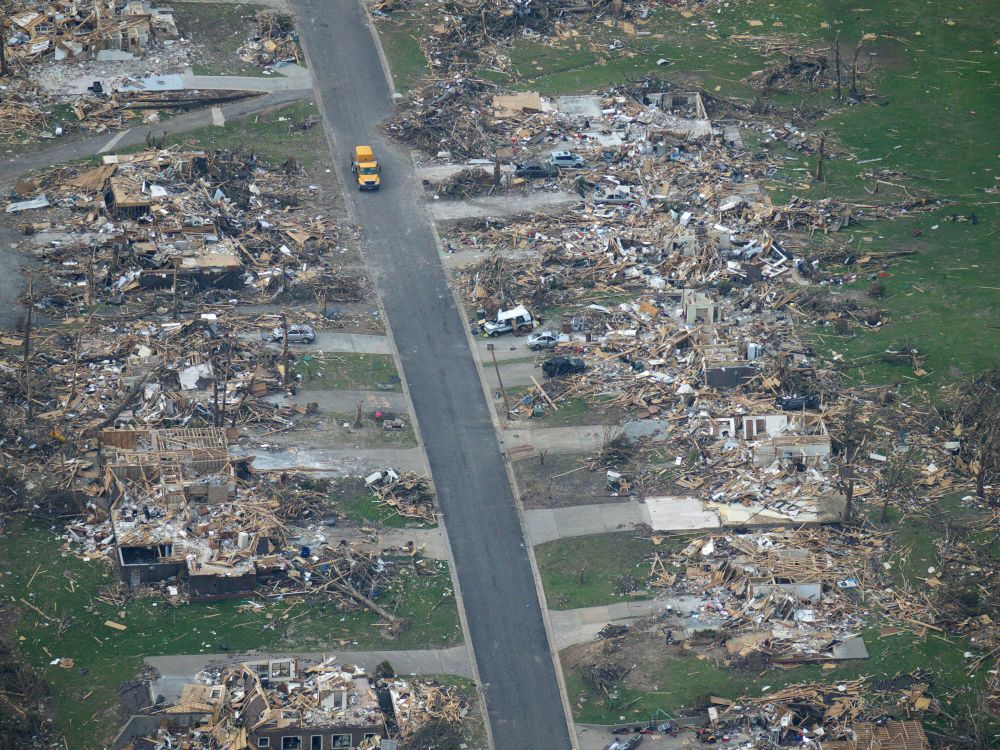
Photo Credit: Bob Webster, Pryor/USA
As a resident of Southern California, I’ve yet to come face-to-face with one of those terrifying tornadoes I’ve seen in movies. Tornadoes don’t occur often in our state. Whenever they do occur, they are weak, ranked EF-0 in the Enhanced Fujita Scale, causing little damage. The reality of being pummeled by a violent tornado is a devastating, life-changing, traumatic experience. Such was the case for people living in Joplin, Missouri, on May 22, 2011, featured in the Netflix Documentary The Twister: Caught in the Storm, released on March 19, 2025.
The tornado that struck Joplin in 2011 was rated EF-5 on the Enhanced Fujita Scale, with maximum winds over 200 mph (320 kph). Ranked seventh among the top ten deadliest tornadoes in United States history, it is the deadliest so far in the 21st century.
With a population of more than 50,000 and a population density near 1,500 people per square mile, Joplin suffered extensive damage amounting to US$2.8 billion. According to the account recorded in President Obama White House Archives, the tornado first touched down in the southern part of the city at 5:41 p.m. local time. During the following 32 minutes, it headed eastward across the city, demolishing everything in its path for 13 miles (21 kilometers) and extending as much as a mile (1.6 kilometers) wide at its widest extent.
The forces of Mother Nature showed no mercy for all those in her path. Our gender, religion, political affiliation, and color of our skin offered no protection. Our techno-creations were mere toys in the face of her might. Heavy buses and tractor trailers were among the more than 15,000 vehicles picked up and tossed by her unstoppable winds. She rolled vehicles into balls of bent metal and broken glass, a reminder of our futile pursuit of limitless power.
The EF-5 tornado destroyed an estimated 6,954 homes and severely damaged 359 homes. Directly hitting Joplin’s Regional Medical Center, it ripped the top two floors from the structure and blew out every window in the building. With just minutes to get to safety, six of the hospital’s 183 patients lost their lives.
Unaware of the ferocious tornado headed their way, teachers, parents, and senior graduates of Joplin High School had gathered off campus at Missouri Southern State University for their graduation ceremony. When the tornado hit the High School, just minutes after the ceremony ended, most of the lucky participants were already on their way home. Miracles do happen.
Joplin’s High School principal rushed the 150 or so stragglers into the basement. Seven students (including one of the graduates) and a staff member died that day. In total, the tornado took the lives of 161 people and injured nearly 1,000.
Commercial buildings, the socio-economic lifeblood of a community, were not spared. The tornado also destroyed or damaged banks, churches, electric power company, elementary schools, two fire stations, gas stations/convenient stores, grocery stores, Home Depot, nursing home, transmission towers, Walmart, and more. Thousands of people were not only displaced, but also lost their jobs.
How does one recover from such devastation and loss?
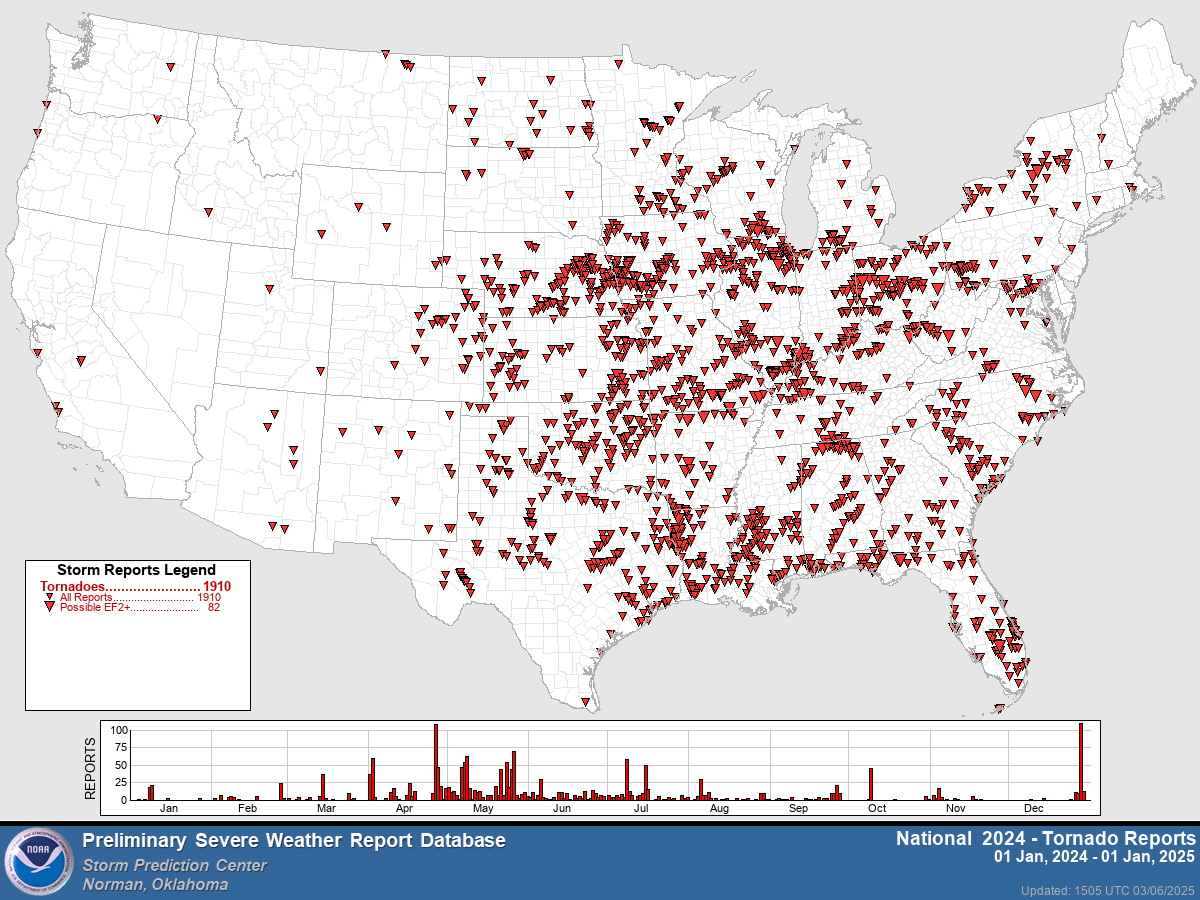
Source Credit: Storm Prediction Center, NOAA, National Weather Service
About 1,200 tornadoes hit the United States every year. While they can strike any one of the fifty contiguous states, at any time of the year, the highest incidence occurs in the central Great Plains region, referred to as “Tornado Alley.” It’s not a fixed location, but rather shifts from the Southeast in the cooler months, toward the southern and central plains in May and June, and the northern plains and Midwest during early summer.
During 2024, according to data from NOAA’s Storm Prediction Center (SPC), there were 1,473 confirmed tornado reports to-date. When the numbers are finalized, 2024 will most likely have the second-most confirmed tornadoes on record after 2004 with 1,817 tornadoes. This number exceeds the U.S. annual average of 1,225 tornadoes for the period 1991-2010. With more than 100 reported tornadoes per month, the months of April, May, June, July, and December were the most prolific last year.
The number of tornadoes continue to increase this year. During the period January to April 2025, we’ve already recorded 711 preliminary tornado occurrences. This number more than doubles the 1991-2010 average of 337.9 tornadoes for this period. If confirmed, this would be the second-highest tornado count on record for this period, behind 912 tornadoes in 2011.
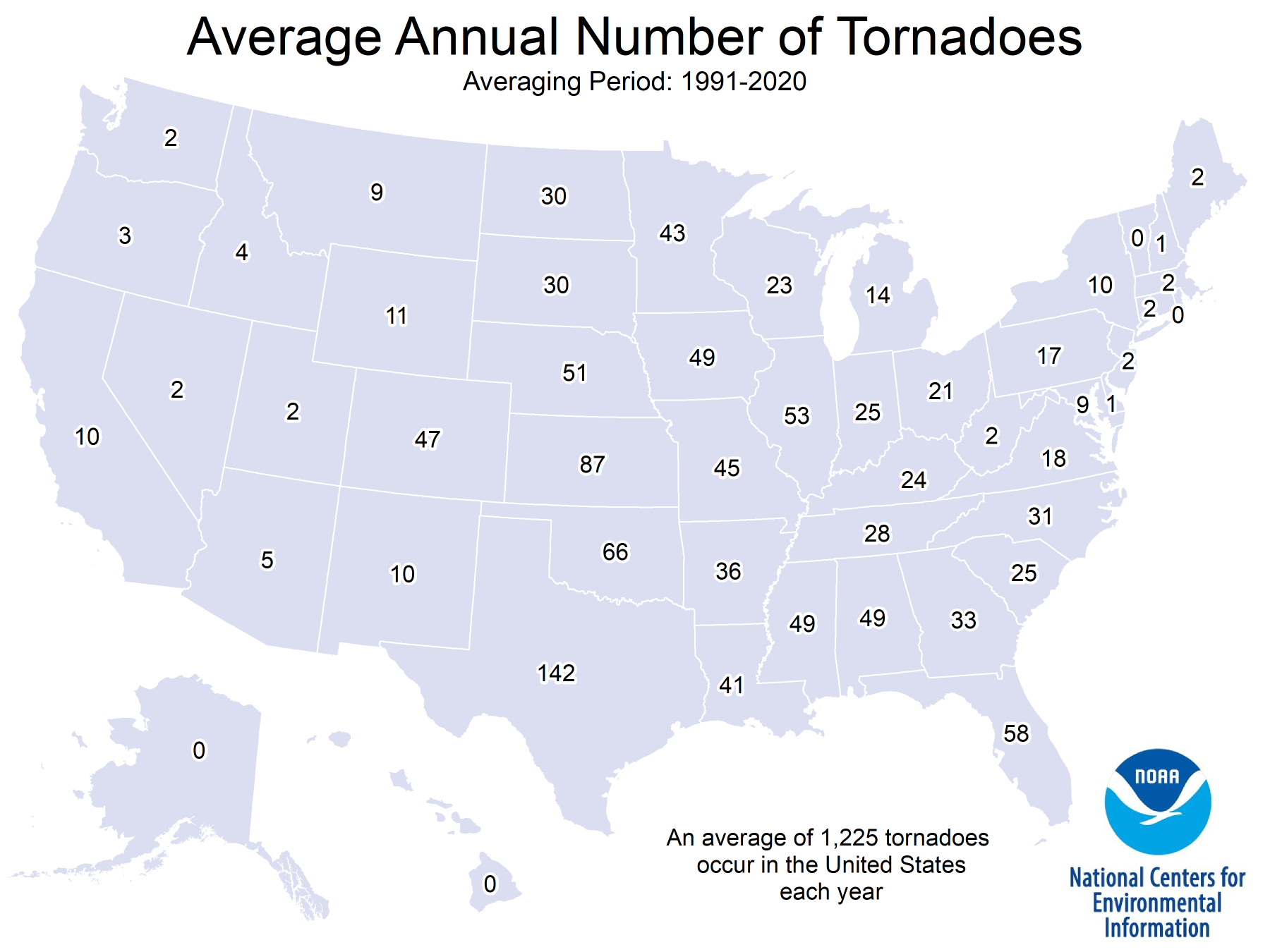
Source Credit: NOAA National Centers for Environmental Information
Is the warming of our planet influencing the number and intensity of tornadoes? Our climatologists don’t know. It’s complicated. Since U.S. tornado records date back only to the 1950s and vary significantly from year to year, it’s difficult for them to identify long-term trends. Until the early mid-1990s when an extensive Doppler radar network increased tornado detection, records of sightings relied upon eyewitness reports. Under such conditions, events in unpopulated or remote areas would go unrecorded.
The nature of the tornado itself presents yet another challenge. When compared to hurricanes, they are relatively small and short-lived, lasting from a few seconds to a few hours. This makes it very difficult for scientists to develop climate change simulation models.
To complicate matters more, while our scientists know the weather “ingredients” necessary for the development of supercell thunderstorms that produce tornadoes, they don’t fully understand how tornadoes are formed. Mother Nature, it seems, is not ready to reveal all her secrets.
What do we know? Tornadoes seem to be occurring in greater “clusters,” with 30 or more tornadoes in one day. For example, during April 25-28, 2024, severe weather produced 183 tornadoes: an average of 45.7 tornadoes per day. These included eight EF-3s and one EF-4 tornadoes. The neighboring states most affected were Nebraska, Iowa, Kansas, Oklahoma, and Missouri.
Evidence also suggests that Tornado Alley has shifted eastward. States notorious for tornadoes such as Texas, Oklahoma, and Kansas are seeing a decrease in tornadoes while states like Tennessee, Georgia, Arkansas, Minnesota, Illinois, and Iowa are seeing an increase. States with higher population densities mean a potential increase in more devastation and more collective trauma.
Recovery after a severe weather disaster can take several years. In the days after the tornado struck Joplin, Missouri, on May 22, 2011, help poured in from volunteers, neighboring cities and states, and federal disaster teams from across the country. Over the years since then, federal disaster relief funds have played a vital role in their dramatic recovery. You can learn about “Thirteen Years of Joplin’s Journey: A Testament to Resilience and Community Spirit” on their Facebook Page Joplin Proud.
When compared to hurricanes, most tornadoes may seem like inconsequential minor storms. Don’t be fooled. Their number and frequency can leave us in a constant state of alert, wearing us thin. Then comes the Big One, the fatal blow that knocks us down. To get back up on our feet again, as individuals and as a community, we must hold each other close. Together, we get to work and rise again.
In case you missed the news on June 5, 2025, while the world’s two most powerful men had an explosive breakup, NOAA and Scripps Institute of Oceanography at the University of California, San Diego, announced that atmospheric carbon dioxide concentrations have peaked above 430 parts per million in 2025—the highest it has been in perhaps 30 million years.


Highly informative Rosaliene. To a European, tornadoes are a mystery, a dangerous one at that.
LikeLiked by 1 person
Thanks very much, Denzil. You are truly blessed in Belgium. There are tornadoes in Europe but mostly in Germany, France, Italy, Poland, the Czech Republic, and the UK. They are usually less intense, rated EF-0 to EF-2.
Here’s an article published by the BBC on August 21, 2024 on “Tornadoes and waterspouts: Europe’s underestimated extreme weather threat?” that you may find of interest.
https://www.bbc.com/future/article/20240821-sicily-superyacht-disaster-how-do-waterspouts-form
LikeLike
Seriously worrying for America. We do get them on these islands but they are usually small. Still they do cause damage. They are more common in southern England. 🙏
LikeLiked by 1 person
It is, indeed, of concern in America, Ashley. According to the NCEI/NOAA report, the United Kingdom has more tornadoes, relative to its land area, than any other country. Fortunately, most of them are relatively weak (UF-0 to UF-2).
LikeLike
Destruction comes in many forms.
LikeLiked by 1 person
It sure does, Dr. Stein.
LikeLiked by 1 person
A very informative, sobering post, Rosaliene.
LikeLiked by 1 person
Thanks very much, Dave. Very sobering, indeed.
LikeLiked by 1 person
Excellent and very informative information. I’m in Florida so our big concern here is always hurricanes. And the western US is lack of water. Seems like no place is safe except perhaps the very far northern states, where for many, it’s just too damn cold to live.
LikeLiked by 1 person
Thanks very much, Mary. According to the NCEI/NOAA report, Florida is not safe from tornadoes. The state’s average annual number of tornadoes for the period 1991-2020 was 58. Added to the hurricanes, that’s a lot of punishment for those hit.
LikeLiked by 1 person
I always watched these news stories with a sense of detachment, until Edmonton had an EF4 tornado in 1987. It cut a swath of destruction 30.8 km (19.1 mi) in length and up to 1.3 km (0.81 mi) wide in some places across our major city and killed 27 people. Until then, I never thought they were even in our area. They are and they are on the increase. Do humans cause or enhance their effects. Who knows, but we need better prediction and forecasting to help save lives and better construction plans to mitigate the damages. Now is not the time to reduce or eliminate staff in NOAA or the U.S. Weather Service. Idiots playing I’m better than you are help nobody in this or many other cases. Have a good Sunday Rosaliene. Allan
LikeLiked by 1 person
Allan, thanks for sharing your own experience of awakening to the dangers of powerful tornadoes. Until I recently watched the Netflix documentary on the Joplin 2011 EF-5 tornado, I also followed these news stories with a sense of detachment. I agree that it’s not the time to reduce the staff and budget for the USA Weather Service. One gets the idea that the powers-that-be want more of us to suffer and die.
During my research, I found an article on “Tornadoes and Climate Change in Canada” published on November 13, 2024, that you may find of interest.
https://climatedata.ca/tornadoes-and-climate-change-in-canada/
LikeLiked by 1 person
A few years ago, a tornado passed through the Philadelphia suburbs. It caused a whole lot of damage. Friends of mine felt its wrath. It toppled trees onto the roof of their house, damaging it heavily. Fortunately, my friends weren’t injured.
LikeLiked by 1 person
Neil, thanks for sharing your own experience. According to the NCEI/NOAA report your state of Pennsylvania has an average annual number of 17 tornadoes for the period 1991-2020. So don’t rule out being hit again sometime in the future.
LikeLiked by 1 person
We are seeing more tornadoes and ones causing more destruction in the last few years. I’m surprised to see so many in Florida and Texas. We have had a few in my town but fortunately areas tended to be open without homes.
LikeLiked by 1 person
Mary, thanks for confirming the increase in number and intensity of tornadoes in your region. It’s always a blessing when they hit open areas without homes.
LikeLiked by 1 person
Ironically, there was a microburst on Sunday two miles from me near my son’s home. Trees came down, houses and cars had trees and branches on them, and streets flooded because of hail and debris blocking gutters.
LikeLiked by 1 person
Thanks for sharing the news, Mary. I’m so glad that your son’s home escaped the microburst. Depending upon where we live, we never know when we’ll be hit by an extreme weather event.
LikeLiked by 1 person
Tornadoes seem to be much more frequent and bigger these days and I’m sure that’s no coincidence. They also seem to be happening in places where they never happened before. Like the DC area for example. Due to their unpredictability, they are especially dangerous for those that don’t have basements or underground shelters. Your last paragraph is pretty ominous. It’s a sure signal we need to put our heads together and be ready for the storm.
LikeLiked by 1 person
Oh, and I have to add one thing. Just saw on the weather we have a tornado watch. Go figure.
LikeLiked by 1 person
Yes, I saw the news. Sad to say, your area is not the only one.
LikeLiked by 1 person
Mara, thanks for sharing observations in your area. Having an underground shelter is definitely a key to survival against tornadoes.
LikeLiked by 1 person
I live in St. Louis, and 3 weeks ago a tornado touched down and decimated parts of Forest Park and neighborhoods north that were already poor and struggling due to the old red-lining practices where people of color’s beautiful homes were purposely devalued, and where home improvement loans were never approved. So many, many homes, many square miles, deteriorated, so when the tornado blasted through, those old brick homes didn’t stand a chance. This was devastating for so many, many people.
If any of your readers wish to donate money to help with the rebuilding efforts here’s a link to the St. Louis Community Foundation: https://stlgives.org/resources/
LikeLiked by 2 people
Tamara, thanks for bringing attention to the recent tornado devastated area in St. Louis. Five thousand homes affected means a lot of displacement. As in far too many other extreme weather disaster events, poor neighborhoods suffer the most. Stay safe.
LikeLiked by 1 person
Thank you Rosaliene, yes, there are many displaced people, left homeless. Some are staying on their properties in tents, hoping that their homes will be repaired and they can move back inside. Many homes have now been condemned, deemed too damaged to repair. Other people were renting, and have no other options than to try to find a new place to live. This has been devastating to a community that was already struggling.
LikeLiked by 1 person
Tamara, what’s so distressing is that this community is just one of hundreds of communities nationwide who are struggling to recover from a severe weather disaster. An elderly couple who lost their home in the Palisades Fire in January have found a temporary home among us. They have no idea if and when they will be able to rebuild.
By the way, have you read the latest news about FEMA’s disaster response going forward?
https://www.yahoo.com/news/trump-says-plans-phase-fema-040445785.html
LikeLike
I’m glad the person was able to relocate to your community, but very sad for their losses. Yes, I’ve been hearing of the plans to dismantle FEMA, and have aid come directly out of the President’s office. Much has already been said by people wary that this will become very partisan.
LikeLiked by 1 person
Exactly, Tamara. California has not yet received FEMA disaster funds requested after the Palisades and Eaton Fires in January.
LikeLike
Unfortunately, very true.
LikeLiked by 1 person
We owe you great thanks for compiling this information, Rosaliene. I grew up in the midwest and remember that eerie feeling when everything would go still and the air would seem yellow-green. We knew to head down to the basement and get under the workbench. I’m grateful to have never experienced a tornado that touched down near me.
LikeLiked by 2 people
Thanks very much, Tracy. Your family was blessed in not suffering a direct hit from a tornado. That must be the dreadful thing about tornadoes: never knowing when it’s your turn to suffer a direct hit.
LikeLiked by 1 person
You have that exactly right…the not-knowing makes tornados particularly scary.
LikeLiked by 1 person
Rosaliene, thank you for your courageous and steadfast commitment to share the truth. I was particularly taken by your line, “Our gender, religion, political affiliation, and color of our skin offered no protection.” When will the cowardly, science denying power-centre realize this? It’s shocking and frightening.
And by what, coincidence? – I think not – there was a weather warning today that conditions were favourable for the formation of funnel clouds in my area. We NEVER get those. The last time one of those hit near our city I was a much, much younger man.
Thank you, and take good care of yourself.
LikeLiked by 2 people
You’re welcome, Steve. I’m just doing my small part in our post-truth world. It’s definitely not good news if you’re getting warning about conditions favorable for funnel clouds in an area where these never occur in recent history. In some way that our climatologists don’t yet understand, global warming IS increasing the number and intensity of tornadoes.
I recommend you check out the link I’ve added to my comment to Allan, who also lives in Canada.
LikeLike
What great research, analysis, and summary, Rosaliene! I wish your articles would appear in more popular media. All the best!
LikeLiked by 2 people
Thanks very much, Friedrich!
LikeLiked by 1 person
I watched the documentary about Joplin. We don’t have to worry about tornadoes fortunately, but it must be so scary and shocking to live where they are active.
LikeLiked by 1 person
Andrea, I’m glad to hear that you’ve also watched the documentary. What a blessing not to have to worry about tornadoes. Given global warming, we can never be sure how the geographical range of these storms will be affected.
LikeLiked by 1 person
Whoa, happy to report I’ve never come face-to-face with a tornado! Sadly, these instances are only increasing due to climate change and it’s not going to be a quick reversal. :0(
LikeLiked by 1 person
Pam, we’re both fortunate in not coming face-to-face with a tornado. We humans are playing with the forces of Mother Nature.
LikeLiked by 1 person
It’s crazy, isn’t it. Scientists tell you that x,y, and z will happen and we just watch it barrel toward us as if we can change the channel at will. We’ve become a nation of sloths. 🦥 I can’t imagine going through some of the trials and tribulations all my immigrant grandparents worked their way through. We’re just too soft and don’t even try to tackle the tough stuff. If we could all be more like Greta Thunberg. 🤷♀️😘
LikeLiked by 1 person
Pam, Greta Thunberg puts us adults to shame with the courage of her conviction to do what is morally right.
LikeLiked by 1 person
Yes, Greta is a modern day Joan of Arc!
LikeLiked by 1 person
She sure is, Pam!
LikeLiked by 1 person
👏
LikeLiked by 1 person
Sistah Rosaliene, every weather condition occurring over the past 10 years seem to be extremely violent. These storms are occurring in places that never saw this type of devastation before and if they did, it occurred decades ago.
It’s tragic that the very folks who should be looking at this data and making sensible decisions to help prepare us for worse case scenarios are saying this is fake news and massively cutting funding to keep us informed. Stupidity and ignorance never cease to amaze me. Thanks so much for sharing this all-important, life-saving piece of information my friend. 😊🙏🏼💖
LikeLiked by 1 person
You’re welcome, Kym. The NOAA website, now scrubbed of all references to climate change, is no longer the power source of information it once was. Your beautiful state of North Carolina has had its share of tornado warnings this year. Now, the hurricane season will soon be upon us. Stay safe, my friend ❤
LikeLiked by 1 person
Oh my goodness Rosaliene, this is absolutely asinine at its highest level sis. Our governor is already telling us to prepare for the unexpected. But California has its share of notorious national leadership that is trying to silent and weaken the local and state leadership to conform to dictatorship. I honestly never thought I would see such extremities, but until the changing of the guards occurs, I fear it’s going to get worse. Just hang in there and you too stay safe my friend. 🥰💖😊
LikeLiked by 1 person
Kym, people living in “favored” cities and states will have a better chance of receiving whatever limited federal disaster funds are still available. My collective American family is now totally fractured.
LikeLiked by 1 person
Oh my gosh Rosaliene, “fractured” is aptly put. If something doesn’t give soon, we will be broken beyond repair, and once broken completely, we are vulnerable in more ways than one. Who is coming to save us…no one because our “leaders” have burned too many bridges. Our allies won’t forget! 😣 Still my sister, stay focused and stay encouraged. 💖
LikeLiked by 1 person
You, too, Kym ❤
LikeLiked by 1 person
😍💖😘
LikeLiked by 1 person
The weather changes and cause are concerning yet we wash over the WHY! I hate to say it but we have ignorant people in charge.
LikeLiked by 2 people
Belladonna, thanks for dropping by and adding your thoughts. While the fossil fuel industry continues to control the narrative, the WHY cannot be addressed.
LikeLiked by 1 person
I grew up in tornado country in Minnesota. We would have school tornado drills every year. Perhaps schools in more states should practice those skills. Wisconsin has seen more tornadoes in the last 20 years. Eagle reports that there are tornado drills yearly at school. In Texas, I was shocked to learn that my coworkers did not know what to do during a tornado warning, and we were in a building with solid windows on the exterior. When I said that we’d need to get into the central bathrooms if the tornado hit, people said not completely in jest that they’d rather die that wait it out in the bathroom. (!!) Not sure whether to laugh or cry at that one.
LikeLiked by 1 person
Rebecca, thanks for sharing your experience of living in tornado country. It makes sense to have tornado drills in schools in at-risk regions. There’s a California Education Code that requires both elementary and secondary schools to have earthquake and fire drills on a regular basis. Your former coworkers probably never experienced a direct hit from a tornado of EF-3 and over.
LikeLiked by 1 person
Your research and thoughtful analysis are truly impressive
LikeLiked by 1 person
Thanks very much, Mr. Ravindre.
LikeLike
Disturbing findings. Thank you for your ongoing effort of keeping us informed. Tornadoes are not a threat in Arizona but seeing a few in Denver gave me an understanding of their power.
LikeLiked by 1 person
My pleasure, Michele. That’s great for Arizona. We in the West have enough to worry about: wildfires, drought, and extreme heat.
LikeLiked by 1 person
So scary…. so much devastation
LikeLiked by 2 people
It is, indeed, Denise. Thanks for dropping by and sharing your thoughts 🙂
LikeLiked by 1 person