
Tags
Climate Crisis, Lifehouse: Taking Care of Ourselves in a World on Fire by Adam Greenfield (UK/USA 2024), Mutual Care, Practical Guide to Urban Community Resilience, Societal Collapse
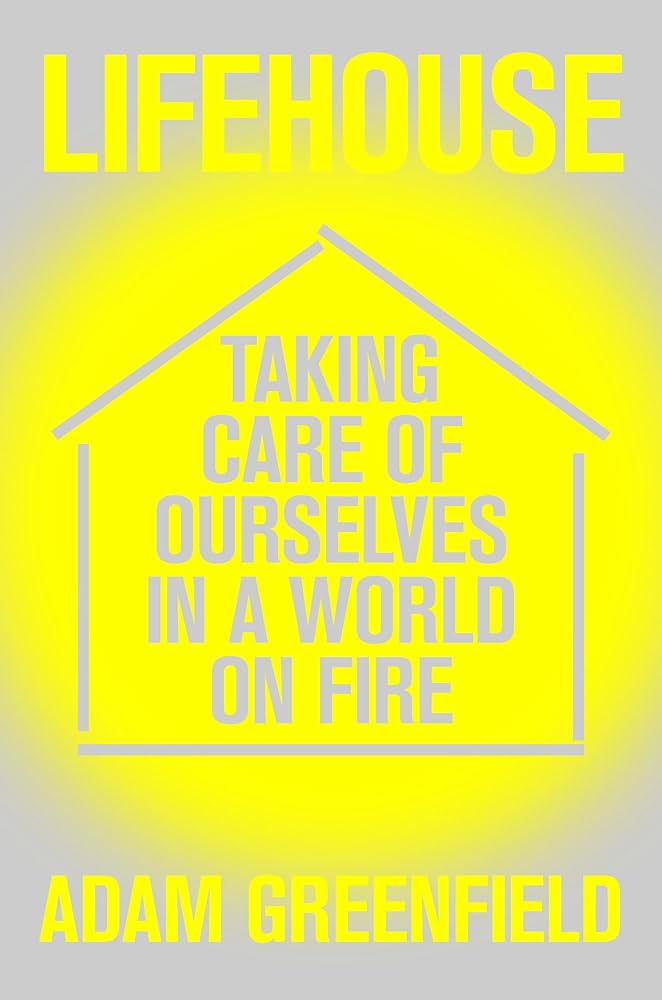
Photo Credit: Verso Books (UK/USA, 2024)
The fundamental idea of the Lifehouse [in a disaster zone] is that there should be a place in every three- or four-city block radius where you can charge your phone when the power’s down everywhere else, draw drinking water when the supply from the mains is for whatever reason untrustworthy, gather with your neighbors to discuss matters of common concern, organize reliable childcare, borrow tools it doesn’t make sense for any one household to own individually and so on—and that these can and should be one and the same place. As a foundation for collective resourcefulness, the Lifehouse is a practical implementation of the values we’ve spent this book exploring.
Excerpt from Lifehouse: Taking Care of Ourselves in a World on Fire by Adam Greenfield, Verso Books, UK/USA, 2024 (p. 167).
Lifehouse: Taking Care of Ourselves in a World on Fire is an urgent and practical guide to community resilience in the face of climate catastrophe and the collapse of late-stage capitalism. Greenfield recovers lessons from the Black Panther survival programs (USA), the astonishingly effective Occupy Sandy disaster-relief effort (NYC/USA), the solidarity networks of crisis-era Greece, as well as municipalist Spain and autonomous Rojava (Syria), to show how practices of mutual care and local power can help shelter us from a future that often feels like it has no place for us or the values we cherish.
Adam Greenfield is an American best-selling author, urbanist, and critical futurist, based in London since 2013. He has spent the past quarter-century thinking and working at the intersection of technology, design and politics with everyday life. Selected in 2013 as Senior Urban Fellow at the LSE Cities center of the London School of Economics, he previously taught in New York University’s Interactive Telecommunications Program and the Urban Design program at the Bartlett School of Architecture, University College London. His books include Everyware: The Dawning Age of Ubiquitous Computing, Urban Computing and Its Discontents, and the bestsellers Against the Smart City and Radical Technologies: The Design of Everyday Life.
Born in Philadelphia, Pennsylvania, in 1968, he graduated with a degree in cultural studies at New York University in 1989. Between 1995 and 2000, he served as a Psychological Operations Specialist in the U.S. Army Special Operations Command.


Rosaliene, Adam Greenfield sounds like a wise person in a faltering world.
LikeLiked by 1 person
Dave, according to the Executive Speakers Bureau, “He is one of the world’s foremost thinkers on urban environments.” His fee as a keynote speaker ranges from $30,000-$50,000 for an in-person appearance.
https://www.executivespeakers.com/speaker/adam-greenfield
LikeLiked by 1 person
Wow, Rosaliene! Rather pricey. 🙂 But he deserves that $ more than a number of other speakers I can think of.
LikeLiked by 1 person
My response, too, Dave 🙂 We’re in the wrong business.
LikeLiked by 1 person
Ha! 😂 Yes!
LikeLiked by 1 person
Sounds sensible! Thank you Rosaliene for sharing this! Enjoy the weekend! 🤗😊
LikeLiked by 1 person
You’re welcome, Ashley 🙂 It was a gloomy, overcast weekend without a chance for gardening 😦
LikeLiked by 1 person
Thanks for the review. This book gives us a lot to think about.
LikeLiked by 1 person
You’re welcome, Neil. Greenfield makes it clear in his Introduction that we have to stop waiting and start doing (p. 15):
“We’ve left it too late, the damage is too deep, the destabilizing process too far advanced. We won’t be able to forestall any but the least part of the sorrows to come, even if we give everything we have to the effort. But what we can still do, perhaps, is join ourselves with the others around us and together make spaces in which more of what we cherish is able to endure. To make life and possibility, where there is otherwise only grief.”
LikeLiked by 1 person
I think a Lifehouse is a good idea in cities, even if they are not in a disaster zone. We are living short term in a large city right now and there are a lot of folks here in need of a direction. Have a good Sunday Rosaliene. Allan
LikeLiked by 1 person
Allan, I witnessed such disaster-relief centers in action during the Palisades and Altadena wildfires here in Los Angeles County. The response to provide assistance from Californians and beyond were remarkable. As these disasters become more frequent and widespread, we will need more long-term disaster-relief centers or “lifehouses” for the mutual care of our communities and urban centers.
I’m not sure which city you live in right now, but I’ve found the following link for disaster support in Vancouver.
https://vancouver.ca/home-property-development/disaster-support-hubs.aspx
LikeLiked by 1 person
No disaster here, but people tend to be stressed in not cities. We are our way to someplace quieter.
LikeLiked by 1 person
Thank the gods that you’re not facing any disaster in your area. With the extreme summer temperature approaching, California is already preparing for the next wildfire.
LikeLiked by 1 person
Interesting that he’s going back as far as the Greeks. That’s cool. He researched. One, probably the only, good thing I’ve seen about natural disasters is this coming together of the community to support each other and their common needs. Having a pre-planned method for doing that is sound.
LikeLiked by 1 person
Ilsa, Greece was hit especially hard by the 2008 Global Financial Crisis, forcing the country to borrow high interest loans which came with austerity demands. The drastic cut in public spending resulted in unprecedented levels in unemployment, poverty, and social deprivation. What’s more, at least 2.5 million people, almost a third of the population, were excluded from access to public healthcare. Sounds familiar?
For more information about how California has prepared to handle extreme natural disasters, check out the Governor’s Office of Emergency Services at the link below:
https://www.caloes.ca.gov/office-of-the-director/operations/planning-preparedness-prevention/planning-preparedness/
LikeLike
My goodness. Poor Greece!
LikeLiked by 1 person
At the time, I was so caught up in our own crises of thousands of job losses and massive foreclosures that I didn’t give a thought to what was happening in other countries.
LikeLike
An essential reminder, Rosaliene. The idea of community involvement in the process of reclaiming the parts of our flourishing and survival that are endangered, if not menaced, is a growing thought and opportunity. We must learn to work together to save ourselves. Thank you.
LikeLiked by 1 person
So true, Dr. Stein. When disaster strikes, we’ve shown that we can come together, regardless of our differences, to help each other to recover and rebuild. The challenge will be sustaining such mutual care across our cities over extended periods under crisis conditions.
LikeLiked by 1 person
Important. Thank you Rosaliene.
LikeLiked by 1 person
You’re welcome, Cindy.
LikeLike
Sounds like a sensible idea! Thanks for sharing. Your posts always help me want to work towards a better future. 😊🌻
LikeLiked by 1 person
You’re welcome, Ada. I’m so glad to hear that my posts are making a difference for you.
LikeLike
Thank you for sharing such a valuable resource, Ros! I’m excited to read it and figure out how this might be done in my part of a city where people need to connect in meaningful (constructive) ways.
LikeLiked by 1 person
You’re welcome, Carol. Greenfield does not spare the nitty-gritty aspects of what’s required to establish these lifehouses for our mutual care and survival. It is not light reading.
LikeLike
I look forward to reading it Ros, and ordered a copy yesterday through my local bookstore.
LikeLiked by 1 person
That’s good news, Carol. You will find his book a valuable resource for the work you do within your community.
LikeLiked by 1 person
Inspirational
LikeLike
It is, for sure, Derrick, and much more. It’s a call to action.
LikeLiked by 1 person
Yes to this book! These kind of places are already necessary and possibly in existence. My town has similar types of places such as a homeless center where people can get a shower, meal, some health care and job help but there definitely needs to be more and on a much larger scale. And, I have a feeling it’s going to be up to citizens to make it happen.
LikeLiked by 1 person
You’re spot on, Mara! Such places already exist here in Los Angeles, but, as you say, we will need to expand these centers or lifehouses as extreme natural disasters increase in the years ahead.
LikeLiked by 1 person
WOW, what an interesting book with an intriguing title in real-time proportions. This is an essential message as a reminder to us all. 🙏🏼 Thanks a million for reviewing Adam Greenfield’s book Rosaliene! 📙📚📗
LikeLiked by 1 person
You’re welcome, Kym. Greenfield shows us a practical path forward, using real-life cases of what works as well as the pitfalls.
LikeLiked by 1 person
Oh yes indeed Rosaliene. Plain and simple! 🥰🙏🏼🤗
LikeLiked by 1 person
Wow, this sounds like the perfect book for me. I’ve been thinking about this kind of stuff for a long time but not taken any action. This book could be the catalyst I need!
LikeLiked by 1 person
Pam, I believe that Greenfield’s book will provide you with the scope of what’s needed to get started. It’s collective grassroots power at work for the mutual care of the community (to be) served.
LikeLiked by 1 person
🙏🥰
LikeLiked by 1 person
This makes so much sense! I imagine any neighborhood/group/church/etc. could start to organize a community hub.
LikeLiked by 1 person
Exactly, JoAnna! Greenfield cites the following locations (p. 171):
“In many neighborhoods, there will often already be a building or physical site that organically serves many of these functions…. Whether house of worship or union hall, high school gym or public library, it will be where people in the surrounding streets instinctively turn for safety and aid in times of trouble.”
He also mentions abandoned or underutilized structures, such as commercial premises that can’t be leased profitably.
LikeLiked by 1 person
Practical and much needed suggestions!
LikeLiked by 1 person
I agree!
LikeLiked by 1 person
love this, we actually have people in our neighborhood involved in doing this which is awesome! 👏
LikeLiked by 1 person
That’s great, Cindy! Do you still live in San Francisco?
LikeLiked by 1 person
It really is. I live south of the city about 40 min where it’s warmer-:)
LikeLiked by 1 person
Cindy, I’m not surprised that your community has a head start in organizing a lifehouse. Just 12 miles away from San Francisco in Oakland, two young African American college students organized a Community Action Program called the North Oakland Neighborhood Anti-Poverty Center in the summer of 1996. They went on to found the Black Panther Party for Self-Defense (Greenfield, pp. 80-96).
LikeLiked by 1 person
It is such a wonderful thing and kudos to those students who made such a difference! 👏
LikeLiked by 1 person
For sure, Cindy!
LikeLiked by 1 person
💕💕💕
LikeLiked by 1 person
So crucial to recover community. From what I’ve read, compassion and community were central to the Black Panther movement.
LikeLiked by 1 person
Rebecca, the extensive list of the Black Panther survival programs, shared in Greenfield’s book (p. 87), is quite impressive. Exactly what a lifehouse needs. Yet they failed. Why?
Greenfield notes (p. 91): “The survival programs, like every other initiative undertaken by the Black Panther Party throughout its existence, suffered tremendously from the FBI’s decades-long campaign of harassment, rumor-mongering, subversion, defamation and sabotage, which has to be regarded as the central factor conditioning their success or failure…. The survival programs were [also] undermined by a degree of ambition that, while no doubt justified by need, nevertheless amounted to a perilous overreach.”
LikeLiked by 1 person
They were innovators. Kids needed breakfast and lunch, and the Black Panthers provided them; a predecessor of the meal programs at school today.
LikeLiked by 1 person
They definitely were innovators, Rebecca. Now, it’s up to us to learn from their mistakes when setting up our lifehouses.
LikeLiked by 1 person
This is so fascinating to me as a former staffer in emergency management with a father who was military then police, who was all about preparing for the worst, an obsession I inherited and got quite good at! This kind of facility is an absolute must in communities. My sweety and I once saw a play that was a depiction of people meeting and starting relationships in one such centre, sitting long times while charging their phones.
As with anything it seems it must take high numbers of preventable deaths (of mostly poverty-muted people) to begin talking about doing something.
By the way, this is a brilliant an succinct introductory sentence; I love how it’s written – “Lifehouse: Taking Care of Ourselves in a World on Fire is an urgent and practical guide to community resilience in the face of climate catastrophe and the collapse of late-stage capitalism.”
LikeLiked by 3 people
Steve, I’m glad to hear that this is a subject close to your heart. Lots of temporary lifehouses must already exist in areas struck by natural disasters, but they don’t make the news. A time is fast approaching when they will become permanent lifelines for human survival.
LikeLiked by 1 person
It’s good to know these exist even if not heavily publicized, though of course that would help people to know they’re available. I believe you are right, that they will by necessity become permanent.
LikeLiked by 1 person