It’s no longer safe for writers like me to express my truth and give voice to the dispossessed, marginalized, and oppressed among us. Our speech is now censored. Here in my adopted homeland, to protest and write about the horrors being inflicted on the Palestinian people has been criminalized. Likewise, for criticisms about our Dear Leader and his policies.
For people like me, such crimes are punishable with incarceration, deportation, or both. Without due legal process. The First Amendment of our Constitution, regarding Freedom of religion, speech, and the press; rights of assembly and petition, has become invalidated or applicable only to political loyalists.
Such is the nature of life for writers under authoritarian regimes. To ensure my safety and that of my sons, I must self-censor what I write. I must be careful, too, with whom I associate, lest I’m accused of being an enemy of the state. If you believe I’m overreacting, you have not been paying attention.
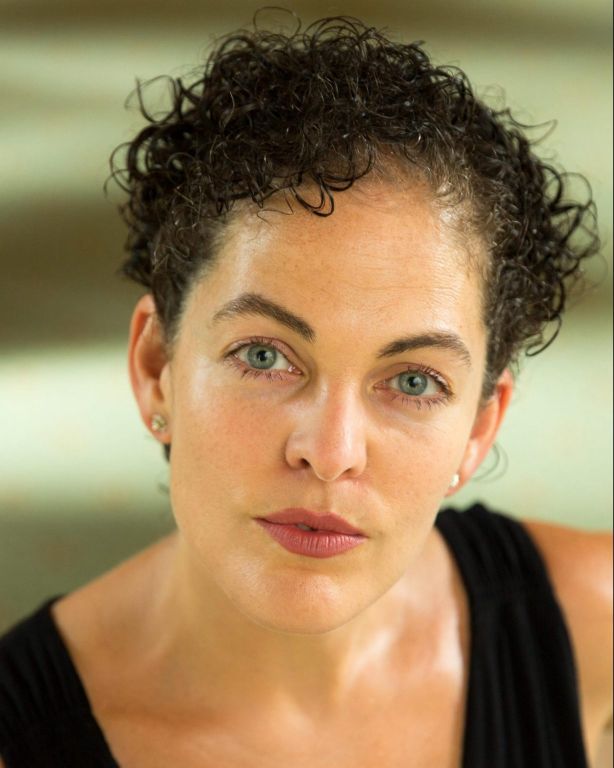
My Poetry Corner May 2025 features the poem “Why Madwoman Shouldn’t Read the News” from the poetry collection, Madwoman, by the award-winning Caribbean American poet and writer Shara McCallum. Born in Kingston, Jamaica, in 1972, to an Afro-Jamaican father and a Venezuelan mother, she was nine years old when she migrated to Miami, Florida, with her mother and sisters. Her father, a singer and songwriter, stayed behind in Jamaica.
McCallum graduated with a bachelor’s degree from the University of Miami. She earned her MFA from the University of Maryland and a PhD in African and Caribbean Literature from Binghamton University in New York. Her poetry collection Madwoman, published in the UK and USA in 2017, won the 2018 OCM Bocas Prize for Caribbean Literature in Poetry and the Sheila Margaret Motton Book Prize (New England Poetry Club).
In Madwoman, McCallum explores themes of race, female identity, and womanhood. During a 2018 interview with Arianna Miller for the Gandy Dancer Literary Magazine, the poet explained: “Madwoman was a voice she heard in her head…. [She] eventually became a voice that McCallum could not ignore, which was actually troubling for her considering her father was a schizophrenic.”
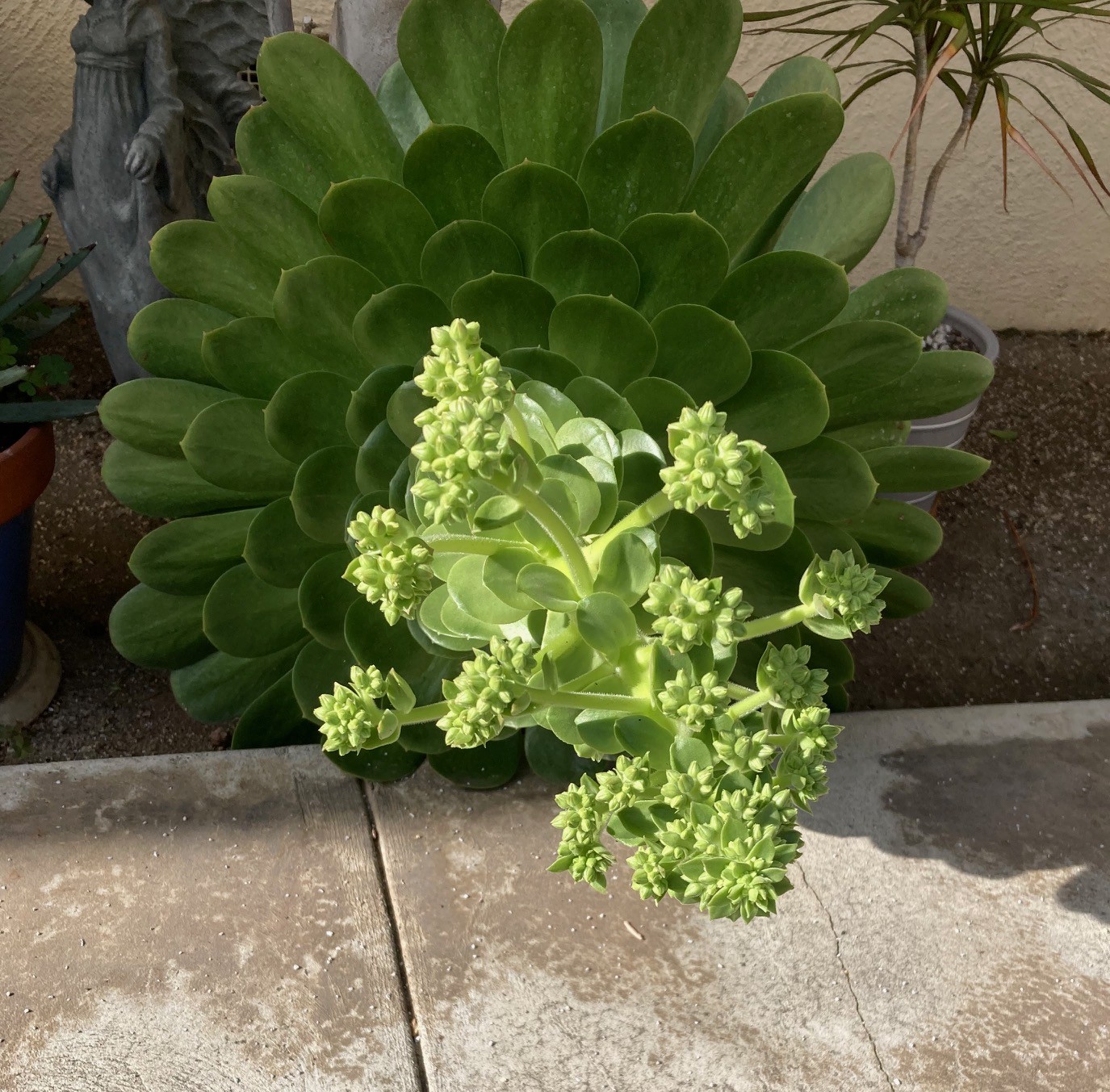
Aeonium Mint 03/15/25Aeonium Mint Decapitated 04/12/25
Decapitated Life cycle interrupted Obstructing the path
I shouldn’t be surprised. After all, it was just a matter of time that a neighbor would complain to Management about a plant obstructing our sidewalk. It’s not the first time. On separate occasions, I’ve had two neighbors complain about a rosebush and potted palm getting in their way. Since then, I’m usually diligent in trimming excessive growth. This time, I couldn’t bring myself to cut back the glorious bloom of the Aeonium Mint invading our space.
With motherhood comes great responsibility to raise a child in the world without guarantees for their safety and growth
Decapitated for being different for obstructing the path of others by the bullies, the haters, the abductors the destroyers of lives In a natural world abounding with diversity
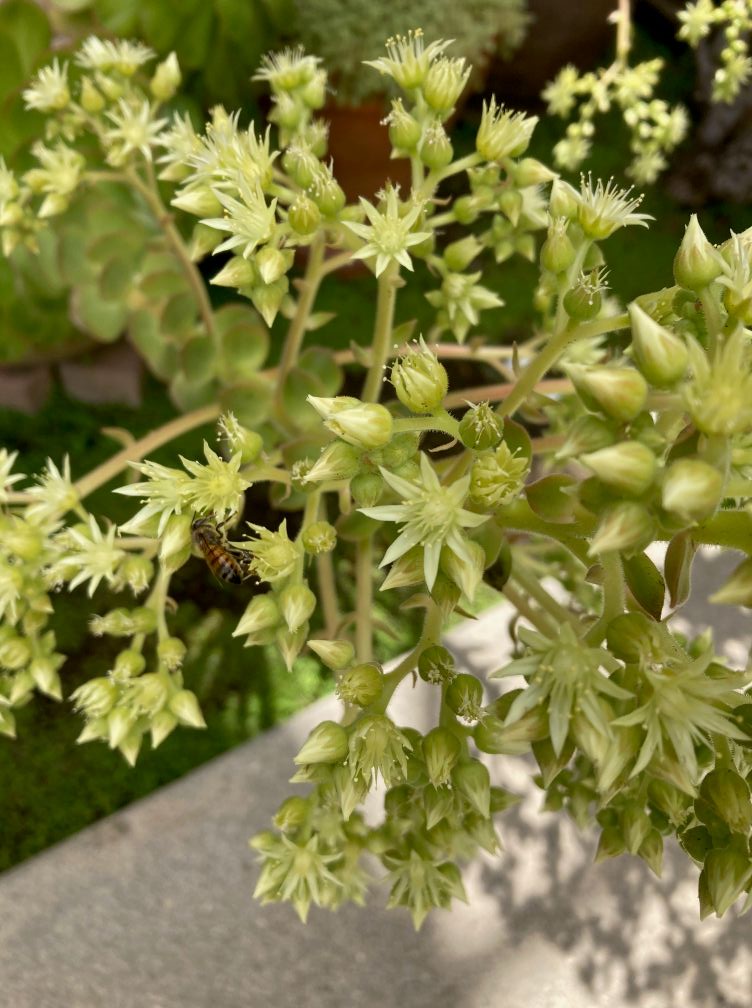
Rosaliene’s Garden: Bee visiting flowers of Aeonium Mint 04/27/25
The children of humankind nurse at the breasts of Mother Earth She gives freely to all for we are all worthy of her grace Such is the miracle of being
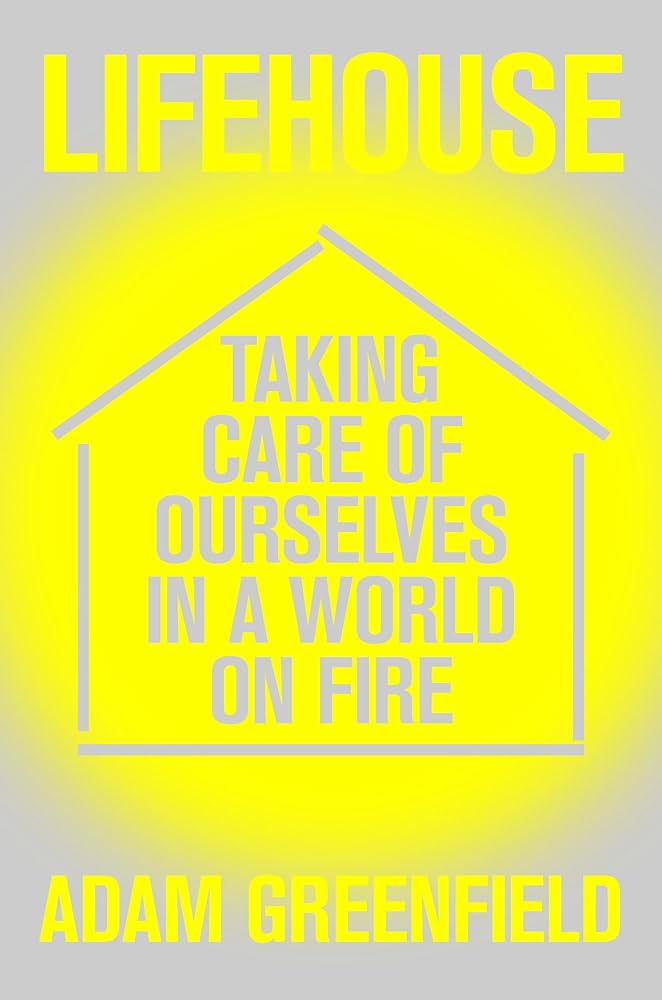
Front Cover: Lifehouse: Taking Care of Ourselves in a World on Fire by Adam Greenfield Photo Credit: Verso Books (UK/USA, 2024)
The fundamental idea of the Lifehouse [in a disaster zone] is that there should be a place in every three- or four-city block radius where you can charge your phone when the power’s down everywhere else, draw drinking water when the supply from the mains is for whatever reason untrustworthy, gather with your neighbors to discuss matters of common concern, organize reliable childcare, borrow tools it doesn’t make sense for any one household to own individually and so on—and that these can and should be one and the same place. As a foundation for collective resourcefulness, the Lifehouse is a practical implementation of the values we’ve spent this book exploring.
Excerpt from Lifehouse: Taking Care of Ourselves in a World on Fire by Adam Greenfield, Verso Books, UK/USA, 2024 (p. 167).
Lifehouse: Taking Care of Ourselves in a World on Fire is an urgent and practical guide to community resilience in the face of climate catastrophe and the collapse of late-stage capitalism. Greenfield recovers lessons from the Black Panther survival programs (USA), the astonishingly effective Occupy Sandy disaster-relief effort (NYC/USA), the solidarity networks of crisis-era Greece, as well as municipalist Spain and autonomous Rojava (Syria), to show how practices of mutual care and local power can help shelter us from a future that often feels like it has no place for us or the values we cherish.
Adam Greenfieldis an American best-selling author, urbanist, and critical futurist, based in London since 2013. He has spent the past quarter-century thinking and working at the intersection of technology, design and politics with everyday life. Selected in 2013 as Senior Urban Fellow at the LSE Cities center of the London School of Economics, he previously taught in New York University’s Interactive Telecommunications Program and the Urban Design program at the Bartlett School of Architecture, University College London. His books include Everyware: The Dawning Age of Ubiquitous Computing, Urban Computing and Its Discontents, and the bestsellers Against the Smart City and Radical Technologies: The Design of Everyday Life.
Born in Philadelphia, Pennsylvania, in 1968, he graduated with a degree in cultural studies at New York University in 1989. Between 1995 and 2000, he served as a Psychological Operations Specialist in the U.S. Army Special Operations Command.


 Three Worlds One Vision