
Tags
Biodiversity, Climate Change, Copernicus Charts of Global Atmospheric Concentrations of Carbon Dioxide and Methane 2024, Copernicus Global Climate Report 2024, Environment, Federal Emergency Management Agency (FEMA), nature, Planetary Life Systems, Sustainability, UN Kunming-Montreal Global Biodiversity Framework (GBF), UNFCCC Paris Agreement 2015, WMO State of the Global Climate 2024, WWF Living Planet Index (LPI)

Photo Credit: Keith Birmingham/MediaNews Group/Pasadena Star-News via Getty Images
I know… I share your pain. I’m also scared. These are dangerous times for immigrants in America—scapegoats for the social and economic ills of our nation. Our trade partners, too, have come under attack. It’s now tit-for-tat for unfair trade practices. “Liberation Day” on April 2nd has unleashed import tariffs/taxes, ranging from 10 percent to 54 percent, for all countries that sell goods to the United States. What a high-risk economic strategy! But this is just the latest drastic change assaulting us daily since January 20, 2025.
Regardless of our political views or ideology, we the people will have to deal with the negative or unexpected consequences of dismantling our government agencies and picking a fight with our closest allies since the end of World War II. Judging from these developments, it seems that the globalized capitalist economic system is under stress. And so it should be. For how much longer can we sustain an economic model of continual growth and profits that is pushing our planetary life systems to their limits?
Non-human life faces extinction and more frequent, extreme weather events are disrupting and threatening human life. The minority billionaire ruling class (MBRC) believes that environmental and other deregulations are the answer to renewed economic growth. Their insatiable greed blinds them to all the warning signs of economic and societal collapse. Instead, they now grasp at AI, an energy guzzler, to preserve their way of life.
In their State of the Global Climate 2024, released on March 19, 2025, the World Meteorological Organization (WMO) confirmed that 2024 was the warmest year in the 175-year observational record. This beats the record set in 2023. Worse still, with an annual average temperature of 1.55°C, we have exceeded the threshold of 1.5°C above the pre-industrial level (1850-1900) set by the UNFCCC Paris Agreement 2015 to significantly reduce the risks of a scorched Earth. My friends, we are now living on a much hotter planet.
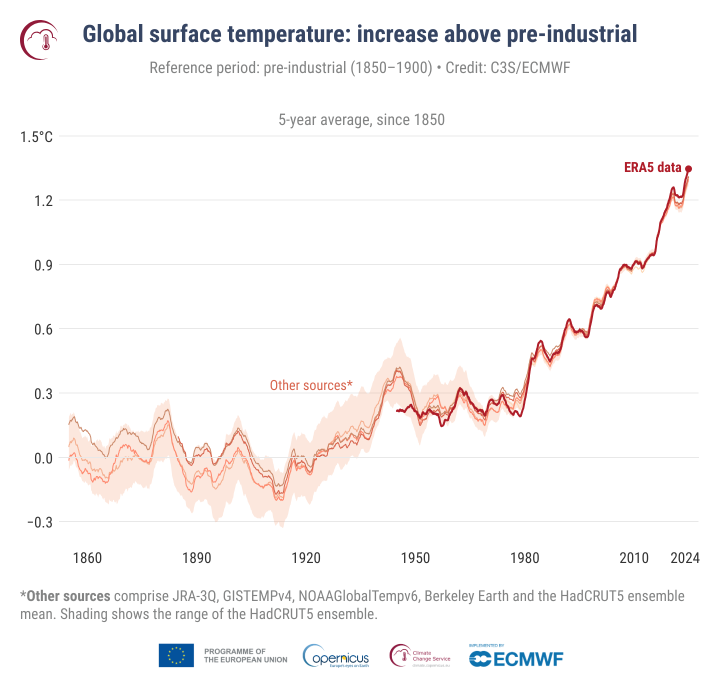
Credit: C3S/ECMWF
As shown in the Copernicus charts below, published in their Global Climate Report 2024, released on January 10, 2025, the atmospheric concentration of the greenhouse gases carbon dioxide and methane continued to increase, hitting levels not seen in 2,000,000 years and 800,000 years, respectively. I repeat: We are now living on a much hotter planet. How much hotter must it get for the MBRC to fully commit to our transition to alternative energy sources?
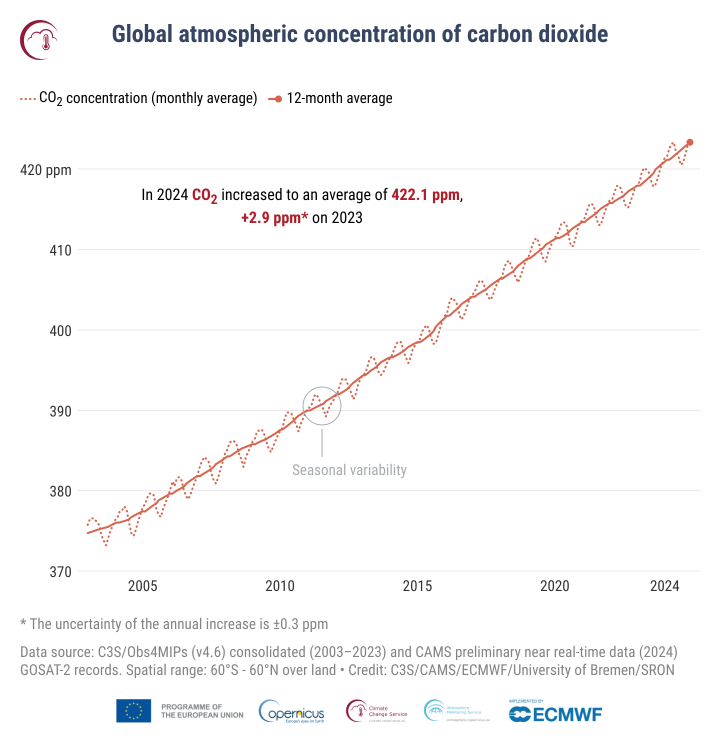
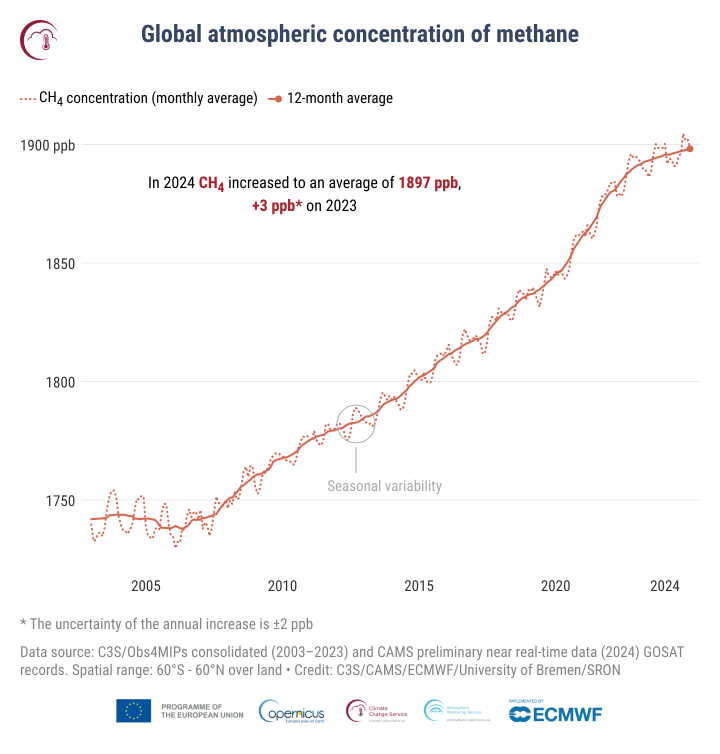
A hotter Earth means fatal consequences for the interconnected planetary life systems. In 2024, our oceans continued to warm, as did ocean acidification, and sea levels continued to rise. The cryosphere, the frozen parts of Earth’s surface, are melting at an alarming rate as glaciers continue to retreat. Antarctic sea ice reached the second-lowest extent ever recorded. With all this melting, Greenland has become a coveted prize for the MBRC.
Meanwhile, extreme weather events in 2024 led to the highest number of new population displacements recorded in a year since 2008. In addition to the destruction of homes, critical infrastructure, forests, farmland, and biodiversity (more on this below), these extreme weather events undermine community resilience. Here in Los Angeles County, we’re still in the process of clearing the highly toxic rubble, resulting from the Palisades and Eaton wildfires on January 7th.
What’s more, communities devastated by extreme weather events and other natural disasters—such as earthquakes, tsunamis, and volcanic eruptions—cannot count on assistance from the Federal Emergency Management Agency (FEMA). This Agency, a helpline in times of disaster, now joins other government agencies slated for elimination. An executive order signed on March 18, 2025, seeks to shift responsibility for disaster preparedness and assistance to state and local governments. Meanwhile, there’s a covert plan to punish states with sanctuary laws for immigrants by withholding FEMA funds, previously awarded for disaster assistance (Courthouse News Service dated April 4, 2025). To my knowledge, Los Angeles has not yet been targeted.
Such political games only serve the MBRC. Natural disasters have no respect for political boundaries or affiliations. Just ask the people across the six Southeastern American states pounded by Hurricane Helene in late September 2024. While the rest of us have moved on with our lives, thousands of survivors are still struggling to re-build their lives.
These extreme weather events also impact our planet’s biodiversity that sustains us. Yet, every indicator used by the World Wildlife Fund (WWF) to track the state of Nature on a global scale shows a decline in Earth’s biodiversity. Their 2024 Living Planet Report: A System in Peril, released on October 10, 2024, warns us about the ongoing global existential ecological crisis.
Over the past 50 years (1970-2020), the average size of monitored wildlife populations has shrunk by 73 percent as measured by the Living Planet Index (LPI). The database comprises almost 35,000 population trends and 5,495 species of amphibians, birds, fish, mammals, and reptiles. Freshwater populations led the decline with 85 percent, followed by terrestrial (69%) and marine populations (56%).
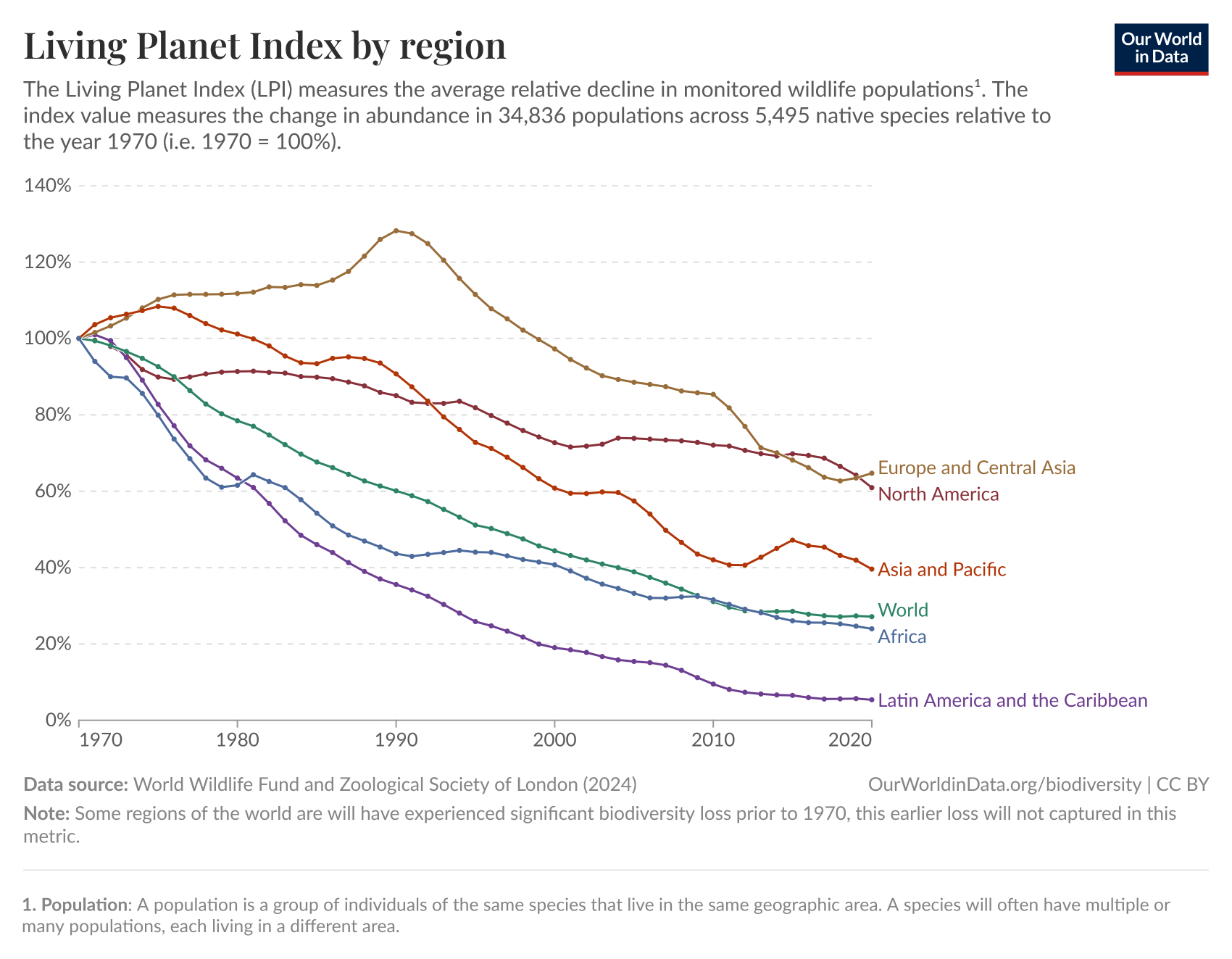
Source Credit: Our World in Data
At a regional level, Latin America and the Caribbean have seen the fastest decline with 95 percent, followed by Africa (76%), and Asia and the Pacific (60%). Europe and Central Asia (35%) and North America (39%) have experienced less dramatic declines.
Threats to biodiversity include: (1) habitat degradation and loss, driven mainly by our food system; (2) overexploitation; (3) invasive species; (4) disease; (5) climate change; and (6) pollution. Unless we change our way of life and relationship with non-human life, several global tipping points—highlighted in the Report—will damage our planetary life systems and destabilize societies worldwide. To maintain a living planet will require nothing less than a transformation of our food, energy, and finance systems.
The urgency of addressing this existential threat to Earth’s biodiversity is nothing new. The United Nations Kunming-Montreal Global Biodiversity Framework (GBF), agreed by nations of the world on December 19, 2022, set four goals and 23 targets to halt and reverse biodiversity loss by 2030. I should mention that the United States is not a party of the GBF. Not surprisingly, America did not send a delegation to the UN COP16 Biodiversity Summit, held in Rome during February 25-27, 2025. Participating nations agreed to a strategy for “mobilizing” at least US$200 billion per year by 2030 to help developing countries conserve biodiversity.
In January 2025, the MBRC executive order to shut down USAID and freeze foreign aid sent conservationists reeling. Funding for nature and wildlife protection projects worldwide are now in jeopardy. In 2023 alone, USAID provided US$375.4 million to such conservation projects.
There appears to be no end to the rapid fire, drastic changes intended to traumatize and immobilize us. As I have learned from my experience of being abandoned in Brazil with two young children, we can find our strength through adversity. I learned, too, that we are stronger when others stand with us throughout our struggles. Let our nationwide protests on April 5th remind us that solidarity makes us stronger. Solidarity in our private spaces! Solidarity in our shared public spaces!


So well covered, Rosaliene
LikeLiked by 4 people
Thanks very much, Derrick.
LikeLiked by 1 person
Many thanks, Rosaliene, for your thought provoking post!
LikeLiked by 3 people
Thanks for reading, Martina.
LikeLiked by 1 person
Thank you again, Rosaliene. You remain a source of light and truth in a dark time.
LikeLiked by 5 people
I appreciate your kind comment, Dr. Stein. Thanks for bringing the WWF 2024 Living Planet Report to my attention.
LikeLiked by 1 person
SOLIDARITY!!!
LikeLiked by 1 person
Thanks very much for dropping by, Frank. Solidarity!
LikeLiked by 1 person
I was never one for protest mobs. It didn’t stop the Vietnam War, it just caused more confusion and resentment. There’s got to be a better way.
LikeLiked by 1 person
GP, protests bring people together to express their public grievances. If they were not effective, authoritarian governments and public officials would not prohibit them or punish the major organizers.
LikeLiked by 2 people
They are not prohibited here; unless they impede traffic or become violent.
LikeLiked by 1 person
You have said it all Rosaliene. Thinking that you, one person, knows what is best for 326.7 million people let alone 8.2 billion people around the world, is hubris in the extreme. Denying history, economy, meteorology and humanity does not make you smart. Just because you do not believe something does not make it any less true. I was very thankful to see the people standing up yesterday in the country of “We, the People”. I just hope it is not too late. Thanks for your timely post Rosaliene. In Canada, we are looking for more reliable friends right now. Happy Sunday. Allan
LikeLiked by 3 people
Allan, I’m saddened that the relationship between our countries has soured 😦 It’s extreme hubris, indeed.
LikeLiked by 2 people
Me too. I always find deals are better with cooperation, instead of intimidation. But, hey, maybe that’s just me.
LikeLiked by 1 person
Great and sobering post, Rosaliene. Extreme weather and an extreme president are a lethal combination. 😦
LikeLiked by 4 people
Thanks very much, Dave. We’re treading dangerous waters 😦
LikeLiked by 1 person
Yes. 😦
LikeLiked by 1 person
Hopefully the protests yesterday are only the beginning.
LikeLiked by 4 people
Thanks for sharing your thoughts, Ken. We have a long struggle ahead.
LikeLike
We are in very scary times Rosaliene, thanks for presenting all of these important details together. Maggie
LikeLiked by 1 person
You’re welcome, Maggie. I’m doing my small part to alert my collective American family that our government’s official denial of our global existential crises puts us all at risk.
LikeLike
SOS! SOS! SOS!
LikeLiked by 1 person
Neil, it’s more than clear that we’ve got to save ourselves.
LikeLiked by 1 person
Thanks for bringing to light these horrifying events, Rosaliene. I do hope we can overcome our differences and fight the good fight. I do believe it’s now or never. Yesterday it was heartening to see this playing out in DC and all over as thousands of people protested in solidarity.
LikeLiked by 2 people
You’re welcome, Mara. I was also heartened to see so many people coming together nationwide. We need each other more than ever.
LikeLiked by 2 people
Thank you for this brutal look at our reality, Rosaliene. I know how awful it was to not only wade into those facts but to assemble them for us. I appreciate you. Solidarity!
LikeLiked by 2 people
I appreciate you, too, Tracy. With little mainstream news, these days, on our ongoing global existential crises, I’m committed to bringing the brutal, scary reality to readers. If we are to save ourselves, we cannot afford to look away. Solidarity!
LikeLiked by 2 people
✊🏽
LikeLiked by 1 person
Thank you for the time you put into this excellent and thoroughly researched article. We can always count on you to present relevant and well-written information.
LikeLiked by 1 person
Thanks very much, Michele.
LikeLiked by 1 person
You’re very welcome. 🙏🏻
LikeLiked by 1 person
Thank you Rosaliene for your wise words. These are deeply disturbing times for the world. How one man can release so much pain is unfathomable.
LikeLiked by 2 people
Denzil, these are truly disturbing times for humanity. He is just the heartless and soulless face of the minority billionaire ruling class.
LikeLiked by 1 person
Very good and profound analyses, Rosaline. I always wonder how the history books in 100 years will cover this dark period. If there are any history books then, of course..,..
LikeLiked by 2 people
Thanks very much, Friedrich. If our species continue on the current path of ecocide, we will not be here in 100 years to tell the tale.
LikeLiked by 1 person
I was thinking of the Mars edition of the history book. 🙂
LikeLiked by 1 person
🙂
LikeLike
The declines are rooted in the lack of respect–respect for all cultures, all economic levels, all wildlife, our planet. Great post, Rosaliene.
LikeLiked by 3 people
Thanks very much, Mary. So true: Respect would be a good start for stopping our race to extinction.
LikeLiked by 1 person
Excellent research and thorough statistics Rosaliene. 👏🏼👏🏼👏🏼 You are spot-on with the reality of our “reality.” As Martin Niemöller stated when he didn’t speak up for others,
Then they came for me
And there was no one left
To speak out for me.
So this reality we’re living in, with the natural disasters and the man-made calamities, we must continue to let our voices be heard and our solidarity bound with strength in our fight through adversity! 😊💪🏼🤜🏼🤛🏼🙌🏼🥰
LikeLiked by 1 person
Thanks very much, Kym. Loyalists and collaborators believe that they will be safe from the collapse. Working together in solidarity will be key to our survival when disaster strikes.
LikeLiked by 1 person
You got that one right Rosaliene. It’s so unfortunate that the enormous amount of people who remain in denial that any of this chaotic stuff going on is wrong saturates our air space. 🤷🏻♀️ I don’t get it, and perhaps I never will. 🤦🏻♀️ Still we rise, as Maya Angelou proclaimed. 🙏🏼
LikeLiked by 1 person
Hey Rosaliene!
Thank you for writing this post.
Isn’t it interesting that AI is the go-to now – one of the most soulless inventions of humanity.
“Instead, they now grasp at AI, an energy guzzler, to preserve their way of life.”
J
LikeLiked by 2 people
Thanks for reading, James. So far, the deployment of AI’s soulless algorithms across the World Wide Web has been working well for them.
LikeLike
And the next phase is manipulation of the answers that we get thru AI to suit various nefarious purposes!
(We must write posts on that!)
LikeLiked by 1 person
James, I don’t use the AI search engines so I’m not aware of this danger.
LikeLike
Even with Google search now you’ll see an AI summary at the top. One search that I did yesterday gave me a misleading answer
I use Ecosia instead, as much as possible.
J
LikeLiked by 1 person
Rosaliene, this is a discouraging and frightening picture of the world we are leaving for our children’s children. Last night, I read a passage from the book I’m reading, ‘Surrender: 40 Songs, One Story’ by U2’s Bono where he quoted a Pentagon official saying words to the effect that if you’re not going to fund a vulnerable country through USAID, you’re making it a target for civil war and oppression by bad actors. That hit hard, thinking of the thoughtless gutting of agencies and services by the felon and his oligarch sidekick.
LikeLiked by 1 person
PS: An American friend sent several e-blasts to all his contacts about the April 5 demonstrations. I do hope these lead to positive change.
LikeLiked by 1 person
My hope, too, Steve.
LikeLiked by 1 person
Thanks for sharing your thoughts, Steve. Our generation is already being impacted. In my view, America’s latest attempt to reset global trade is an indication that all is not well with our supply systems. Negotiated concessions should be revelatory.
LikeLiked by 1 person
It’s a troubling time indeed; such damaging and unnecessary actions that, unfortunately, have changed international relationships forever.
LikeLiked by 1 person
Long sigh…
LikeLiked by 1 person
Indeed…
LikeLiked by 1 person
If only we valued the earth and each other as much as we value money.
LikeLiked by 1 person
If only, Rebecca! We wouldn’t be in the mess we’re in today.
LikeLiked by 1 person
You know things are bad when the sleepy little town of Cape May Courthouse in NJ had a few hundred folks protesting! I was happy to be part of that. I just hope we can keep the momentum going all across the country, Rose.
LikeLiked by 1 person
That’s my hope, too, Pam.
LikeLiked by 1 person
What a comprehensive post Rosaliene. I certainly hope people wake up. Thanks for sharing!!! 💓
LikeLiked by 1 person
Thanks very much, Cindy!
LikeLiked by 1 person
What a comprehensive post, Rosaliene! Thank you for the information on the environment. I feel that the next few years in the US will see much more degradation of the environment, and much more extreme weather. Though it is painful to think about this, it is good to stay informed.
LikeLiked by 1 person
Thanks very much, Cheryl. We also need to be prepared for when an extreme weather event hits our community.
LikeLiked by 1 person
❤️
LikeLiked by 1 person
❤
LikeLiked by 1 person
A post that speaks for so many of us. The power of solidarity is needed more than ever, and the recent protests are signs we are all awakening. As you mention, the incredible chaos of the current administration and politics in general are intended to traumatize us, but we can take this power back. Standing strong together can get us through any struggle ~ thank you for such a heartfelt post.
LikeLiked by 1 person
Randall, thanks for reading and sharing your thoughts. It’s heartening that people are finally fighting back.
LikeLike
The extent of these rapid fire, drastic changes feels overwhelming, but thank you for continuing to write the truth. Your summary is accurate and we need to face the facts. I used to go to rallies when I lived in a bigger city but admire those who did. I’m hoping there will be some sort of boycott action we can all take along with continuing to put pressure on all our elected officials and supporting those running for change.
LikeLiked by 1 person
Thanks for sharing your thoughts, JoAnna. Boycotts work when thousands of participants curtail profits. As more of us change our way of being and doing, corporations will have to adapt to survive.
LikeLiked by 1 person
😦
LikeLiked by 2 people