
Tags
AB-2013 Generative Artificial Intelligence: Training Data Transparency, AI Licensing, ChatGPT, Copyright and Artificial Intelligence, Craft of writing fiction, Created by Humans licensing platform, Creative Writing Course, Database for Large Language Models (LLMs), Dataset Providers Alliance (DPA), Generative AI Companies, Generative AI Copyright Disclosure Act of 2024, Generative Artificial Intelligence (GAI), Human Authored Certification, OpenAI, Technology, The Authors Guild (AG), UK AI Opportunities Action Plan 2025, Writers Guild of America West (WGA West)
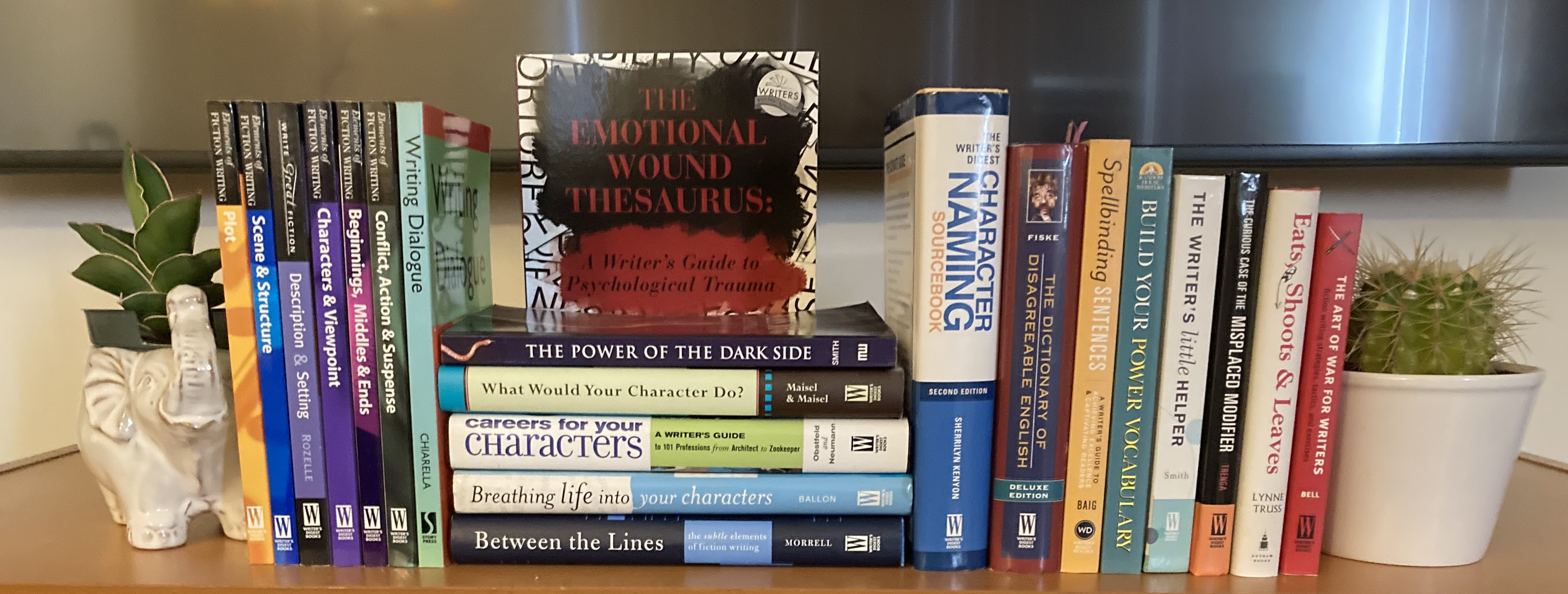
In 2004, when I decided to share my story of overcoming abandonment and loss, it became imperative to learn the craft of writing fiction. With limited funds and a crazy work schedule at a large department store in West Hollywood, I opted for a correspondence course. Through an ad in a magazine, I found the Stratford Career Institute (Vermont, USA). Their Creative Writing Course guided me from crafting my first scene of up to 500 words to finding my voice in a 3000-word short story. Working at my own pace, I completed their writing course within two years. On the left in the captioned photo, the five books on the “Elements of Fiction Writing,” all published by Writer’s Digest Books (Ohio, USA), comprised the reading materials for their course study.
After obtaining my Creative Writing Diploma from the Stratford Career Institute in February 2006, I spent four years writing short stories to develop my craft. At the same time, I began working on my writing project: research for the historical setting, the plot, and character development. I completed the first manuscript of Under the Tamarind Tree: A Novel in 2012. Several revisions followed over subsequent years. Believing in the value of my book, despite several rejections from literary agents and publishers, I finally self-published my novel with Lulu Press in 2019.
After years of developing and honing our writing craft, writers are now being ripped off by AI. Without consent from authors or publishers, generative artificial intelligence (GAI) companies have been illegally using copyrighted materials to develop and train their large language models (LLMs) that power chatbots like ChatGPT. Worse still, writers receive no compensation for the copycat books, mimicking or incorporating an author’s work, generated by these LLMs.
On experimenting with ChatGPT, 58-year-old Hollywood screenwriter John Rogers, co-creator of the world of the TV drama series “Leverage,” discovered that 77 episodes of the series—five years’ worth of work—had been used to fuel AI. Also included in the LLMs database were other scripts from shows he was involved with, including “Transformers” and the series “The Librarians.”
“I’m angry at the absolute arrogance of these companies,” Rogers told Wendy Lee of the Los Angeles Times. “These companies have gotten hundreds of billions of dollars of value that would not exist if not for our work.”
Despite screenwriters’ complaints, no major film studio has filed a lawsuit against the big AI companies.
“The studios own the copyrights to our material that’s being stolen, so they have grounds for legal action,” Meredith Stiehm, president of the Writers Guild of America West (WGA West), said in an interview. “Frankly, they’ve been negligent. They have not protested the theft of this copyrighted material by the AI companies, and it’s a capitulation on their part to still be on the sidelines.”
Not surprisingly, the tech companies contacted by the Los Angeles Times saw no problem in appropriating copyrighted material to train their AI models. When contacted, among other AI companies, OpenAI responded in a statement:
“We build our AI models using publicly available data, in a manner protected by fair use and related principles, and supported by long-standing and widely accepted legal precedents. We view this principle as fair to creators, necessary for innovators, and critical for US competitiveness.”
While the film studios are reluctant to litigate, several groups of authors filed proposed class-action lawsuits in 2024 over the use of their text in AI training. As reported in Reuters, these authors include John Grisham and “Game of Thrones” author George R.R. Martin.
The Authors Guild (AG), America’s oldest and largest professional organization for published writers, has also joined the legal battle again AI companies on all fronts. These actions include: litigation, lobbying for amendments to the copyright law, development of a “Human Authored” certification for human-written texts, and recommended clauses for authors’ book contracts to prevent publishers from using AI or licensing books for AI without permission. Read AG’s guidelines “AI Licensing: What Authors Should Know” for more details.
As a relatively unknown indie-author—who is not eligible for AG membership, due to income requirement—how will I know if the generative AI companies are stealing my published work? U.S. Senator Adam Schiff from California has the answer. On April 9, 2024, he proposed the “Generative AI Copyright Disclosure Act of 2024” that requires these companies to disclose their use of copyrighted work to the Registrar of Copyrights “not later than 30 days before the generative AI system with respect to which the training dataset is used is made available to consumers…” This bill would be great for writers, if approved.
Here in California, on September 28, 2024, Governor Gavin Newsom approved a similar bill, named “AB-2013 Generative artificial intelligence: training data transparency.” This bill gives generative AI companies until January 1, 2026, to make available to Californians the database used to develop their LLM system or service, “regardless of whether the terms of that use include compensation, a developer of the system or service to post on the developer’s internet website documentation, as specified…”
Three months earlier, on June 26th, in response to the outcry for AI database transparency, a group of seven pioneering companies launched the Dataset Providers Alliance (DPA). Representing a diverse range of content sectors in music, image, text, video, and voice, the founding members share the commitment “to promoting the responsible and ethical licensing of intellectual property content for AI and ML (machine learning) datasets. The alliance aims to foster collaboration, develop best practices, and advocate for the rights of content creators in the rapidly evolving AI and ML landscape.” You can learn more at the DPA link provided.
With regards to “text content,” Authors Guild is listed on the DPA website as endorsing Created by Humans, a groundbreaking AI Rights licensing platform that connects authors with AI developers for the licensing of copyrighted works for AI training and development. In my view, only time and author usage will reveal the efficacy of this platform.
In their latest report “Copyright and Artificial Intelligence Part 2: Copyrightability,” released on January 29, 2025, the U.S. Copyright Office, housed in the Library of Congress, “affirms that existing principles of copyright law are flexible enough to apply to this new technology, as they have applied to technological innovations in the past. It concludes that the outputs of generative AI can be protected by copyright only where a human author has determined sufficient expressive elements. This can include situations where a human-authored work is perceptible in an AI output, or a human makes creative arrangements or modifications of the output, but not the mere provision of prompts.”
As part of an AI Opportunities Action Plan, released on January 13, 2025, to turbocharge generative AI development and adoption in Britain, the Secretary of State Science, Innovation and Technology by Command of His Majesty has proposed a novel solution for addressing the copyright controversy. Proposal 13 calls to “Establish a copyright-cleared British media asset training data set, which can be licensed internationally at scale. This could be done through partnering with bodies that hold valuable cultural data like the National Archives, Natural History Museum, British Library and the BBC to develop a commercial proposition for sharing their data to advance AI.” Proposal 24 reiterates that “the current uncertainty around intellectual property (IP) is hindering innovation and undermining our broader ambitions for AI, as well as the growth of our creative industries. This has gone on too long and needs to be urgently resolved…”
What a gift to the generative AI companies! What a kick in the butt for published writers! We spend years honing our craft, while they reap the profits.
For interested British writers, you can learn more about the government’s “Open Consultation on Copyright and Artificial Intelligence,” published on December 17, 2024, and the concerns raised by the British creative community. The Open Consultation for UK citizens will be live until Tuesday, February 25, 2025.
Will the British copyright-cleared proposals become law? If so, would the United States follow suit? Until then, I see no cause for concern. I’m not a successful Hollywood screenwriter like John Rogers. It’s unlikely that an AI company would adapt one of my novels for the silver screen—without my permission and without compensation. But in our crazy new world where tech giants have risen to high places, the strangest things can happen.


It’s absolutely obscene and criminal that these AI companies are scanning writers’ work without compensation!
LikeLiked by 5 people
Denzil, it’s all in the name of human advancement, while filling their pockets.
LikeLike
Anything goes in today’s world it seems
LikeLiked by 4 people
Derrick, they’re already making money on our attention 24/7. Why not capitalize on our creative content as well?
LikeLiked by 1 person
Excellent post, Rosaliene. It’s disgusting the way tech giants can vacuum up the hard work of writers (and others) for their own profit-driven greed. I think AI is clearly more negative than positive.
LikeLiked by 4 people
Thanks very much, Dave. As I see it, the tech giants will also be better equipped to control the narrative.
LikeLiked by 2 people
You are so right about that, Rosaliene. Profit AND control. 😦
LikeLiked by 2 people
I read your article with great interest, and as I read I saw many of my fears about artificial intelligence and the creative process confirmed.
LikeLiked by 3 people
Luisa, I’m so glad that you found my article of interest. I learned a lot during the research process. There is definitely a need for refining/redefining the copyright law as well as transparency in the database used for training AI.
LikeLiked by 1 person
Thanks a lot also for this kind reply ❣️🙏❣️
LikeLiked by 1 person
Of course, AI is a human creation without a soul, like Russell Vought, who said he wants to traumatize federal employees. We must fight for a humane future.
LikeLiked by 4 people
Dr. Stein, you raise an interesting point. What kinds of stories are the tech giants feeding AI? Will AI have the same biases as its creators?
LikeLiked by 1 person
This is all very sad Rosaliene. AI, instead of inspiring creativity is killing it. Why put effort into something, when AI can do it for you? Without effort and struggle, what is created has little value. As with politics these days, its a brave new world. I see others dabbling with AI in their posts, but resist the urge to click that button. Happy Sunday Rosaliene. Allan
LikeLiked by 4 people
Allan, I’ve also opted not to use the AI feature on WordPress. I’ve noticed when using Google Search, the AI response now appears at the top of the page, giving it prominence. I can recognize images created by AI, but have not yet learned how to tell if a post was written by AI. Something else for me to investigate. Thanks.
LikeLike
Rosaliene, As you know, I’m a dedicated NaySayer. My trademark is disagreement with conventions of all varieties. Thought cannot be copyrighted. In the past, the US has automatically protected copyrights (until someone begins to make money from them). AI is only a threat if it can sell its work to someone and make money on the transaction. I’m not worried. Wordiness and shallow content marks AI content, as in the laws themselves, and the splitting hairs over the meanings of the laws. If someone publishes anything truly unique, it will be picked up by others and repeated, probably without acknowledgement or even memory of who produced that particular arrangement of words.
LikeLiked by 1 person
Katharine, thanks for stopping by and sharing your thoughts. The disconcerting reality is that the generative AI companies are already regurgitating and selling our content without our knowledge.
LikeLiked by 1 person
How strange. What can be gained by such blatant plagiarism?
LikeLike
A very sad and disgusting development and I am afraid nothing can stop them in the near future. As you quote ”…and critical for US competitiveness.” A killer argument.
LikeLiked by 3 people
Friedrich, it’s the same killer argument being used by other countries and all industries. AI is the latest frontier for human progress.
LikeLike
Problems and rip-offs probably will escalate and escalate. AI is only in its infancy.
LikeLiked by 4 people
Neil, may the gods protect us when AI becomes a defiant adolescent seeking freedom to do as it pleases.
LikeLiked by 1 person
Thanks for this Rosaleine, this is something I wasn’t aware of and didn’t even know our government here in the UK was consulting on it. I find AI very worrying for creative work and also in general.
LikeLiked by 3 people
You’re welcome, Andrea. I also didn’t know about the UK’s open consultation until I began digging deeper about the AI copyright threat.
LikeLiked by 1 person
The technology has certainly advanced faster than the law. I think this is a thorny issue. I appreciate the importance of protecting writer’s interests. You write that the AI companies say they only use freely available information. Are they purchasing books? Does an author care about that one book sale if their work is perpetually part of an LLM? If a given work is one brick in a giant wall of training, is the author injured?
Also, if I read Asimov, Heinlein, and Bradbury and I am inspired to write a novel heavily influenced by these brilliant authors, is that not OK? Is AI training that different?
There are certainly a lot of perspectives to consider.
LikeLike
I would have a deeper appreciation of AI if it would do my taxes or my shopping–things I don’t like–rather than arrogantly trying to take over writing, which we humans have learned to do at great personal expense because we see it as a precious endeavor which each of us can add to in a unique way.
Great post, important topic.
LikeLiked by 3 people
Thanks very much, Ginger. You’ve made an excellent point about the personal value of the writing process. For us humans, writing can also be quite cathartic.
LikeLike
Rosaliene, thank you this well-research and well-written essay on AI. With the widespread embracing of AI for fake image and fake written content creation, I’ve been thinking I’m alone in believing this unchecked new technology is the beginning of the end of literacy, art and culture. A friend and former colleague of mine calls Generative AI “the world-burning plagiarism machine,” and I couldn’t agree more with him.
I saw the official body for my former profession (public relations) sit on its hands in the rise of AI, instead of lobbying for regulation and making the case that the thieving platform would undercut and lead to the downfall of professional writers and advisors. And here we are.
By the way, in case you have not already done so, I recommend that you and all fellow bloggers TAKE A SIMPLE STEP TO PROTECT YOUR INTELLECTUAL PROPERTY from theft by (apparently licensed) content robbers:
Go to your blog dashboard, and on the left navigation, click on “General” which is right below “Settings.” At the very bottom of that “General” page, you will see “WordPress.com Site Settings” in bold and, to the right of that, inline linked text, “Manage site settings, gift…” Click on that link, and it will take you to a hidden page, another page of “General Settings.” In the Privacy section, make a check mark on the sub-bullet “Prevent third-party sharing for [sitename.domain]…” and below that:
“This option will prevent this site’s content from being shared with our licensed network of content and research partners, including those that train AI models. Learn more.”
The above sounds more complicated than it is. It’s very easy, when you know where to go, that is.
The change to how one navigates to this page is recent, and I’m sure you’ll agree is anything but user-friendly. The way this page has been hidden from the main dashboard is extremely under-handed and,, I believe, designed to prevent people from protecting their content from the kinds of abuses you so eloquently wrote about. I also encourage anyone reading this to submit a support ticket to WordPress DEMANDING THEY REVERSE THIS CHANGE AND MAKE ALL SITE SETTINGS DIRECTLY AVAILABLE ON THE DASHBOARD. (Sorry for the shouting 😉)
LikeLiked by 3 people
Thanks for sharing this valuable info, Steve!
LikeLiked by 2 people
You’re very welcome, Mara.
LikeLiked by 2 people
Steve, thanks so much for sharing your own misgivings about generative AI. The GAI companies so captivated us with ChatGPT and other creative tech marvels that we didn’t consider what they were doing behind the scenes.
I appreciate the information on how to protect our intellectual property on WordPress. I recall that when WP first introduced this feature, they also alerted that opting to prevent third-party sharing would apply to all search engines. I’ll verify this using the info to the link you’ve provided. Thanks for sharing.
LikeLiked by 1 person
You’re welcome, Rosaliene.
LikeLiked by 1 person
This is all so complicated, and uncharted territory. Not sure where it will go.
LikeLiked by 2 people
Jacqui, thanks for stopping by and sharing your thoughts. When it comes to protecting our work as writers, I’m also unsure where we’re headed.
LikeLiked by 1 person
Bravo to you for pursuing a subject of interest, around a busy life and persevering to completion! 👏🏻 How outrageous for that Hollywood screenwriter and others who have their hard work stolen. Suppose all of us putting content out there are at risk. It is good to see bills being passed and different content sectors coming together to protect their work, although it is too bad that time and resources are needed to do so. Thank you for the detailed article with links included.
LikeLiked by 1 person
Thanks very much, Michele. After reading about the uproar from screenwriters here in Los Angeles, I decided to learn more and knew that I had to share what’s going on. This is theft at a grand scale that requires legislation to protect content creators.
LikeLiked by 1 person
Thank you for digging in deep and sharing what you’ve learned, Rosaliene. As if it isn’t hard enough to be a decently compensated creative!
LikeLiked by 1 person
I know! Amazon pays us pennies for books sold.
LikeLiked by 1 person
Exceptions of course, but traditional publishers are too generous either.
LikeLiked by 1 person
I don’t like AI, and knew it would likely be a problem for writers, but you’ve brought up examples that make it much worse than I imagined. Maggie
LikeLiked by 1 person
Maggie, I was also surprised at the gravity of our situation as content creators.
LikeLiked by 1 person
What a scary world we are in! As if it isn’t hard enough for artists to make a living, now there’s AI stealing their work! Except I can’t blame AI can I? Must be nice to be at the top and have the world at your fingertips.
LikeLiked by 1 person
Mara, it sure is scary to have an artificial intelligent entity(?) that’s being programmed with humanity’s collective knowledge and creative output.
LikeLiked by 1 person
I know AI can be useful in some areas, but when it comes to art and literature, authors and artists are getting the short end of the stick.
LikeLiked by 1 person
We sure are, Tamara. I believe that there should be limitations to its applications.
LikeLiked by 2 people
There were talks on control and regulations in Europe last week and we know who stepped out.
LikeLiked by 2 people
Friedrich, could you share a link to the news report. Thanks.
LikeLike
I guess you know of this summit and I just confused. Here is a link https://www.aljazeera.com/news/2025/2/12/paris-ai-summit-why-wont-us-uk-sign-global-artificial-intelligence-pact
LikeLiked by 1 person
Thanks for sharing the link, Friedrich. There’s so much going on here about ending the war in Ukraine that the European AI Summit went unnoticed.
LikeLike
For me as European even more important is this article https://www.aljazeera.com/news/2025/2/11/vance-rails-against-ai-regulation-in-paris-as-us-faces-off-with-eu-china
LikeLiked by 1 person
Thanks for sharing, Friedrich. Very disturbing news. We humans are playing with fire. Here in California, we know what happens when a wildfire is not contained in its early stage.
LikeLiked by 1 person
Very disturbing indeed. But it is only a part of a much bigger threat.
LikeLiked by 1 person
I know!
LikeLike
Even the guy who created AI years ago warned of what would happen if it did not operate as a helpmate, but problematic for many areas, including that for creatives and for security purposes. I’ve seen some ads on YouTube about how to write your book in an hour, and get it published on platforms like Amazon in no time at all. After working hard to hone on my writing ability and paying my dues, AI cannot have my voice. This is insane! 😠
LikeLiked by 1 person
I couldn’t agree more, Kym. It’s insane! Sounds like great business for online booksellers like Amazon. We’ve got to do our due diligence when buying books by indie-authors who appear and disappear on WordPress.
LikeLiked by 1 person
Oh I concur Rosaliene. It’s a mean business out here, especially when it comes to Indie Artists and Creatives. 🤗💖😘
LikeLiked by 1 person
I don’t believe we can do anything to prevent our work being taken or the overrun by AI, Rosaliene. Musicians and artists are also seeing this and feeling the push. At this point, we can see the difference between human and computer works, but this won’t be so in the very near future. We will have to learn how to adapt and show what we have. I don’t know how that will look but we need to keep running the race with technology and step up the pace.
LikeLiked by 2 people
Mary, thanks for sharing your thoughts on what is becoming a great threat to creative artists of all types. Unfortunately, professional writers who depend upon income from their work cannot afford to ignore the illegal use, without compensation, of their intellectual content by generative AI companies.
LikeLiked by 1 person
There seem to be AI websites that leave comments on my site, but when I visit them the texts in their posts don’t make sense. Glad I can still sometimes tell it was not written by a person.
LikeLiked by 2 people
Rebecca, I’ve also visited a few though they’re mostly of AI generated images with little text.
LikeLiked by 1 person
The Pink Floyd song comes to mind, Rose: “All in all, we’re just another brick in the wall.” At least that’s what the people in charge think, sadly. :0(
LikeLiked by 1 person
Sadly true, Pam 😦 Now they’re using generative AI systems to break down the wall.
LikeLiked by 1 person
One gets so tired of screaming into the void, doesn’t one?
LikeLiked by 1 person
Indeed, Pam. Yet, to remain silent suggests acceptance, defeat, or resignation.
LikeLiked by 1 person
Do not go gentle into that good night…
LikeLiked by 1 person
You may not be a successful Hollywood screenwriter, yet, but the thoroughness of your research on relevant topics is impressive, (and the strangest things can happen.) Thank you for continuing to enlighten us.
LikeLiked by 2 people
Thanks very much, JoAnna. My research is also a process of self-learning on issues covered.
My pleasure 🙂 Just doing my small part in a post-truth world.
LikeLiked by 1 person
Your commitment to your craft as a writer is truly impressive, Ros, and evident in the quality of the the excerpts you have shared on your blog.
It is disturbing that AI profits at the expense of those who create like you. But in the process, AI also robs those who think it’s a shortcut to knowledge. As a teacher, I learned that’s not true. The only way to really understand something is to test it out in the real world and explain it in your own words, struggling to share what you think you know with others in ways they’ll understand.
LikeLiked by 1 person
Thanks very much, Carol, for your kind comments and for sharing your thoughts on this issue. I believe that our “shortcut to knowledge” will prove fatal the day we lose access to the digital database.
LikeLiked by 1 person
Ah, yes, Ros, there is that very real potential to lose digital connections!
LikeLiked by 1 person
Rosaliene, Thank you for the very comprehensive article on AI and its use in ripping off authors. It’s very sobering stuff!
In my opinion, the AI on WordPress has a very long way to go in understanding poetry and poetry forms. I have never used their suggestions in my work, though I was curious enough to read them.
Some of the ludicrous errors they have made included suggesting adding words to haiku, tanka, and sonnet forms. Doing so would have thrown the syllable counts off! AI also seemed unaware of the iambic pentameter requirements of writing sonnets.
Poem titles AI suggests are long and wordy, more appropriate for a formal research paper!
The images they create after reading poems often miss the mark and do not look appropriate to me. One example is a poem that referred to the tiny, tassel-like blossoms of live oak trees. AI created an image of an oak tree draped in Spanish moss, which was OK, but hanging all over the tree were huge “tassels” that looked like giant donkey tails! That one was quite amusing! 🤪
LikeLiked by 1 person
My pleasure, Cheryl. Thanks for sharing your experience with generative AI’s poetic suggestions. I avoid using AI on WordPress and elsewhere.
LikeLike