
Tags
Booker Group of Companies, Georgetown/Guyana/South America, Guyana Prime Minister Forbes Burnham (1923-1985), Historian & Political Activist Walter Rodney (1942-1980), The Declaration of Sophia 1974, The Guyana National Service (GNS), The Non-Aligned Movement (NAM) 1970s, University of Guyana (UG)
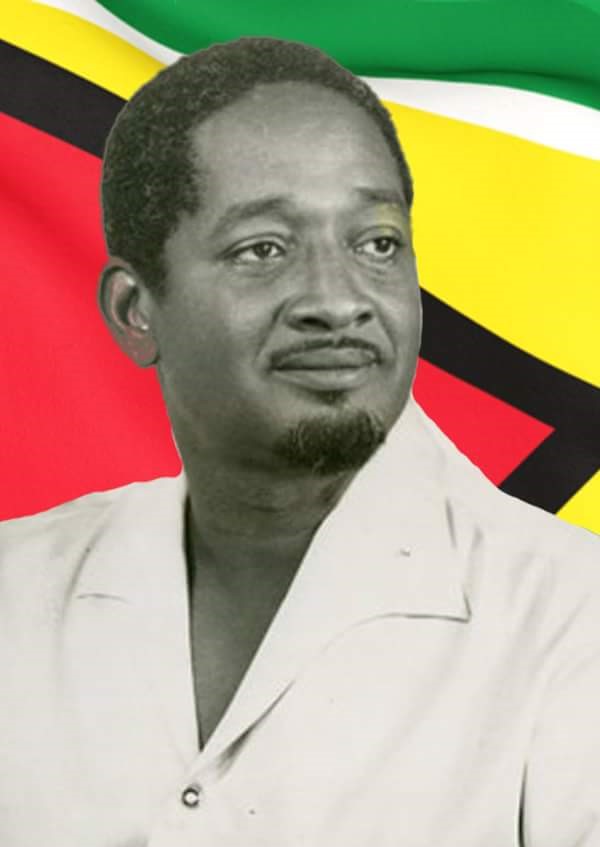
First Executive President of Guyana (1980-1985)
Photo Credit: Forbes Burnham Foundation (Facebook)
In Chapter Fifteen of my work in progress, I speak about the rise of the autocratic government in Guyana in 1974. In my adopted country, we now face the possibility of re-electing a former President who promises to be a dictator only on Day One. He’s got lots of judicial protection in his favor. On July 1, 2024, the U.S. Supreme Court ruled that “the nature of Presidential power entitles a former President to absolute immunity from criminal prosecution for actions within his conclusive and preclusive constitutional authority. And he is entitled to at least presumptive immunity from prosecution for all his official acts. There is no immunity for unofficial acts.”
Without push-back from Britain and the United States, Guyana Prime Minister Forbes Burnham (1964-1980) consolidated his power through rigged general elections. For the American government, during the Cold War Era, the alternative leftist communist government was a definite no-no. Then, on December 14, 1974, as we the people prepared for the Christmas and year-end festivities, Comrade Leader Burnham declared his political party to be paramount above the State and all its institutions. That included the Courts and all pending cases against activists of the opposition parties. Burnham’s ruling political party and the State became interchangeable.
For those of us outside the corridors of power, our lives changed in unexpected ways. Churches that didn’t support the government’s agenda were viewed as enemies of the State. Any privileges the Catholic Church once held in the field of education were lost. Within three years following the declaration of the “paramountcy of the party,” my life was turned inside out.
Who knows what lies ahead for me and my sons should the framers of Mandate/Project 2025 have their way?
Chapter Fifteen: Paramountcy of the Ruling Party & Free Education for All
In the 1970s, during my semi-cloistered life in the religious community, Guyana’s social and political transformation rammed forward. After becoming a Cooperative Republic in 1970, Guyana joined the Non-Aligned Movement (NAM) of independent, developing nations. United in their desire for national self-determination, these governments rejected the tentacles of colonialism and imperialism. With a membership of 96 countries across Africa, Asia, and the Americas, including the Caribbean Region, they argued that the developing world should abstain from allying with either of the two superpowers at the time—the United States of America and the Union of Soviet Socialist Republics (USSR)—then in the grip of a Cold War.
Our capital city was all abuzz in August 1972 when Prime Minister Forbes Burnham hosted the Conference of Foreign Ministers of Non-Aligned Countries. A monument with the busts of NAM’s four founders—Tito of Yugoslavia, Nasser of Egypt, Nehru of India, and Nkrumah of Ghana—erected in a prominent location in downtown Georgetown, stands as a reminder of that auspicious moment as a young nation. Together with fellow Guyanese, I shared the pride of making our mark on the world stage.
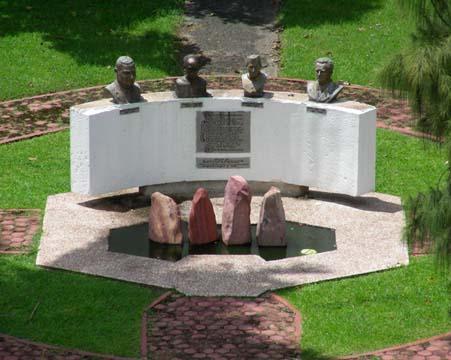
In honor of its founders: President Gamal Abdel Nasser of Egypt, President Kwame Nkrumah of Ghana,President Pandit Jawaharlall Nehru of India and President Josip Broz Tito of Yugoslavia
In our drive for self-determination, our government began nationalizing foreign-owned companies exploiting our natural resources. The bauxite industry became the first target with the takeover of Canadian operations in 1971, followed by that of the Americans in 1973.
During the 1973 general elections, our blossoming pride as a nation suffered a blow with cries of electoral fraud from the opposition parties. Allegations spread of the army’s tampering of several ballot boxes in the Berbice region where rice farmers, fishermen, and sugarcane cutters favored the leftist party of Cheddi Jagan. That year, Burnham’s cooperative socialist party won the elections with seventy percent of the votes. At the time, the nuns had no inkling of what lay ahead for us as a religious community and nation.
On December 14, 1974, at Plantation Sophia in Georgetown, Prime Minister Forbes Burnham declared the “paramountcy of the party.” The ruling People’s National Congress (PNC) and the State became interchangeable. All institutions of the State, including the courts, were to be considered agencies of the ruling PNC and subject to its control. The objectives of the ruling party became public policy. From thence forward, opposition groups—including those within the Catholic Church—operated within prescribed limits.
The Declaration of Sophia, as it became known, set out the premises upon which our socialist country would be based. Instead of the capitalist system of production of goods and services for individual profit, the gains of production would be applied to the use and service of we the people. Surpluses would be invested in development and providing services to all. What’s more, socialism would establish a classless or egalitarian society. How could the struggling working class oppose such noble goals? How could the Catholic Church?
To achieve this socialist ideal would require much more than taking control of our land, land use, natural resources, and major industries. We would also have to revolutionize our education system. The old colonial and capitalist values had to be eradicated. The Guyana National Service (GNS)—a paramilitary, public service organization formed earlier that year—would become part of the educational system. With separate units for children in primary (8-14 years) and secondary schools (12-18 years), and for young adults (18-25 years), GNS served as the means to promote the concept of the new Guyana man and woman and our role in nation-building. Participants engaged in more than military drills and public parades. Agricultural projects provided on-the-job training in cultivating black-eye, corn, cotton, legumes, and peanuts. Some GNS centers offered skills in breeding poultry, swine, and other livestock.
Starting in September 1975, tuition fees were abolished for pursuing a degree at the University of Guyana. That was good news for me, a final year 1975-1976 undergraduate. As we would soon learn, there was a catch. One year of National Service became a requirement for pursuing studies at the university. To receive our degrees, the graduating class of 1976 would have to complete only three months of National Service, since we had received only one year of free tuition. Together with about ten other graduates, I served my three months at the GNS recently acquired publishing center located in Georgetown. Our weekends were reserved for military drills, agricultural activities, and political indoctrination classes conducted at the Plantation Sophia Complex.
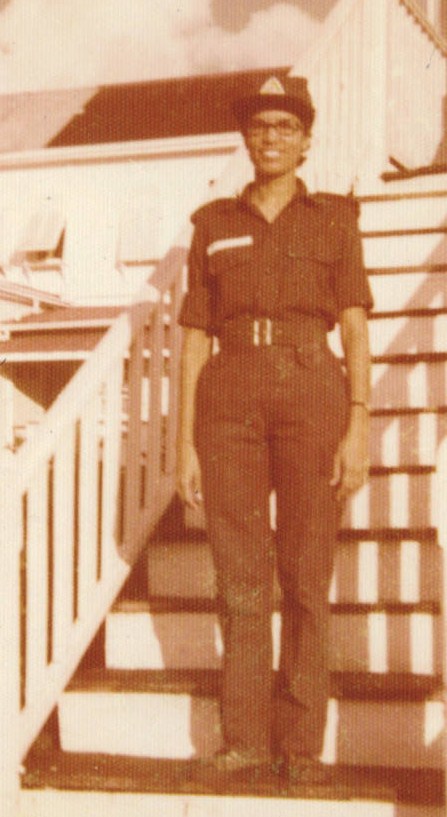
While there was an outcry among Indo-Guyanese families for their daughters’ safety at GNS outposts in Guyana’s Interior, the Christian churches feared that the socialist state would prohibit religious education in the schools. Comrade Leader Burnham did much more. In 1976, his government took over all schools owned and/or run by the Catholic Church and denominational churches. Education became free from kindergarten to university. What a difference that would have made for my mother who had labored for years to pay for our high school fees! More children from working-class families like mine could now have a secondary education and attend university, if desired.
Our lives as teaching nuns and priests changed overnight. We became public servants, subject to the policies and whims of the State. We were not alone. Our country’s largest industry and employer, the sugar industry, was the next industry to come under State control.
In 1976, after nationalizing two British-owned sugar estates the previous year, our socialist government went after the vast holdings of the Booker group of companies. So extensive were their interests, pre-independent Guyana was referred to as ‘Bookers Guiana.’ They wholly or partly owned the remaining nine sugar estates, controlled the bulk of the retail trade, engaged in shipbuilding, and produced rum and rubber. They manufactured eighty-five percent of Guyana’s sugar and accounted for forty percent of our exports. The government signed a compensation agreement with Bookers for G$102.5 million with payment over twenty years.
With nationalization of the sugar industry, the State replaced Bookers as our biggest employer. What was considered a good thing for our economy and development soon turned out to be a curse for working people. Simply criticizing Comrade Leader Burnham, the ruling party, or its policies could put you out of your job. Without your permission, contributions to the ruling party were deducted from your salary. The workers’ unions, offering protection against arbitrary dismissal and other abuses, soon came under fire. To gain control, the State infiltrated the workers’ unions and their governing body, the Trade Union Council, achieving its aim by 1980.
The privately owned media companies were not spared. Criticism of the leadership and the policies of the State were not tolerated. By 1974, Burnham’s ruling party had already gained control of our country’s three major newspapers. The only surviving independent newspapers were published by Jagan’s opposition labor party (daily) and the Catholic Church (once weekly). One of the two radio stations owned and controlled by a British firm was taken over in 1968. Though the other radio station was not bought until 1979, Burnham held strict control of the content they aired. In the seventies, Guyana did not have a TV network. We became a people under siege in an open prison.
Amidst our emergent socialist state, under the heavy hand of the paramount ruling party, arose a new opposition party—the Working People’s Alliance (WPA). In 1974, after teaching at the university in Tanzania and other African countries, Guyanese-born Walter Rodney returned home to take up an appointment as Professor of History at the University of Guyana. But our Comrade Leader used his influence to rescind the appointment. Thirty-two-year-old Rodney—a historian with a Ph.D. in African History, Pan-Africanist, and political activist—had already created waves in Jamaica for his work among the island’s poor and oppressed people. Unable to take up the position at the university, Rodney remained in Guyana and joined the newly formed WPA in a leadership position.
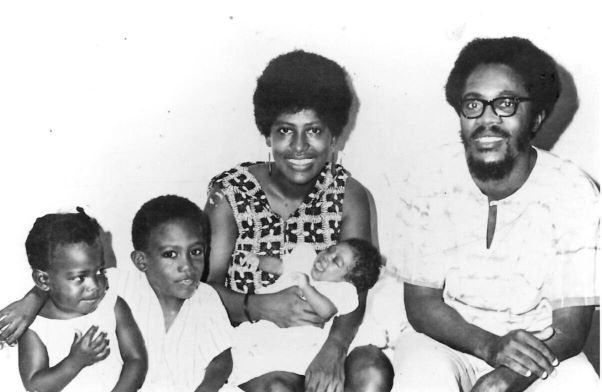
Photo Credit: Walter Rodney Foundation
In September 1976, under this political landscape, I moved to Guyana’s remote Northwest Region to take up an appointment as the geography and art teacher at the Northwest Government Secondary School in Mabaruma, the government’s administrative center for the region. I would learn that eradicating our old colonial and capitalist values does not happen with a mere Declaration and its new code of conduct for party members. Instead, we replaced our former white masters with new masters. The abuse of men in power was still very much in evidence, as I describe in the following chapter of being sexually harassed by the District Education Officer of the Ministry of Education.
 Three Worlds One Vision
This should be read by those who support GOP or are undecided in your next election. Most people have no idea (including me) how horrible things could be. My husband grew up in Communism, which although is at the other end of the spectrum, has many similarities in how it affects the average person. I shudder when I hear his stories. Thanks for sharing this chapter Rosaliene. Maggie
LikeLiked by 3 people
You’re welcome, Maggie. As your husband must’ve mentioned, there comes a time when you don’t know who to trust.
LikeLiked by 2 people
This frightening reminder reinforces how lucky we are over here
LikeLiked by 1 person
And may it remain that way for many years to come, Derrick.
LikeLiked by 1 person
Nice post 🌺🌺
LikeLiked by 1 person
Thanks very much, Satyam 🙂
LikeLike
Great timely post Rosaliene. The first step in autocracy is to discredit the press, the next is to discredit the opposition and the truth. #45 was doing this even before he came to power. America has come too far away from being ruled by a foreign overlord to go back now. Project 2025 is the MAGA manifesto and everyone should read at least part of it before casting their vote for dictatorship. Have a pleasant day. Allan
LikeLiked by 3 people
Thanks very much, Allan. In the US, thousands of people already live in an alternate reality in which they are continually fed alternate truth and facts.
LikeLiked by 3 people
Your posts continue to intrigue me, Rosaliene. We have seen power rise and fall, all over the world. Now is particularly unstable, and the US election in November is getting lots of worldwide attention. I keep saying the US needs to build from within. We have lots of talent and lots of unrecognized internal value in our people. Anyone wonder where the name Pacific Ocean came from?
LikeLiked by 1 person
Thanks very much, Katharine. I survived to see the passing of our Comrade Leader, who had boasted of his family’s longevity, in 1985 at the age of sixty-two.
LikeLiked by 1 person
Rosaliene, a fascinating historical look at your life, Guyana, and authoritarianism.
LikeLiked by 2 people
Thanks very much, Dave. The historical setting is important when telling our stories, since we don’t live out our lives in a vacuum.
LikeLiked by 1 person
That is SO true, Rosaliene.
LikeLiked by 1 person
I just watched a YouTube video about a new book by Anne Applebaum ‘Autocracies INC’. I think you already know about them! Great post, Rosaliene! 🤗🌹🙋♂️
LikeLiked by 1 person
Thanks very much, Ashley. Thanks, too, for bringing Applebaum’s latest book to our attention and for the video link. I’ve added her book to my To Read List.
LikeLiked by 1 person
Sorry, meant to add this link:
LikeLiked by 1 person
“We became a people under siege in an open prison.” —- This sentence, I think, says it all.
LikeLiked by 3 people
Thanks very much, Neil.
LikeLiked by 1 person
Thanks for the history lesson of Guyana in your 20s. Were people hopeful at first that the government of Forbes Burnham would produce change, but more skeptical as he stayed in power? Great photo of you in your GNS uniform!
LikeLiked by 1 person
You’re welcome, Rebecca. His supporters were, indeed, hopeful for change. As was I. But, as often happens, absolute power corrupts the mind. Glad you like the photo 🙂 It was taken on the front steps of the Hospital Convent, where I was living at the time, by one of the sisters.
LikeLiked by 1 person
Rosaliene, thank you for this fascinating read; your writing is a compelling impeachment of the power structures men continue to advance around the world.
It’s rather horrifying to see half of American polled voters blindly heading in the direction of this type of tyranny, and remarkably, hearing the plans in advance. While not everyone will know history like you’ve shared, surely the promise that “you’ll never have to vote again” should chill everyone into thoughtful reflection and a clear choice.
LikeLiked by 3 people
You’re welcome, Steve 🙂 It’s distressing to watch our slide into an autocracy under the leadership of an unscrupulous man who admires dictators.
LikeLiked by 1 person
I’m sure it is; it’s disturbing to watch from across the border, too. Here’s hoping common sense will prevail, Rosaliene.
LikeLiked by 1 person
This is an interesting history lesson, Rosaliene. Seems like having a government by and for the people is a very difficult thing.
LikeLiked by 2 people
Thanks very much, Mara. For too long, we’ve taken our democracy for granted.
LikeLiked by 1 person
The step by step removal of freedom would surprise no one who knows Germany’s history after Hitler’s assention to power. How sad and terrifying. Thank you for the reminder of historical lessons and their potential application to the present day. Everyone would do well to take note, especially those who value our Democratic Republic.
LikeLiked by 2 people
Dr. Stein, it’s easy to forget the lessons of the past after securing a victory. But those who seek to rise again to achieve absolute power are never at rest.
LikeLiked by 1 person
Rosaliene, thank you for posting these in-depth, informative, and important posts. Your history is frightening for what you went through and the possibilities of what will happen in the US.
LikeLiked by 1 person
Thanks very much, Mary. Our Democratic Republic stands on unstable ground.
LikeLiked by 1 person
You’ve seen and experienced so much, Rosaliene. Thank you for sharing this glimpse into your life in the aftermath of the CIA helping install Burnham in office. The damage the US has done around the world is shameful. I’m sorry for all you and other peoples have endured as a result, but am grateful for how you shed light on hard topics.
LikeLiked by 2 people
You’re welcome, Tracy. Power corrupts the mind and blinds men to their own folly. Solidarity!
LikeLiked by 1 person
The one thing we have in abundance right now is human folly. 😦 Solidarity, always.
LikeLiked by 1 person
OMG Rosaliene, men in power who abuse that power by manipulating and misleading others as a result of their arrogance, seems like an all too common occurrence lately. I simply can’t understand how people can walk around with their eyes shut. But of course there are many who face great danger speaking out. Nowadays, complicity is not acceptable! 😠
On a much lighter note my sistah, I must say you know how to rock a military uniform. I am simply impressed by all of the personal events you survived my friend. You possess an unbelievable strength to thrive beyond surviving. Thanks so much for sharing this message of courage! 🥰💖🤗
LikeLiked by 1 person
Thanks very much for your kind praise, Kym 🙂 I get the sense that Americans believe that our democracy is secure and are unable to see several steps already in place for the rise of an autocratic leader.
GNS was a paramilitary organization. Far from rocking the GNS uniform, I was very uncomfortable wearing pants 😦 There was no end to the comments from the guys who were only used to seeing me in the habit and veil.
LikeLiked by 1 person
Girl Rosaliene I concur with your comment about how oblivious we are on how very close we are to losing our democracy. I want to walk around to deniers and just shake some sense into them. We are living in some dangerous and scary times that people are acting nonchalant about. 😣
But the ignorance of comments that people make simply leaves me in awe. And history somehow seems to repeat itself, but why the horrifying parts of history repeating itself stuns and stings beyond measure we have to cling to hope. While you may not be in a habit and veil now, you still have that inner power to fight and stand for what’s right. You are certainly not one to roll over and die. You’ve seen and been through more than many of us can imagine. When I say you are strong, you are my sistah! 💪🏼
LikeLiked by 1 person
❤
LikeLiked by 1 person
This slightly reminds me of a movie “First they killed my father”, children who survived the Khmer Rouge regime when politics changed the country for the worse!
Anyway, it seems it had become a norm for minerals and resources to be stolen, I thought Africa was the only victim, but Guyana too!
It’s a pity free education has never reached us, there have been more protests begging for free education but fruitless.
LikeLiked by 1 person
Zet Ar, the exploitation of minerals and other natural resources occurred everywhere across the European colonies, with the wealth transferred to Europe. I would recommend that you read “How Europe Underdeveloped Africa” by Walter Rodney, first published in 1972. There’s a 2018 edition available at a reasonable price.
Free public education does have a great impact on the society and, ultimately, the nation’s economy and development. But it’s not cheap as Burnham’s government learned. That’s why the designers of the USA Mandate/Project 2025 is proposing to eliminate the Department of Education.
LikeLiked by 1 person
Thanks for your reference Rosaliene, the name says it all and I will definitely go through it should I get hold of it! As for free education, I wonder how the Scandinavian countries are succeeding executing what other countries are failing to pursue!
LikeLiked by 1 person
You’re welcome, Zet Ar.
LikeLiked by 1 person
I always find it much more interesting to learn history from personal accounts like yours. Thank you for relating these lessons to the frighteningly real risk of a former US President who desperately wants to be a dictator. Part of me wants to think that couldn’t happen in the US, but your experiences show how it could.
LikeLiked by 1 person
Thanks very much, JoAnna. While it seems just like yesterday that Guyana lived through an autocratic regime, that period has now become part of its early history as a young, independent nation. Guyana’s first Prime Minister and Executive President was very charismatic and eloquent. Our wannabe autocratic president has a charisma and allure that most Americans, including myself, have difficulty in grasping.
LikeLiked by 1 person
That most of us have “…difficulty grasping” his “charisma and allure” is putting it nicely.
LikeLiked by 1 person
😦
LikeLiked by 1 person
Such fascinating experiences and observations about the changing socio-political context during a crucial time of your life, Ros, It leaves the reader wanting to read the next chapter! 💜
LikeLiked by 2 people
Thanks very much, Carol! ❤
LikeLiked by 2 people
Ah, as you have already made the connection, we have much to tremble at with the upcoming election. No matter who wins, there’s going to be tumult and upheaval. I sincerely hope it would never rival what Guyana experienced, but many are claiming that ‘The Handmaiden’s Tale’ could become our new reality. Truly, we don’t learn from our pasts.
LikeLiked by 2 people
Tamara, I also share your view that there will be tumult and upheaval following our upcoming elections. The extremist far-right leaders and advocates have led us down a dark path that will further weaken our national cohesiveness.
LikeLiked by 2 people
Very true. If red loses, there will be much ado, that J6 will look like child’s play. If red wins, we may be faced with the same world shifting changes that you experienced in Guyana all those years ago. We need to hang onto our hats!
LikeLiked by 2 people
Dear Rosaliene, you’re creating quite the historical narrative, and your photos add a rich personal detail. Thank you for sharing.
LikeLiked by 2 people
Thanks very much, Michele! My pleasure in sharing our stories 🙂
LikeLiked by 2 people
You’re very welcome and as I’ve said before, your stories are a treasure that have incredible impact potential. You know this better than me! 👏🏻Thank you for sharing.
LikeLiked by 2 people
Interesting well written post that filled in the gaps for the period AFTER I left Guyana, even though I have read some of it in the past. My book RACING WITH THE RAIN is historical-fiction that dwells a great deal in the period immediately following independence.
LikeLiked by 2 people
Interesting, well written post that lays bare the fallacies of allowing a dictator to grab the reins of power, as the British and Americans did when they engineered the PNC into power back in 1966 in Guyana.
LikeLiked by 3 people
Ken, thanks for dropping by and sharing your thoughts.
LikeLiked by 1 person