
Tags
Catholic Religious Community in Guyana, Childlessness, Convent Life, Georgetown/Guyana/South America, Patriarchal Church, Religious Novitiate, Religious Vows of Poverty Chastity and Obedience
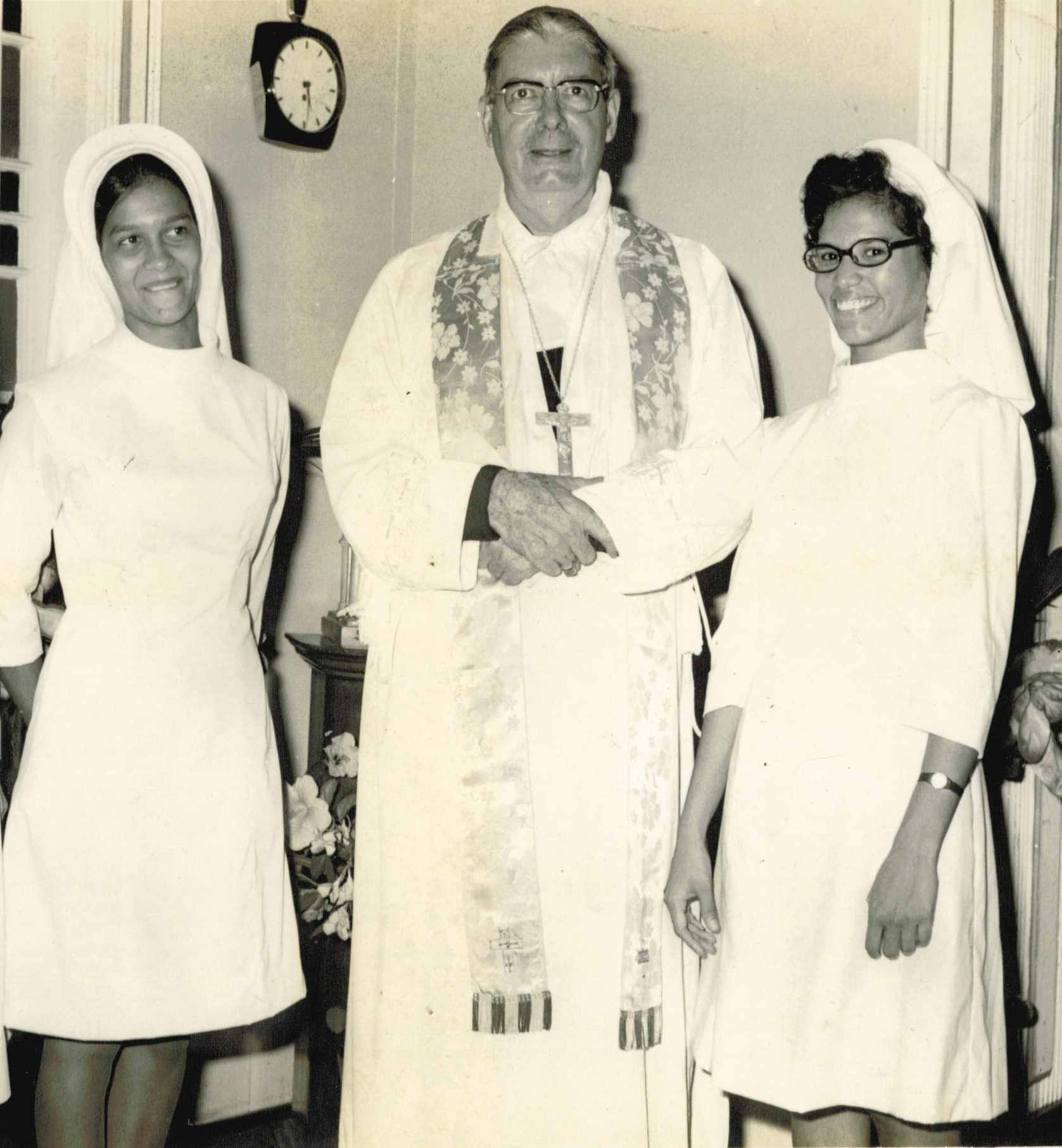
Photo taken by Father Bernard Darke SJ for the Catholic Standard Newspapers
In Chapter Thirteen of my work in progress, I share my failure in living the religious vows as a celibate and childless woman in a patriarchal church. In retrospect, I have come to realize that the Guyana Mission, established during the British colonial period and headquartered in the United States, was not prepared for dealing with young women who challenged the lingering colonial mindset within the community.
The 1970s was a decade of great social-political-economic upheavals in our fledgling nation. The 1976 government takeover of all schools owned and run by the Catholic Church and other Christian denominations struck a decisive blow for the religious community accustomed to its autonomy. By abandoning my teaching post in Guyana’s hinterlands, I unwittingly became the first casualty for the religious community, as discussed in more detail in Chapter 16.
While the sisters struggled to adapt to the country’s new ways of thinking and being, three of the youngest professed local nuns, all trained in the United States, left the community. Of the seven of us, trained at the newly established novitiate in Guyana, only three stayed to make final or perpetual vows.
Nowadays, here in the USA, the patriarchal religious right would like to turn back time to the “Golden 1950s.” Make America Great(er) Again, they implore, bowing down before their Anointed One. A faithful disciple, now sharing the pulpit, believes that “childless cat ladies” shouldn’t have the same civic rights as women with children. What an upside-down world for women who are childless by choice or for biological reasons!
Chapter Thirteen: Living the Religious Vows in a Patriarchal Church
The Novitiate was located on the top floor of an L-shaped building, in the Catholic Hospital compound, that had once served as the nurses’ hostel. The Nursing School occupied the ground floor. Celeste and I lived with six sisters, one of whom was our Novice or Formation Mistress. The oldest was a recently retired elementary school headmistress, three were high school teachers including a headteacher, an elementary teacher-trainee, and the youngest a nurse-trainee at the hospital. Released from our teaching jobs for a year, Celeste and I spent our days at study, prayer and meditation, and charitable work: visiting the sick in the hospital and assisting in the care of abandoned children at the Red Cross Children’s Convalescent Home, not far from the hospital.
As novices, we soon learned that listening to soap operas on the radio—we had no TV in Guyana at that time—was inappropriate for the religious woman.
“It’s escapism,” Sister Marian from New York told us. A petite white woman with the largest handwriting I’d ever seen, she was a teacher and student counselor at St. John’s High School, and our tutor for Psychology 101 during our Novitiate year (1971-1972).
Listening to the radio, so much a part of our lives as Guyanese, was scratched from our daily activities. Though disconnected from worldly affairs to focus on our spiritual formation, we had face-to-face connection with men on a similar journey. Four young Guyanese Jesuit Brothers—two black, one East Indian, and one Portuguese—also in formation, joined us for courses on the Bible, theology, and Church history given by British priests of the Society of Jesus, known as Jesuits. In Paris in 1540, the Spanish soldier-turned-mystic Ignatius of Loyola, together with six companions, founded the religious order of the Society of Jesus.
As early as 1810, before the foundation of British Guiana in 1831, the Anglican Church, also known as the Church of England, had already established itself as the first religious organization in the territory. The Catholic Church, represented by three Jesuit priests, did not arrive until 1857. They came to serve the needs of the growing Catholic Portuguese community who, in 1835, had begun arriving as indentured laborers for the sugar plantations. Eight months later, six more Jesuits joined them. In May 1866, when education became their priority, they opened a Catholic Grammar school for boys in their Georgetown presbytery. With growing enrollment, they relocated the school to a more spacious school building, a few blocks away. They started the Catholic Standard newspaper in 1905 as a monthly Catholic magazine. Instrumental in inviting the English Catholic Religious Sisters to the colony in 1894, the Jesuits maintained a close supportive role with the order. It came as no surprise, then, that the Jesuits would be involved in our (Celeste and I) spiritual training for the religious life.
Of our three Jesuit tutors, Father Gregory was my favorite. A deeply religious and rigidly self-disciplined, ex-military man in his forties, he never shared with us his conversion story to Catholicism. In his classes on the Bible, we learned, among other things, about the different narrative sources—often placed side by side, as in the two creation accounts in the Book of Genesis—for the books of the Old Testament. We also covered the contradictions contained between the four Gospels of the New Testament. This was intriguing information I hadn’t learned in high school. I was hooked.
The study of Church history brought its own revelations about when and how the early Church leaders—popes, papal legates, cardinals, archbishops, and bishops—came to the definition of the Catholic doctrine on the nature of Jesus, salvation, the sacraments, and even the books to be included in the Biblical canon. No doctrine had been fixed in stone as I was led to believe. What’s more, the role of women in the Church was based on archaic beliefs of male superiority over the voiceless and powerless female.
In one of our theology classes, I raised the question of God’s gender. The Jesuit dismissed my question with a smile. At that time in the 1970s, religious sisters in the United States and elsewhere had already begun to question the male gender of God. I shared their view that God is both male and female, as stated in Genesis 1: 27 (as quoted from the King James Bible, 1611): So God created man in his own image, in the image of God created he him; male and female created he them.
In what was then referred to as the Third World countries, there was also the question of God’s racial identity, a topic discussed among our study group but not raised with our white tutors. In Christian art and the statues adorning our churches, God is a depicted as a white European; His son, Jesus is white; Mary, the mother of Jesus is white; and all the angels of Heaven are white. I recall the energy of the young American singers of the Up With People organization during their visit to Guyana in the 1970s. Their song, “What Color is God’s Skin,” resonated with me as I began questioning our long-held colonial beliefs of white racial superiority.
During our free time together before each class, the six of us in formation had a chance to become acquainted and share our experiences about religious life. We chatted about the political changes taking place in our country and our place in the new socialist Guyana. We could not ignore our role as religious men and women serving the poor, sick, and ignorant in speaking out against the abuses of our growing authoritarian government.
During our lunchbreak, we also shared more playful moments. They teased me about my presumptuous manner when talking with Father Gregory, then the Father Superior of the Jesuits in Guyana.
“You have a fresh-up stand-up way of talking with him,” Celeste told me, using our Creole English expression. The others agreed.
“You’re Sister Seducia,” the tallest Jesuit Brother told Celeste with a twinkle in his bespectacled eyes.
“Who is seductive is that attractive American nun…Sister Joanna,” said the shortest and most playful of the Jesuit Brothers. “Her penetrating blue eyes leave a man weak-kneed.”
Sister Joanna, in her thirties, also happened to be our tutor in human sexuality. Our course textbook was titled Everything You Always Wanted to Know About Sex But were Afraid to Ask by Dr. David Reuben (USA, 1969).
The Brothers didn’t join us for Sister Joanna’s course, nor Sister Marian’s psychology course. Our course on the religious vows—poverty, chastity, and obedience—conducted by our Novice Mistress, was also designed only for me and Celeste.
Regulated by the Code of Canon Law of the Catholic Church, the religious vows of poverty, chastity, and obedience are public vows witnessed and accepted in the name of the Church by the Mother Superior of the religious order and the Bishop of the diocese. After completion of our novitiate period, Celeste and I took temporary vows for a three-year duration (see captioned photo), and later renewed them for another three years. Final vows, like the Christian marriage vows, meant a commitment until death. As sacred promises, the vows free the religious sister to live for God and to be a witness of His love, compassion, and care for all people.
The vow of poverty means that the sisters not only live together under the same roof, but also hold everything for common use. As for all sisters, my earnings as a high school teacher went directly to the order for the benefit of all. A small monthly stipend covered expenses with items for personal use, such as clothing and toiletries. There were times when half of my stipend went towards art materials for my students whose parents couldn’t afford to buy them.
Demanding much more than a simple lifestyle, the vow of poverty calls for detachment from material things. Without such attachment, the religious makes a commitment to share her resources, time, and talents with those she served, especially the poorest and most needy. As such, my life became one of solidarity with the poor and remains so to this day.
The vow of chastity—really a vow of celibacy—is a promise before God to live without an exclusive or sexual relationship. The sister making such a vow is no longer free to marry. In dedicating all her energies to God, she frees herself for compassionate love towards the needs of others and the world. It became for me a vow of deep loving commitment for those I served.
Living a celibate life didn’t offer me immunity from attraction for men. And they were many during my four years as an undergraduate at the University of Guyana. I remained faithful through daily prayer and meditation, dedication to my work as a teacher and voluntary social services, as well as avoiding temptations of the flesh. Understanding my body’s menstrual and ovulation cycles also proved invaluable. When our parish priest asked me to teach the natural method of birth control to a group of couples preparing for their marriage vows, I began tracking my ovulation cycle: the woman’s most fertile period of her monthly cycle. I discovered that my sexual desires peaked during this period of natural programming for the propagation of our species. Forewarned is forearmed, as the wise saying goes.
The vow of obedience was for me the most challenging of the three vows. This vow was formulated when kings and queens ruled the world. Moreover, in those early days, bishops, abbots, and abbesses were generally more educated than the general population and believed that they knew best what their underlings needed. Like the monarch, these religious leaders expected those in their charge to obey them, especially in matters of the religious life and God’s ministry.
Before the Second Vatican Council (1962-1965), the Men of God had decided the needs—teaching, nursing, or other social services—of the diocese under their jurisdiction. In turn, following the directives of their bishops and archbishops, the superiors of religious orders had determined what ministry and which location each sister should be assigned.
Vatican II freed religious orders to choose their own ministries and living arrangements. They were freed, too, to modernize or do away with the traditional habit that revealed only the nun’s face and hands. The Guyanese community had opted to modernize the habit, making it less austere and lighter for the tropical heat and humidity. In addition, the sisters no longer had to choose a religious name, but could keep their given birth name, as Celeste and I did.
In accordance with the new directives, religious superiors stopped giving orders to the sisters in their charge. Sisters were encouraged to make their own decisions on where and how to best use their talents and skills to serve God. During the discernment process of prayer and meditation, sisters who needed further guidance could consult a spiritual director, usually their chaplain or parish priest. Wary of the exclusive relationship that could develop—based on my observations, presented in Chapter Fourteen on “The Men of God”—I was never inclined to seek a spiritual director.
Old ways of thinking and doing things can persist for a generation. After years of being told what to do, the older sisters continued to rely on Mother Superior, name later changed to Regional Coordinator, for direction. Some viewed us, the young generation of novices, as disruptive or “having it easy.”
On conclusion of my first year as a novice, at the directives of the Mother Superior and her Council of five sisters, I started studying at the University of Guyana (UG), where I majored in geography and minored in sociology, with an emphasis on Caribbean society. I had preferred to study art but, at the time, the visual arts were not offered at UG. During the mornings, I returned to teaching geography, art, and religious knowledge at St. John’s High School. From five to ten o’clock in the evenings, I attended classes at the university. Since I used public transport to get to and from the Turkeyen Campus, located over four miles (7 kilometers) away from downtown Georgetown, I didn’t return home until eleven at night.
Given my work and course schedules, I was often absent from community events, leading to complaints from some sisters that I was not participating in community life. Struggling to cope with the demands of my teaching job, university course load, parish work, as well as those of the sisters, I suffered my first bout of depression. Fearful of being sent home as unfit for the religious life, I told no one of my struggle to live up to the community’s expectations.
Help came during an official visit to the Guyana Mission, our Mother Provincial from the United States. She arranged to speak privately with every member of the community. When my turn came, I told her about my difficulty in doing everything required of me. Following her suggestion, I dropped one of my university courses. The sociology professor was not at all happy that I dropped out of his course.
My transfer to the convent nearest to the Turkeyen Campus did little to improve my mental health. The move separated me from my emotional supportive group of other young Guyanese women—then totaling seven of us—who, at various stages of religious formation, faced similar challenges.
The double standards within the community irked me. A privileged few could enjoy an exclusive relationship, referred to as a “particular friendship.” Use of the convent vehicle was also a contentious issue. Told not to get accustomed to being driven around, Celeste and I were given bicycles to move around town. No problem. I was used to getting around Georgetown on a bicycle or on foot. Yet, we were expected to learn to drive so that we could help with chauffeuring the older sisters. My refusal to learn to drive, in keeping with a life of poverty, didn’t go down well with my superiors. I was stubborn that way.
I also objected to being treated like a former colonial subject. At a silver jubilee celebration of one of the sisters, we the seven young Guyanese sisters in formation were assigned to a table in the back of the large dining hall of the Motherhouse. This wasn’t the usual buffet event. Our responsibility was to serve the sisters and invited guests, as done in the days before Vatican II. Under colonialism, such treatment might have been great in fostering humility and obedience among sisters of the privileged class. As a young working-class Guyanese of an independent socialist nation—forged in the fire of our struggle for independence—I found this antiquated religious practice offensive and belittling. To be sure, my attitude did not win me friends among the older sisters. One called me an “upstart.”
My interpretation of the virtue of humility conflicted with that of my religious superiors. Humility, in my mind, meant acknowledgment of my nothingness before God. It meant, too, treating ALL people as equal in God’s sight. To the patriarchal Church, humility meant total submission to God’s will as represented by my religious superiors.
We were also subjected to humiliating yearly evaluation sessions of our progress before the Mother Superior and her Council. I always fell short. It was not enough that I had given up everything I held dear to follow Jesus and live a religious life. I was still not worthy to serve Him.
With my acute sense of fairness and justice, I challenged the authority of both religious women and the Men of God. I paid the price.
“You have an authority problem,” a member of the Council once told me.
“You lack emotional maturity to deal with conflict situations in community life,” the Regional Coordinator told me, after she and her Council had discussed my case. In desperation, I had done the unacceptable: I had abandoned my teaching post in the Interior Mission and returned to the capital. (I share details in Chapter Sixteen: Sexual Harassment as a Public School Teacher.) Their final verdict: Not suited to the religious life. Must leave. Did any of them speak up on my behalf?
I left the convent during Christmas Week 1977. Nine months later, I returned to witness Celeste make her final vows in the presence of Guyana’s first local bishop—a descendant of East Indian indentured laborers.
The pain of inadequacy, failure, and rejection settled in my bones.
 Three Worlds One Vision
More most insightful biography. I would prefer something like “disillusionment” to “failure” in your first introductory sentence. Having been educated in a Jesuit grammar school, when, in my twenties, and married with three children (the eldest from my first, late, wife) I was struggling with my faith it was natural to seek advice from one of the priests in the parish. He asked me what work I did. When I said it was Social Work, without exploring this at all, he said that the habits of my clients had rubbed off on me. I never went back there and it took me about 12 more years to abandon my guilt at lapsing.
LikeLiked by 3 people
Thanks for your kind comment, Derrick, and for sharing your own experience. My disillusionment with the Catholic Church would come later in Brazil when I stopped going to church. How easy for your parish priest to blame you for your struggle. Fear and guilt are powerful weapons deployed for those who dare to question the tenets of their faith.
LikeLiked by 3 people
The use of fear and guilt are universal, not restricted to any religion. Parents use it, too, and today’s media, to guiltify people into various emotions. The predictive power of negative expectation holds sway. Even weather forecasts change my daily plans, sometimes.
LikeLiked by 1 person
Rosaliene,
Yet another insight into the adaptation of church and changing statehood in colonial Guyana. How tumultous a time for you and your contemporaries! Where else could I learn of such personal upheavals and of their repercussions around the world?
Growing up in the Southern US of A, I knew or cared little about world events at that time. I was focused on breaking ties from family expectations and being free to make my own decisions.
Like you, I tried to conform to the expectations of adults. Also like you, I lost faith in conventional beliefs about how things ought to be, but I was an “upstart” too, for daring to go my own way.
Unfortunately, the cloak of religion hides a lot of personal weakness, in both sexes, as we are seeing now, in many religions.
But like you, I still respect the humble Golden Rule, to do unto others as I would have them do unto me.
LikeLiked by 2 people
Katharine, thanks for sharing your own struggles of dealing with the expectations of family members and other adults. It’s a losing game since there’s often a backlash for making our own choices and decisions. What a difference it would make if we could all follow the humble Golden Rule.
LikeLiked by 1 person
Yes, It took me a long time to realize that others’ expectations were holding me back, yet I’m glad my family also gave me the will to fight. I have a lot to be grateful for.
LikeLiked by 1 person
We learn with each setback, don’t we?
LikeLiked by 1 person
Yes, all day long, and every day.
LikeLiked by 1 person
An interesting read.
LikeLiked by 1 person
Thanks very much.
LikeLike
A very interesting story Rosaliene. Funny, how religion has been used for many years to control the people and particularly women. Now with good old DJT spewing and Project 2025, they are again trying to control everything, but mostly women. It is a sad regression and I do hope the voters do not fall for it. It is time for the all men and women are created equal part. Happy Sunday. Allan
LikeLiked by 2 people
Thanks very much, Allan. The patriarchy has difficulty in accepting women as equal partners in society. They continue to do whatever it takes to maintain their dominance and power. As I see it, DJT is only a tool to achieve their goals.
LikeLiked by 1 person
He’s a tool, alright
LikeLiked by 1 person
It’s puzzling and incredible to me that the patriarchal religious right contains so many members. They are the opposite of forward-thinking. How fine the world would be if 75% or more of the population were forward-thinking.
LikeLiked by 1 person
As I see it, Neil, it’s not that simple a proposition. Forward-thinking is not immune to error and lack of foresight.
LikeLiked by 1 person
A very compelling remembrance, Rosaliene, with your personal story closely tied to the questions of religion, patriarchy, and more.
LikeLiked by 1 person
Thanks very much, Dave.
LikeLiked by 1 person
Such an honest account of a life that is so foreign to me. Your comparison to what is happening in the US right now is frightening. Maggie
LikeLiked by 1 person
Thanks for reading, Maggie. It’s indeed frightening to realize that all our gains as women over the last 100 years could soon be lost if the designers of the “Mandate for Leadership 2025: The Conservative Promise” have their way.
LikeLike
An extraordinary story, one which tells of the use of “force” of a sort to obey the mortals, rather than to obey God. The failure was not yours, Rosaliene.
LikeLiked by 1 person
Thanks very much for your kind words, Dr. Stein. Coercion takes many forms.
LikeLiked by 1 person
I like your description of the vows, especially the vow of poverty, to not be focus on material goods and instead help others who have very little.
LikeLiked by 1 person
Thanks very much, Rebecca. Imagine my culture shock when faced with the consumer-driven American way of life.
LikeLiked by 1 person
I can’t imagine the culture shock, Rosaliene. It must have been very difficult to get used to!
LikeLiked by 1 person
It was for sure, Rebecca! To top it off, I ended up working for four years at one of America’s top retail chains. A total immersion in consumerism 🙂
LikeLiked by 1 person
Oh my gosh, salesperson. That must have been hard on the feet. I was a cashier for two years. Sure gives one an interesting view on humanity. I am So Patient waiting in line now!
LikeLiked by 1 person
Rebecca, it was sure hard on my feet! After years of sitting behind a desk, I was not accustomed to standing for eight hours. When the knee and foot pain started, a supervisor recommended New Balance footwear; the in-house pharmacist recommended Osteo-Flex supplements. Both offered much-needed relief 🙂
LikeLike
So glad you found a way to support your feet, Rosaliene! That makes all the difference.
LikeLiked by 1 person
I learn so much from each of your posts. The failure was not yours.
LikeLiked by 1 person
Thanks very much for your kind comments, Ginger 🙂
LikeLike
The layers of learning from your story are incredible. Thank you for the time you spend with historical information, personal reflection and perspective, wisdom, and much more. I sure know what it’s like to spend your own money for students who would otherwise go without. Love this: “A petite white woman with the largest handwriting I’d ever seen” – for your attention to those details! Great photo, too!
LikeLiked by 1 person
Thanks very much, Michele. I appreciate your feedback on the writing process. I remember the strangest things about each sister. Some things are best not shared. Glad you like the photo 🙂 At that joyful and memorable moment, my younger self had no idea what lay ahead.
LikeLiked by 1 person
You’re very welcome, Rosaliene. It is an honor to read your unfolding story. It is interesting and fascinating to be immersed in writing about the past and what the mind offers, when given the time. I sure understand that! The future is a grand mystery. Writing gives us the opportunity to reflect and try to make sense of things.
LikeLiked by 1 person
Michele, I’m pleased that you find my unfolding story engaging 🙂 Your comment about writing helping us to make sense of things is so true. It can also be very cathartic.
LikeLiked by 1 person
Absolutely, yes. I am grateful for all of the learning and lessons writing has offered. Thank you so very much for sharing yours!
LikeLiked by 1 person
🙂 ❤
LikeLiked by 1 person
Thank you for sharing your insight and experience. I was pleasantly surprised that sisters in the 70s questioned God’s gender and appreciate the reference from Genesis. I’m sorry you had to go through that pain of “inadequacy, failure and rejection” and hope there has been a lot of healing for you over the years. Still, I know that kind of healing can be an ongoing, layered process.
LikeLiked by 1 person
Oh, and I saw you as courageous and honest in your questioning the authorities.
LikeLiked by 1 person
Thanks very much for your kind comments, JoAnna ❤
LikeLiked by 1 person
❤
LikeLiked by 1 person
JoAnna, when I decided to include auto-biographical information in my women’s book, I had no idea of the pain involved in reliving that period of my life. I had forgiven the nuns years ago, but forgiving my younger self has been an ongoing process.
LikeLiked by 1 person
Forgiving ourselves seems the hardest. I’m glad you’re including autobiographic info. It makes it more real and personal.
LikeLiked by 1 person
JoAnna, I appreciate your feedback about autobiographic info. Thanks.
LikeLiked by 1 person
You are welcome!
LikeLiked by 1 person
Thanks for sharing your interesting past in excellent detail, Rosaliene! It’s especially interesting to me since my dad’s family is Catholic. It must have taken a lot of courage to go against the grain!
LikeLiked by 1 person
I appreciate your kind feedback, Mara. Details are essential elements of storytelling. I surprise myself in remembering so much. I don’t recall seeing myself as courageous. I grew up questioning the actions of adults around me.
LikeLiked by 1 person
God gave you the ability to discern, Rosaliene. You are an intelligent woman. I’m sorry that intelligence made you feel unfit.
LikeLiked by 1 person
Sad to say, Mary, the nuns did not agree with my discernment. As I’ve come to learn over the years, intelligent women are a threat to the patriarchal male. We can see it play out with yet another woman running for the top post. Will she be the one to achieve the inconceivable?
LikeLiked by 1 person
I sure hope so! VP Harris has my vote.
LikeLiked by 1 person
Sistah Rosaliene, the patriarchal society on all levels can torment women to make them feel inferior when they are more intelligent and knowledgeable than their male superiors. I admire your strength. This one is for you my girl. https://youtu.be/bto_IqNmOCU?si=C-Gr0J22TRPtUpEP
LikeLiked by 1 person
Thanks so much for your kind comments, Sistah ❤ The song brought me to tears: I did not know my own strength.
LikeLiked by 1 person
Oh girlfriend, you thought you didn’t know your own strength, but the power for the courageous moves you made, came deep from within. You are a true inspiration for sure. 🙏🏼 Thank you for sharing your courageous journey with us. 😊💖🤗 Hugs and smooches! 😘
LikeLiked by 1 person
❤
LikeLiked by 1 person
I love the way you have interwoven the larger socio-historical context and personal observations and details so seamlessly together. An important and engaging read!
LikeLiked by 1 person
Thanks very much for your kind comments, Carol ❤ I appreciate your feedback about interweaving our inner lives with the outer world. When I decided on the episodic-style structure for telling the stories of women in my life, I was unsure that it would work in connecting with readers.
LikeLiked by 1 person
From what I have learned from ethnographic writing, most works focus on the middle ground, providing descriptions of what writers observe and their interpretations. The next step up includes details about past events and individual stories. The best ethnographies, though, include information from both these levels and link them to a larger historical, political, and multicultural context. That’s what I saw in your chapter.
I know I read a pithy quote somewhere that expresses this far more eloquently, but it’s buried somewhere in my memory, perhaps irretrievably, and in one of the thousands of things I’ve read on my bookshelves and forgotten. But the perspective, which I have found valid, did come from a notable scholar on this topic. 😂
LikeLiked by 1 person
Carol, you’re right in regarding my work-in-progress as ethnographic since I write from the viewpoint of a participant observer. Thanks again for confirmation that my work, at least this chapter, succeeds as a valuable ethnographic study of male-female relationships in Caribbean culture of the period under examination. Your viewpoint is much appreciated ❤
LikeLiked by 1 person