
Tags
Brazilian Poet Angélica Freitas, Climate Change Deniers, Climate Crisis, Poem “porto alegre 2016” by Angélica Freitas, Poetry Collection Canções de Atormentar by Angélica Freitas (2020), Porto Alegre/Rio Grande do Sul/Brazil, Record-breaking Flood in Rio Grande do Sul 2024
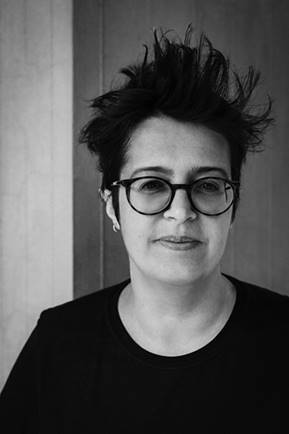
Photo Credit: Dirk Skiba / Companhia das Letras, Brazil
In my Poetry Corner June 2024, featuring a Brazilian poet, I would like to call attention to a climate change disaster that struck the people of Porto Alegre, capital of Brazil’s southernmost state of Rio Grande do Sul.
The contemporary poet and translator Angélica Freitas is no newcomer to my Poetry Corner. In May 2019, I featured her poem “the woman is a construction” from her poetry collection a uterus is the size of a fist / um útero é do tamanho de um punho (2012). This month’s featured poem “porto alegre, 2016” is from her third collection Songs of Torment / Canções de Atormentar (2020). In this collection, she takes a wider view of injustice, machismo, and her disillusion with the Brazilian dream that’s still out of reach for the majority.
Born in Pelotas, Rio Grande do Sul, in 1973, Angélica Freitas began writing poetry at the age of nine, but her journey to finding herself as a poet took a long and circuitous route. Her discovery, at fifteen years, that she was gay made it difficult to fit in with her peers. Bullies found her and easy target. Then, her father’s sudden death when she was eighteen upended her dream to study in Glasgow, where she spent six months with a Scottish girlfriend.
With her mother’s insistence that she earn a university degree, she opted to pursue a career in journalism at the Federal University of Rio Grande do Sul in Porto Alegre. She remained in the capital after graduation, where she could be invisible. In 2000, an unexpected acceptance as a trainee with O Estado de São Paulo, one of Brazil’s largest newspapers, led her to the metropolis of São Paulo.
Freitas confessed that she wasn’t a good reporter, but that the experience exposed her to the other realities of life. During a period of depression in 2005, she attended a poetry workshop conducted by Carlito Azevedo, a poet from Rio de Janeiro, that changed the course of her life. At 31 years old, she realized she was on the wrong path. During an interview for the Public Library of Paraná, she said:
“Okay, I want to write, but it’s not journalism, it’s poetry. You see, that was in my face the whole time. It was what I had been doing since I was little. So that’s it. Best to quit my job and dedicate myself to literature. I called my mother and said I was thinking about spending time in Pelotas. She supported me. Six months later, I resigned, handed over my apartment. Then I returned to Pelotas to organize and finish writing what became my first book, which was called Rilke shake.”
The six-stanza poem “porto alegre, 2016” deals with events worldwide that soon become a reality in one’s neighborhood. The poem could well be describing our world and lives in 2024.
when you saw it on TV
those people queuing in the rain
at night on a road
on the border of a country that doesn't want them
For those among us who might have forgotten, 2016 was the year that thousands of Syrian refugees, fleeing the civil war in their country, amassed at the borders of European countries. Here in the United States, the number of migrants on our southern border with Mexico have ballooned into thousands. On June 4, 2024, President Biden announced new executive actions to bar migrants who cross our southern border unlawfully from receiving asylum.
and when you saw the bombs
fall on distant cities
with those houses and streets
so dirty and so different
In Syria in 2016, Russian and Syrian government forces unleashed a fierce bombing campaign on the rebel-held eastern part of Aleppo. They made no attempt to avoid killing women and children. Using cluster and incendiary bombs, they targeted medical facilities, search and rescue teams, and aid workers. Sounds familiar?
Fast forward to 2024. Following the Hamas October 7, 2023, attack that killed more than 1200 Israelis and took hostage more than 240 people, the Israeli government has rubblized the Palestinian Gaza Strip and killed an estimated 34,622 civilians as of April 30, 2024. The fully identified death toll is comprised of 7,797 children, 4,959 women, 1,924 elderly, and 10,006 men.
and when you saw the police
in the square of the foreign country
attack the protesters
with tear gas bombs
In September 2016, the fatal police shooting of a 43-year-old man in Charlotte, North Carolina, sparked overnight protests and unrest. Protestors threw rocks at the police, injuring 16 officers, while police wearing riot gear fired tear gas into the crowds.
you didn't think twice
nor change the TV channel
and went to get food
in the fridge
How easy it is for me to become numb to hatred, violence, and war that threaten and destroy the lives of others in faraway places. I am comfortable in my personal space. I want for nothing. My refrigerator is stacked with my favorite food and drinks. I am safe.
you didn't notice what was coming
that it was just a matter of time
you didn’t interpret the news as a sign
you didn’t need to stock up on groceries
By the end of 2016, nearly 5.2 million refugees and migrants reached European shores, undertaking treacherous journeys from Syria, Afghanistan, and other countries torn apart by persecution and war. That year in the United States, a presidential candidate promised to build a wall on the border with Mexico to keep out the caravan of refugees fleeing violence and hunger in Latin America and the Caribbean.
now the spoon falls from the mouth
and the sound of a bomb is outside
and the police come after your belongings
armed with swords, on horses
In 2016, thousands of protestors filled the streets in major cities across Brazil, following the impeachment and removal from office of the country’s first female president. The interim all-male and all-white government, established on August 31, 2016, began dismantling the social policies and institutions that had lifted millions of Brazilians out of poverty. The newly elected president who rose to power in 2019 was a climate change denier like his counterpart in the United States.
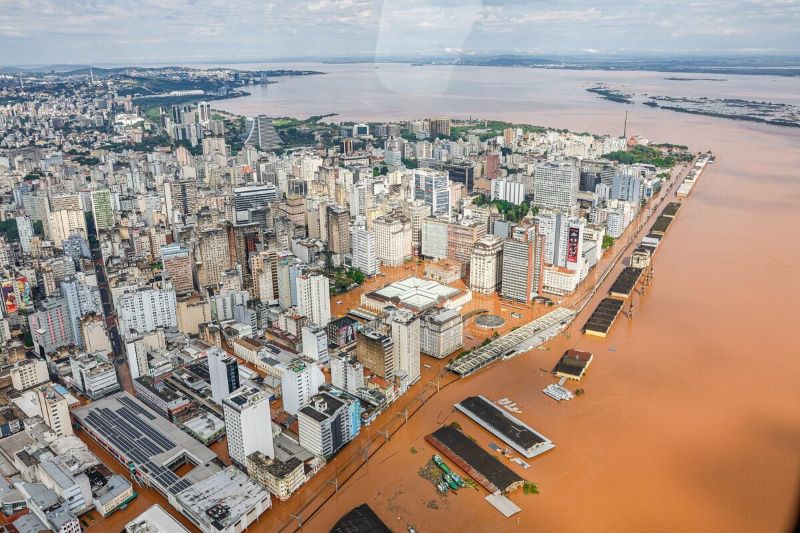
Photo Credit: Ricardo Stuckert / PR
Between April 24 and May 4, 2024, over 16 inches (420 mm) of rain fell across the State of Rio Grande do Sul, breaking the historical record. More than 90 percent of the state was hit by flooding, an area equivalent to the US State of Wyoming or the United Kingdom. The capital of Porto Alegre, with a population of 1.3 million (Census 2022), was not spared. More than 300,000 homes were flooded, as well as the port and airport.
Essential services were also disrupted across the state, leaving 418,000 households without electricity and over a million consumers without water. Several municipalities lost telephone and internet services.
In a Press Release on June 14, 2024, the Governor of the State of Rio Grande do Sul reported that 478 cities were affected, 422,753 people displaced, and over 2.3 million affected. Thankfully, the confirmed missing (39), injured (806), and dead (176) are relatively minimal. An estimated 20,000 cats and dogs were also rescued.
Meanwhile, here in Los Angeles, I’m preparing for another summer of excessive heat. Staying cool and well hydrated are key to avoiding heat stress or heat stroke. Outdoor activities are best reserved for the late afternoon when temperatures fall. I can do this.
To read the complete featured poem “porto alegre, 2016” in its original Portuguese, and to learn more about Angélica Freitas’ work and awards, go to my Poetry Corner June 2024.
 Three Worlds One Vision
A wonderful poem and yes, we learn nothing from history. The basic conditions for war and displacement have not changed and so it will continue as before. The misery will be packaged in a nicer way or made a marginal issue with algorithms. And if we look at the right channels, we won’t see any of it. 🙂
LikeLiked by 4 people
True, true, true, Friedrich. We are so shortsighted and ego-centrist that we are unable to learn from our collective madness.
LikeLiked by 2 people
She was meant to be a poet and she is right, we all watch these things unfold, as if they are a reality TV show. The trouble is that reality (war and climate change) will come for us all one day, if we remain as stupid as we are. Have a good Sunday Rosaliene and stay cool. Allan
LikeLiked by 3 people
Allan, it’s so much easier to dissociate ourselves from the dilemma of others. As in the case of the recent record-breaking flooding in Porto Alegre/Rio Grande do Sul, we live our lives not knowing how close we may be to a catastrophe, whether natural or man-made.
LikeLiked by 1 person
A wonderful poet, with a laser focus on the wrongs of the world. Glad you spotlighted Angélica Freitas again, Rosaliene!
LikeLiked by 2 people
You’re welcome, Dave 🙂 In responding to a question about what it means to be a poet, during an interview with the Continente Magazine in 2020, she said: “I think being a poet is a … very intense way of being in the world, because most people don’t do anything with the stimuli they receive…”
LikeLiked by 1 person
Angelica has a wonderful way with words. I also really appreciate your details to help put the poem into context. Maggie
LikeLiked by 2 people
Thanks very much, Maggie 🙂 It was my way of making sense of her poem. She does, indeed, have a wonderful way with words.
LikeLiked by 1 person
What a world. It’s somewhat amazing that the human race is still around.
LikeLiked by 2 people
It is amazing, indeed, Neil! We should not forget that human civilizations have risen and fallen over millennia. All signs indicate that our current Western Civilization is undergoing collapse.
LikeLiked by 1 person
This is a lot of sadness. I’m glad she has poetry for an outlet. She uses it well. (And she has cool hair.)
LikeLiked by 4 people
I also love this photo of her, Betsy 🙂 There is, indeed, a lot of sadness in our world 😦 Here in California, we have our own challenges with excessive heat and raging wildfires. Stay cool.
LikeLiked by 2 people
A testament to pursuing professional passions and the benefits that can have, not just on the individual but for the greater good. From the excerpts you have shared it is evident that Freitas gives a voice to the voiceless and offers a poetic perspective and increased awareness to violence and tragedy. Thank you for sharing this poet. 🙏🏻
LikeLiked by 2 people
My pleasure, Michele 🙂
LikeLiked by 2 people
Powerful and impactful prose. Thank you for posting Rosaliene ❦
LikeLiked by 2 people
My pleasure, Cindy 🙂
LikeLiked by 1 person
Thank you for this masterful job of making connections between Freitas’s words and our reality, Rosaliene. You connected those many dots, showing our shared humanity. The one thing in all this that makes me very glad is that her mother approved her pivot to her life-long love: poetry.
LikeLiked by 2 people
You’re welcome, Tracy. It does make a great difference to have such support when making a major career move.
We often forget how we are all connected, as you share in your recent post “Day 261: it’s all connected, we’re all connected.”
LikeLiked by 1 person
That was kind of you to link my blog post, Rosaliene. Thank you! It made me happy that right after I posted that, I read your post with all those connections. Synchronicity!
LikeLike
You’re welcome, Tracy 🙂 Synchronicity at work!
LikeLiked by 1 person
The climate is at all of our doorsteps in turn. It was Porto Alegre’s turn, as the poet so well described. But soon it will be everywhere and the toll on the earth immense.
LikeLiked by 2 people
Rebecca, the toll on Earth will, indeed, be immense. Business as usual just makes our predicament much worse.
LikeLiked by 1 person
🥲
LikeLiked by 1 person
Her themes reflect the resilience required in her own life
LikeLiked by 2 people
So true, Derrick. Resilience will be key to our survival in the face of climate disaster.
LikeLiked by 1 person
it’s a pity there are leaders who love waging wars just to fulfill their own selfish desires, not concerned about the defenceless civilians who, some of them, become illegal immigrants in a country where they are not wanted. Unfortunately it has always been like that over the years. This Poet is just on-point!
LikeLiked by 2 people
Zet Ar, our lives mean nothing to those who profit from war.
LikeLiked by 1 person
Poetry and war. The first example must be Homer’s “Iliad,” created before there was written language in Greece.The first word is “rage,” referring to the wrath of Achilles. Has anything changed but for the advance in weaponry?
LikeLiked by 2 people
True, Dr. Stein. We now have the power to kill more people and level the ground. We’ll soon learn that our advanced weaponry is useless against the fury of Mother Nature that we have unleashed.
LikeLiked by 2 people
So sad. Just as many turn away from seeing the suffering of those we don’t know, we turn from the “the fury of Mother Nature.” We need more like Simone Weil, who wept for others and took action.
LikeLiked by 1 person
Dr. Stein, we do, indeed, need more people like Simone Weil (1909-1943), the French philosopher and activist. Your recent article about her, “The Purest Way of Paying Attention to Another,” is not only illuminating but also reminds us of the challenge of connecting and engaging with others.
Here’s the link for any one interested in learning more about Weil’s philosophy:
LikeLike
Insightful as always, Rose. Wow, what a poem! I wonder how long we continue this interminable march into what is sure to be the wreckage of the future without a backward glance at the havoc we’ve left in our wake. The fires, the floods, all of it can’t really still be considered an act of God, right?, especially when so many of us are complicit? Alas.
LikeLiked by 2 people
Thanks very much, Pam. Glad that you like Freitas’ poem. Alas, to admit our complicity and guilt would mean changing our ways.
LikeLiked by 1 person
Not sure why, but I just found this & 23 other post in my spam box & I knew some folk were missing. Just figured it was the vertigo, smh.
Have a great week!
LikeLiked by 2 people
It happens, Tammy. WP can be quite unreliable.
LikeLiked by 2 people
I can see 1 or 2 now & then but it was several of my regulars. I would’ve caught it sooner but was in bed all day due to the vertigo, smj.
LikeLiked by 1 person
Hope you feel better soon, Tammy ❤
LikeLiked by 1 person
Angélica Freitas’s poetry is powerful. She definitely knows how to move the world with her words.
LikeLiked by 2 people
Thanks very much, Mary 🙂 Glad you appreciate her poetry.
LikeLiked by 2 people
Oh Rosaliene, thank you for sharing such an amazing poet whose mission reveals how we don’t get it until it happens to us. Angélica Freitas is truly a warrior and I adore her sentiments when she said, “…experience exposed her to the other realities of life.” Oh the powerful lessons we learn when we go through some stuff! Thanks sistah queen! 🤗💖🥰
LikeLiked by 2 people
My pleasure, Kym 🙂 As a reporter, she worked for a while covering crime in São Paulo–the worse experiences of the realities of life.
LikeLiked by 2 people
Oh wow Rosaliene how interesting. To survive such conditions and be able to talk about it is so courageous and admirable. Thanks sistah girlfriend. We need to hear more stories about warriors like her! 🥰🙏🏼😘💖🤗
LikeLiked by 1 person
A foreboding poem, Rosaliene. Even with our well stocked fridges, our safety is pretty frail I’d say.
LikeLiked by 3 people
Mara, it is, indeed, a foreboding poem. Our well stocked fridge is useless when a wildfire, flood, or tornado reduces our home to naught.
LikeLiked by 2 people
Sort of like what someone said about the Hitler ‘rise’. Until it happened in my backyard…..
LikeLiked by 2 people
Exactly, Beautiful. It’s just a matter of time. Thanks for dropping by 🙂
LikeLiked by 1 person
👍🏽👍🏽
LikeLiked by 2 people
A masterful weaving of poetry and the state of our world, Rosaliene, and some heartbreaking details here I hadn’t realized. Thank you for spotlight on Angélica Freitas. I’m always inspired by those who follow their dreams.
LikeLiked by 2 people
Thanks very much, Crystal. It is truly heartbreaking what has happened to the people of Porto Alegre and across the State of Rio Grande do Sul. Reconstruction will take time. The poor, working class people may never recover.
So glad that you’re inspired by Angélica’s journey.
LikeLiked by 1 person
Thank you for highlighting this impressive poet and her courageous journey. And for profiling the many male-caused disasters and aggressions costing so many lives and well-being.
The things you and I have to do to maintain comfort seem so trivial when we truly examine what is going on around the world…
LikeLiked by 2 people
You’re welcome, Steve 🙂 So glad that you can appreciate her poetry.
I agree when you say that our concerns seem so trivial when compared with others worldwide. We don’t realize how privileged we are and why millions of people undertake a long and treacherous journey to reach our borders.
LikeLiked by 1 person
May they somehow find welcome and safe refuge… 🙏🏼
LikeLiked by 1 person
Steve, according to 2022 data from the UN Refugee Agency (UNHCR), 108.4 million people worldwide are forcibly displaced. Most refugees (76%) are hosted by low- and middle-income countries. You can learn more at their website and ways you can help.
https://www.unhcr.org/us/
LikeLiked by 1 person
What horrific statistics.
LikeLiked by 1 person
They are, indeed, Steve, and will only get worse as our climate crisis intensifies.
LikeLiked by 1 person
And as greed increases, as well. It’s hard to feel hope in the world sometimes, yet we must.
LikeLiked by 1 person
This is why poets are essential to society. To bring our eyes outside of our comfort zone and to watch learn and listen. But more than anything to have empathy for those who are suffering.
LikeLiked by 2 people
Pam, I’m so glad that you also appreciate the importance of our poets to society 🙂 Thanks for sharing your thoughts ❤
LikeLiked by 1 person
“I can do this.”
What a lovely way to conclude your post.
Go you.
Linda xx
LikeLiked by 3 people
Thanks very much, Linda 🙂 ❤
LikeLiked by 2 people
We need people to leave greed and be content within themselves so that they don’t trample other human beings!!!
There is no amount of bank balance that can fill in the void within the chest filled with insecurity
LikeLiked by 1 person
Thanks for dropping by and sharing your thoughts 🙂
LikeLiked by 1 person