
Tags
A Paradise Built in Hell: The Extraordinary Communities that Arise in Disaster by Rebecca Solnit (USA 2009), Disaster myths, Elite panic, History of Disaster, Human resilience in times of crisis, Natural disaster response
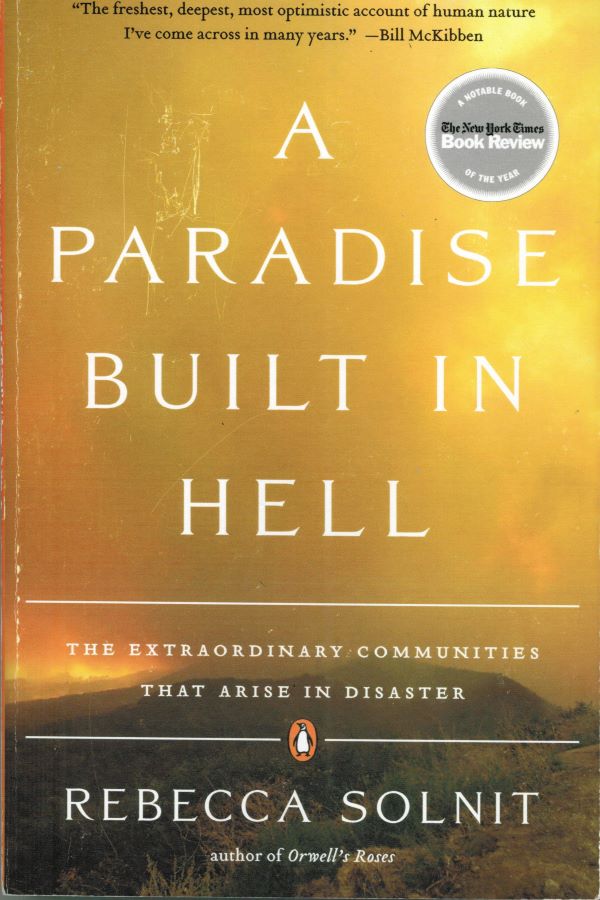
Photo Credit: Penguin Books (USA, 2009)
Who are you? Who are we? The history of disaster demonstrates that most of us are social animals, hungry for connection, as well as for purpose and meaning. It also suggests that if this is who we are, then everyday life in most places is a disaster that disruptions sometimes give us a chance to change. They are a crack in the walls that ordinarily hem us in, and what floods in can be enormously destructive—or creative. Hierarchies and institutions are inadequate to these circumstances; they are often what fails in such crises. Civil society is what succeeds, not only in an emotional demonstration of altruism and mutual aid but also in a practical mustering of creativity and resources to meet the challenges.
Excerpt from “Epilogue: The Doorway in the Ruins,” A Paradise Built in Hell: The Extraordinary Communities that Arise in Disaster by Rebecca Solnit, Penguin Books, New York, USA, 2009 (p. 305).
The disasters covered in this book include: Earthquake San Francisco/California/USA (1906), Explosion Halifax/Nova Scotia/Canada (1917), The Blitz/London/UK (1940), Earthquake Mexico City/Mexico (1985), Bombing World Trade Center/New York/USA (2001), and Hurricane Katrina New Orleans/USA (2005).
REBECCA SOLNIT, writer, historian, and activist, is the author of more than twenty books on feminism, western and urban history, popular power, social change and insurrection, hope and catastrophe. Her books include Orwell’s Roses; Recollections of My Nonexistence; Hope in the Dark; Men Explain Things to Me; and A Field Guide to Getting Lost. A product of the California public education system from kindergarten to graduate school, she writes regularly for the Guardian, serves on the board of the climate group Oil Change International, and recently launched the climate project Not Too Late (nottoolateclimate.com).
 Three Worlds One Vision
This looks like a very inspirational book for our times
LikeLiked by 3 people
Indeed. Thank you, Rosaliene, for sharing.
LikeLiked by 1 person
You’re welcome, Katharine.
LikeLike
Thanks very much, Derrick. It is, indeed.
LikeLiked by 1 person
Powerful, insightful Rebecca Solnit excerpt, Rosaliene.
LikeLiked by 1 person
Thanks very much, Dave. Her study gives me hope as we prepare for more and more extreme weather and other natural disasters.
LikeLiked by 2 people
The title is brilliant.
LikeLiked by 1 person
I agree, Diana. In the “Prelude: Falling Together,” Solnit shared that she was surprised by “the startling, sharp joy [she] found in accounts of disaster survivors…. The possibility of paradise hovers on the cusp of coming into being, so much so that it takes powerful forces to keep such a paradise at bay. If paradise now arises in hell, it’s because in the suspension of the usual order and the failure of most systems, we are free to live and act another way” (p. 7).
LikeLiked by 1 person
Thank you for the introduction to this author, Rosaliene.
LikeLiked by 1 person
You’re welcome, Dr. Stein.
LikeLiked by 1 person
This looks like a brilliant book Rosaliene. I will have to give it a look. Sometimes, all a community needs is common ground. I heard many stories of the London blitz from relatives and friends who lived through it. Keep calm and carry on had to be their daily mantra. Happy Sunday. Allan
LikeLiked by 1 person
Allan, I consider it a brilliant book in that it reveals what we are capable of as citizens when the structures of our economy and society collapse in the aftermath of a disaster.
LikeLiked by 1 person
Sounds great, channeling disaster into impetus for change. Important viewpoint.
LikeLiked by 1 person
Rebecca, it is an important viewpoint, much needed in these times of climate disasters.
LikeLiked by 1 person
People definitely come together, sometimes, under trying circumstances.
LikeLiked by 1 person
Neil, we definitely do. American sociologist Charles E Fritz (1921-2000), who pioneered disaster research during and following World War II, declares: “Disasters provide a temporary liberation from the worries, inhibitions, and anxieties associated with the past and future because they force people to concentrate their full attention on immediate moment-to-moment, day-to-day needs within the context of the present realities.” (As quoted by Solnit, p. 108)
LikeLiked by 1 person
Hi Rosaliene, Thank you for telling us about this book. I’m not familiar with it, but it looks like something I would want to read.
LikeLiked by 1 person
You’re welcome, Barbara.
LikeLiked by 1 person
What a fantastic idea for a book. I’m so glad she wrote this. I do love stories about humans coming together to help each other after disasters. Strangers all have a common enemy in those moments, and strangers, by necessity, become friends. I love this.
LikeLiked by 1 person
I’m so glad that you can appreciate Solnit’s book. It’s filled with lots of real-life stories of how people worked together to overcome very challenging situations.
LikeLike
Sounds great!
LikeLiked by 1 person
I love the quote you’ve shared here, Rosaliene. So meaningful for our times. Thank you.
LikeLiked by 1 person
Thanks very much, Steve. You’re welcome.
LikeLiked by 1 person
My pleasure.
LikeLiked by 1 person
As a matter of fact, this is a brilliant title displaying humanity!
LikeLiked by 1 person
I agree, Zet Ar. The title reflects our human contradictions. Solnit quotes Gioconda Belli, a poet and daughter of Nicaragua’s elite, about the earthquake that devastated Nicaragua’s capital and helped bring on a revolution (p. 157):
“It’s a very profound transformation that takes place during catastrophes. It’s like a near-death experience but lived collectively. It makes such a big difference. I think that’s what brings out the best in people…. Something kicks in and you start worrying about the tribe, the collective. That kind of makes life meaningful.”
LikeLiked by 1 person
Absolutely!
LikeLiked by 1 person
Disasters tend to bring out the best in people under the worst of circumstances.
LikeLiked by 1 person
It sure does, Pablo, and that’s a good thing.
LikeLiked by 1 person
Looks like an important book to read, Rosaliene.
LikeLiked by 1 person
Thanks very much, Mary.
LikeLike
That’s a chewy excerpt, but it sounds fascinating indeed and the notion rings very true. We see it happening over and over as communities gather in strength together, to overcome, when disaster strikes.
LikeLiked by 1 person
Dawn, it is a fascinating notion to know that we are not alone when disaster strikes. Putting aside our differences, we rise up together to meet the challenge. That gives me hope ❤
LikeLiked by 1 person
Amen. Me too. I pray I rise to meet the challenges too.
LikeLiked by 1 person
I’m working on it, Dawn. More about that in my “Thought for Today” post in July.
LikeLiked by 1 person
I look forward to that.
LikeLiked by 1 person
This is a powerful excerpt from this book Rosaliene, and I especially found this so true: “Hierarchies and institutions are inadequate to these circumstances; they are often what fails in such crises.” That speaks volumes my friend. Thanks so much for introducing us to this book. I was not familiar with it, but it sounds like an eye-opening read. 😊📚💖
LikeLiked by 1 person
Thanks very much, Kym. It was, indeed, an eye-opening read to hear the real-life stories of disaster survivors. The book is not a recent publication, but remains very relevant as there is no end these days to the growing number of climate/weather disasters here in America and worldwide.
LikeLiked by 1 person
Oh my gosh Rosaliene, you are so very right about that. You are welcome my dear sistah friend. My pleasure as always! 🥰💖🤗
LikeLiked by 1 person
🙂 ❤
LikeLiked by 1 person
YES to being social animals, hungry for connection! We all do so much better when we remember our shared humanity. Thank you for highlighting this book by the incomparable Solnit.
LikeLiked by 1 person
Exactly, Tracy! This becomes so clear when reading the stories of disaster survivors in Solnit’s book. When we share a collective disaster, we forget ourselves and our differences and work together for our collective survival and recovery.
I’m so glad that you’re familiar with Solnit’s work. I became a fan after reading her 2014 book, “Men Explain Things to Me.”
LikeLiked by 1 person
I put in a request for this one (and thank you for bringing it to our attention), Rosaliene. And I also became a fan by way of “Men Explain Things to Me.” 🙂
LikeLiked by 1 person
You’re welcome, Tracy 🙂
LikeLike
Motivational book ! Well shared thanks 👍🙏
LikeLiked by 1 person
Thanks for stopping by, Priti 🙂
LikeLiked by 1 person
🙏
LikeLiked by 1 person
I so hope we can unite in finding this doorway out of the ruins we all face and I do believe community is key. Thanks for sharing this hopeful sounding book, Rosaliene.
LikeLiked by 1 person
Community is definitely the key, Mara. The stories Solnit shares of disaster survivors indicate that we cannot go it alone when devastation hits a community, whether it’s a small town or large city.
LikeLiked by 1 person
A thought-provoking excerpt that made me think about how Americans came together following the tragic events of 9/11. So many of us doing whatever we could to help, in any way that we could. Thank you for another outstanding author share, Rosaliene.
LikeLiked by 1 person
So glad that you appreciate the author highlight, Michele 🙂 Solnit’s chapter on the immediate aftermath of 9/11 shows Americans at their best. [I was living in Brazil at the time.]
Temma Kaplan, a historian at Rutgers University, recalls (Solnit, p. 197):
“I felt that everybody was holding on to each other in order to try to brace and embrace each other, and it was both a horrible and wonderful experience at the same time. I felt that sense of collectivity I’ve experienced only rarely in my life, and it’s always been in the face of tremendous horror. For a short time, during the first few days after 9/11, I felt that ‘beloved community’ that we talked about in the Civil Rights Movement.”
LikeLiked by 1 person
Thank you so much for making the time to share this passage – made me cry. It was an emotional and confusing time, en masse. I joined a group of people washing cars to raise money. A long line of people waiting to get their car washed, mostly just to help.
“a horrible and wonderful experience at the same time” ~ sums it up.
LikeLiked by 1 person
You’re welcome, Michele. Thanks for sharing your own experience of that emotional and confusing time ❤ My American best friend, who has since passed away, remembered being struck by the silence across Los Angeles.
LikeLiked by 1 person
Thank you for the opportunity to share. The silence… yes, a shockwave that left most of us speechless.
LikeLiked by 1 person
❤
LikeLiked by 1 person
❤
LikeLiked by 1 person
We love all the books of R. Solnit.
She writes a fine style we appreciate.
Thanks and cheers
The Fab Four of Cley
🙂 🙂 🙂 🙂
LikeLiked by 1 person
Thanks for stopping by, Klausbernd. So glad to meet another Solnit fan 🙂
LikeLiked by 1 person
Yes, we are!
The Fab Four of Cley
🙂 🙂 🙂 🙂
LikeLiked by 1 person
Such strength in connection! In the wake of Hurricane Harvey and loss, I was buoyed by the kindness of friends, strangers, and the spirit of community.
LikeLiked by 1 person
Crystal, thanks for reading and sharing your own experience ❤
For readers interested in learning more about Crystal's story, check out her article "That Time When I Met Harvey," published in The Houston Flood Museum journal.
https://houstonfloodmuseum.org/that-time-when-i-met-harvey/
LikeLiked by 1 person
Thanks so much for sharing, Rosaliene!
LikeLiked by 1 person
My pleasure, Crystal 🙂
LikeLiked by 1 person
Somehow, these types of stories give us hope, in a time of constant upheaval
LikeLiked by 1 person
Thanks very much, Pablo. They do give me hope.
LikeLiked by 1 person
Your opening questions “Who are you? Who are we?” calls to mind a book I read recently called QUIET by Susan Cain, about introverts living in a world of mostly extroverts, who are arguably the principal power seekers in the world. If most of us are “social animals,” that would suggest that the term is synonymous with “extroverts”….but I don’t see many extroverts (especially right wing politicians and corporate executives) as being “hungry for purpose and meaning.”
In any case, I’ll stop here before my introverted nature gets disastrously in too deep!
LikeLiked by 1 person
Difficult questions, indeed, Mister Muse 🙂 Thank heavens for our differences! What we hunger for can have disastrous results to self and planet. So that we both don’t sink too deep in the swamp, I’ll leave it there!
LikeLiked by 1 person
It makes me feel good when we all come together and help each other.
LikeLiked by 1 person
So glad, Belladonna! So do I. Thanks for stopping by 🙂
LikeLiked by 1 person