
Tags
Catholic Religious Community in Guyana, Convent Life, Georgetown/Guyana/South America, Purpose-driven Life
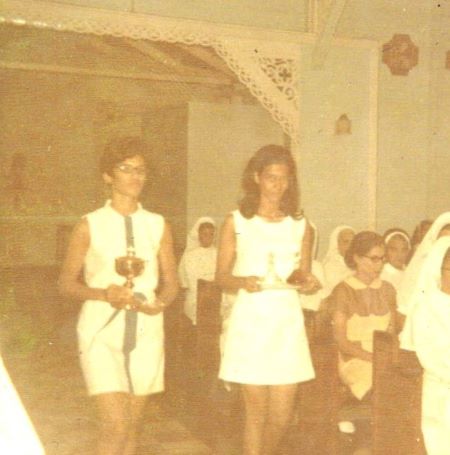
In Chapter Twelve of my work in progress, I share my experience of adjusting to convent life. The captioned photo was taken during Mass on our Entrance Day. That’s me on the left carrying the chalice. Celeste (fictitious name) served within the religious community until her death in November 2021. The laywoman with glasses, seated in the pew on the right, is my invitee and senior high school geography teacher, another influential woman during my adolescent years.
As far as I know [Celeste used to keep me up to date with news], only two nuns who welcomed the two of us into the community that day are still alive today. I honor the memory of the Sisters in Christ who, by their exemplary life, shaped my formation into the purpose-driven woman I still am today.
Instead of featuring the life of a particular nun, I decided to focus on adjusting to convent life (Chapter 12) and on the three religious vows of poverty, chastity, and obedience (Chapter 13) that define the life of the religious woman.
Chapter Twelve: Purpose-Driven Religious Women
On January 14, 1971, I joined the community of Catholic Religious Sisters founded in 1831 in Ireland. The Sisters had arrived in then British Guiana in 1894 at the invitation of the Roman Catholic Bishop of the Society of Jesus to provide for the colony’s educational needs. The first two Sisters and later arrivals came from the Motherhouse in England.
By the 1930s, the small and aging community could no longer cope with the growing enrolment in both their elementary and secondary schools. The local Mother Superior turned for help to the Union of the Religious Sisters in the United States. Forming a new affiliation, the British Guiana Mission became part of the Province in Pennsylvania in November 1934. Eleven months later, ten American sisters arrived in the colony. Within two years, the first Guianese postulant entered the American Novitiate in Pennsylvania. Over the next thirty-five years, twenty-seven Guianese sisters prepared for their final or perpetual vows in the United States. On their return to the colony, they brought with them the American way of being and doing.
All this changed when another young woman, Celeste, and I were received as postulants during a Mass and entrance ceremony held at the Motherhouse in Kingston, Georgetown. My mother and younger sister were present, as well as my senior high school geography teacher, my invitee. In the spirit of Guyana’s independence and focus on self-determination as a young nation, the Sisters decided to train the two of us in Guyana, as was done in the early days under the British Religious Sisters.
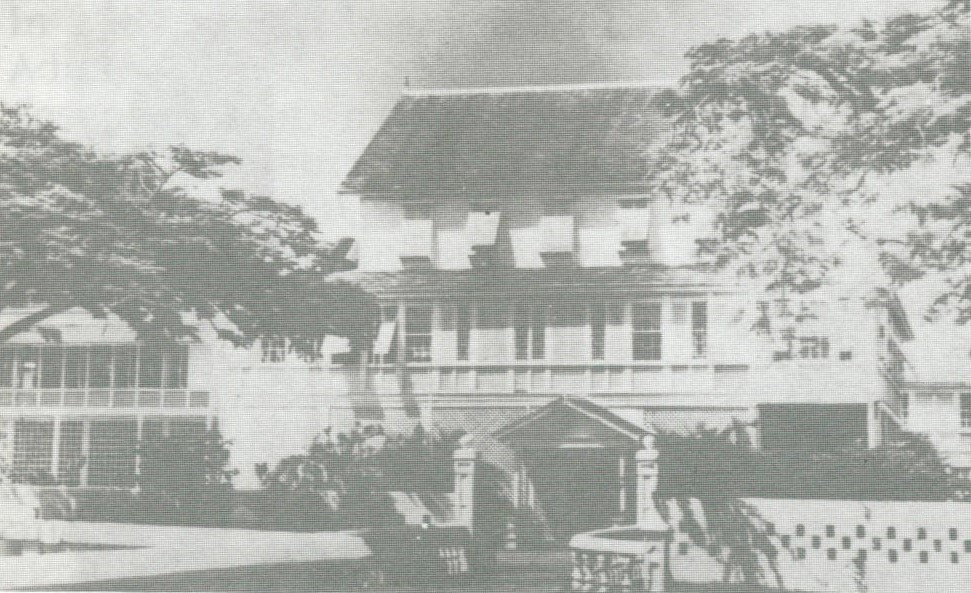
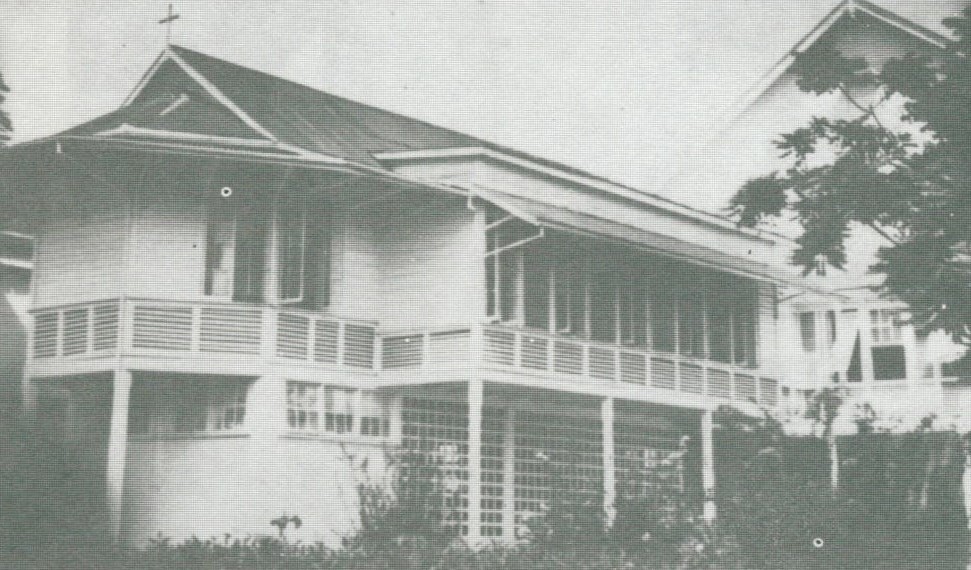
The Motherhouse dwarfed my family’s small, three-bedroom flat in Queenstown, a middle-class residential area in the capital. The Community Room alone, with its back wall lined with books, took up more space than our three bedrooms together. Located on prime real estate property in Kingston, a neighborhood in old colonial Georgetown, the vast three-story building and spacious grounds with a flower garden extended over the entire length of the block facing the Atlantic Ocean, just a ten-minute walk away.
June 1971 marked the twentieth anniversary of the opening of the Kingston Convent. Their former Motherhouse for fifty-eight years, in a poor working-class neighborhood in southern Georgetown, had become unsafe for habitation, prompting the move. The dismantled chapel reconstructed in a central position of the Kingston Motherhouse must’ve given the old, retired sisters a sense of continuity with their foundation home.
At nineteen-going-on-twenty years old, I became the youngest member of the Guyana community; Celeste was six years older. Two young Guyanese nuns were in their late twenties. The oldest Sisters were in their eighties. The majority were in their forties and fifties.
I found it intimidating to live among these purpose-driven, educated women with outstanding service to our country and vast life experience. Most were educators: among them were headmistresses, current and retired, and a university professor. Others were in the medical profession—doctors, nurses, and a pharmacist—working at the Catholic hospital administered by a member of the Religious Community. A few served in the social services at the orphanage for boys three to sixteen years old, also run by the Sisters. With the exception of the Sisters in their eighties, they all engaged in charitable work of some kind, usually once a week. Such work included visiting the sick and dying in the hospitals, teaching reading and writing to illiterate adults, Catechism classes in the parish, and helping with care of abandoned infants and handicapped children at non-governmental institutions.
These religious women were nothing like my mother’s sewing clients. Dressing up and other frivolous concerns of secular women were not topics discussed at the dining table. Celeste and I fell into observation mode. We only spoke when spoken to. They didn’t use Creole English, a Guyanese dialect spoken at home and among the general population. They spoke in perfect British or American English, with all the added th’s and word-ending emphases. We followed suit. By the time I started university in September 1972, my English diction was so perfect that the other undergraduates in my geography class thought I was a foreign student from Brazil.
To avoid disturbing the silence that reigned within the convent walls and beyond in the upscale neighborhood, I began speaking with a lower tone. After an older nun commented on my loud laugher, I also began covering my mouth with my hands to muffle the sound. “Very vulgar,” she told me.
Another major change for me was meal-related: mealtimes, cuisine, and eating habits. Unlike local practice, the nuns ate their main meal at dinner time in the evenings, instead of lunch time at noon. American-style meals, prepared by two black, female kitchen staff, didn’t include my favorite local dishes—chow-mein, cook-up rice, curry, mettagee, and pepperpot. Worse yet, the food tasted bland. I learned later that onion, garlic, pepper, and several herbs and spices used to season our local foods were considered aphrodisiacs, to be avoided by those living a celibate life. Who knew?
Celeste and I also observed that the nuns ate like parakeets. To fall in line with such temperance, we began eating much less than we were accustomed to doing at home. For years to come, my digestive system grumbled against the new regime.
For over a year, I resisted adapting to the nuns’ bathing habits. They showered once a day…in the evenings. Who takes only one shower in a hot and humid tropical country—located between 8.7- and 0.9-degree latitude north of the Equator—where you sweat all day and night? At my parents’ home, we showered two to three times a day: in the morning before school or work, in the afternoons on returning home, and again in the evening if we had to go out.
Over the next eight months of our postulancy, Celeste and I continued to wear our regular laywomen clothing, but with a more moderate hemline than the mini-skirt length popular at the time. We both joined the teaching staff at St. John’s High School for girls, then still run by the Religious Community. As a school education had lifted me and my siblings out of a life of poverty, I had no doubt that choosing the teaching profession was God’s will for my life of service. Under the supervision of the Deputy Head Mistress, I taught art, geography, and religious knowledge to the four classes of Form One twelve-year-old students, equivalent to seventh grade in the USA.
For my convent chore, Sister Mary Magdalene, a Guyanese kindergarten teacher and sister-in-charge of the Motherhouse, assigned me to assist the Sister Sacristan, a local-born nun in her forties responsible for the chapel and adjoining sacristy. In the evenings after dinner, she taught me how to set out the vestments for our chaplain to be used for the celebration of Mass the following morning at 6:00 a.m. In the mornings before community prayers at 5:30 a.m., she prepared the altar for Mass. The sacristan entrusted me with the task of picking fresh flowers and arranging them in two large vases. The flowers adorned the tabernacle, housing the consecrated Eucharist on the altar against the back wall of the chapel.
With my artistic skills, I also worked with another sister in creating textile banners, usually 16 inches wide by 32 inches long, that hung from the lectern used during Mass. These banners changed with the Church’s liturgical seasons: Advent, Christmas, Ordinary Time (after Epiphany), Lent, Easter, and Ordinary Time (after Pentecost).
The chaplain, a teacher at the Jesuit high school for boys, was a lanky English priest in his sixties. He wore his shirt tucked into trousers, a size larger at the waist, pulled tight with a belt. He belonged to the older pre-Vatican Council II generation of priests who didn’t look a woman in the eye for fear of having impure thoughts. He didn’t eat with us. Instead, he preferred to eat alone at a dining table reserved in the Visitors’ Room, adjacent to the Community Room, on the second floor. After Mass, Sister Sacristan made sure that his breakfast tray, prepared by one of our cooks, was set out to his liking. She never shared this duty with me: Serving Father was a privilege she wasn’t ready to relinquish.
One day, while arranging flowers in the workroom adjoining the sacristy, a visiting older nun from the Mahaica Convent, 22 miles from Georgetown, approached me to ask if I could assist her in doing research on the history of the Mahaica Leper Hospital. With Sister Magdalene’s permission, I accompanied her to the building housing the National Archives. I don’t recall how many times we visited the Archives. Beginning in 1936, at the request of the Catholic Bishop at the time, American nuns began working as trained nurses at the Mahaica Hospital where there were over two hundred patients suffering from Hansen’s Disease. Over the next thirty-five years, American Sisters administered the hospital. After they left in 1971, two Guyanese nuns continued to assist patients in every way possible with bi-monthly visits and care.
I also had the opportunity to accompany Sister Magdalene on one of her weekly visits to the Tiger Bay slum area of mostly black residents, located in the Downtown Commercial District along the Demerara Riverbank. Though the slum or ghetto was known for its violence, Sister Magdalene was not afraid of visiting the families in their makeshift shacks. After several years of assisting them in whatever way she could, she was well-known and respected by everyone who greeted us that day.
With the children of Tiger Bay in mind, Sister Magdalene asked me to plan and take charge of a two-week Arts & Crafts Workshop in August, during the school holidays, for twenty girls ranging from eight to twelve years old. She gave me a thick handicrafts book with ideas to choose from and provided the materials I would need. Two adult women accompanied the children on their trip to and from the convent compound. The sessions, held in a spacious room next to the laundry room, took place from Monday to Friday in the mornings from nine to twelve o’clock, with a half-hour break for a drink and snacks. I divided the girls into two groups—eight and nine years and ten to twelve years.
It was the first major project I had undertaken on my own. The two women helped with supervision. Sister Magdalene only joined us at snack-time. The joy on the girls’ faces at the end of each session gave meaning to all my hard work. At the end of the workshop, I had learned to push beyond my limits and achieve much more than I thought possible. What a gift she had in bringing out the best in others!
Without any impediment to our acceptance by the Religious Community, Celeste and I moved on to the next phase of our religious training—the novitiate. Our new makeover would demand much more than an external transformation. It would demand a new way of being—a destruction of the Self. Everything that defined my self-expression—artistic talent, singing popular songs, and love of dance—had to be relinquished and transformed for the glory of God alone.
As a young, brown-skinned Guyanese woman of an independent socialist republic, I would later clash with our white, New York-born Formation Mistress.
 Three Worlds One Vision
Thank you for sharing this Rosaliene, I enjoy reading about other people’s life experiences, you have certainly had an interesting life.
LikeLiked by 3 people
Thanks very much, Kate. My current work-in-progress is about women in a patriarchal world. I couldn’t omit sharing my own experience as a religious woman.
LikeLiked by 1 person
Excellent retelling of your experiences, Rosaliene. You described a whole other world. And a bit of a cliffhanger at the end…
LikeLiked by 4 people
Thanks very much, Dave. Since my work is episodic, I try to link each chapter with the next. It’s great that this one is a bit of a cliffhanger. I questioned every directive and complained about the double standards within the community. I learned years later from Celeste that I had caused our Formation Mistress much emotional distress. Too late to apologize 😦 She had long returned to the USA and had lost her life in a car accident.
LikeLiked by 1 person
A lot to question and complain about, Rosaliene, but sorry about that car accident.
LikeLiked by 1 person
❤
LikeLiked by 1 person
Fascinating story Rosaliene. I was surprised at the length of your skirts in the picture. Then later you said they were longer than fashion at the time, which I can see, but they still seem much different from my impression of a novice nun’s wardrobe. Looking forward to your next chapter. Maggie
LikeLiked by 3 people
So glad that you find the chapter fascinating, Maggie! We were not yet novices, but postulants on probation. We received the religious habit and veil after completing the first year in the novitiate (described in the next chapter). The hemline fell just below our knees.
LikeLiked by 1 person
A fascinating view into this a life that is hidden from most of us, Rosaliene. As they say, everyone has a story. You only have to ask. Happy Sunday. Allan
LikeLiked by 3 people
Thanks very much, Allan. It has taken me over fifty years to share this “hidden life.” To protect their identity, I don’t name the religious community and all names of the school and sisters are fictitious.
LikeLiked by 1 person
Such an interesting read.
LikeLiked by 3 people
Thanks for dropping by and reading 🙂
LikeLiked by 1 person
Your story is fascinating, Rosaliene. While I’m disappointed on your behalf at the lack of onions, salt, pepper, and spices in the food, I’m glad you had Sister Magdalene and that teaching experience. Arts and Crafts of your choice, with all materials provided! I can picture the children’s happy smiles.
LikeLiked by 3 people
Thanks very much, Tracy 🙂 Teaching art was my greatest joy 🙂
LikeLiked by 1 person
That came through in your writing, Rosaliene. Hooray for joy!
LikeLiked by 1 person
I’m amazed at your memory for detail, Rosaliene! Thanks for sharing your purpose-driven life.
LikeLiked by 3 people
My pleasure, Crystal 🙂 I’m amazed, too! I’ve found that long forgotten memories, related to the chapter I’m working on, surface while lying half-awake in the early mornings.
LikeLiked by 1 person
I’ve said it before: Yours has been a fascinating, very varied life.
LikeLiked by 3 people
Thanks very much, Neil 🙂
LikeLiked by 1 person
I love reading about your convent experience. How many foreign, non-Catholics can understand even a little about how Catholicism has spread through the world through unselfish service?
LikeLiked by 3 people
Katharine, I appreciate that you find this period of my life of special interest. You raise an interesting point. The unselfish service of religious men and women has not only spread much goodwill across our world, but also their religious beliefs.
LikeLiked by 1 person
Absolutely, and they did it through selfless service. I contrast that with the ways of war, in which the purpose is different.
LikeLiked by 1 person
Very interesting, Rosaliene. I look forward to learning more about you.
LikeLiked by 3 people
Thanks very much, Mary 🙂
LikeLiked by 1 person
Sounds like the perfect bucolic life. The buildings, the grounds, everything kept up for appearances.
I’m glad for you, Rosaliene, that you moved on to the life I’ve heard you describe in your writings.
LikeLiked by 3 people
As I learned, Pablo, there is no perfect bucolic life. The transition back to secular life was not easy: A period I’m struggling to write about.
LikeLiked by 1 person
I didn’t realize that the austere life also included giving up onions, garlic, pepper and any other herb. That you also needed to sublimate your artistic skills would have been too much for me. How could a God given gift be shut down? How has your life changed since then, have you reclaimed your artistic skills and needs to express yourself?
LikeLiked by 3 people
Tamara, though I was no longer able to explore and develop my artistic skills, it was not shut down. Instead, they were channeled in God’s service as a teacher and other needs within the community and parish. For example, I was often called upon to make posters for our school and parish fairs. Over the years, my attempts to reclaim my artistic expression did not bear much fruit. My last attempt was designing and painting the book cover for my second novel “The Twisted Circle.” I find release in my storytelling and garden creations.
LikeLiked by 1 person
I’m happy you didn’t have to completely give up your creativity! Yes, writing is definitely an artistic experience!
LikeLiked by 1 person
I enjoyed reading the story of your early years in the convent. These experiences must have made lasting impressions.
LikeLiked by 3 people
So glad that you enjoyed this chapter, John 🙂 My years in the convent have played an important role in shaping my vision of the world and my place within it.
LikeLike
Fascinating Rosaliene. Did you keep a daily diary during your time here? Do you still have it to refer to?
LikeLiked by 3 people
Thanks very much, Denzil 🙂 It would’ve been great to have kept a diary during that period. There was simply no time during the day or night for putting my struggles into words. When it comes to the history of the community, I have a copy of the order’s “Souvenir History 1894-1994” prepared by their Sister Historian. The photos of the Motherhouse came from that edition.
LikeLiked by 1 person
Sister Magdalene was clearly inspirational. First encouraging you to use your artistic skills then to sublimate them seems destructive to me, especially as you were in a purpose-driven order
LikeLiked by 3 people
Sad to say, Derrick, Sister Magdalene (fictitious name) was not the Mother Superior, later known as the Regional Coordinator, of the Guyana community, nor was she a member of the Council. I wonder now if her own gifts were sublimated as a young nun by the community.
LikeLiked by 1 person
That would be consistent
LikeLiked by 1 person
You had a vast experience as a sister and your youth was busy! You looked cute by the way!
LikeLiked by 3 people
Zet Ar, they sure did keep us busy. You might have heard the proverb, “An idle mind is the devil’s workshop.”
Thanks! The photo did not age well.
LikeLiked by 1 person
You have an amazing memory for details that make an already interesting story even more interesting! I see what you mean about those nuns being strong and intimidating women.
LikeLiked by 2 people
Thanks very much, Mara! It’s good to know that my novel writing skills of adding details make a difference in engaging the reader 🙂
LikeLiked by 1 person
🩵🩵🩵
LikeLiked by 3 people
Thanks very much, Luisa ❤
LikeLiked by 1 person
You’re more than welcome. Rosaliene 💗
LikeLiked by 1 person
WOW Rosaliene what an experience that you have chronicled here. And honey, you in that photo reveals just how stunning you are today. Our lives are purpose-driven indeed my friend. Your story reminds me of the book by Rick Warren that I read years ago, “The Purpose Driven Life.” Thanks so much for sharing your fascinating story my sistah! 💖🙏🏼💞
LikeLiked by 3 people
Kym, I’m not as slim as those days. Old age spread is a brute 🙂 I know that you, too, lead a purpose-driven life. I’ve heard about Warren’s book but never read it. So glad that you enjoyed this chapter 🙂 ❤
LikeLiked by 1 person
Oh yes my sistah, your accounts are so vivid and relatable in many ways. But girl, to survive such persecution, you EARNED your spot on top of the mountain! 👏🏼👏🏼👏🏼
LikeLiked by 1 person
❤
LikeLiked by 1 person
Dear Rosaliene, I do believe you could make a trip to the grocery store sound interesting with your storytelling skills. What an incredible history you’ve had. There are so many points of interest, as I read through your latest installment. Interesting to learn that several herbs and spices were not permitted, among other things. The pictures are fabulous. Do you refer to journals when writing?
LikeLiked by 3 people
What a compliment about my storytelling skills, Michele! Thank you. Thank you. As I mentioned to Denzil, I wish I had kept a journal during that period. I’ve been tapping into my memory vault by using songs, mental images, photos, and visualization of individuals associated with the period. One chapter at a time. My greatest challenge occurs when negative emotions flood all images. Focusing on the details needed for good storytelling becomes impossible. These are the times when I have to work at healing.
LikeLiked by 1 person
You’re very welcome, Rosaliene. Thank you for the thoughtful response. Your process is yielding great results including the healing that you’re receiving. A challenging process that takes time, patience, dedication, sacrifice, and many other things. I commend you.
LikeLiked by 1 person
🙂 ❤
LikeLiked by 1 person
Thank you, Rosaliene, for sharing this fascinating story of your life in what was at first a very foreign atmosphere, and the beginnings of transformation into the life of the convent. I would imagine the move away from all those things that formed your early identity must have felt like a loss. I’m at the edge of my seat wondering about the clash you allude to at the end!
LikeLiked by 3 people
My pleasure, Steve 🙂 Thanks for joining me along this journey as a woman in a man’s world. You are so right about feeling a sense of loss. It’s especially overwhelming when I look at old photos of the sisters that recorded important achievements for the community. The clash is not pleasant to recall. Today, I’m surprised that the community put up with my critical views for seven years. When we’re young, we think we can change the way things have been for centuries.
LikeLiked by 1 person
🙏🏼
LikeLiked by 1 person
Still happy to host you on my blog to talk about your book, Rose. ;0)
LikeLiked by 3 people
How kind of you, Pam 🙂 Chapters 13 & 14 of my work-in-progress should answer some of the questions you’ve raised regarding the religious life.
LikeLiked by 1 person
Awesome! Whenever you’re ready. You can do both books at once!
LikeLiked by 1 person
The word, fascinating, came to my mind, too as I read this. I imagine and wonder if giving up —artistic talent, singing popular songs, and love of dance—was a big sacrifice. I continue to look forward to reading your book.
LikeLiked by 3 people
Thanks very much, JoAnna 🙂 At the time, I didn’t think it was a big sacrifice. I found joy in teaching art and helping others. It was not until I moved to Brazil that I was able to reconnect with the joy of song and dance so essential for our self-expression as humans.
LikeLiked by 1 person
The devotion to serving others sounds like a beautiful aspect of the religious order. The oppressive cultural change sounds a bit like the residential schools for Native Americans in the US. Did the British inflection influence you permanently?
LikeLiked by 4 people
Rebecca, it was indeed a beautiful aspect of the religious life. My objections to the dominant American culture within the community went unheard. I’m not sure what you mean by British inflection.
LikeLike
The more I read about your life, the more I am impressed by how extraordinary it is and has been for a long time. Thank you, Rosaliene.
LikeLiked by 3 people
I appreciate your kind words, Dr. Stein 🙂 ❤
LikeLiked by 1 person
Thank you for sharing your memories and a part of your life!.. “Every single thing that has ever happened in your life is preparing you for a moment that is yet to come”. (Author Unknown).. 🙂
Hope all is well and your path in life is paved with peace, love and happiness and until we meet again…
May flowers always line your path
and sunshine light your way,
May songbirds serenade your
every step along the way,
May a rainbow run beside you
in a sky that’s always blue,
And may happiness fill your heart
each day your whole life through.
(Irish Saying)
LikeLiked by 2 people
Thanks very much for stopping by, Dutch ❤ How true! My religious life prepared me for raising my sons alone after their father abandoned us in Brazil.
LikeLike
This is a mesmerising chapter, fully fascinating. Thank you for sharing this with us.
LikeLiked by 2 people
So glad you found this chapter fascinating, Dawn 🙂 I’ll be posting the follow-up chapter on the religious vows this Sunday.
LikeLiked by 1 person