
Tags
Atmospheric CO² Jan 1959 – Jan 2024, City of Los Angeles/California, Climate Change, Climate Crisis, EU Copernicus Global Climate Highlights 2023, Fossil Fuel Emissions, NASA Goddard Institute for Space Studies (GISS), National Centers for Environmental Information (NCEI), NCEI/NOAA Annual 2023 Global Climate Report, NOAA Mauna Loa Observatory, NOAA/NASA 2023 Global Climate Media Briefing, Pineapple Express Atmospheric River, US 2023 Billion-Dollar Weather and Climate Disasters Map

Photo Credit: David Crane / Associated Press
The sun is out again. Alleluia! Beginning last Sunday and throughout Monday, Tuesday, and Wednesday, the Pineapple Express atmospheric river unloaded its burden across California. Don’t get me wrong: We need the rain to replenish our state’s depleted reservoirs after years of drought. Is it asking too much not to have the rain all at once? Consider downtown Los Angeles. Within just four days, the area was drenched with more than 8 inches (20 cm) of rain. That’s more than half of the area’s normal annual rainfall of 14.25 inches (36 cm).
We were well warned ahead of the onslaught. To ensure our city had the required resources to respond to the storm’s impacts, on Monday, February 5th, our Mayor Karen Bass signed a Declaration of Local Emergency throughout the City of Los Angeles. Flooding, fallen trees, and hundreds of mudslides were merciless to everything and everyone in their path. I give thanks that our neighborhood was spared from such devastating blows. At our apartment complex, the lawn and garden plots are fully saturated. Some plants thrive in such weather. Others, like some of my succulents, not so much.
Extreme climate change events have become more frequent and severe. How the gods must laugh at human ineptitude in connecting the dots between our behavior and our environment! We can no longer have it all. Yet, we persist in our self-destructive ways of being and doing. Drill, Baby, Drill!
On January 13th, NASA announced that 2023 was the hottest year on record, based on analysis of annual global average temperatures by the Goddard Institute for Space Studies (GISS). Overall, Earth was about 2.5 degrees Fahrenheit (or about 1.4 degrees Celsius) warmer in 2023 than in 1880 when modern record keeping began.
In the video below, Gavin Schmidt, director of NASA’s GISS, explains how they measure global temperatures and calculate how much temperatures have changed compared to temperatures from 1951-1980. Praise to our mathematicians!
“The exceptional warming that we’re experiencing is not something we’ve seen before in human history,” said Gavin Schmidt. “It’s driven primarily by our fossil fuel emissions, and we’re seeing the impacts in heat waves, intense rainfall, and coastal flooding.”
The chart below depicts atmospheric CO² from January 1959 to January 2024, based on carbon dioxide concentrations at NOAA’s Mauna Loa Observatory in Hawaii. The line of “350 parts per million” highlights the “safe” level of carbon dioxide for human societies to thrive.
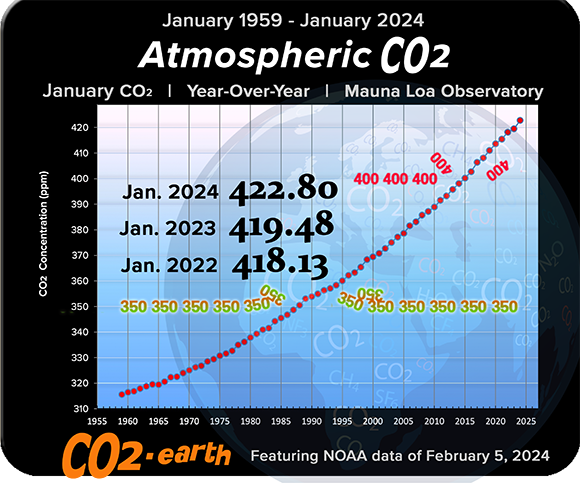
Source Credit: CO2 Earth
Other factors affecting the 2023 record heat include:
- The return of El Niño, increasing sea surface temperatures in the Pacific Ocean
- Long-term global ocean warming and hotter-than-normal sea surface temperatures
- Decrease in aerosols that slow the rise in temperatures, and, to a lesser degree,
- Eruption of the Hunga Tonga-Hunga Ha‘apai undersea volcano in January 2022.
Read the complete NASA Press Release on January 13, 2024.
In addition to ranking 2023 as the warmest year in its global temperature record, dating back to 1850, NOAA’s National Centers for Environmental Information (NCEI) offers a more comprehensive look in their Annual 2023 Global Climate Report.
Other highlights of the NCEI/NOAA report include:
- Upper ocean heat content—the amount of heat stored in the top 2000 meters of the ocean—was record high in 2023.
- Average annual Arctic sea ice extent was among the 10 lowest since 1979, and Antarctic sea ice extent was the lowest on record.
- There were 78 named tropical storms across the globe in 2023, which was below average, and 20 in the North Atlantic, which was well above average.
Their predictions for this year offer little relief:
- A one-in-three chance that 2024 will be warmer than 2023 and
- A 99 percent chance that 2024 will rank among the five warmest years on record.
Read the Full Report at NCEI/NOAA.
In a press release on January 9, 2024, on Global Climate Highlights 2023, the European Union’s Copernicus Climate Change Service also confirmed 2023 as the warmest calendar year in their global temperature data records going back to 1850.
What I find disconcerting is one of their key messages (emphasis mine):
2023 marks the first time on record that every day within a year has exceeded 1°C above the 1850-1900 pre-industrial level for that time of year. Close to 50% of days were more than 1.5°C warmer than the 1850-1900 level, and two days in November were, for the first time, more than 2°C warmer.
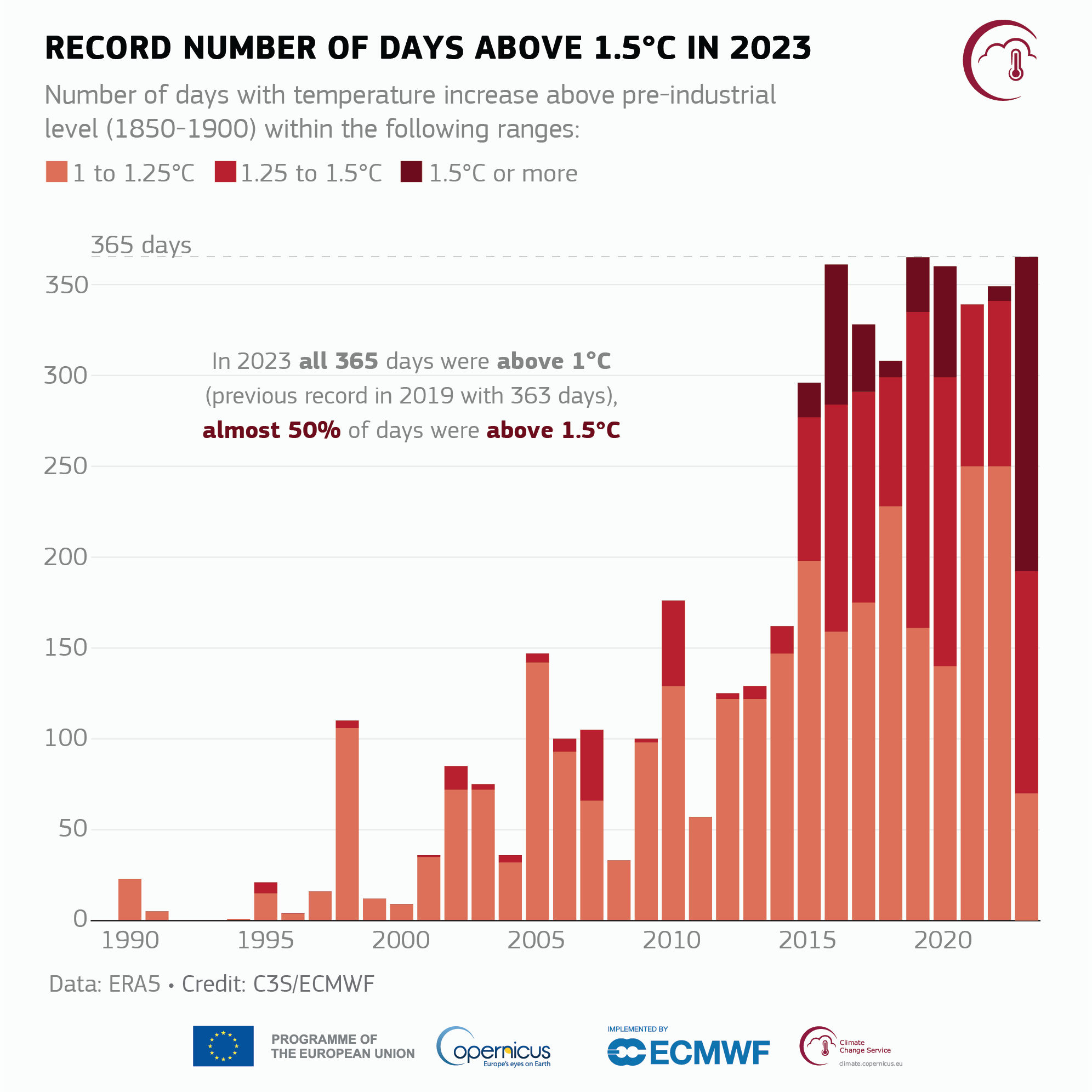
Source: ERA5. Credit: C3S/ECMWF
As in the case of exceeding the optimum CO² 350 ppm limit for human societies to thrive, we are now tampering with the 1.5°C limit agreed upon at the 2015 UN Climate Change Conference (COP21) in Paris, France.
There’s no cause for alarm, says Russel Vose, chief of the Monitoring and Assessment Branch at NCEI/NOAA. During the NOAA/NASA 2023 Global Climate Media Briefing on January 12th, he noted: “In one year, above 1.5°C doesn’t mean we’ve crossed that threshold permanently, but the message is that things are starting to approach that threshold. Which is, I think, projected to happen on a sustained basis sometime in the 2030s or 2040s.”
All these recorded global temperature data caused dire real-life consequences for our safety, property, and livelihood. These weather/climate disasters also impact our local and state economies. Thanks to our record-keepers at NCEI/NOAA, we know that our hottest year on record resulted in over US$90 billion in damages here in the United States. Twenty-eight (28) of these confirmed weather/climate disaster events exceeded US$1 billion in losses.
As shown in the US 2023 Billion-Dollar Weather and Climate Disasters Map, these events included 1 drought event, 4 flooding events, 19 severe storm events, 2 tropical cyclone events, 1 wildfire event, and 1 winter storm event. Overall, these events resulted in the deaths of 492 people and had significant economic effects on the areas impacted. The 1980–2023 annual average is 8.5 events; the annual average for the most recent 5 years (2019–2023) is 20.4 events.
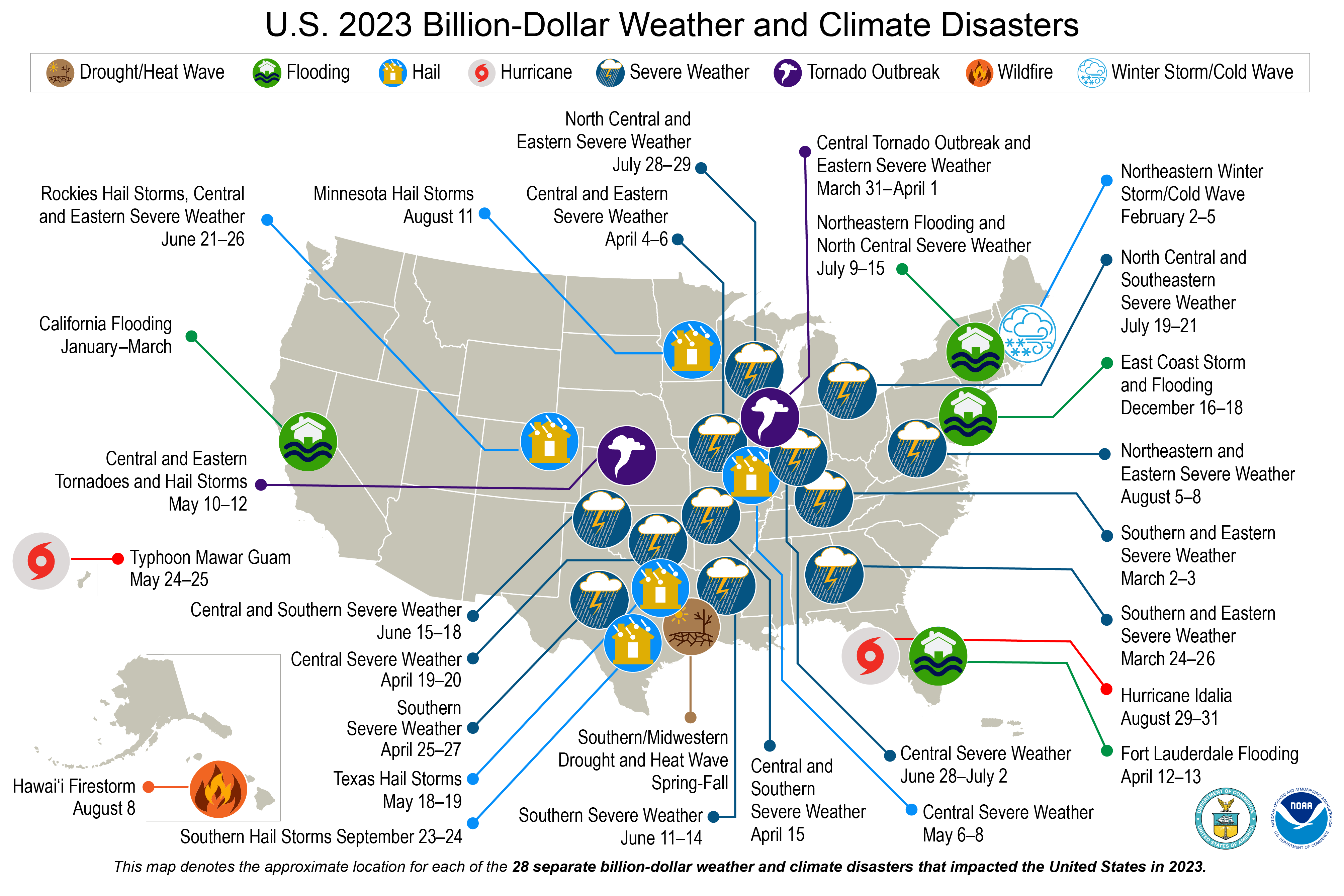
Source Credit: NOAA National Centers for Environmental Information (NCEI)
For me and my sons, the global climate crisis has made our lives more precarious and uncertain. I hold on to what is essential. I embrace each new day as a blessing to be lived with compassion and love.
 Three Worlds One Vision
Glad you came through the storm OK Rosaliene. Hard to fathom that some still think the presence of man has no affect on climate. That is like saying that when you are driving your car, pushing harder has on the gas pedal has no affect on your speed. We are either in the way of or contributing to the severity of the major climate events. Sometimes, I think we are a lot like the people who watched Noah build his ark and laughed at him up until the rain started. Hopefully weather in your area will settle down for a while. Allan
LikeLiked by 1 person
Thanks very much, Allan. So chance for relaxing yet: Another storm is coming again this weekend.
The story of Noah’s ark is a good reference for the current denial we face today. What we’re experiencing right now is just a warning of much worse yet to come.
LikeLiked by 1 person
I can’t add anything, Rosaliene. Many of us can’t see the stars, can’t find the Monarch butterflies, and remember the once pesty houseflies with fondness. Mankind appears to be its own worst enemy. Whoever said the dog is man’s best friend had it right with respect to climate change. We know it’s not the methane producing cow we eat for dinner.
LikeLiked by 2 people
Thanks for sharing your thoughts, Dr. Stein. I’m done with trying to convince climate change deniers of the unfolding existential threat. They cannot claim that they were not warned. What they do with the information is their responsibility.
LikeLiked by 2 people
I’m grateful you came through the storm unscathed Rosaliene. In Australia we have so many extreme weather events, floods droughts bushfires duststorms – mostly in the summer although it is becoming more common in other seasons as well. I hope your garden comes through okay.
LikeLiked by 1 person
Thanks very much, Kate. I remember well that devastating wildfire, not that long ago, that drove people into the sea.
LikeLiked by 1 person
Yes Rosaliene it was terrible. Yet all of that area has come back to life and the wildlife too, it is extraordinary how powerful the regeneration of nature can be, it gives me hope.
LikeLiked by 1 person
This is great news, Kate!
LikeLiked by 1 person
I thought you might need a little respite from all the terribly sad outlook elsewhere.
LikeLiked by 1 person
😀 ❤
LikeLiked by 1 person
Glad that the awful California storm wasn’t worse for you, Rosaliene. As for all the examples of climate change? Terrible. And nowhere near enough vision on the part of most of our “leaders” to do something about it. 😦
LikeLiked by 1 person
Many of those “leaders” know climate change is an existential threat, but they’re bought and paid for by corporate interests.
LikeLiked by 3 people
Exactly, Dave!
LikeLiked by 1 person
Me, too, Dave. Thanks a lot 🙂 The fossil industry continues to control the narrative and limit efforts at the UN for a faster transition.
LikeLiked by 1 person
All that rain was nuts. There’s still a mud puddle in our driveway because it hasn’t been able to dry up yet. I’m glad you were okay where you were. Some small branches down, and a lake in our driveway that required heavy duty rain boots to navigate, as well as parking elsewhere, but on the whole, we survived down here. I know L.A. had it worse.
LikeLiked by 2 people
I’m glad you and the boys are doing good.
LikeLiked by 1 person
Thanks.
LikeLike
Where do you live (city/state), Betsy? These atmospheric river storms are so extensive that they impact a vast area. Stay safe and dry.
LikeLiked by 1 person
San Diego county.
LikeLiked by 1 person
Betsy, I didn’t realize that you’re so close. The first storm hit San Diego really hard. Another storm is expected this weekend. Stay safe.
YAY for the Black Belt!!!
LikeLiked by 1 person
It’s nice we got a bit of a reprieve before the next storm. You stay save and dry too!
And thanks on that other thing! 😉
LikeLiked by 1 person
My pleasure, Betsy 🙂 Your martial arts escapades help to keep me sane 😀
LikeLiked by 1 person
Hahaha. They might help keep me sane also. 😛
LikeLiked by 1 person
It’s a juggernaut leading us to a confrontation with Mother Nature. I fear for the outcome of such an event. It’s as if Earth wants to spit us out.
LikeLiked by 1 person
Pablo, I cannot blame Mother Nature: We humans have become a metastatic cancer.
LikeLiked by 1 person
So many weather events and billions of dollars. Happy you are okay, Rosaliene, but it’s all so sad!
LikeLiked by 2 people
Thanks very much, Crystal. It’s, indeed, sad for all those who have lost everything.
LikeLike
Humanity is in big trouble. And the ever-increasing human population makes it harder and harder to slow down global warming.
LikeLiked by 1 person
We sure are, Neil. More consumers keep the engines of industry running.
LikeLiked by 1 person
An important informative post
LikeLiked by 1 person
Thanks very much, Derrick.
LikeLiked by 1 person
Yeah, “drill baby”! And let’s continue killing our “green lungs”, the rainforests, so that we can sit on precious wood in our toilets. And we shouldn’t forget the enormous amounts of methane that are being released by the melting of permafrost. At full speed against the wall….
LikeLiked by 2 people
It’s crazy, Friedrich!
LikeLiked by 1 person
So many heartbreaking events. I’m glad you and your boys made it through this one and are ok but what devastation and sadness!
LikeLiked by 1 person
Thanks very much, Nancy. It’s heartbreaking to watch interviews with people who have been hit real hard.
LikeLike
We’re living in a world that is changing fast; changing quicker than we can adapt to! Still we continue to think that we’re cleverer than what created us, the laws of nature, the cosmos!
LikeLiked by 2 people
So true, Ashley. I believe that this is humanity’s greatest downfall: thinking we know it all and are in control.
LikeLiked by 1 person
I am relieved to read you and your family are safe and well, Rosaliene. Thank you for sharing this well-researched and written article.
LikeLiked by 1 person
Thanks very much, Michele. You’re welcome 🙂
LikeLiked by 1 person
💐🌻💐
LikeLiked by 1 person
Rosaliene, I read this post once last night, thought about it overnight, and watched the videos this morning. It left me with more questions than answers, because the data seems incomplete and chaotically arranged. First, CO2 represents a minute portion of gasses in the earth’s atmosphere. It is a vital nutrient for all plants, which recycle the elements to release oxygen and water, storing the carbon in the form of sugars.
This carbon cycle ultimately provides for all plant and animal life. CO2 emissions can be attributed more to the animals who exhale CO2 when they breathe, especially the glut of human breathers on the planet now.
Second, deforestation is a major disrupter of ecosystems around the globe, yet NASA and NOAA do not consider the destruction of trees and forests in their models. Third, the videos gave three cities as models for the temperature comparisons, but everyone should know that cities themselves are heat sinks, because of the mass of concrete used to build their structures and road systems. New York City is a good example of extreme climate change, especially in summer, but it’s not representative of the rest of the world. The thermals (hot air rising like small tornadoes) would delight hang gliders and hawks. I wanted to know where the recording stations are located, but my guess is they are scattered and locations have changed over time.
Finally, I don’t know how much the planet’s wobble contributes to the changes in the climate, but I understand the magnetic north pole has been moving eastward, towards Siberia, at increased rates the last couple of decades. Maybe the larger problem we face is that the earth is in danger of tipping over, not attributable to human activity. Geological findings suggest the magnetic poles have reversed polarity several times in the earth’s 4.5 billion-year history.
We may have a rough ride over the next few years, but I doubt anyone, including the scientific mucky mucks, can predict our planet’s future.
LikeLiked by 1 person
Katharine, I don’t envy the task of our climate scientists in considering the multiple of known and still unknown variables that affect Earth’s climate and weather. Predictions are just predictions. They are subject to change with new observations and new data. Climate/weather predictions are intended to save lives. What we as a society and individuals do with the information they provide is entirely up to us.
LikeLike
Thank you for sharing this sobering information. What will any of us do about it though? What are we willing to sacrifice and change personally? We have global summits, but nothing changes.
LikeLiked by 1 person
Dawn, as I see it, we have to be ready to help each other when a climate/weather disaster hits our neighborhood. We’re in this together.
LikeLiked by 1 person
We are, sister.
LikeLiked by 1 person
Glad to hear you and your family are safe. When will the people of this earth listen to its cries for help!!?? Maggie
LikeLiked by 2 people
Thanks very much, Maggie. We humans are skilled in finding ways to shut out the unpleasant things of life. We even create new diversions with warfare.
LikeLiked by 1 person
Unfortunately this is very true.
LikeLiked by 1 person
I heard about that horrible weather in your area and thought about you. So glad your neighborhood was spared the worst! We are in a world of hurt. Your succulents are just one example of how hard it’s going to be for life that’s adapted to a particular climate. It will have to adapt to the inconsistencies or die. It’s past time we power down.
LikeLiked by 2 people
Thanks very much, Mara. Plants and other non-human life, unable to adapt to changing environmental conditions, become extinct. I’m learning with those plants that find a way.
LikeLiked by 1 person
The climate crisis is no joke, that’s for sure Rosaliene. I am so glad to hear you and your family are safe from a situation that could have proven far worse. The stats you provided are extremely alarming but it’s not like we haven’t been warned about the consequences of our negligence and complicity about what we are currently facing for decades now. 😥🙏🏽😣
LikeLiked by 1 person
Thanks very much, Kym. Yes, we’ve been warned decades ago. Now, there’s no escaping the consequences of our negligence.
LikeLiked by 1 person
Girl, as heartbreaking as this is, I agree with you 100%. Hard head makes a soft butt as my mother used to say! 😣🙏🏽😞
LikeLiked by 1 person
Glad to hear you are OK Rosaliene and thank you for this extensive information. It’s difficult to retain hope when you see governments and leaders continue to avoid making the big decisions that are going to make a difference to the world our children and grandchildren are going to inherit, but continue to focus on short-term economic growth, or, even worse, war.
LikeLiked by 1 person
Thanks very much, Denzil. As I see it, hope lies with the ability of our towns and cities to recover from each climate/weather disaster event. We’re all in this situation together. It’s up to each one of us to hold on to what is important for keeping our families and communities together.
LikeLiked by 1 person
Very grateful to hear that you did not have any major issues due to the weather, Rosaliene. The need for countries around the world to curb greenhouse gases is so important, but politics being politics, I do not hold out much hope… however, even with little hope we need to do what we can as these wild swings in weather will just worsen moving forward. Information like this is needed – needed to become mainstream and common sense. Take care, and wish you well.
LikeLiked by 1 person
Thanks very much, Randall. I don’t hold out much hope for our political leaders to do what’s needed to slow down the process. We the people everywhere have to prepare ourselves for whatever comes.
LikeLike
There is an incongruity to “liking” this post – all to say, thanks for articulating the web of our responsibility.
LikeLiked by 2 people
You’re welcome, Rusty. Thanks for dropping by and reading 🙂
LikeLike
The extreme fluctuation of weather has put so many homes in jeopardy. Both coasts seem to be getting the worst of it. I’m sorry for the stress it puts on you, Rosaliene. God protect you.
LikeLiked by 1 person
Thanks very much, Mary ❤
LikeLike
Thank you for sharing!!.. glad you made it through the storms relatively unscathed!.. as in most other issues, in the end it is up to the people to make the changes, the politicians are only going to do what the voters that put them in office want… “The saddest aspect of life right now is that science gathers knowledge faster than society gathers wisdom”. (Isaac Asimov)…. 🙂
Hopefully, with today’s technology the people of the world and come together and work together by doing things that could help with the issue… I always said that if everyone would do a little, a few would not have to do a lot…. 🙂
Hope all is well in your part of the universe and until we meet again…
And nothing but happiness
Come through your door
May the kindness you spread
Keep returning to you
(Irish Saying)
LikeLiked by 1 person
Thanks very much, Dutch 🙂
LikeLike
Thank you for collecting and sharing this information. The atmospheric CO2 graph is clear as are other observations. I’m thankful your neighborhood was spared and that more people seem to be telling the truth. I just hope more people will listen and we can learn. God, help us.
LikeLiked by 1 person
Thanks very much, JoAnna. Another storm moved in last night and is expected to stay through Wednesday. My post is intended as an update, a reality check. I’ve stopped trying to convince deniers of what is already self-evident. I focus now on adaptation and a loving response to collapse as it unfolds.
LikeLiked by 1 person
Adaptation and loving responses are healthy, in my opinion. I hope and pray for your safety.,
LikeLiked by 1 person
Thanks very much, JoAnna. Our neighborhood appears to have good drainage.
LikeLiked by 1 person
Wow! Glad you’re okay! Read this morning that the big oil companies are seeking to build CO2 sucking machines, and they’re hoping they can continue business as usual with those!
I mentioned this to a colleague and we had a long discussion about “business as usual”. Since the 70’s environmentalists have been sounding the alarms, and now all of that had been relegated to annoying background noise for most people. We are like frogs in a warm pot of water on the stove… blissfully unaware of our impending consequences because we feel so comfortable in our lives.
LikeLiked by 1 person
Thanks, Tamara. We’re facing another storm but it’s not as intense as the last one.
It’s incredible the way the fossil fuel industry sells false promises of technological remedies. When the world as we know it collapses around us, we will have no one to blame but ourselves.
LikeLiked by 1 person
I’m sure there will be a lot of finger pointing! Capitalism and greed will continue for a long time!
LikeLiked by 1 person
I’m so glad you and your neighborhood survived mostly intact, Rosaliene. I appreciate you putting together all this information which is decidedly bleak. It’s hard to face, but it’s the truth and we cannot keep pretending otherwise.
LikeLiked by 1 person
Thanks very much, Tracy. The rains are back through Wednesday. We’ll be okay as it’s not as intense as the last storm. People in flood-prone areas were asked to evacuate. I thought it was a timely reminder for an update of our ongoing climate crisis.
LikeLiked by 1 person
Didn’t realize the rains had returned. Hope you continue to stay safe in your neighborhood, Rosaliene!
LikeLiked by 1 person
We’re fine, Tracy, but some areas have been hit very hard with flooding and landslides.
LikeLiked by 1 person
Glad to hear you and yours continue to be safe, but OOF to the flooding and landslides. 😦
LikeLiked by 1 person
I always think of you when I hear the term “atmospheric river” Rosaliene. We are at a frightening place in time where global warming is concerned. Are you familiar with Greg Braden? He’s a brilliant-minded spiritual soul who has written several books. It is his belief that once the carbon content in our atmosphere reaches a certain point, we will go into another ice age.
LikeLiked by 1 person
Lisa, I’m not familiar with Greg Braden. Earth is presently in the process of melting ice caps and glaciers. Is there another Ice Age in Earth’s future? Probably. Will humans still be around then? Who knows?
Currently, our climate scientists are more concerned about the slowdown of the global “conveyor belt” of ocean currents that transport heat around the Earth, known as the Atlantic Meridional Ocean Circulation (AMOC). Current projections from the IPCC show that the AMOC is unlikely to stop, or collapse, before the year 2100. However, “if such a collapse were to occur,” the IPCC says, “it would very likely cause abrupt shifts in regional weather patterns and the water cycle.” These could include “a southward shift in the tropical rain belt, weakening of the African and Asian monsoons, strengthening of Southern Hemisphere monsoons, and drying in Europe,” impacts that would greatly alter food production worldwide.
You can learn more at https://climate.nasa.gov/explore/ask-nasa-climate/3266/slowdown-of-the-motion-of-the-ocean/
LikeLiked by 1 person
It’s all very interesting and terrifying.
LikeLiked by 1 person
It’s terrifying, indeed, Lisa. It’s coming up a lot these days in climate change news articles.
LikeLiked by 1 person
Thanks for this clear scientific data. We must confront our CO2 generating lives now. It’s good business and good sense.
LikeLiked by 1 person
You’re welcome, Rebecca. When property insurance companies are moving out of some areas, as in California and Florida, you know for sure that weather disasters are not good for business.
LikeLiked by 1 person
Sounds like a sign we need to lower our CO2 emissions!
LikeLiked by 1 person
Mother Earth has been sending us a lot of signs, Rebecca, but we keep on ignoring them.
LikeLiked by 1 person
Who will be the Rachel Carson that we heed?
LikeLiked by 1 person
Rebecca, more recently in 2018, the young Swedish environmental activist Greta Thunberg succeeded in awakening young people worldwide. Then, the 2019 Covid pandemic struck and drove us all indoors. These days, we don’t hear a lot about her in the news.
LikeLiked by 1 person
Yes, I thought of her when I wrote the comment. She put a lot of energy into the green movement and is taking a rest now.
LikeLiked by 1 person