
Tags
2002 Treaty of Tlatelolco, Alejandro Moreno Cárdenas President of the Permanent Conference of Political Parties of Latin America and the Caribbean (COPPAL), Daniel Erikson US Deputy Assistant Secretary of Defense for the Western Hemisphere, David Rutley British Minister for the Americas Caribbean and Overseas Territories, Essequibo Region/Guyana, Guyana-Venezuela border dispute, Guyana-Venezuela Joint Declaration of Argyle for Dialogue and Peace of December 2023, Guyanese President Irfaan Ali, HMS Trent Guyana December 2023, Venezuelan President Nicolás Maduro
An update of events following my blog article, “Guyana-Venezuela Border Dispute: Mounting Tensions December 2023,” published on December 10, 2023
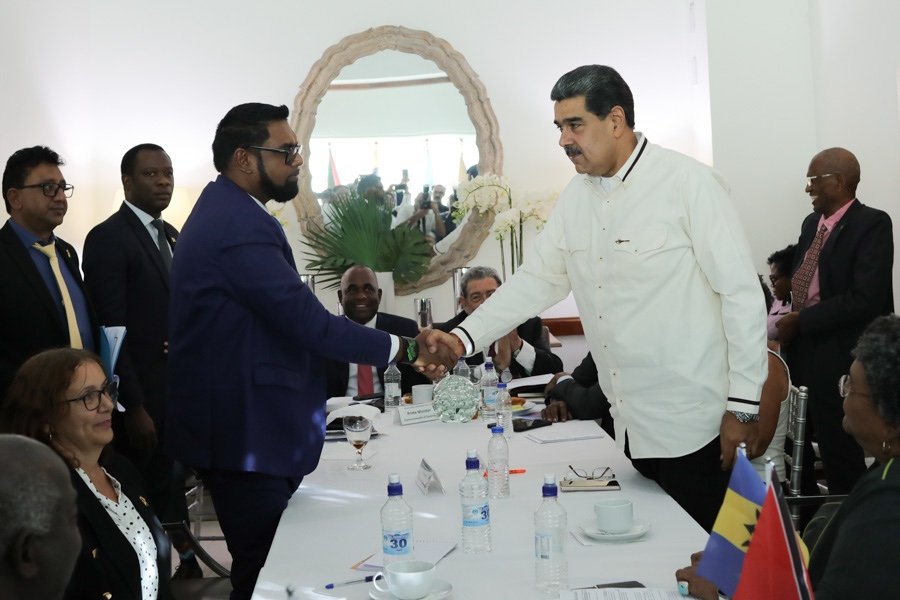
Photo Credit: Miraflores Palace/Reuters
What a relief! Venezuela did not invade Guyana’s Essequibo Region. After meeting with Guyanese President Irfaan Ali on December 14, 2023, in Argyle, Saint Vincent and the Grenadines, Venezuelan President Nicolás Maduro agreed not to threaten or use force against Guyana. In the Joint Declaration of Argyle for Dialogue and Peace, the two leaders “committed to the pursuance of good neighborliness, peaceful coexistence, and the unity of Latin America and the Caribbean.”
To clarify a sticking point for the two parties, the Declaration also noted:
“Noted Guyana’s assertion that it is committed to the process and procedures of the International Court of Justice for the resolution of the border controversy. Noted Venezuela’s assertion of its lack of consent and lack of recognition of the International Court of Justice and its jurisdiction in the border controversy.”
Guyana received lots of support from member nations of the Caribbean Community and Latin America. In addition to the Prime Minister of Saint Vincent and the Grenadines, the main Interlocutors at the meeting included the Personal Envoy of Brazil’s President Inácio Lula da Silva, Prime Minister of Dominica and Chairman of the Caribbean Community (CARICOM), President of the Community of Latin American and Caribbean States (CELAC). Also present were CARICOM Prime Ministers of The Bahamas, Barbados, Grenada, Saint Kitts and Nevis, Saint Lucia, and Trinidad & Tobago. Other Latin American participants represented Colombia and Honduras. Two representatives from the United Nations attended as Observers.
Pleased with the results of the meeting, President Maduro shared a copy of the Argyle Declaration on X, formerly Twitter, and added:
“Excellent day of dialogue! We did it!”
Four days later, with the Venezuelan military threat averted, David Rutley, the British Minister for the Americas, Caribbean and Overseas Territories, met with President Ali in Georgetown, Guyana, to reaffirm the UK’s support. Minister Rutley said:
“I am in Guyana, a fellow Commonwealth member, to offer the UK’s unequivocal backing to our Guyanese friends. The border issue has been settled for over 120 years. Sovereign borders must be respected wherever they are in the world. We welcome the recent agreement by Venezuela in St Vincent to refrain from the use of force and any further escalation. The UK will continue to work with partners in the region, as well as through international bodies, to ensure the territorial integrity of Guyana is upheld.”
The Minister was also scheduled to meet with Ambassadors from the United States, Canada, and the European Union, as well as the Secretary-General of the Caribbean Community, headquartered in Guyana.

Photo Credit: Wikipedia
Tensions with Venezuela flared up again five days later when the British Ministry of Defence confirmed that the HMS Trent would take part in joint exercises with the Guyana Defence Force after Christmas. As reported in a BBC article by James Landale on December 23rd, a British Ministry of Defense spokesperson told the BBC:
“HMS Trent will visit regional ally and Commonwealth partner Guyana later this month as part of a series of engagements in the region during her Atlantic Patrol Task deployment.”
Foreign Secretary Lord Cameron said the UK would “continue to work with partners in the region to ensure the territorial integrity of Guyana is upheld and prevent escalation.”
An offshore patrol vessel, the HMS Trent has a crew of 65, a top speed of 24 knots and a range of 5,000 nautical miles. With a contingent of Royal Marines, it is armed with 30mm cannon and can deploy Merlin helicopters and unmanned aircraft.
According to a Guyana’s Stabroek News report on December 31st, the HMS Trent arrived in Guyana on Friday, December 29, 2023. It’s not clear how long the vessel remained offshore for joint exercises.
Condemning the presence of the British vessel as a military threat and British provocation, Venezuelan President Maduro declared the act “a breach of the Argyle Agreement” signed on December 14th. On Thursday, December 28th, he ordered the deployment of 5,000 Venezuelan troops for military exercises on the Atlantic coast.
During a year-end ceremony with officials from the Bolivarian National Armed Forces (FANB), Maduro said:
“Venezuela will not stand idle in the face of any threat, no matter where it comes from. We do not accept provocations. Venezuela has the right to defend its integrity…. We are responding proportionally to the threats: today, we have issued a statement, and we reserve all actions to defend Venezuela’s sovereign areas.”
The presence of the HMS Trent in the region did not go unnoticed in Mexico City. Alejandro Moreno Cárdenas, President of the Permanent Conference of Political Parties of Latin America and the Caribbean (COPPAL), expressed concern over the presence of the British military vessel. Considering it a hostile act of provocation, he called on the intervention of the United Nations and its Secretary-General António Guterres to rule on the British military presence as a violation of the Treaty of Tlatelolco which defined Latin America and the Caribbean as a region of peace. He called on the British government to withdraw the warship.
If you’re like me and have never heard of the 2002 Treaty of Tlatelolco, you can learn more here.
Just as tensions had subsided between Guyana and Venezuela, following the departure of the HMS Trent (exact date unknown), the U.S. Deputy Assistant Secretary of Defense (DASD) for the Western Hemisphere at the U.S. Department of Defense, Daniel P. Erikson, arrived in Georgetown, Guyana, for a two-day visit on January 8 to 9, 2024. DASD Erikson is responsible for U.S. defense and security policy for the 34-nation region that encompasses Canada, Mexico, the Caribbean, and Central and South America.
He was scheduled to meet with the Government of Guyana, the Guyana Defence Force, and CARICOM leaders to discuss the U.S. defense and security partnership with Guyana and regional partners.
As published in an Associated Press article by Bert Wilkinson on January 10th, DASD Erikson told reporters that Guyana is seeking to modernize its defense capabilities. Part of the talks focused on scope and capability, as well as cybersecurity.
“One thing of great interest to us is ensuring that as Guyana looks to increase its defense capacities, it does so through a plan that is strategic, nested in its overall defense institutions, and sustainable over time.”
Given President Maduro’s concern about a permanent U.S. military base in Guyana, expressed during the Argyle meeting on December 14th, Guyanese government officials had to make their position clear to avoid escalating tensions. On Thursday, January 11th, following the end of DASD Erikson’s visit, Guyanese Vice President Bharrat Jagdeo told the Associated Press:
“We have not been approached by the United States to establish a military base in Guyana.”
Such is now the nature of peaceful coexistence between Guyana and its neighbor Venezuela. Any action in strengthening its defense against the more powerful aggressor is perceived as a threat with repercussions. Only time will tell what could trigger yet another threat to the Venezuelan government under President Nicolás Maduro.
With proven oil and gas reserves of more than 11 billion oil-equivalent barrels, Guyana now ranks among the world’s largest per capita oil producers. What a prize for all parties involved in this territorial conflict!
 Three Worlds One Vision
Thank you for this information, Rosaliene. Good to hear that Guyana is safe (at least for the moment).
LikeLiked by 3 people
You’re welcome, Dave. Political instability is spreading worldwide.
LikeLiked by 1 person
Yes. 😦
LikeLiked by 1 person
What a relief! Just one more place in the world we don’t need a conflict over. Thank you for sharing this update. I have compatriots in Baltimore from Guyana.
LikeLiked by 2 people
You’re welcome, Pablo. Say hello for me to your Guyanese compatriots 🙂
LikeLiked by 1 person
Glad to hear that Guyana is safe for now. The oil production is definitely a reason for wanting to invade. It’s still a valuable resource that countries go to war for. Unfortunately.
LikeLiked by 1 person
Tamara, oil production is a curse for small countries in the developing world.
LikeLiked by 1 person
The more countries that move to renewable energy will also help themselves to have better national security.
LikeLiked by 1 person
I am happy for you and the people of Guana, Rosaliene. It is heartwarming to hear of a peaceful resolution of any conflict these days.
LikeLiked by 2 people
Diplomacy does work, Dr. Stein. A little show of force, as with the presence of the HMS Trent, also sends a strong message.
LikeLike
Oil. So it boils down to greed. Figures. Glad things are improving at least.
LikeLiked by 1 person
Greed. Exactly, Betsy! Here’s hoping the peaceful coexistence lasts.
LikeLiked by 1 person
It’s interesting how events are in alignment. My Uber driver to church this morning is from there & spoke about this situation, yet still wanting/planning to relocate his family. Thanks for sharing & keeping us in the loop!
LikeLiked by 2 people
Tammy, is the Uber driver from Guyana? With the new oil wealth, living conditions are improving for lots of people in Guyana.
LikeLiked by 1 person
As I recall, he mentioned near by but has family there who have been struggling. He didn’t go much into detail.
LikeLiked by 1 person
Sad to say, Tammy, but not all Guyanese people are sharing in the newfound oil wealth.
LikeLiked by 1 person
I was intrigued by the timing of his conversation and your post. I wish I’d read your post first that way I would’ve been more informed likely leading to a more in depth discussion. Now, it will be on my mind unfortunately. 🤔
LikeLiked by 1 person
P.S. I usually get the same drivers depending on where I’m going so now I can elaborate a bit more with him🙂
LikeLiked by 1 person
That’s good 🙂 Perhaps, you could mention my blog to him.
LikeLiked by 1 person
I’m so glad to read this update, Rosaliene. It sounds as if Britain and the U.S. did the usual by inserting themselves into the situation, but cooler heads prevailed and crisis was averted. Whew.
LikeLiked by 1 person
Tracy, for a small country like Guyana without a large military force and defense systems, the show of support from Britain and the U.S. was important in sending a warning to Venezuela to stand down.
LikeLiked by 2 people
Ah, apologies for going to my default belief about the U.S. and Britain always, always being on the wrong side of the struggle. I’m glad Guyana felt supported by their presence!
LikeLiked by 1 person
Understandable, Tracy. We in the USA do tend to use excessive force when not needed. What’s unfortunate is that the Guyanese government, with a population of less than one million, must now invest in building a strong military defense system.
LikeLike
A really interesting blog post, thank you. It’s almost amusing how the initial aggressor always ends up by being the poor, sad, aggrieved party. Why, it’s just like poor Mr Putin, threatened by the nasty Nazi threat of the Ukraine.
LikeLiked by 1 person
Thanks for sharing your perspective, John. I thought you would be interested in knowing that your country has not abandoned Guyana, a Commonwealth member nation. Sometimes, all it takes is a show of force without engagement.
LikeLiked by 1 person
It is encouraging, in these times, to see that such disputes can be resolved, for however long it lasts, without resorting to wiping each other off the map
LikeLiked by 3 people
Couldn’t agree more, Derrick. The last thing the USA wants is a war in the Caribbean Region.
LikeLiked by 2 people
Invading a weaker neighbor to shore up support at home is one of the basic “tried and true” tactics in the Unpopular Dictator’s Handbook. I’m glad Maduro realized that an invasion wouldn’t be in his best interest, this time.
LikeLiked by 2 people
Exactly, John! Perhaps, he figured that our dysfunctional government was too embroiled in Ukraine and Israel-Gaza to pay attention to his tactics. I was also happy to see that the British finally stepped up with a show of support.
LikeLike
Anytime peace reigns, we take a tiny step forward.
LikeLike
So true, Mary ❤
LikeLike
Oil – Greed – Oil – Greed – Oil – Greed…always the root of territorial conflicts. I never heard of the 2002 Treaty of Tlatelolco either. So glad that it seems like there is some type of peaceful resolution, at least for right now. Thanks so much for sharing this detailed update Rosaliene. 🙏🏽💖☮
LikeLiked by 2 people
You’re welcome, Kym. Greed is a curse for small oil-rich nations. I share the details for other Guyanese in the Diaspora who read my articles.
LikeLiked by 1 person
Awesome Rosaliene! I love your spirit of activism. 🙏🏽 Reach those who will read and listen to your message through your powerful delivery of words and education. I adore that my sister. 🥰💖😊💐😍
LikeLiked by 1 person
Thanks very much, Kym 🙂 ❤
LikeLiked by 1 person
It’s always my pleasure Rosaliene. Thank you for your advocacy! 😊🙏🏽🥰💖🤗
LikeLiked by 1 person
The problem with DICTATORS is they say one thing then do the opposite! Putin said he wasn’t going to invade Ukraine, then did just that! I’m afraid I just don’t trust any DICTATOR.
LikeLiked by 1 person
Neither do I, Ashley. Here in the USA, we have one waiting in the sidelines who promises to be a dictator only on Day One.
LikeLiked by 1 person