
Tags
Essequibo Region/Guyana, ExxonMobil-Guyana, Guyana-Venezuela Arbitral Award of 1899, Guyana-Venezuela border dispute, Guyana-Venezuela Geneva Agreement of 1966, Protocol of Port-of-Spain (1970-1981), Venezuelan Draft Organic Law for the Defense of the Guayana Esequiba December 2023

Source: Caracas Chronicles
Autocratic leaders can sometimes act in reckless ways to hold on to power. This appears to be the case with Venezuelan President Nicolás Maduro who is up for re-election in 2024. To rally supporters for his party, weakened by U.S. economic sanctions, he has reignited claims over the disputed Guayana Esequiba territory, an issue known to unite Venezuelans across political divides.
Last Sunday, December 3, 2023, President Maduro held a national consultative Referendum to determine the people’s position on Venezuela’s longstanding claim over Guyana’s Essequibo Region (see captioned Map of Guyana with highlighted disputed territory). In so doing, Maduro’s regime ignored the objections of Guyana’s leadership and the order issued by the International Court of Justice (ICJ) on December 1, 2023, to “refrain from taking any action which would modify the situation that currently prevails in the territory in dispute, whereby the Co-operative Republic of Guyana administers and exercises control over that area.”
The day after the Referendum, the president of the National Electoral Council announced overwhelming support for annexing Guayana Esequiba. The following results represent the percent of YES votes of the alleged 10.5 million participants (approximately 50 percent of the electorate) to five questions raised for their consideration:
- Do you reject the Paris Arbitral Award of 1899? – 97.99%
- Do you support the 1966 Geneva Agreement as the only valid legal instrument for resolving the controversy? – 98.26%
- Do you agree with Venezuela’s position of not recognizing the International Court of Territorial Justice as arbitrator? – 96.31%
- Do you oppose Guyana’s attempt to assert control over the [Atlantic] Ocean pending delimitation? – 96.34%
- Do you agree with the creation of the State of Guayana Esequiba and incorporating said state into the map of Venezuela’s territory? – 96.33%
“With the delivery of the notification of the will of the Venezuelan people in the consultative referendum, a new stage begins in the defense of Essequibo,” Maduro said during the official presentation, emphasizing that “now we are going to recover our territory of Guayana Essequiba.” He also made it very clear to the Guyanese people, the ICJ, and other leaders across the region and beyond that “This referendum is binding and, as Head of State, I abide by the popular mandate.”
- Creation of a new High Commission for the Defense of Guayana Esequiba.
- Immediate activation of debate for approval of the Organic Law for the Defense of the Guayana Esequiba.
- Creation of a Zone of Integral Defense in Tumeremo [see location in top left of captioned Map of Guyana].
- Designation of Major General Alexis Rodríguez Cabello as Sole Authority with headquarters in Tumeremo.
- Division of [annexed] region for exploration and exploitation of gas, oil, and mining.
- Publication and dissemination of the new Map of Venezuela [shown below] to all schools and universities nationwide.
- Activation of an Integral Social Attention Plan for the population of Guayana Esequiba, including Census [compilation] and issuance of identification cards.
No mention was made in the December 5 statement about the final clause in the Draft Organic Law for the Defense of the Guayana Esequiba, unanimously approved by Venezuela’s National Assembly on December 6, which reads:
“[T]he creation of a special law for companies with illegal concessions to withdraw, within three months, from the promulgation of this law, and the recovery of the Guayana Esequiba through approval of a decree creating areas and new national [oil drilling] parks.”
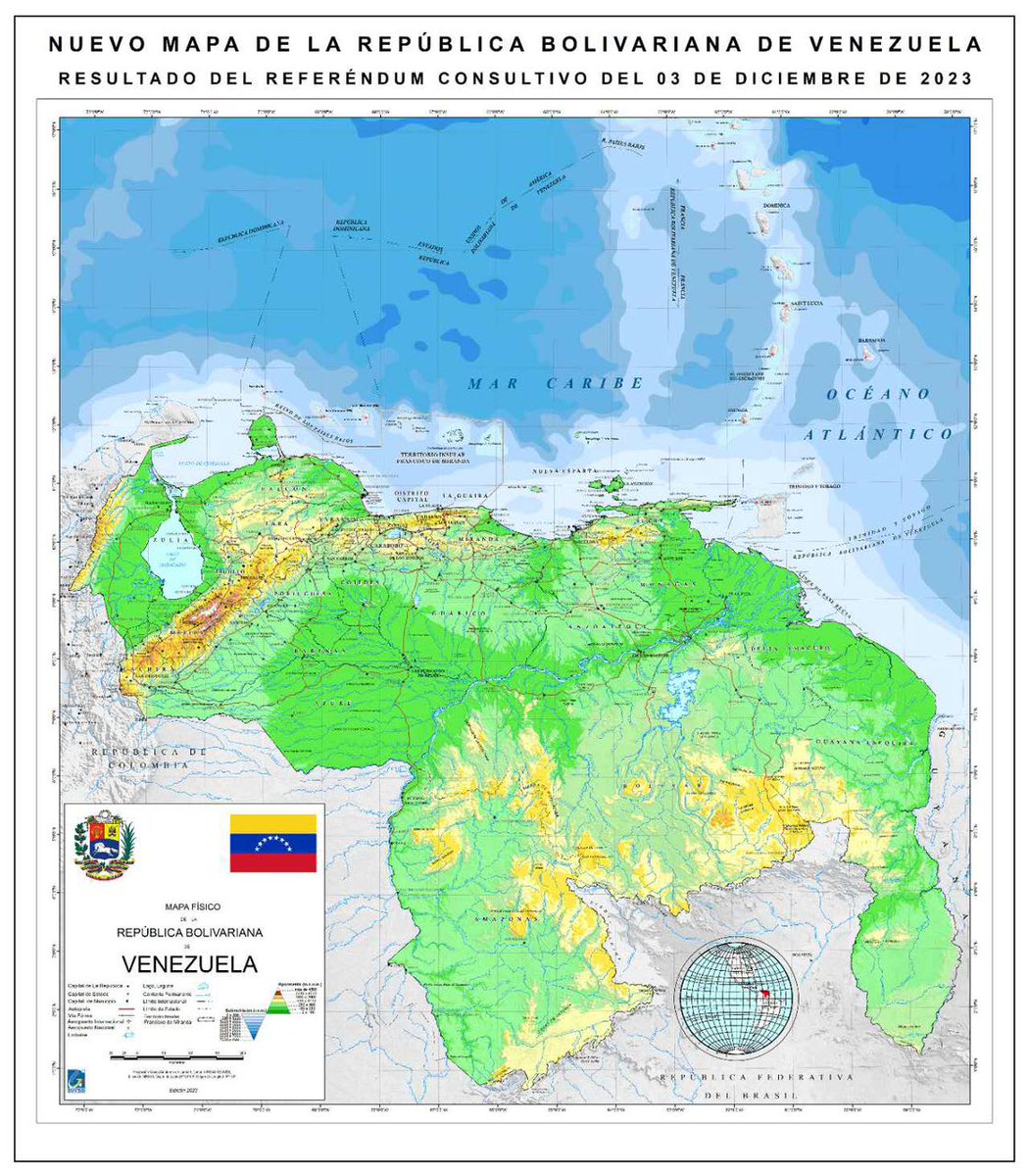
Photo Credit: teleSUR English, December 5, 2023
That same day, in response to Venezuela’s proposed measures, Guyanese President Dr. Mohamed Irfaan Ali released a statement to the people of Guyana:
“The measures announced are in blatant disregard of the order given by the International Court of Justice on December 1, 2023. Guyana views this as an imminent threat to its territorial integrity and will intensify precautionary measures to safeguard its territory.”
President Ali made it clear that Guyana was pursuing all diplomatic avenues available for dealing with this territorial threat: the United Nations Security Council, CARICOM, the OAS, the Commonwealth, and many of Guyana’s bilateral partners including the United States of America, Brazil, the United Kingdom, and France.
He advised that “the Guyana Defense Force is on full alert and has engaged its military counterparts including the US Southern Command.”
The Venezuelan Ministry of Foreign Affairs responded that “The Bolivarian Republic of Venezuela condemns the recent statements made by President Irfaan Ali, who, in a reckless manner, has given the green light to the presence of the United States Southern Command in the territory of the Guayana Esequiba region, over which Guyana maintains a de facto occupation and a territorial dispute with Venezuela.”
The Foreign Affairs Ministry further accused Guyana of “[a]cting under the mandate of the U.S. transnational ExxonMobil [by] opening the possibility of establishing military bases for an imperial power, thereby threatening the Zone of Peace outlined in this region.”
According to an Oil Price news report on December 7, ExxonMobil has refrained from commenting on the developing situation and Maduro’s accusations. “Border issues are matters for governments and appropriate international organizations to address,” their spokesperson told journalists earlier in the week.
Brazil, the United Kingdom, and the United States have all expressed concern about the growing tensions. During his December 6th call with President Ali, U.S. Secretary of State Antony J. Blinken reaffirmed the United States’ “unwavering support for Guyana’s sovereignty” and called for “a peaceful resolution to the dispute.”
On Thursday, December 7, the U.S. Embassy in Guyana issued a Press Release stating that “In collaboration with the Guyana Defense Force (GDF), the U.S. Southern Command (USSOUTHCOM) will conduct flight operations within Guyana on December 7. This exercise builds upon routine engagement and operations to enhance security partnership between the United States and Guyana, and to strengthen regional cooperation.” The Embassy further renewed its continued “commitment as Guyana’s trusted security partner and promoting regional cooperation and interoperability.”
This was not the first involvement of American military forces. A week before Venezuela’s December 3rd Referendum, the U.S. Army 1st Security Force Assistance Brigade (SFAB) met with the top brass of the Guyana Defense Force on November 27 and 28. As noted in a Press Release from the U.S. Embassy on November 28, the two forces “discussed upcoming engagements to include strategic planning sessions and processes to enhance both countries’ military readiness and capabilities to respond to security threats.”
During his telephone conversation on December 9 with Maduro, Brazilian President Lula da Silva called for dialogue and suggested that the current president of the Community of Latin American and Caribbean States (CELAC), Ralph Gonsalves, Prime Minister of Saint Vincent and the Grenadines, mediate on the matter between the two parties involved. Lula also reiterated that Brazil is available to support and accompany these initiatives and asked that there be no unilateral actions that would worsen the situation.
I first became aware of Guyana’s border dispute with Venezuela in 1970 when the leaders of the two nations signed the Protocol of Port-of-Spain (1970-1981), suspending Venezuela’s territorial claim for twelve years. I feared then for our security. The Guyana Defense Force was no match then—and now—against Venezuela’s relatively vast armed forces.
During the 1970s, there was talk within the government of then Prime Minister Forbes Burnham (1923-1985) to make “every citizen a soldier.” I didn’t know how, but I was ready to do whatever was needed to defend our country against a Venezuelan invasion. We rallied behind what became our new anthem “Not a Blade of Grass,” a song written by Dave Martin. Then, in December 1976, our government launched the Guyana People’s Militia (1976-1985). Its goals went beyond national defense and internal security to encompass uprooting the psychological effects of colonialism and building a new socialist society.
Much has changed since those early days of building a new socialist society. With Guyana’s new oil wealth, involving the presence of transnational oil corporations like ExxonMobil, the stakes have become higher. While I don’t believe that Guyana’s government has intentions of establishing U.S. army bases along its border with Venezuela, ExxonMobil will no doubt lobby the U.S. government for protection of its vast oil and gas assets in the offshore disputed region. The threat to the “Zone of Peace” across Latin America and the Caribbean Region now hangs in the balance.
Learn More:
- Closed Consultations on the Territorial Dispute between Guyana and Venezuela, Security Council Report, December 8, 2023
- Guyana-Venezuela Border Dispute: Geneva Agreement of 1966
- International Court of Justice, Arbitral Award of 3 October 1899 (Guyana v. Venezuela)
- ExxonMobil – Guyana
 Three Worlds One Vision
This puts me in mind of the Falklands. There are too many autocratic leaders in the world today
LikeLiked by 5 people
Yes, autocracy is coming back into fashion. Democracy is really very annoying. And it reduces the profits of the puppet masters. Warlike actions are much more profitable.
LikeLiked by 4 people
Derrick, the Falklands did come to mind. As to autocratic leaders, we have one here in the making, but he promises that it would only be on “day one.”
LikeLiked by 2 people
Come on, only one day! And then he will be the handsome gentleman we missed so much.
LikeLiked by 1 person
How foolish he must think we all are!
LikeLiked by 1 person
Well, some obviously are – as he seems to win again. 😎
LikeLiked by 1 person
Incredible, isn’t it!?
LikeLiked by 1 person
Thank you Rosaliene, for the most informative article! There is one constant throughout history: When there is a global crash everywhere, soldiers of fortune seize the opportunity. Sometimes it was possible to create facts.
These days we can reflect on how thin the line is between civilization and barbarism. And how little we can change from our ivory tower.
LikeLiked by 5 people
Like (when I clicked “Like,” it didn’t take).
LikeLiked by 1 person
WordPress glitches can be quite frustrating! In most cases I can only click “Like” and make a comment on the WP Reader.
LikeLike
You’re welcome, Friedrich! I’ve been following developments online with great concern. Maduro’s government must see the dysfunction in Washington DC as an excellent opportunity for their stunt.
LikeLiked by 2 people
Right, perfect timing ☹️
LikeLiked by 1 person
I think many leaders around the world are seeing opportunities with the dysfunction in Washington DC. Russia has already interfered with one election, that we know of. Autocrats are finding opportunities to seek more power, territory and notoriety. The optimist in me is trying to find something positive to say, but I’m at a loss for words now.
LikeLiked by 2 people
Tamara, I, too, get lost for words. I’m currently reading a book by a woman who works at improving the conditions of incarcerated women in America. She warns us against misanthropy with this observation: “Most people are merely cooperating with the world as they understand it, either under the threat of violence or because they are navigating the illusions that were constructed around them. The people driving those conditions are a relative minority whose greed and violence does not define all of humanity, no matter how much they would like us to suppose it does.”
LikeLiked by 1 person
Oh, I love this quote! Yes, we must do what we are able to do. It might not seem like much, but when people of like minds connect, their energies get multiplied.
LikeLiked by 1 person
I was completely unaware of this situation (as I suspect 99.9 % of Americans are), but I have no doubt that Venezuelan President Maduro is very aware of the divisive situation in the U.S. re support for Ukraine and Israel, and knows that vigorous involvement by America in this dispute is likely to go over like the proverbial lead balloon.
LikeLiked by 5 people
Mistermuse, I watch the BBC news that has mentioned it in passing, so I have no idea if it’s being covered in the online mainstream media. I learned today on a Guyanese Facebook forum that the Venezuelan Americans in Miami are not at all happy with Maduro’s move. I share your view that he’s taking advantage of the current divisive situation in the U.S. regarding Ukraine and Israel.
Perhaps for tactical reasons, there is no official photo or report yet available on SOUTHCOM [https://www.southcom.mil/] regarding the scale of the Guyana-Venezuela border flyover. Photos circulating on TikTok appear to be promotional images.
LikeLiked by 1 person
Thanks for your reply, Rosaliene. I watch MSNBC, CNN, and the evening network (ABC or NBC) news for several hours almost every day, and haven’t heard a word about the situation, nor have I read a word about it in the local paper. I have to agree with your reply to GP that the media will only take notice when a Russian warship arrives off the coast of Venezuela.
LikeLiked by 1 person
Unbelievable, Mister Muse! Latin America and the Caribbean falls within the U.S. domain. No doubt, the Pentagon is paying attention.
LikeLiked by 1 person
This is unknown to many. The media only talks about the items they believe will bring avid listeners.
LikeLiked by 3 people
Like (when I clicked “Like,” it wouldn’t take).
LikeLiked by 1 person
Brother do I know THAT feeling!!
LikeLiked by 1 person
Me, too, GP!
LikeLiked by 1 person
I have to agree, GP. The media will only take notice when a Russian warship arrives off the coast of Venezuela. Maduro did mention in one of his responses to the Guyanese president that he has support from Russia, China, Iran, Turkey or Belarus.
LikeLiked by 2 people
More potential heartache, theft, and death. This must be especially troubling for you, Rosaliene. I hope calmer years prevail.
LikeLiked by 2 people
Thanks, Dr. Stein. It is, indeed, a troubling time for me as well as all Guyanese in the Diaspora. Most of us have family, relatives, and friends in Guyana. Many own property as well as have business relations with Guyana.
LikeLike
Not another egotistical autocrat! Where do they crawl from? Thanks for this interesting and relevant article Rosaliene.
LikeLiked by 2 people
You’re welcome, Denzil. As I mention in my comment to Derrick, we have our own egotistical autocrat here in the US who is anxiously waiting backstage.
LikeLike
Thank you, Rosaliene. I, like many others, was unaware of this situation. 🙏
LikeLiked by 2 people
You’re welcome, Sunnyside. With all eyes on Ukraine and Gaza, not forgetting the action/non-action in Washington DC, who cares what a weakened dictator in America’s backyard is planning to strengthen his hold on an already suffering population?
LikeLike
Territorial disputes partly define all of human history.
LikeLiked by 1 person
Spot on, Neil! More so than we realize.
LikeLiked by 1 person
You’re very good at finding out about things happening around the world that I’m likely to not have known about otherwise.
LikeLiked by 1 person
Betsy, I’m glad that my articles bring awareness of events not covered by the mainstream media. I have a special interest in Guyana as it’s my place of birth. I lived for one year in the Waini-Barima Region/Essequibo located not far from the Venezuelan border. The local population, mainly indigenous peoples, now live in fear of an invasion. The area is the setting of my second novel, The Twisted Circle.
LikeLiked by 2 people
Very interesting!!!
LikeLiked by 1 person
Let’s hope this remains just sabre rattling, rather than becoming a vast waste of life. Don’t expect too much from the UK though. We’re already sending arms to the Ukraine and helping to protect Estonia.
Argentina is in political trouble, by the way, so the Falklands is back on the agenda to divert the attention of any potential revolutionaries.
LikeLiked by 1 person
John, I also hope that it’s just sabre rattling. Looks like things are moving forward for a diplomatic resolution. On Thursday, December 14, Presidents Maduro and Ali will meet for talks in Saint Vincent and the Grenadines at the invitation of President Ralph Gonsalves, current chairman of the Community of Latin American and Caribbean States (CELAC). Brazilian President Lula da Silva has also been invited at the request of both parties in the dispute.
I haven’t been following the situation in Argentina.
LikeLiked by 1 person
As far as I know, to divert attention from the unbelievable rates of inflation, the president has raised the question that the Falklands are/should be Argentinian. This is irrespective of the wishes of the people who consider themselves British 100%.
LikeLiked by 1 person
John, what the people want in disputed areas is/was rarely considered. We see it playing out on our screens, large and small, in what was once Mandatory Palestine (1920-1948).
LikeLike
I’d just learned about this situation via someone I follow on Twitter (@TamanishaJohn), but didn’t dive into her thread so was basically clueless. Thank you for your succinct explanation and links, Rosaliene. It’s exhausting to be in a world filled with one crisis after another although your connection to this situation goes WAY beyond my feeling of exhaustion. I hope you’re doing alright in the midst of everything going on.
LikeLiked by 1 person
It is, indeed, exhausting, Tracy! There are days when my BP spikes.
LikeLiked by 1 person
I’m sorry to hear all this does affect you physically, Rosaliene, although it’s understandable. I hope you can carve out moments of peace and calm in your days.
LikeLiked by 1 person
Thanks, Tracy. Watching a Hallmark Christmas movie in the evening is a great escape 🙂
LikeLiked by 1 person
That sounds like an excellent plan for your emotional health. Love it!
LikeLiked by 1 person
Those are some solid election results. The people have spoken! Informative and well-written article. Thank you for the education. 👍
LikeLiked by 1 person
Thanks very much, Michele. The Venezuelan Referendum results are dubious: According to the Venezuelan opposition party, the voter turnout was not as high as the Maduro regime would like the world to believe.
LikeLiked by 1 person
You’re welcome. That makes more sense. Apologies if I missed that detail.
LikeLiked by 1 person
Well writ, Rosaliene. I can remember reading in my Primary School history book “The Children’s Story of Guyana,” written by the historian Guy E.L. De WEEVER, that Surinam which was owned by the English Governor of Barbados, Lord Willoughby was traded for Essequibo re the TREATY OF BREDA IN 1667. Later on, Essequibo, Demarary and Berbice formed British Guiana.
LikeLiked by 1 person
George, thanks very much for that reminder about the 1667 Treaty of Breda. Europe’s endless wars of succession and expansion in the New World still cast their shadow over the region.
LikeLiked by 1 person
Rosaliene, first let me commend you on a well-delivered message that seems like a page taken from the dictator playbook of regimes staking claims for territories like Guyana for more power and stealing their resources for financial gain. With recent conflicts mounting, and these narcissistic power-hoarding bullies, holding people hostage, is despicable. The people do not want conflict. They want to live peaceful lives. But the powers that be don’t give a crap and are making calculated, deplorable decisions that’s interrupting generations of innocent lives.
Thanks for sharing this information that we have heard little about, but news that cannot continue to be ignored. 💖🙏🏽💞
LikeLiked by 1 person
Thanks very much, Kym. You’re spot on: Venezuela is after the oil off the Essequibo coast.
LikeLiked by 1 person
You know Rosaliene, this insane greed isn’t what the people want. I believe they want to live in peace, but greed and power is mindblowing in such situations. Thank you for shedding light on this horrific situation. You really don’t hear a lot about this story because it gets lost in the other unbelievable conflicts going on around the world. 😥
LikeLiked by 1 person
Kym, what we the people want matters little to the minority power elite.
LikeLiked by 1 person
Yep Rosaliene, that is pretty obvious. Sad, but very true! 😥
LikeLiked by 1 person
Thank you, Rosaliene for this very informative post. We seem to be going through a period of rising autocracies and with it the rising egos of their leaders. There is nothing I can do personally except my prayers & thoughts are for a peaceful & democratic solution. 💓💛💚🙏
LikeLiked by 1 person
You’re welcome, Ashley. Here’s hoping that the mediated meeting on December 14 between Maduro and Ali has a peaceful and democratic solution.
LikeLike
I did not know about this matter. You explained it clearly. I’m not surprised at anything rulers like Maduro will try to hang on to power. Trump must admire him for that. I hope Guyana retains its territory.
LikeLiked by 1 person
John, I not surprised that you haven’t heard about this. It hasn’t been covered by our mainstream media. I’m awaiting news of the outcome of the mediated meeting on December 14 between the two leaders.
LikeLiked by 1 person
Thanks for bring attention to this important matter. Rosaliene, I hope the outcome is just and Maduro keeps his hands of Guyana’s land.
LikeLiked by 1 person
Thank you for that comprehensive post on the border dispute between Guyana and Venezuela. Fights over natural resources never end well, and when I was studying economics, it was honestly depressing to see how dependent economies are on natural resources. Wishing Guyana well in this!
LikeLiked by 1 person
So far so good, Claire. At a mediated meeting on December 14, the two sides agreed upon a non-violent solution.
LikeLiked by 1 person
Glad it’s working so far!
LikeLiked by 1 person
Thank you, Rosaliene, for sharing this beautiful, colorful and tear-bringing testament to how things could be. Although I couldn’t understand the words, the spirit got me to thinking of the hopefulness inspired by Christmas, and again with the resurrection of life at Easter. These times are so wrapped up in human history, cultures, and all religions, that we must have respect for whatever makes it all possible.
LikeLiked by 1 person
Rosaliene,
My comment below referred to the Christmas wish expressed by the Brazilian ensemble. I’m less familiar with the border dispute but read last night in AP News that Mexico’s president Andres Manuel Lopez Obrador has called on the US to assist in resolving Latin-American tensions, especially with Venezuela and Cuba, and to provide assistance in the form of programs designed to build up strong internal work forces, like tree planting and youth assistance programs.
The ExxonMobil role in this ongoing drama transcends all governments and creates additional cause for controversy.
It reminds me so much of the territorial dispute now between Israel and Palestine, with the added dimension that a natural gas deposit has been found off the Mediterranean coast of the West Bank.
I wish everyone could learn how to get along, with the common purpose of inspiring hope for all the world.
LikeLiked by 2 people
My wish also, Katharine ❤
LikeLiked by 1 person