
Tags
Covid-19 lockdown, Defining the Anthropocene, Pandemic poems, Poem “The Orbis Spike 1610” by Jennifer Rahim, Sanctuaries of Invention: Poems by Jennifer Rahim (UK 2021), Trinidad/Caribbean Island, Trinidadian poet Jennifer Rahim

Photo Credit: Peepal Tree Press Ltd.
My Poetry Corner November 2023 features the poem “The Orbis Spike, 1610” by Jennifer Rahim from her poetry collection Sanctuaries of Invention (UK, 2021). Born in the Caribbean Island of Trinidad in 1963, Jennifer Rahim was an award-winning poet, fiction writer, and literary critic. She held a BA (1987) and PhD (1993) in English Literature, and an MA in Theology (2016). After joining the University of the West Indies, St. Augustine in 1997 as a lecturer in the Department of Liberal Arts, she went on to teach a range of courses at both undergraduate and postgraduate levels, including creative writing, literary criticism, and feminist theory. She died unexpectedly in March 2023, leaving behind a substantial body of published work.
Most of the poems in Rahim’s collection were written during the Covid-19 lockdown and a state of emergency in Trinidad. Her poems address the nature of time, place, and mass death. In “Gone Viral,” she notes in the opening lines (p. 18):
Some words return to haunt us at the root.
The world reels from an underrated flu – gone viral,
as when a presidential gaffe becomes a kind of math.
Exponential: Many people will die who have never died before.
She recalls, too, in the opening verse of “Survival” (p. 19):
Any number of days is one too many
when home is no safe haven against the death
that roams neighborhood streets,
coughs on a public bus,
reaches for toothpaste on a grocery shelf,
jogs by in less friendly parks. . .
After watching televised reports of George Floyd’s murder and the resurgence of racist white nationalism in the United States, Rahim reminds us in “No / Language is a Virus” (pp. 59-60) that Words fly the grave, steal / the only thunder a virus can claim, / and, alive, / witness to goodness that quietly thrives.
If language is a virus,
let poetry be antidote to mend divides,
neutralize frictions, cause upset
to the anatomy of sound & sense
to oust diseased alphabets one yard,
one odyssey, one slur
and poisoned syllable at a time.
In the featured 38-line poem “The Orbis Spike, 1610” (pp. 12-13), Rahim takes us back in time to a period that has shaped our present world. So great was the mass death by smallpox and warfare of an estimated fifty million indigenous peoples of the New World, resulting from European settler invasion, beginning in 1492, that there was a recorded dip in global carbon dioxide levels.
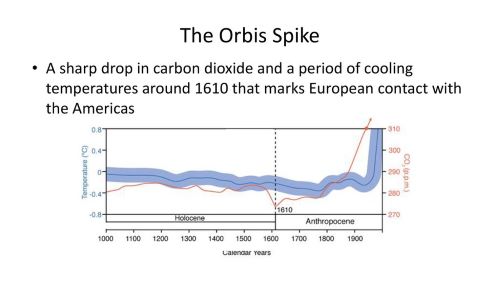
Image Credit: Defining the Anthropocene, Nature Magazine
The abandoned former farmlands in the newly depopulated Americas allowed the regrowth of forests. By 1610, the trees had trapped so much carbon dioxide from the atmosphere to cause a significant drop in carbon levels and start a little ice age. Ecologist Simon Lewis of the University of Leeds and University College London (UCL) and his UCL colleague, geologist Mark Maslin dub the decrease in atmospheric carbon dioxide the “Orbis spike,” from the Latin for world, because after 1492 human civilization has progressively globalized.
Rock, ice and sediment tell
their own stories.
They keep this memory:
in 1610, CO2 levels dipped –
an Orbis Spike marks the martyred
on fields emptied of trees, emptied
of the dead that could no more labor.
Breathing hectares &
breathing lungs – limbs of bark & limbs
of flesh. No more alive.
The poet reflects on the un-grieved dead across a land that would never-ever be the same, where an infinite absence remains.
Now, uncaring, we strip ourselves
and call that development.
Forests burn like cancerous lungs
and First Nations are still
the first to die.
In remembering that the Ancients tell us that humans and the land share the same breath, the poet resolves to plant a poem deep in the soil. She closes with a prayer to Mother Earth:
Dear Earth,
we have grown so apart.
Now that we are full-blown, obscenely
anthropocene, will you forgive, allow us, again,
to breathe. . .
To read the featured poem “The Orbis Spike, 1610” and learn more about the work of Jennifer Rahim, go to my Poetry Corner November 2023.
Learn more about the study, published in 2015, that considers 1610 as the start date of a new, proposed geologic epoch—the Anthropocene, or recent age of humanity.
 Three Worlds One Vision
She sounds a very interestring poet. She has certainly coined at least one line that gives a lot of food for thought…..
“Many people will die who have never died before.”
LikeLiked by 2 people
She is, indeed, John. Those words in her poem are actually a quote attributed to then President Trump that was spread on social media in March 2020.
LikeLiked by 1 person
Your contextual explanation paragraphs are very helpful. Jennifer has captured the essences of this age. Her early death seems unfortunately relevant
LikeLiked by 2 people
Thanks very much, Derrick. I added the information for readers who may not be familiar about the term. I did not know of her death when I purchased her collection. This discovery of her sudden and unexpected death unsettled me. For those of us who do not live in a war zone, the sudden death of a loved one can take us by surprise and upturn our world.
LikeLiked by 1 person
Indeed
LikeLiked by 1 person
Jennifer Rahim — whose work I was not familiar with until seeing your excellent post, Rosaliene — is an exceptional poet. Love the beauty and sociopolitical nature of her words.
LikeLiked by 1 person
Dave, I’m so glad that you can appreciate her exceptional work 🙂 The Caribbean Region has lost an excellent writer and important voice.
LikeLiked by 1 person
You’re a student of poetry, and you bring attention to poets that many people are unfamiliar with. You’re doing good work.
LikeLiked by 1 person
Thanks very much, Neil 🙂 Poetry carried me through a very difficult period of my life here in the USA. I hope that it can do the same for others.
LikeLiked by 1 person
She knew how to play with words when expressing her point, she would definitely be remembered for her brilliant writing!
LikeLiked by 1 person
Thanks very much, Zet Ar. She will definitely be remembered in Trinidad and across the Caribbean.
LikeLiked by 1 person
I have never heard of the Orbis Spike before. It’s really telling isn’t it. Jennifer Rahim’s poetry is honest and beautiful. The information about her life was helpful too. Maggie
LikeLiked by 1 person
So glad you like Rahim’s poetry, Maggie 🙂 I’ve read about calling this period the Anthropocene, but did not recall hearing about the Orbis Spike in 1610.
LikeLiked by 1 person
Thank you for this overview of Rahim’s work. I like her politically minded voice.
LikeLiked by 1 person
My pleasure, Rebecca. So glad you like Rahim’s voice 🙂
LikeLiked by 1 person
Interesting poem and person. I read a book a while back that talked about the Orbis Spike. Such a crazy thing. Nature works in mysterious ways.
LikeLiked by 1 person
Thanks very much, Mara. Until we humans change our way of relating with Mother Nature, we will continue to jeopardize her harmonious balance of Earth’s elements.
LikeLiked by 1 person
WOW Rosaliene, thanks so much for introducing me to an extraordinary poet! 🙏🏽 I was not familiar with Jennifer Rahim, and her poem is quite intriguing. I love how you brought out her reflections on the un-grieved dead across a land that would never-ever be the same, and remembering the Ancients. Awesome, and thank you for offering your teachable moment my friend! 😍💖🥰
LikeLiked by 1 person
Thanks very much, Kym. My pleasure 🙂
LikeLiked by 1 person
🥰🙏🏽😊
LikeLiked by 1 person
This is all beautiful and heart-wrenching, especially this:
Dear Earth,
we have grown so apart.
Now that we are full-blown, obscenely
anthropocene, will you forgive, allow us, again,
to breathe. . .
LikeLiked by 1 person
Thanks very much, Tracy 🙂 I thought so, too.
LikeLike
Some quality sharing going on here! Thank you for sharing this poet and some highlights from her meaningful work. Reading her words has added to McNickle’s lines that washed over me this morning. 🙏🏻
“If language is a virus,
let poetry be antidote to mend divides” 👏🏻
LikeLiked by 1 person
Michele, I’m so glad that you connected with Rahim’s poetry 🙂 As a believer in the power of poetry to “mend divides,” I do my small part in bringing diverse poetic voices to the attention of my readers.
LikeLiked by 1 person
Welcome and well done! 🙏🏻
LikeLiked by 1 person
Jennifer Rahim’s clarifying poetry has the power to be an antidote to mend divides, or at least get people to think deeply about things that need changing. I often cringe when I hear or read the word, “development,” when it really means the stripping of the land. She makes a powerful analogy of the forests burning like cancerous lungs. I hope Mother Earth can forgive us and give us another chance, but I don’t know why she should if we remain “obscenely anthropocene.” Still, I believe there is hope for us in people like this poet. I’m sorry she died, but thankful for you sharing her poetry. I had never heard of the Orbis Spike before.
LikeLiked by 1 person
JoAnna, thanks so much for adding your own clarifying thoughts about Rahim’s featured poem. On researching her bio, I was shocked to learn that a poet with such clarity about our world was no longer with us.
Learning more about the Orbis Spike in 1610 gave me a greater appreciation of her poem. It’s incredible to realize that we humans have been on this path of destruction–we call development and progress–for over four hundred years. This is why it’s so difficult to change our way of being and doing as proposed by Jem Bendell.
LikeLiked by 1 person
Good point. Long term, generational habits are hard to change, but we can change if we work hard enough.
LikeLiked by 1 person
I love how she describes words going viral!
LikeLiked by 1 person
Thanks for reading, Claire 🙂 Sadly, far too many words used to spread disinformation have also gone viral.
LikeLiked by 1 person
Definitely, and I think ChatGPT and other AI tools don’t help either
LikeLiked by 1 person
For sure.
LikeLiked by 1 person
Thank you for sharing!!.. while I were growing up on the farm, decades in the past, my dad always said “if I take care of the land, the land will take care of me”… unfortunately, when it comes to today’s societies the words of Isaac Asimov ring true “The saddest aspect of life right now is that science gathers knowledge faster than society gathers wisdom” ( Isaac Asimov)… hopefully the next generation of young folks can use that technology and wisdom will prevail once again…. 🙂
Hope all is well in your part of the universe and until we meet again…
May the road rise to meet you
May the wind be always at your back
May the sun shine warm upon your face
The rains fall soft upon your fields
May green be the grass you walk on
May blue be the skies above you
May pure be the joys that surround you
May true be the hearts that love you.
(Irish Saying)
LikeLiked by 1 person
It’s my hope, too, Dutch. Thanks for dropping by and sharing your thoughts 🙂
LikeLike