
Tags
British Guiana (Guyana)/South America, British Regiments in British Guiana 1953-1966, Dogged Persistence, Dream Husband, Pursuing One’s Dream, The Argyll and Sutherland Highlanders British Guiana 1953-1954
Chapter Five of my work in progress presents the third portrait of a woman in my life. Auntie Baby, Mother’s baby sister, played an important role during my formative years. Nine years younger than Mother, she was just four years old when her parents and nine older siblings left British Guiana in 1946 for the United States. With the end of World War II in September 1945, my maternal grandparents must’ve seen better prospects for their future under America’s President Harry Truman. For reasons unknown to me, they failed to fulfill their promise to return for the three girls left behind.
Auntie Baby lived with us on and off from the late-1950s to mid-1960s. She brought lots of fun into our lives as kids. I must’ve been around eight to nine years old when I became aware of her dream to marry a white man and move to the Mother Country. Perhaps, the arrival of British soldiers in the colony incited her imagination.
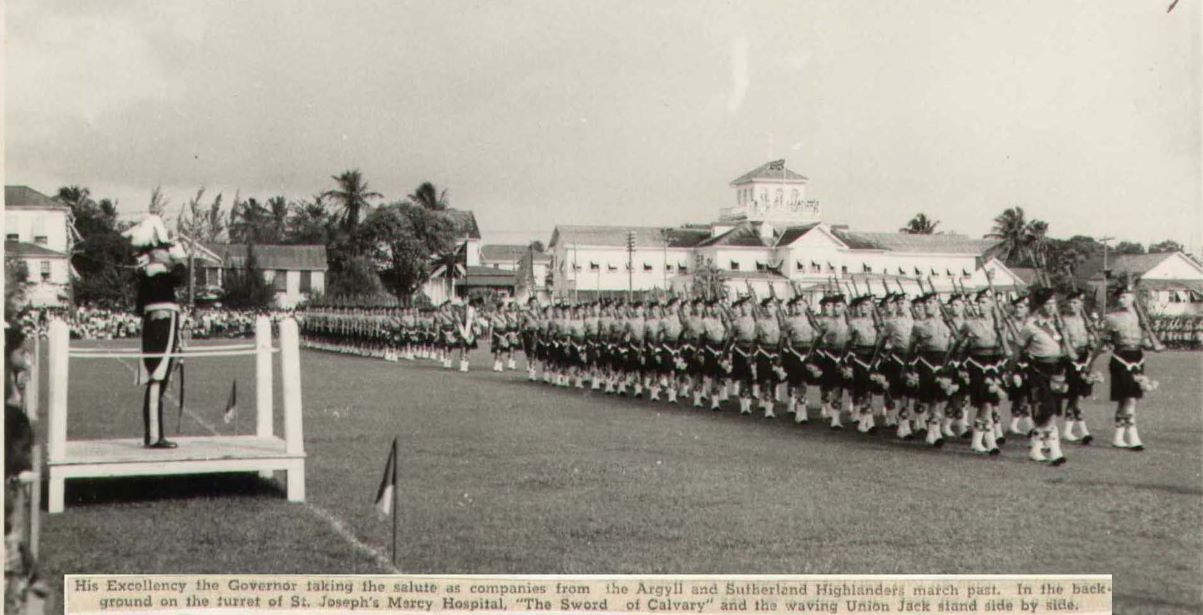
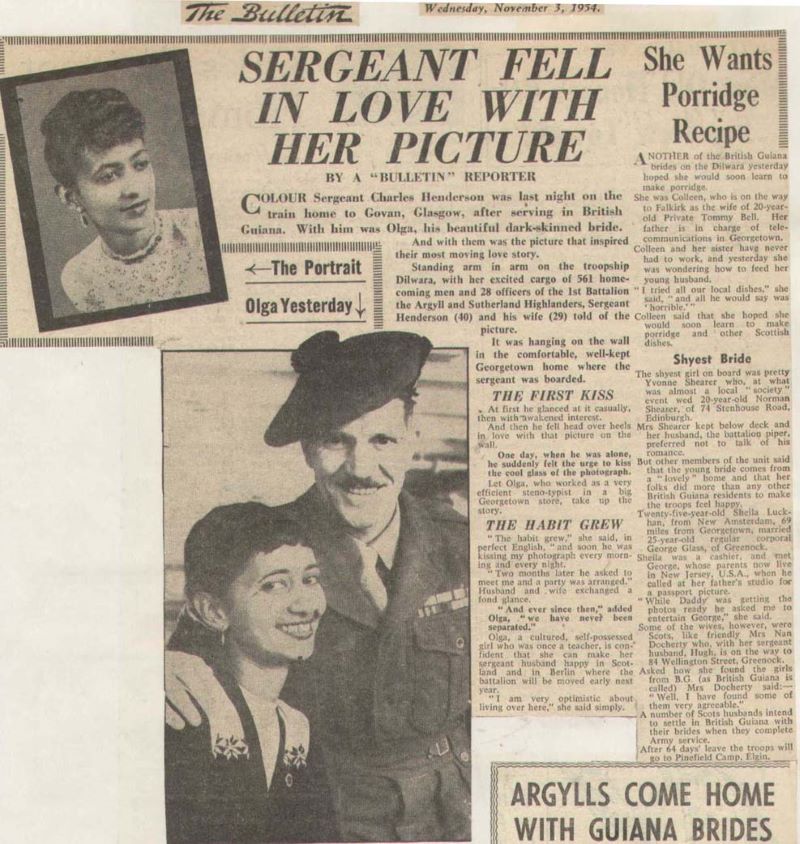
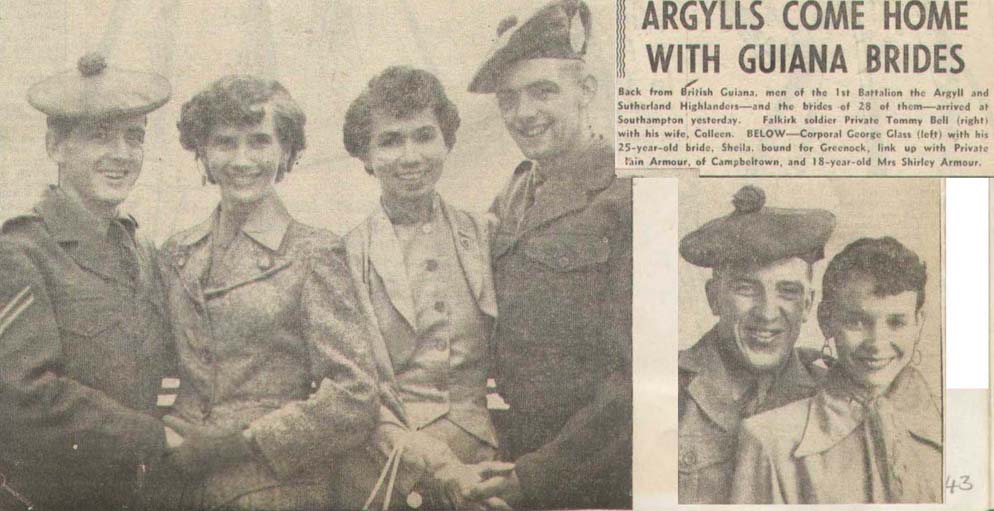
On October 8, 1953, the Royal Welsh Fusiliers were the first battalion to arrive in the colony to suppress an alleged communist takeover. Two weeks later, they handed over to the Argyll and Sutherland Highlanders. Auntie Baby was twelve-going-on-thirteen years old when they left in October 1954, taking twenty-five Guianese-born wives with them back home to Scotland. When she began dating at eighteen years old, the Worcestershire Regiment was on their one-year tour of duty. Her time had finally come to catch her dream husband. She soon learned how elusive dreams can be. Yet, she persisted.
Auntie Baby was the inspiration for the minor character, Joanna de Freitas, niece of protagonist Richard Cheong’s mother-in-law, in my debut novel Under the Tamarind Tree. Joanna first appears in Chapter Seven (p. 32) when she arrives with her Scottish soldier boyfriend at a family Christmas party (December 1953).
Chapter Five: Auntie Baby – Whitening Her Bloodline
Mother’s youngest sister, Carmelita, known as Baby, lived with our family on and off from the late-1950s to mid-1960s. She must have been about sixteen years old when she first moved into our one-bedroom, bottom flat in the tenement yard. Had Grandfather sent her to help Mother with her growing brood of kids? I could only speculate. Her single bed occupied a corner of our dining room.
For us kids, Auntie Baby was fun. She played hide-in-seek with us; took us for walks around the neighborhood. Her scary stories gripped our attention, like the one about the ole higue, an old woman who shed her skin, turned into a ball of fire, and entered people’s homes to suck the blood of little children.
“The ole higue only sucks the blood of bad-behaved children,” Auntie Baby told us, as a warning to be on our best behavior.
While Mother was busy with her sewing, Auntie Baby braided my thick hair that, at six years old, had already grown below my shoulder. Seated outdoors on the front steps, she tested my spelling of the words listed in my primary school spelling book. Using scraps of cloth from Mother’s waste basket, she made dresses from our prized Barbie dolls. She took me to Church on Sunday mornings: Mother and Father were not churchgoers.
I adored her.
Auntie Baby was brown-skinned; not light-complexioned like Mother. When she started working, she began a nightly ritual of covering her face and neck with a skin cream that a friend had recommended for lightening dark skin. To straighten her natural, soft, curly, short hair, she slept in large hair rollers. But it was her thick skin nose that she hated most of all. She believed that pinching her nostrils with a wooden clothes pin could shape her nose like that of the American actress, Grace Kelly. No pain was too much to achieve her perfect nose.
She was determined to marry a white man and have light-skinned offspring. “You gotta have white-skin to get anywhere in this country,” she told her best friend, a fair-skinned young woman from neighboring Dutch Guiana. The single young white British soldiers—stationed in the colony to suppress an alleged communist takeover, following the suspension of the Constitution in October 1953—offered opportunities to catch her dream man.
I don’t know how she met her first “limey” boyfriend, but I remember his name—Peter Baker. At the time, she was working as a cashier at one of the cinemas in Georgetown. I shared her excitement. When Peter’s one-year tour of duty ended, they continued their relationship through letters. The sealed back flaps of his envelopes were always covered with X’s and O’s.
“Hugs and kisses,” Auntie Baby told me when I asked her what they meant.
Auntie Baby guarded Peter’s letters in a shoebox that she kept under her bed. For her eyes only. I never betrayed her trust. When the letters stopped coming, she started dating another soldier from among the British regiment’s latest arrivals. She invited him home one Sunday when Father and his friends usually gathered outdoors to play dominoes and drink rum. Father nicknamed him “Speedy Gonzales,” after the fastest cartoon mouse in all Mexico, for the speed with which he downed his liquor. I found his ruddy face, like a ripening tomato, amusing.
Mother did not like him as a prospective husband. “He’s too crude,” she told her baby sister. But Mother had no cause for concern. Like Peter, he left Guiana’s shores without a marriage proposal.
As the years went by, Auntie Baby’s white boyfriends came and left Guiana. Their names and regiments are lost in the changing winds of time. The love letters never stopped coming, filling up more shoeboxes. Yet, she persisted, sure that she would one day achieve her dream husband. To each of her beaux, she was the charming and affectionate Carmelita.
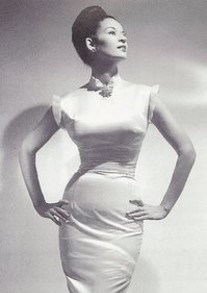
At a friend’s suggestion, she attended the Sara Lou Charm School for Girls to learn about poise and proper etiquette. Born in North Carolina in 1926, Sara Lou Harris was a black American high fashion model known for her elegance and charm. She married Guianese John Carter, a barrister and politician, in 1959 after meeting him a year earlier when she visited the colony to participate in a fashion show. When her husband was knighted in 1966, she became Lady Sara Lou Carter. Then in June 1966, less than a month after the country’s independence from Britain, she and Sir John Carter moved to Washington D.C. to take up his appointment as Guyana’s first ambassador to the United States.
Under Auntie Baby’s tutelage, my sister and I practiced walking erect with a heavy book on our head. She demonstrated how to cross our legs at the ankles when seated. Then, there were all the rules of proper table manners. Mother looked on in silence as her baby sister taught us how to behave like ladies.
Mother dressed Auntie Baby like a refined young woman in the latest fashion: cotton seersucker, shirtwaist dresses, with pleated or gathered skirts that fell below the knees. No low necklines. No sleeveless dresses. No fitted curves.
“Good men don’t marry loose women,” Mother told Auntie Baby.
We were living in the Queenstown bottom flat when Auntie Baby received the news she had longed for over the years. It was late 1965, just a few months before our independence from Britain and the departure of the British armed forces.
“Coming for you on next flight,” her white Royal Air Force (RAF) airman and engineer wrote in a telegram.
Elated, Auntie Baby began preparations to leave Guyana. Outdoors in the yard at the side of the house, I helped her burn the four or five shoeboxes of old love letters. It was a bittersweet moment for me. My beloved aunt was going far away. Our years spent together seemed to disappear in the smoke.
Mother made a white, two-piece dress suit for their marriage at the Registrar’s Office and other dresses for Auntie Baby’s trip overseas. She did not want a wedding gown: Her husband-to-be planned to have a formal wedding ceremony with his family in England. How sad not to see her dressed up as a bride next to her dream husband!
I wept the day she left Guiana. Mother guarded her own feelings.
Auntie Baby knew what she wanted in life and never took her eyes off her prize. I’ve never met her husband or her two children, a boy and a girl, my British-born first cousins. From the photos she sent to Mother, they were white-skinned as she had longed for.
I reunited with Auntie Baby during an unexpected two-hour visit sometime in 1980. At the time, she was thirty-eight years old. I had left the convent and was then working at the University of Guyana Library. She arrived on an RAF aircraft that had come to collect a British army unit upon conclusion of their training exercise in the Guyana jungle. By chance, I was off that day and was visiting my youngest brother at the bank where he worked. Standing out from among the female customers in the bank, Auntie Baby seemed to have stepped out of time. She was still dressed like the modest housewife of the 1960s—high neckline, sleeves just above her elbows, and full skirt hanging below the knees.
After we chatted with my brother, I accompanied her as she visited her former elementary school in Alberttown, not far from our Queenstown home where Father, my brother, and I still lived. By then, Mother and my other three siblings had all migrated to the United States or Canada. Auntie Baby’s former schoolteachers had moved on. Then, I took her home. Father was not at home, but she had the chance to chat with our landlord and his wife. For a while, we exchanged letters, but lost touch as our lives unraveled under an autocratic government.
Did her life in England turn out to be all she had hoped for? With only an elementary school education, she had trained as a Nursing Assistant and worked in a hospital in London. Not everyone was as accepting of her brown skin and Guyanese origin as her husband and his family. She faced racism from some white patients who refused to be cared for by a black woman. “I learned to deal with it,” Auntie Baby told me. “God knows what’s in my heart and soul. He will be my judge.”
Through Mother, I learned that Auntie Baby’s marriage to her white English husband endured until her death from cancer in 2008.
 Three Worlds One Vision
The motives for people’s behaviour, good or bad, never cease to fascinate.
LikeLiked by 3 people
Me, too, John. Mind you, as a participant observer, I can only presume what motivated her based on her behavior and attitudes.
LikeLiked by 2 people
What a beautiful story. She sounds like a wonderful woman. It’s breaks my heart though to read how she tried to change her skin colour (like many others). I hope she found happiness. Maggie
LikeLiked by 4 people
Thanks very much, Maggie 🙂 During those days when we were British colonial subjects, skin color played a decisive role in our lives. I, too, hope that she found happiness.
LikeLiked by 1 person
Fond memories for you, Rosaliene. I do hope she had a happy life.
LikeLiked by 3 people
Derrick, I didn’t realize how much it hurt losing her until I began working on her portrait. I would like to think that her happy disposition carried her through the tough times.
LikeLiked by 2 people
You’ve had fascinating women in your life, Rosaliene, and this is a great written portrait of your Auntie Baby.
LikeLiked by 4 people
Thanks very much, Dave! That’s music to my ears 🙂
LikeLiked by 1 person
Quite a story. The goals we have and the paths we choose to achieve them, often one and then another, say much about who we are. Oscar Wilde offered this comment: “There are two tragedies in life. One is not getting what you want. The other is getting it .” Was his cleverness also wise? Not for me to say.
LikeLiked by 5 people
So glad that you can appreciate her story, Dr. Stein. I believe that whatever our choices in life, they always come with the upside and downside. The tragedy comes in ignoring the dangers of the thing desired.
LikeLike
A lovely story, Rosaliene. Auntie Baby sounds like a wonderful woman.
thank you for sharing this with us all. 💙🙋♂️
LikeLiked by 4 people
Thanks very much, Ashley 🙂 My pleasure ❤
LikeLiked by 1 person
That is quite the story Rosaliene. A story full of hope. She sounds like quite the lady. Have a wonderful Sunday. Allan
LikeLiked by 2 people
Allan, how interesting that you see it a story full of hope! In this light, hope for a better outcome must’ve kept her trying again and again after each failed relationship. A wonderful Sunday to you, too 😀
LikeLiked by 1 person
Pardon my alliteration, but this post was riveting reading, Rosaliene. Beyond that, I can only echo the responses of previous commenters.
LikeLiked by 3 people
Oh, what a joy, Mister Muse! Thanks very much 🙂
LikeLiked by 1 person
Auntie Baby sounds like a special woman. I hope her husband was good to her. Thanks for sharing her story, Rosaliene. ❤️
LikeLiked by 3 people
My pleasure, Sunnyside 🙂 I, too, hope that her husband was good to her ❤
LikeLiked by 2 people
Sadly, the motives of your Auntie Baby is not an uncommon thing Rosaliene. It’s hard when people voice how we have to live with this, but somehow manage to survive. What a heartwarming story my friend. 😊💖🤗
LikeLiked by 2 people
So glad that you found her story heartwarming, Kym ❤ Sadly, the color of our skin continue to determine how we are perceived and treated. Like Auntie Baby, we do what we think necessary for our survival.
LikeLiked by 2 people
AMEN Rosaliene. 🙏🏽 If only folks knew what a blessing we could be to them, then we would be treated much better. But, such is reality, and somehow we have learned to rise above such bigotry and we, honey child, are still here, surviving and THRIVING! Bless you Rosaliene. Stay strong and encouraged my dear friend. 🤗💖🥰
LikeLiked by 2 people
So true, Kym ❤
LikeLiked by 1 person
I really enjoyed reading Auntie Baby’s character. While I thought she could be 81 this year, I realised she’d passed on at 66 and may her soul rest in peace!
LikeLiked by 2 people
You’re right, Zet Ar, she would’ve been 81 this year if she had lived. So glad you enjoyed my portrayal of her 🙂
LikeLiked by 1 person
Greetings. After marrying, did she stay in close contact with anyone in your family?
LikeLiked by 2 people
Greetings, Neil 🙂 As far as I know, she only kept in touch with my mother.
LikeLiked by 1 person
Wow, another piece of history that your family lived. The newspaper clippings are amazing.
LikeLiked by 2 people
Thanks very much, Rebecca 🙂
LikeLiked by 1 person
Interesting story. I know at least one other Guianese girl who made that move: marrying a soldier from the Scottish regiment and relocating to Scotland. Interesting also about the discrimination your aunt faced. I wonder if it changed her outlook in any way. And what of her children? Did she in any way teach them about her homeland, or did she take pride in bringing them up completely ignorant of the country?
LikeLiked by 1 person
Ken, thanks very much for reading 🙂 I regret that I’m unable to answer your questions as I know nothing about her children and their upbringing 😦
LikeLike
Another compelling and fascinating chapter, Rosaliene. It hurt my heart to read about your aunt’s efforts to lighten her skin, straighten her hair, and change the shape of her nose. She sounds like a wonderful person who played a very important role in your life and I’m glad you were able to reconnect in later years.
LikeLiked by 1 person
So glad that you enjoyed this chapter, Tracy 🙂
LikeLiked by 1 person
Your writing is a pleasure to read.
LikeLiked by 1 person
Thanks very much, Tracy! Such delight to my ears 🙂
LikeLike
Incredible story and historical details, Rosaliene. The photos enhance the entire reading experience. Heartbreaking to read that Auntie Baby was one of three girls left behind and the part of the burned love letters. 😢 It is an honor to read your story.
LikeLiked by 2 people
I’m so glad that you enjoyed Auntie Baby’s story, Michele 🙂 She found a way to overcome being abandoned by her birth parents and to enjoy the life her adopted parents provided for her. I see the burning her love letters as her desire to leave the past behind and prepare for a new beginning.
LikeLiked by 1 person
Many powerful messages and strong themes in your writing. 👏🏻
LikeLiked by 1 person
Michele, I appreciate your feedback ❤ So good to know I'm on the right track 🙂
LikeLiked by 1 person
Welcome 🌻😊
LikeLiked by 1 person
Thank you for sharing part of your family history and your aunt’s story.
LikeLiked by 1 person
My pleasure, Paula 🙂 Thanks for dropping by and reading my work 🙂
LikeLike
Rosaliene, you have a wonderful way of bringing people to life! This is a special gift you have! Auntie Baby was a very resilient woman who saw her realities, but also found ways to try to improve her life. Like many have said here, it is regretful that she needed to use a skin lightening cream, but those were and still are the realities so many still face. I love reading about the people you bring to life. Thank you!
LikeLiked by 2 people
Thanks very much, Tamara! Much appreciated ❤ I don't know if it's a special gift as much as the result of several years of putting in the work of creating fictional characters as a novelist. As I recall, the skin lightening cream did very little in changing her skin color. Like lots of us women, Auntie Baby did what she thought necessary to attract her desired mate.
LikeLiked by 1 person
You are very humble, but I’m still convinced you have a gift! I’m always happy when you share it! Yes, women do some very extreme things to attract a mate, I’m thinking of the different kinds of implants or surgeries!
LikeLiked by 1 person
Thanks, Tamara ❤ Yes, the implants and surgeries are truly extreme! I'd forgotten about those 🙂
LikeLiked by 1 person
👋 Great post 💖💓💚
Since you have a good day 🌈🌄
A cordial greeting 👋 🇪🇸
LikeLiked by 1 person
Thanks very much, Pkmundo, and for following my blog 🙂
LikeLiked by 1 person
I hope follow my blog ok?
?
I GROW TOGETHER
LikeLiked by 1 person
Wondrous story and window into the life of a determined and diligent woman following her dream. I imagine living in the country and culture of the time, and her perseverance is so inspiring. I think of the “belief” in her dream that she maintained. She had a dream, her dream, and she and didn’t give up. I also think of her children and the gifts of their mothers spirit, and your opportunity Rosaliene, to observe this passionate woman and how this may have influenced you. Thank you for such a wonderful portrait, I enjoyed this very much!
🙂❤️☮️
LikeLiked by 1 person
Liza, thanks for reading and sharing your thoughts 🙂 I’m so glad that you enjoyed the story of my Auntie Baby 🙂 Sadly, I’ve never met her children, but hope that they share her spirit of perseverance.
LikeLiked by 1 person
Thank you for sharing your wonderful story about your aunt!!.. she is a role model of someone who, in spite of the fears and challenges, followed her dream and made it happened… something all of us can make note of as we venture down our life’s path… 🙂
Hope you are able to follow your dreams, all is well in your part of the universe and until we meet again….
May love and laughter light your days,
and warm your heart and home.
May good and faithful friends be yours,
wherever you may roam.
May peace and plenty bless your world
with joy that long endures.
May all life’s passing seasons
bring the best to you and yours!
(Irish Saying)
LikeLiked by 1 person
Thanks so much, Dutch! So glad that you enjoyed my aunt’s story of following her dream 🙂
LikeLike
A fascinating account of your Aunt Baby’s life, Ros, and such an important, compelling project. You are awesome! 💜
LikeLiked by 1 person
Thank you very much for your wonderful comments, Carol! I’ve not be called “awesome” before, but it’s a great boost to know that my project has some worth 🙂 My plan is to feature nine portraits of women for each country where I’ve lived: Guyana, Brazil, and the USA. Since I’ve lost so much time in meeting my self-imposed deadlines, I’ve decided to publish my book in three separate books by country. If all goes well, Book One on Guyanese women should be out in 2024. Though we still live in a patriarchal world (some American men beg to differ), women have not only survived but also find ways to achieve their dreams and goals.
LikeLiked by 1 person