
Tags
Climate Chaos, Father Bernard Darke SJ (1925-1979), IWW Song “Solidarity Forever”, Jem Bendell’s C-O-S-M-O-S Remedy, Solidarity
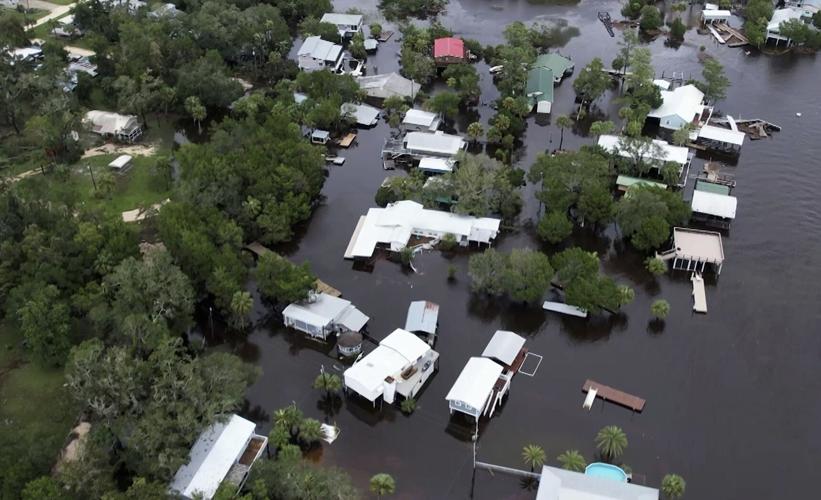
Photo Credit: AP News (Photo/Daniel Kozin)
This is the sixth and final part of my series of reflections on the “c-o-s-m-o-s remedy” proposed in opposition to the “ideology of e-s-c-a-p-e” by Jem Bendell in Deep Adaptation: Navigating the Realities of Climate Chaos (UK/USA 2021).
#1: Reflections on Compassion
#2: Reflections on Openness
#3: Reflections on Serenity
#4: Reflections on Mutuality
#5: Reflections on Oneness
In contrast to the habit of Exceptionalism in e-s-c-a-p-e ideology, which means assuming ‘I am annoyed in this world because much about it upsets me and so I believe I’m better and/or needed…,’ Bendell proposes that Solidarity involves acting from the part of you that knows ‘our common sadness and frustration arise from our mutual love for all life and motivate us towards fairness, justice and healing’ (p. 147).
Solidarity is defined as unity (as a group or class) that produces or is based on community of interests, objectives, and standards (Merriam-Webster Dictionary). As he so often does, Bendell calls us to look at the essence of what drives our shared sense of solidarity as a group or class.
For some unknown reason, I do not use the word ‘solidarity.’ Yet, I’m very familiar with the word since my childhood growing up in then British Guiana during the 1950s and 1960s. Whenever I hear the word, I immediately recall the song “Solidarity Forever” that played every day on our local radio stations. Though I don’t remember the verses, I can still sing the chorus:
Solidarity forever!
Solidarity forever!
Solidarity forever!
For the Union makes us strong!
I later learned that it was the anthem of the workers’ unions, mainly the agricultural workers, who were fighting for better wages, workplace safety, and living conditions. Could it be that I associate the word with its negative images of danger to one’s safety?
In those early days of my youth, the managers and owners of the sugar plantations and factories across the colony were hostile towards striking workers. They were known to hire thugs to terrorize the workers on the picket line. To join picket lines in a show of solidarity came with the risk of losing one’s job, being beaten, teargassed, or even killed. Such risks did not change when we became an independent nation in May 1966.
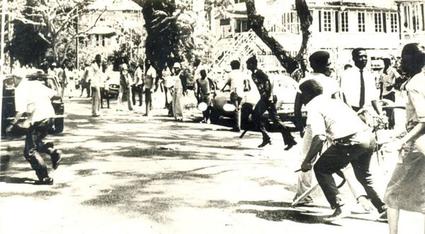
Photo Credit: Wikipedia from Jesuits.org.uk
On Saturday morning, July 14, 1979, after celebrating Mass and having his breakfast, Father Bernard Darke SJ spent the morning marking examination papers at the Catholic high school where he taught the Scriptures and Mathematics. As Scouts Master, the British Jesuit priest also made plans with some of the scouts for their annual camp. At the request of the Editor of the Catholic Standard newspapers, he had his cameras with him to take photos of a political demonstration to be held outside the Magistrates’ Court.
During a period of civil rebellion against the dictatorship government, leading members of the opposition party Working People’s Alliance (WPA) had been arrested and charged with burning down the building housing the Ministry of National Development. As peaceful demonstrators marched along the street heading towards the court, Father Darke stood on the sidelines, in front of the school building, taking photographs.
The demonstrators were about 65 feet (20 meters) away from him when thugs, armed with wooden staves, cutlasses, and knives, charged into the picket line. The crowd scattered in all directions. Father Darke captured the confusion with his camera. Across the two-lane roadway, three men attacked the Assistant Editor of the Catholic Standard newspapers, who was covering the story. After receiving a blow to the head, the Assistant Editor fell to the ground, bleeding. In taking photos of the attack, Father Darke became the next target. He tried fleeing to safety, but the two cameras slung around his neck slowed him down. After beating him to the ground with wooden staves, one of the three assailants stabbed him in the back with an old bayonet. That evening, shortly after 6:00 p.m., he died in hospital from a ruptured lung.
Serving in the Guyana Mission since 1960, Father Bernard Darke SJ (1925-1979) was a quiet man who did not seek attention. He served in the Royal Navy during World War II and joined the Jesuit Order in 1946. His killing in broad daylight shook us all in the Catholic community.
Working for change in unjust social, economic, and political systems involves taking life-changing risks. Solidarity can come with a steep price. I don’t join picket lines or take part in mass public demonstrations. I lack such courage. I prefer to contribute in quiet ways: speaking out, making posters and banners, spreading awareness, listening to and engaging with others, and changing my behavior.
Solidarity in our fight to save Earth’s pollinators and other endangered species!
Solidarity in our fight for clean air and clean water!
Solidarity in our fight to end humanity’s dependence on fossil fuels!
Solidarity makes us strong!


Wise words as ever. We could all do with Bendell’s proposition now
LikeLiked by 1 person
Thanks very much, Derrick 🙂 We do, indeed.
LikeLiked by 1 person
Your writing is evidence of your courage, Rosaliene. Thank you. ❤️🙏
LikeLiked by 3 people
Thanks very much for your kind words, Sunnyside ❤
LikeLike
Excellent, sobering post, Rosaliene. The oppression often wrought on people seeking basic human rights is heartbreaking.
LikeLiked by 2 people
Thanks very much, Dave. The oppression still visible in our world is, indeed, heartbreaking.
LikeLiked by 1 person
Here’s to you and all you do, Rosaliene. My understanding of solidarity is a circumstance of bonding within groups, not between groups. When most of us have the means to live satisfying lives, differences between groups are set aside to some extent. When conditions are fraught, or one group believes its position is now or soon to become less advantaged, opposition to other groups increases in order to maintain its status and advantage. I wish it were otherwise.
LikeLiked by 2 people
Dr. Stein, thanks for raising this important aspect about solidarity. Our difficulty in forging unity between diverse groups remains a challenge in achieving much-needed societal change.
LikeLiked by 2 people
Indeed, this is something we need in this time! There are a few situations around the world that could greatly benefit from these thoughts and we need leaders who are more than just politicians, we need true statement and peacemakers.
LikeLiked by 3 people
When violence is the response to violence, there is no chance for a peaceful resolution.
LikeLiked by 2 people
Indeed, we are seeing this daily around the world.
LikeLiked by 1 person
I remember “Darko” with his pipe dangling steadly on his lower face. Oh where have all the flowers gone? The buds………….My gosh, are we the flowers, now?
LikeLiked by 1 person
George, I’m not familiar with “Darko.”
LikeLike
Sorry. That’s the fond name we (us Boys Scouts) called Fr Darke (behind his back of course)
LikeLiked by 1 person
Thanks for the clarification, George. What was he like as Scouts Master?
LikeLike
I always thought that a shared crisis, like Covid or labour oppression would unify people, but I was wrong. It just makes them choose a side. We need more people like Father Darke. My son joined a peaceful protest student group when he attended UC Berkeley for his Masters. The local police forces decided to use the protest as a training exercise and my son had to assist several students who were hit with rubber bullets or trampled by police moving crush barriers. Common sense and kindness are certainly lacking these days, where money and power are involved. Have a good day Rosaliene and keep up your efforts. Allan
LikeLiked by 2 people
Allan, humanity’s response to the Covid pandemic also opened my eyes to the uncomfortable truth of our divisiveness in the face of a shared crisis. As Dr. Stein mentions in his comment, bonding within a group does not necessarily result in bonding between opposing groups.
Thanks for sharing your son’s experience during a peaceful student protest. How little has changed since my own days as a university student! Money and power continue to dictate the rules of human engagement.
LikeLiked by 2 people
As we know, the struggle for justice never ends.
LikeLiked by 1 person
Just too much hysteria that is clearly political. I live off the grid on solar power and I work with forestry service to manage my land and the DNR to protect my river. I walk the walk. I’m a conservationist. But even Bill Gates is admitting the planet is not in trouble–people might have to adjust some. When HE tells you that, you ought to relax. We should move slowly toward protecting the environment as long as we can prove the individual measures are efficacious, do all we can afford, but this level of panic is political. And it’s doing humanity and our children a disservice. And BTW, the issue itself is suffering from this over-reaction. You can get everybody on board with common sense measures; you are turning people off with the hysteria. It’s being used as a wedge. Bobby Kennedy who made his life as an environmental attorney will tell you that. I was a college professor and I spent weeks reading actual studies. Not opinion. Science isn’t science when it’s being censored, people are fired, and studies funded by people with a political interest. Just like with the vaccine. Convince people, don’t demonize them. The truth will be obvious. You’ll find we all have the same goals.
LikeLiked by 1 person
Lynn, how blessed you are that you’re able to live off the grid and can care for your precious gift of land!
I do not trust any member of the billionaire class who profits from our globalized capitalist economic system and the chaos of society when catastrophe strikes our lives. If you consider this a political stand, and not one of injustice, I stand accused.
Climate change is scary. In California, it’s not easy to find a special place to live out one’s retirement. Extreme weather takes all forms: drought, wildfires, heavy rain and snow, flooding, and heat waves. All interrelated. I cope with my anxiety through mindfulness meditation, gardening, and building connections with my neighbors.
I do not speak on behalf of any particular political party. As I see it, America’s two-party system is dysfunctional. As a member of the body politic, I fear for the future of our nation. A nation divided becomes an easy target for its foreign enemies. I fear for the future of my sons. I fear for those among us who have no refuge when their health fails, lose their jobs, or become homeless.
JIM BENDELL is a world-renowned British scholar on the breakdown of modern societies due to environmental change. A full Professor with the University of Cumbria, he is a sociologist specializing in critical integrative interdisciplinary research analysis on topics of major societal concern.
LikeLike
Rosaliene, I don’t know your personal politics and I am sure you want the best for the planet and for people–I’m just so distressed that this issue is being hijacked by politics when we could have everybody aboard without the hysteria. For instance, one issue at time: does a certain light bulb actually work or is it a problem in the landfill? Solar is great, it works in some places as long as we have back ups. All we have to do is take the politics out of it and deal with it one issue at a time instead of as an impending religious disaster. Which in reality is how we MUST deal with it. It is lumped together as a religious issue just like vaccines are. Vaccines are not all good and not all bad–some are much more efficacious than others and some are much riskier and there is not one fits all strategy. But when they lump “climate change” into one religious fervor, something that is not specific, cannot be proven to the extent they try to carry it, we all lose. I wish cooler heads prevailed. Breaks my heart.
LikeLiked by 1 person
So sadly true, Neil 😦 We win today, only to lose again tomorrow. Yet, we must go on…
LikeLiked by 1 person
Rosaliene,
Your memories of your personal experiences tell a lot about who you are now. That includes your emotional reaction to the word “solidarity”.
I don’t like to waste energy fighting, but I do enjoy challenges to my fixed notions of how things ought to be.
Father Bernard Darke SJ was brave to put himself in the position he did, and your tribute to him now shows he did have a lasting influence on those he touched.
LikeLiked by 1 person
Katharine, until my current reflections on solidarity, I was unaware of my emotional reaction to the word. It’s amazing how each new day can reveal revelations of self not previously explored.
I know that we don’t agree on a lot of issues and appreciate your openness to challenge your “fixed notions of how things ought to be.” For my own part, I’m working at understanding and accepting our differing beliefs that we all take for granted or as divine truth.
I have fond memories of Father Darke during his brief period as chaplain for the Mother House of the religious community for which I was once a member (1971-1977). I never expected that such an unassuming and humble person would have such a tragic ending.
LikeLiked by 1 person
Rosaliene,
Differing beliefs can teach us so much about ourselves and the world outside ourselves, if we allow it. It’s sad to me that so many people have closed themselves off to understanding.
“Mob rule” does exist in unruly crowds, as you saw. People do things they might not do alone. As I write, I’m trying to come to terms with the world’s latest crisis, in Israel and Gaza. I see so many taking sides, but they are not on the scene or directly affected. I don’t know what to think.
LikeLiked by 1 person
Katharine, I am also trying to come to terms with the renewed violence between Israel and Hamas.
LikeLiked by 1 person
How refreshing to read your acknowledgement that you, too, are having difficulty with this.
LikeLiked by 1 person
Back in those days, solidarity and unity were vital to defend the interest of ordinary, and usually, poor workers. Today, unions in England can be rather optimistic in what they think they can achieve, but if you’re ever in trouble from the management, particularly for disciplinary reasons, membership of the union is vital.
Do you remember this one?
LikeLiked by 2 people
So true, John. Without the workers’ unions, back in those days, we would not have achieved the rights we take for granted today. Here in the USA, where industries still have union representation, workers still have some recourse for change. But there’s no easy victory.
I’m not familiar with the 1973 song, “Part of the Union.” The group was not popular in Guyana at the time.
LikeLike
In an era when the unions were at their peak, this song became the unions’ anthem.
The Strawbs were in actual fact more of a folk group and it is rather ironic that this was pretty much their only chart hit.
LikeLiked by 1 person
Thank you for this post, Rosaliene. I appreciated the history and tribute. And I would argue that you *do* have courage, for “speaking out, making posters and banners, spreading awareness, listening to and engaging with others, and changing my behavior” all have a positive impact on the world we share, in solidarity.
LikeLiked by 2 people
You’re welcome, Steve. Thank you very much for your kind words ❤
LikeLiked by 1 person
My pleasure, Rosaliene. 🙏🏼
LikeLiked by 1 person
I’m very sorry you all lost Father Darke to that violence, Rosaliene, and I can understand your avoidance of picket lines and demonstrations. I want to echo what others have said about your courage because it clearly shines in what and how you write. After reading this post, I’m even more appreciative that you take the time to read and comment on my climate posts that always end with “solidarity!”
LikeLiked by 1 person
Tracy, thanks very much for your kind words ❤ You are the only blogger-friend who ends your climate or any other post with "solidarity!" I appreciate the work you do in raising awareness of this existential threat that we Americans have difficulty in coming to terms with. I also like that you offer concrete ways to contact our local government representatives, as well as events taking place. Solidarity!
LikeLiked by 1 person
Glad you have this way of making your voice heard!
LikeLiked by 1 person
Indeed “Solidarity Forever” has always been a workers union song, I first heard this song at the Metals Union of South Africa. It’s true it relates to the struggle and exploitation workers are continually facing even after the amendment of the labour legislation of the post apartheid era in 1995.
LikeLiked by 1 person
Zet Ar, thanks for sharing your experience in South Africa.
LikeLiked by 1 person
Girl Rosaliene, this is beautifully composed and delivered my friend. Solidarity is a powerful force to be reckoned with on so many levels. This is absolutely a beautiful show of unity and support. Continue to be the advocate and voice that we need in this day and time my friend. 😍🙏🏽😘💖😍
LikeLiked by 1 person
Thanks very much, Kym ❤
LikeLiked by 1 person
You are so very welcome Rosaliene. My pleasure my friend. 🥰💖😍
LikeLiked by 1 person
Father Darke was a courageous man. Very sad. 💔 Like you wrote, needed change does not come quietly. I have demonstrated in marches related to education but those have been nonviolent – loud and large but peaceful. Some needed change did follow.
LikeLiked by 1 person
Michele, thanks for sharing your positive experience with public demonstrations. We don’t need violence to achieve change.
LikeLiked by 1 person
You are welcome, Rosaliene. True. 😌
LikeLiked by 1 person
Thank you for sharing this memory and history. I can see how it would have been very frightening. I’ve done my share of public protests/demonstrations in broad daylight with little thought of danger but have stepped back from those lately. It’s good to have other ways to contribute to justice and environmental movements. Thank you for doing your part.
LikeLiked by 1 person
JoAnna, thanks for sharing your own experience in showing solidarity. We do what we can.
LikeLike
Wow!!!! What a moving post. When we bond together we can accomplish so much! Unity, it just makes sense!
LikeLiked by 1 person
Thanks very much, Belladonna! We are so much in need of unity at this time.
LikeLiked by 1 person
(Huge Sigh) We sure are and it’s so upsetting!
LikeLiked by 1 person
Great post
LikeLiked by 1 person
Thanks very much 🙂
LikeLiked by 1 person
My pleasure. ❤️
LikeLike
Thank you for sharing a wonderful post, sharing your thoughts!.. while the pickets and protests are making the news, believe those quietly working together in the background, using today’s technology and knowledge, like YOU, and sharing thoughts with others with patience and understanding are making the difference… 🙂
Hope all is well and until we meet again…
May the sun shine all day long
Everything go right, nothing go wrong
May those you love bring love back to you
And may all the wishes you wish come true
May your troubles be less
Your blessings be more
And nothing but happiness
Come through your door
(Irish Saying)
LikeLiked by 1 person
My pleasure, Dutch 🙂 Just doing my small part. Thanks.
LikeLike
Very good !
LikeLike
Thanks very much!
LikeLiked by 1 person
Most welcome!
LikeLike
And you do a marvelous job of spreading awareness and helping to educate us, Rosaliene! Thank you for doing what you do. It’s a shame that so many folks with beautiful hearts have met their demise so violently. I’ve never really used the word ‘solidarity,’ either, but it might not hurt to start!
LikeLiked by 1 person
Thanks very much, Lisa! I’m doing my small part. I agree, it might not hurt to start using the word ‘solidarity’ 🙂
LikeLiked by 1 person
I am another that was blindsided by the extreme reactions of many during pandemic, and the escalating facts of global warming. It was a rude awakening for me that the moment did inspire all humanity to “unite” for a greater good, but be divided by a fraction with extreme fear, promoting fear, demanding their “freedom” by oppressing others with their greed and violence, and their lack of desire to ask for and seek, again and again the highest available truth in each moment. “Solidarity in the light of truth, and solutions serving the greater for all.”
Thank you for your inspired “Reflections on Solidarity” Rosaliene!
LikeLiked by 1 person
You’re welcome, Liza! We humans are so unpredictable in our response to a crisis affecting us all, whether it be a health or climate crisis.
LikeLiked by 1 person
Well, I hope to say this in a manner that you will all consider since I definitely only see one opinion represented here. Freedom is part of it, but that was just an oversimplified narrative–those that disagreed were selfish and stupid– Biden announced repeatedly. The fact is that if you (or the government) wanted people to take a chance on that vaccine, they all couldn’t have handled it worse. They demonized people who were experts in their fields because they held a different opinion, who were concerned about the lack of long-term studies and knew it was a risky vaccine. If they’d allowed the other experts to be part of the dialogue, openly, and made their case, debated some of these issues, not only would they have gotten more compliance, but the country wouldn’t be in the dire shape it’s in. The truth is always compelling and if they had it, they should have persuaded people with it, not demonized and silenced people–many of them highly reputable people. And it appears they’ve learned nothing from it. There is also not a one-size fits all approach to the vaccine or any health protocol–it’s a matter of risk. The vaccine was “experimental” and the version they gave people wasn’t even the one approved by the CDC. Mandating it and shutting down the country was a huge mistake. Our country was founded on the free expression of ideas, and we should all have that in common. The next people silenced could be you. I’m not sure what happened to all the Baby Boomers who mistrusted the government in the 60’s and 70’s, marched for free speech. I guess they are in power now (about to go out), so other views can be silenced. Wow. That’s a mistake. I am a retired professor and there are others, like Margaret Atwood who have written open letters in the Atlantic and elsewhere concerned about this. Well, perhaps you all will consider this at least.
LikeLiked by 1 person