
Tags
All Hell Breaking Loose: The Pentagon’s Perspective on Climate Change by Michael T Klare (USA 2019), Climate Change Challenges to US National Security, DOD Climate Risk Analysis 2021
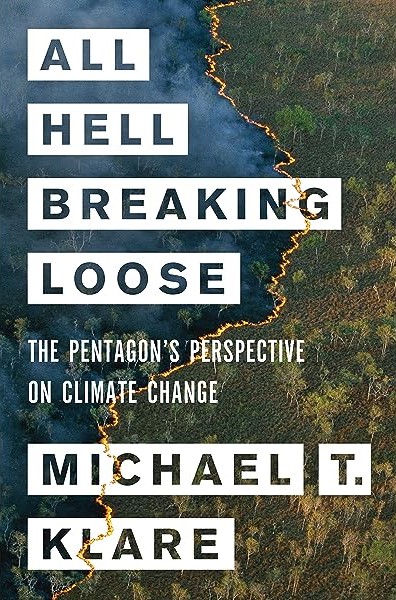
Photo Credit: Macmillan Publishing Group (2019)
[T]he American military leadership has devised its own distinctive analysis of the climate change threat to U.S. and world security. In contrast to scientific and environment assessments, which tend to begin with warming’s threat to vulnerable wildlife and natural habitats, the military’s analysis begins with the threat to human systems—both physical (energy infrastructure, medical facilities, communication and transportation networks) and organizational (governments, public services, community organizations). From this perspective, climate change presents its greatest harm not by hastening the extinction of endangered species but by decimating the vital systems upon which our communal life depends. When those systems fail, chaos and conflict ensue, triggering waves of human migrations and the violent resistance they often provoke. “Destruction and devastation from hurricanes can sow the seeds for instability,” former secretary of defense Chuck Hagel once explained. “Droughts and crop failures can leave millions of people without any lifeline, and trigger waves of mass migrations.”
Excerpt from All Hell Breaking Loose: The Pentagon’s Perspective on Climate Change by Michael T. Klare, Henry Holt and Company, New York, USA, 2019 (pp. 234-235).
Michael T Klare, the author of fifteen books, is the Five College Professor Emeritus of Peace and World Security Studies at Hampshire College and a senior visiting fellow at the Arms Control Association. He holds a B.A. and M.A. from Columbia University and a PhD from the Graduate School of the Union Institute. He has written widely on U.S. military policy, international peace and security affairs, the global arms trade, and global resource politics. He lives in Northampton, Massachusetts.
Learn More:
U.S. National Intelligence Council, National Intelligence Estimate: Climate Change and International Responses Increasing Challenges to US National Security Through 2040, released 2021.
Department of Defense, Office of the Undersecretary for Policy (Strategy, Plans, and Capabilities). Department of Defense Climate Risk Analysis. Report Submitted to National Security Council. 2021.
 Three Worlds One Vision
I read this book a couple of years ago. I gave it five stars. One thing that amazes me is that even though climate change denial is common within the military the military leadership takes it very seriously. There is a huge disconnect between the leaders in the military, who are seriously worried, and the common man within the military. As a volunteer for the citizens climate lobby I have listened to many admirals and generals expressing their concern on this topic. Pentagon takes the problem very seriously. If only the average military employee knew, but they don’t know.
LikeLiked by 4 people
The disconnect also struck me, Thomas, not just between military leadership and members of the military, but also with the climate change deniers among our political representatives.
LikeLiked by 1 person
Yes you are right. I cannot believe they are still around. When you go talk to them, no one is a climate change denier, and then some still are publicly. Some on the far right are only concerned about making an impression with the far right base, and care nothing for their constituents and especially not the children of their constituents.
LikeLiked by 1 person
Lets see if I can add my Amazon review to the comments. It’s long:
Very interesting and a somewhat scary read (but author got Scandinavian countries mixed up)
When Trump rescinded Executive Order 13653 on preparing the United States of the Impacts of Climate Change most government agencies complied, but one organization carried on like before, the US Department of Defense. The DoD, the Pentagon, the military, cannot afford to completely ignore a present major threat to our national security just to go along with the political sensibilities of some leaders.
Droughts, water scarcity, weather disasters, and floods lead to food insecurity, resource competition, and can cause conflicts between groups and nations and destabilize governments. Climate change has already made some difficult situations worse. The conflicts in northern Africa, the Arab spring, the war in Syria, etc., were partially caused by droughts that were made more severe by climate change. Climate change did not cause those conflicts, but it acted as a threat multiplier for instability of some of the most volatile regions of the world. Conflicts around the world often become a national security threats to the United States for various reasons, and it is getting worse.
The Brahmaputra River, which is very valuable to both India and China, draws much its flow from the melting of Himalayan glaciers, and climate change is shrinking the glaciers. Both countries are nuclear powers. That is just one example of potential water conflict. The Arctic ice is melting making 30% of the worlds untapped oil reserves accessible, and Russia, the US and other Arctic nations are already contesting the area. Half of Bangladesh will be flooded, and where are those people going to go? Add pandemics, wildfires, failing ecosystems, not to mention American naval installations around the world and at home being threatened by sea-level rise and worse extreme weather. The military see a substantial problem for good reason, and they have been studying it.
This book gives an overview of a large set of different kinds of problems related to climate change that concerns the military. The book is well researched, fact filled, and it is interesting reading. As I have already participated in lectures given by admirals and other military leaders on the threat that climate change poses to national security, none of this was surprising. I’ve heard a good deal of it before. However, I learned additional details and gained some more insights from this book. It is a very well written and fascinating book.
I found an error on page 114. The author writes about Syrian refugees “from there they sought passage to wealthier European countries farther north, especially Germany, Austria, and Norway”. According to the statistics the European countries that received the most Syrian refugees were Germany (572,818), Sweden (113,418), Austria (51,955), and considering that Germany has an eight times larger population that Sweden, Sweden was the country that received the most Syrian refugees per capita. Norway was close to the bottom with only 14,359 refugees. So, he must have mixed up Norway and Sweden. Not a big deal, and I am not deducting stars for that, but it was still a bit sloppy.
Overall, it is a great book that I highly recommend.
LikeLiked by 3 people
Thanks for sharing your review, Thomas. I recommend Klare’s book as an important perspective of the security challenges we face here in the USA and in countries worldwide as the crisis intensifies and grows beyond our control.
LikeLiked by 1 person
Someone appears to be waking up
LikeLiked by 2 people
Derrick, according to Klare’s research, their awakening occurred back in 2007 with the publication of “National Security and the Threat of Climate Change,” the first major study to view global warming as a security concern. It was published by the CNA Corporation, a Pentagon-funded think tank originally known as the Center for Naval Analyses. Not surprisingly, we the people were kept in the dark.
LikeLiked by 2 people
I can still remember very well when, under GWB (II), scientists ran the risk of losing their jobs if they wanted to research or write about climate change. An iron lid was kept on the subject. That was also an era of “alternative facts”.
LikeLiked by 3 people
Thanks for that reminder, Friedrich. It got worse under the last administration headed by a climate change denier president. These days, those scientists who claim that we are heading for or are already undergoing societal collapse are now under fire.
LikeLike
Thank you for sharing!!.. “The saddest aspect of life right now is that science gathers knowledge faster than society gathers wisdom” ( Isaac Asimov) and unfortunately there are many who will deny change because it may affect their wealth or life style… if it doesn’t affect them directly, will turn a blind eye to the issue “out of sight, out of mind”.. 🙂
Hopefully with today’s technology wisdom will rule the day… 🙂
Hope you weathered Hilary okay, life is all that you wish for it to be and until we meet again…
May your spirit only know peace
May your heart only know love
May all your dreams come true
May your life’s journey be filled with happiness
And life is all that you wish for it to be….
(Larry “Dutch” Woller)
LikeLiked by 2 people
So true, Dutch. Those who benefit from our failing systems and the resulting chaos continue to resist essential changes for our survival as a species. Our belief in our technological progress may well be our downfall.
LikeLike
Technology is available and/or being developed to help find/determine issues, technology is available and/or being developed to help deal with those issues, technology is available and/or being developed that can help unite us humans to better understand one another and issues that are present, and by working together using that technology, overcome those issues and create a better world for everyone… the failure lies in the human being, not technology, “Change will not come if we wait for some other person, or if we wait for some other time. We are the ones we’ve been waiting for. We are the change that we seek.” (Barack Obama )… 🙂
Sooooooooooooooo, the question for us mortals is “Every morning your have two choices: are you going to continue to sleep with your dreams, or wake up and chase them.” (Author Unknown).. 🙂
LikeLiked by 1 person
“From this perspective, climate change presents its greatest harm not by hastening the extinction of endangered species but by decimating the vital systems upon which our communal life depends.”
In the end, also the homo sapiens sapiens is just a species, which I am afraid one day we will remember.
LikeLiked by 4 people
Bridget, I was also struck by this form of thinking that fails to see the connection between homo sapiens and all other species on our planet upon which our “vital systems” are built. In acting like gods, we have forgotten our oneness with Earth’s web of life.
LikeLiked by 2 people
perhaps that’s the real issue, that only some of us see that we are part of a bigger picture?
LikeLiked by 2 people
Exactly!!!
LikeLiked by 1 person
I’m not totally surprised to see that the military views the effects of climate change in a different way, but as long as everybody does their bit in their own particular area, this is so much better than just doing very little…..which will be the response of many of the worst polluters of the planet.
LikeLiked by 2 people
That’s true, John. The military has its own role. Unfortunately, their focus must be on addressing the chaos following catastrophes, not the causes.
LikeLike
A good point. What a pity, though, that they don’t realise that they could make their own job so much easier, if they had an input as to how the problem was created in the first place.
LikeLiked by 1 person
If wind/water/solar don’t become the predominant sources of power generation soon, there will be little hope for a manageable future.
LikeLiked by 2 people
Neil, the news on that front is not very encouraging. What I should’ve known is that every form of renewable energy generation is dependent upon fossil fuels for its manufacture, construction, operation, and maintenance. What’s more, according to a 2021 calculation by the International Energy Agency (IEA), global energy transition off fossil fuels would increase demand (percent shown in brackets) for key minerals such as lithium (4,200%), graphite (2,500%), nickel (1,900%), and rare-earth metals (700%) by 2040.
LikeLiked by 2 people
When “vital systems” make money (no matter if they make a mess), the powers-that-be want profits rules-free, otherwise they could care less.
LikeLiked by 2 people
Distressingly true, Mister Muse 😦
LikeLiked by 1 person
Thank you, Rosaliene. There is a Dana Milbank opinion piece of 9/1/23, “Don’t You Dare Rake Your Leaves This Fall” that offers multiple climate and insect friendly suggestions for those who own a home. Worth reading and using the ideas.
LikeLiked by 4 people
I should add, it is from the Washington Post.
LikeLiked by 2 people
Found it. Thanks.
LikeLike
Dr. Stein, thanks for mentioning Dana Milbank’s opinion piece. He calls our attention to yet another vital link in Earth’s web of life: insects. The insect population decline is troubling and so very much evident in my urban garden plots. I celebrate the sighting of a butterfly, moth, bee, or wasp. Nowadays, I let the spiders run free whenever I disturb their hideouts during my garden clean-up.
LikeLiked by 1 person
Rosaliene, very glad you mentioned this book and the thoughts of much of U.S. military leadership about climate change. Those military leaders are often up to no good, but it sounds like they have not deluded themselves when it comes to the devastating current and future effects of climate change.
LikeLiked by 2 people
Dave, I know what you mean. Klare’s book revealed a perspective regarding our military forces that I’ve rarely considered: their role in humanitarian emergencies at home and worldwide. He also raises the Pentagon’s strategic dilemma (p. 171): “At what point will defending the homeland from severe climate impacts erode the armed forces’ ability to address conventional military threats arising overseas?”
LikeLiked by 1 person
They have their own agenda(s). Their veil of fear will drive humans to look for help where it simply isn’t.
LikeLiked by 1 person
Susan, this is a risk that we face in looking to those who hold power to save us.
LikeLike
Thank you, Rosaliene, for sharing this information. It is bad news, but the good news is that the military, and presumably the government in general, are trying to deal with climate change realistically. Hopefully, we are beyond the days when an American president neglects to participate in an international climate change summit.
LikeLiked by 1 person
You’re welcome, Cheryl. Until our political representatives agree on our climate and ecological reality, we are left to deal with one catastrophe to the next. So far, agreements made at the international climate change summits are just promises without enforcement.
LikeLiked by 1 person
These risks may be better understood by the climate change deniers. If the military is looking at the world situation and making plans and policies, it is difficult to deny, since guns and shows of strength are their currency.
LikeLiked by 2 people
Tamara, the military stance should make a difference, but, then again, climate change deniers live in an alternate world with its own alternative truth.
LikeLiked by 1 person
Yes, you are right. I keep hoping they too will see, before it is too late, for many of the deniers also hold power positions to make a difference.
LikeLiked by 1 person
Thank you for sharing this, Rosaliene, as every piece that widens people’s perspectives is a good thing. Solidarity!
LikeLiked by 1 person
You’re welcome, Tracy 🙂 Solidarity!
LikeLike
Thank you for this compelling post, Rosaliene. When, outwardly, governments are doing very little to address the climate emergency, yet in back rooms are pondering it militarily, it seems like a red flag, or at the very least, isn’t of much reassurance…
LikeLiked by 1 person
Steve, thanks for adding your perspective. I believe that this was one of Klare’s objectives in publishing this book. He writes in the Introduction (p. 2): “Well aware of the partisan nature of [the national debate over climate change] and reluctant to become embroiled in domestic politics, senior [military] officials have said relatively little about the causes of warming or other controversial issues.”
LikeLiked by 1 person
Not unusual for government/military officials to avoid wading into political issues publicly, but hopefully they are giving stern advice to politicians on the dangers as they see them, as another perspective to add to what is publicly discussed.
LikeLiked by 1 person
I agree, Steve. It would be foolhardy for politicians to ignore national security concerns raised by military leaders.
LikeLiked by 1 person
This is a wake up call, for those who still need it!
LikeLiked by 2 people
For sure, Rebecca!
LikeLiked by 1 person
Thanks for bringing this scary and sad sh*t to our attention. (I’m wondering where the mass migrations would be going, away from the coasts?) It had not consciously occurred to me that the military strategists would take climate change more seriously, but it makes sense since they are geared toward dealing with crisis and catastrophe. Maybe this can influence a few politicians.
LikeLiked by 3 people
You’re welcome, JoAnna. Reports released by the US Department of Defense and the National Intelligence Council (links provided in post) indicate that our current administration is taking these threats seriously. Climate change deniers like MTG are another matter.
Mass migrations away from coastal cities worldwide will definitely be a challenge for all nations. With regards to the USA, Jake Bittle addresses this in his 2023 book “The Great Displacement: Climate Change and the Next American Migration.”
LikeLiked by 1 person
Thank you. You are very knowledgeable on this topic along with others.
LikeLiked by 1 person
Lord, help us. Thanks so much for sharing this information with us Rosaliene. What planet are some of the folks on anyway? SMH 😠
LikeLiked by 1 person
You’re welcome, Kym. Better to tell ourselves that climate change is a hoax than face the terrifying truth.
LikeLiked by 1 person
Crazy isn’t it? SMH 🙄
LikeLike
Thank you although I would be more happy to be uneducated.
LikeLiked by 1 person
Don’t we all, Don! Especially when we’re already dealing with our own troubles ❤
LikeLiked by 1 person
The Pentagon’s perspective on climate change is important. Thank you 🙏🌍
LikeLiked by 1 person
It is, indeed, important. Thanks for dropping by 🙂
LikeLiked by 1 person
You are welcome, Rosaliene 🙏🌍
LikeLiked by 1 person